
Table of Contents
Table of Contents
Managed Kafka pricing looks straightforward until two quotes describe different systems with the same nouns. One provider charges for broker hours and storage. Another exposes throughput units, partitions, retained data, egress, support, or private connectivity. A self-managed baseline adds cloud instances, block storage, monitoring, upgrades, and people. The hard part is not finding a price page; it is turning every price page into the same production model.
That matters because Kafka cost is rarely one line item. Apache Kafka clusters combine compute, durable storage, replication, network paths, retention, and operational control. When a managed service hides part of that machinery behind a simpler billing model, the platform team still has to understand which costs scale with write traffic, which scale with retained bytes, and which appear during replay, migration, or failure recovery.
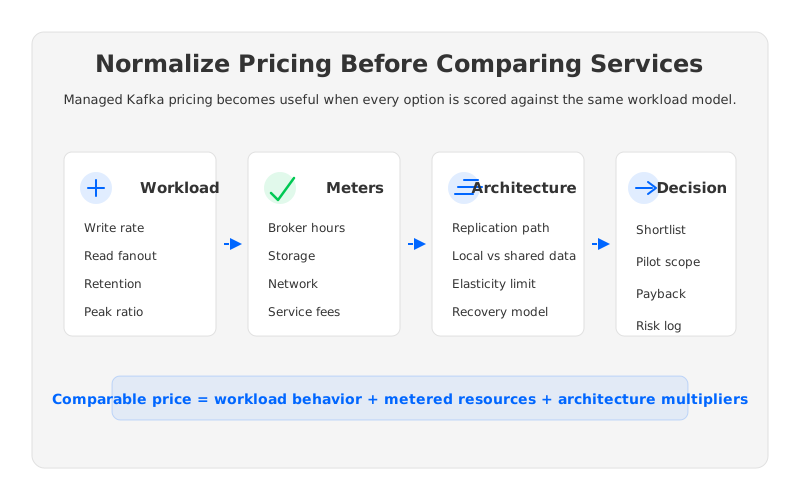
The useful question is therefore not "Which managed Kafka service has the lowest monthly number?" A stronger question is: Which pricing dimensions change when our workload grows, fails over, replays data, or moves between deployment models? That framing helps architects, SREs, FinOps teams, and procurement compare services without reducing the decision to a vendor spreadsheet.
1Why Teams Search for kafka cost
Teams usually search for kafka cost at one of three moments. The first is planning: a new platform team needs a budget before business owners commit to Kafka as shared infrastructure. The second is renewal: the bill has grown faster than data volume, and procurement wants a defensible comparison. The third is migration: the current cluster works, but broker storage, cross-zone traffic, partition movement, or operational load has become the limiting factor.
Those moments produce different questions, but they all need the same normalization step. A planner wants unit economics. A renewal team wants variance analysis. A migration team wants to know whether a different architecture changes the cost curve or only changes the invoice format. Without a shared cost vocabulary, each group can talk past the others.
Start with workload behavior before provider terminology:
- Write throughput and burst ratio. Sustained writes drive storage growth and replication traffic; bursts drive broker headroom and throttling risk.
- Read fanout and replay behavior. One online consumer group is a different cost shape from analytics backfills, recovery reads, and multi-team downstream fanout.
- Retention by topic class. Short-lived operational topics, compacted topics, compliance topics, and replayable data products should not share one storage assumption.
- Availability and locality. Replication factor, Availability Zone placement, client locality, and private connectivity can affect network transfer as much as instance size.
- Operational ownership. A managed service may reduce patching and provisioning work while still leaving capacity planning, client governance, migration, and cost allocation to the platform team.
These inputs turn a pricing page into an architecture conversation. If a provider's headline price is attractive but the service charges heavily for traffic your workload must generate, the headline number is not wrong; it is incomplete. If another option exposes more infrastructure detail but lets the team control data placement and scaling, it may look messier while being easier to govern.
2The Pricing Dimensions That Need Normalization
Every managed Kafka comparison should reduce the bill into a small number of common dimensions. The exact meters differ by provider, but the underlying resources do not disappear. Kafka needs compute to serve requests, storage to retain records, network paths to move records, control-plane work to keep the service available, and operational evidence to prove it can meet production commitments.
| Dimension | What to normalize | Why it changes the decision |
|---|---|---|
| Compute | Broker hours, throughput units, coordinator overhead, connector nodes, standby capacity | Fixed broker sizing can overpay during quiet periods while under-serving bursts |
| Storage | Local disk, block storage, remote tiers, snapshots, retained bytes, compaction overhead | Retention is often a business requirement, not a tuning preference |
| Network | Producer paths, broker-to-broker replication, consumer reads, cross-zone movement, egress, private connectivity | Network cost scales with topology, not only with user-facing throughput |
| Managed-service fees | Cluster fees, support tiers, partition or throughput limits, control-plane features | Operational convenience may be valuable, but it should be named separately |
| Migration and operations | Parallel clusters, data copy, offset continuity, runbooks, testing, upgrades | A low run-rate can still fail the business case if cutover takes too long |
The table forces teams to avoid a common mistake: comparing a fully loaded managed-service quote with an undercounted self-managed estimate. If a self-managed Kafka baseline omits engineer time, incident drills, observability, patching, security review, or parallel migration infrastructure, it is not a baseline. It is a partial cloud bill.
The inverse mistake is also common. Some teams treat every managed-service surcharge as waste. That is too crude. Paying for a provider to handle broker replacement, patch orchestration, monitoring integration, or service availability can be rational. The point is to separate convenience from structural cost. Convenience can be bought. Structural cost is created by the architecture.
3Architecture Choices That Change the Cost Curve
Traditional Kafka uses a Shared Nothing architecture. Each Broker owns local log data for the partitions it leads or follows, and durability comes from replication across Brokers. This model is proven and familiar, but it couples compute, storage, and network movement. Add retention and the disks grow. Add replicas and the data moves. Add capacity and the team may have to rebalance partitions or move data between Brokers.
Apache Kafka Tiered Storage changes part of that equation by moving older log segments to remote storage while keeping active data on broker-local storage. That can help long-retention workloads, especially when historical reads are less frequent than tailing reads. It does not make the Broker stateless. The hot path, local data ownership, leader placement, and recovery model still matter when teams calculate managed Kafka cost.
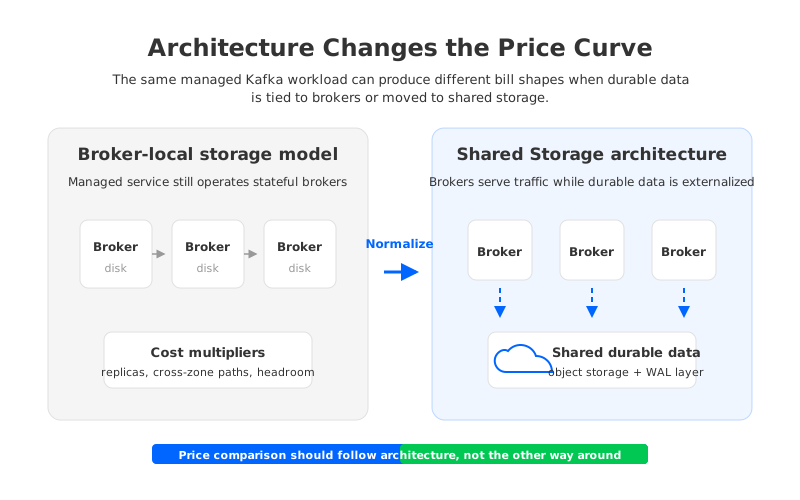
This is why pricing analysis should separate tunable cost from architectural cost. Compression, retention cleanup, topic design, producer batching, follower fetching, and client locality can all improve a Kafka deployment. They deserve attention before any migration. But if the largest cost driver is durable data tied to broker-local disks, or replication traffic between zones, tuning may reduce waste without changing the main multiplier.
Managed Kafka services also differ in how much of the architecture is exposed. A cloud-provider service may feel close to Apache Kafka operations while removing undifferentiated infrastructure work. A SaaS service may present higher-level units and stronger operational abstraction. A Bring Your Own Cloud deployment may keep the data plane in the customer's account while changing who operates the control plane. None of these models is automatically superior; each moves cost, control, and responsibility to a different boundary.
The normalization test is practical. Ask what happens when write throughput doubles, retention doubles, or a consumer group replays a week of data. Ask what happens during a broker replacement, zone impairment, client migration, or security change. A pricing model that cannot answer those questions is not ready for production evaluation, even if the monthly estimate looks tidy.
4A Procurement-Ready Cost Worksheet
FinOps and platform teams should build one worksheet before requesting final quotes. The worksheet should be boring enough to survive a procurement meeting and technical enough to catch hidden assumptions. It should not contain vendor slogans. It should contain workload units, service meters, architectural multipliers, and validation evidence.
Use these rows as the minimum shape:
| Input | Baseline value | Sensitivity to test |
|---|---|---|
| Average write throughput | MiB/s by topic family | 2x sustained write growth |
| Peak write throughput | Peak-to-average ratio | Failure-zone traffic and throttling behavior |
| Read fanout | Consumer groups and replay jobs | Backfill and recovery reads |
| Retention | Hours or days by topic class | Compliance extension and compaction |
| Partitions | Count, skew, and growth rate | Hot partitions and metadata pressure |
| Availability | Zones, replicas, locality, private access | Zone failure and client locality change |
| Migration | Parallel run duration and rollback plan | Offset continuity and cutover timing |
The worksheet should produce two outputs. The first is a monthly cost range: expected, peak, and failure-mode cost. The second is a risk register: assumptions that must be validated before contract approval. A workload with high read fanout should validate egress and cache behavior. A workload with strict recovery objectives should validate failover, data durability, and replay time. A regulated workload should validate account boundary, encryption, audit logs, and IAM ownership.
This approach also prevents overfitting to one price page. A price page is optimized for service clarity, not for your workload. It may tell you exactly what the provider charges for a cluster size or a storage tier, but it cannot know whether your consumers replay data every weekend, whether producers sit in the same Availability Zone as Brokers, or whether migration overlap will last two weeks or two quarters.
5How AutoMQ Fits the Evaluation
Once the neutral worksheet points to broker-local durable storage, cross-zone replication, and data-heavy scaling as the main cost drivers, a shared-storage Kafka-compatible architecture becomes relevant. AutoMQ fits that category: it keeps Kafka protocol compatibility while using a Shared Storage architecture based on S3Stream, WAL (Write-Ahead Log) storage, data caching, and S3-compatible object storage.
The cost implication is specific. AutoMQ Brokers are stateless for durable stream storage, so retained data is not anchored to broker-local disks in the same way traditional Kafka data is. Writes pass through a WAL layer and are organized into object storage. Compute and storage can therefore be modeled more independently: broker capacity follows active traffic, while retained bytes follow object-storage economics and the chosen WAL type.
For managed Kafka buyers, this does not remove the need for validation. It changes what to validate. Instead of only asking how many Brokers to provision, the team should test Kafka client compatibility, producer acknowledgment behavior, consumer lag, replay performance, WAL health, object storage errors, cache behavior, migration workflow, and observability. A shared-storage architecture can reduce certain structural cost multipliers, but production confidence still comes from workload-shaped testing.
AutoMQ is most relevant when the current cost problem is architectural rather than only administrative. If the team mainly wants someone else to patch Brokers and the workload is small, stable, and low-retention, conventional managed Kafka may be the right operating model. If the bill is dominated by replicated storage, cross-zone traffic, slow partition reassignment, retained data, or idle headroom, then the architecture itself belongs in the cost conversation.
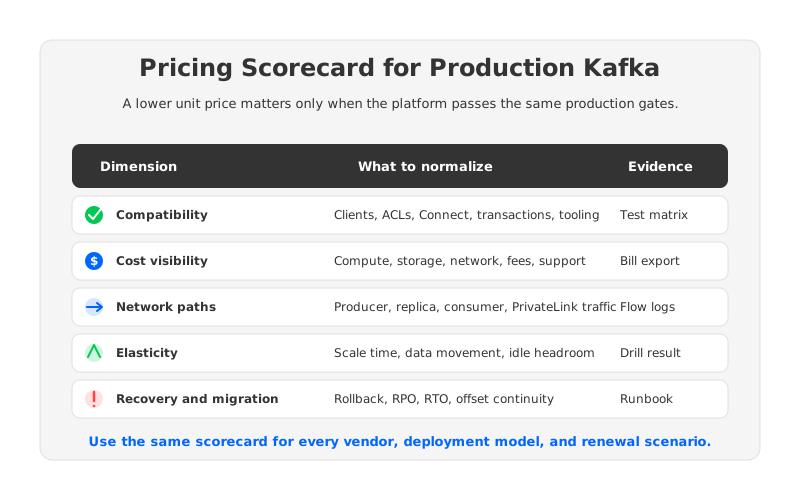
The clean way to test AutoMQ is the same way to test any managed Kafka alternative: take one representative topic family, run the real clients, preserve the operational constraints, measure cost drivers, and run failure and replay drills. If the scorecard improves under those conditions, the business case becomes defensible. If it does not, the team has still learned which cost dimensions matter most.
If your team is building that worksheet now, start with the AutoMQ Cloud entry point and validate the architecture against your own workload, migration, and governance requirements.
6References
- Apache Kafka Documentation: Core documentation, replication, operations, and client behavior
- Apache Kafka KIP-405: Kafka Tiered Storage
- AWS Pricing: Amazon Managed Streaming for Apache Kafka pricing
- AWS Documentation: Amazon MSK multi-VPC private connectivity
- AWS Pricing: Amazon VPC pricing
- AutoMQ Docs: Shared Storage architecture overview
- AutoMQ Docs: S3Stream Shared Streaming Storage
- AutoMQ Docs: Inter-Zone traffic overview
7FAQ
7.1What should teams compare first in managed Kafka pricing?
Compare workload behavior before comparing provider units. Write throughput, read fanout, retention, partition count, availability model, and migration scope determine whether broker hours, storage, network transfer, or service fees dominate the bill.
7.2Why can two managed Kafka quotes differ so much?
Two quotes may include different responsibility boundaries. One may expose broker, storage, and network resources directly. Another may bundle those costs into service units. A third may include support, private connectivity, or operational automation. Normalizing each quote into compute, storage, network, managed-service fees, and migration cost makes the comparison fairer.
7.3Is Tiered Storage enough to lower Kafka cost?
Tiered Storage can reduce pressure from long historical retention by moving older log segments to remote storage. It does not fully remove broker-local storage from the active path, so teams should still model local disk, replication, broker replacement, hot-data recovery, and cross-zone network movement.
7.4When should AutoMQ be evaluated?
Evaluate AutoMQ when the Kafka cost problem is tied to broker-local durable storage, cross-zone replication traffic, slow scaling, high retention, or repeated data movement. The right proof is not a generic claim; it is a representative workload test with real clients, failure drills, migration checks, and cost evidence.


