
Table of Contents
Table of Contents
Most teams do not search for managed Kafka pricing because they enjoy reading pricing pages. They search because a Kafka bill is about to become a budget conversation. The awkward part is that the line item called "managed Kafka" rarely explains the real workload economics. A cluster can look reasonable at launch, then become hard to forecast after retention grows, consumers multiply, or private connectivity appears outside the base subscription.
That is why pricing screenshots are a weak planning tool. Confluent Cloud, Amazon MSK, Aiven for Apache Kafka, Redpanda Cloud, WarpStream, AutoMQ, and other hosted Kafka options expose different meters: capacity units, broker hours, ingress and egress, partitions, storage, private networking, support, platform fees, or customer-owned cloud infrastructure. The useful question is: which architecture makes my workload expensive, and which meters move when the workload changes?
1The Managed Kafka Pricing Dimensions To Model
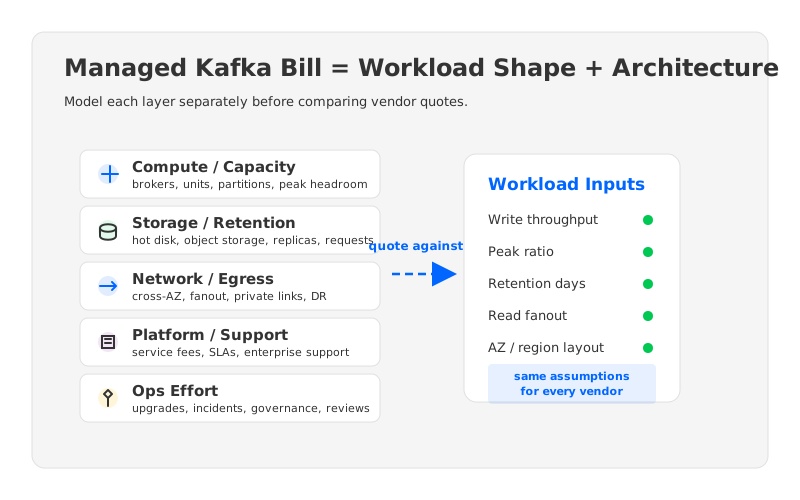
A credible managed Kafka pricing model starts with workload behavior, not vendor packaging. Kafka is a distributed log, so cost is driven by data volume, replication, retention, fanout, network placement, operational guarantees, and the amount of spare capacity you reserve for peaks. A managed service can hide the operating burden, but it cannot make the physics of replicated logs disappear.
For FinOps and platform teams, the first worksheet should separate usage-based meters from commitments created by risk tolerance:
| Cost driver | What to ask | Why it changes the bill |
|---|---|---|
| Compute or capacity | How many broker nodes, capacity units, throughput units, partitions, or service units are required? | Kafka clusters often provision for peak write throughput, peak read fanout, and partition count, not only average traffic. |
| Storage and retention | How many GiB or TiB are retained, on what media, and with what replication or tiering model? | Retention turns short traffic spikes into persistent monthly storage and recovery obligations. |
| Read fanout | How many independent consumers read the same retained data? | A topic with 5 consumer groups can create more read-side pressure than the write path suggests. |
| Cross-zone and egress traffic | Where do producers, brokers, followers, consumers, and connectors run? | Multi-AZ replication, cross-zone reads, cross-region replication, and internet egress can create cloud network charges outside the Kafka service line. |
| Private connectivity | Is traffic routed over PrivateLink, VPC peering, VPN, Direct Connect, ExpressRoute, or Interconnect? | Private paths improve security posture but may add endpoint, port, or data processing charges. |
| Support and platform fees | Is support bundled, usage-based, enterprise-only, or negotiated? | The invoice may include a platform fee even when infrastructure appears usage-based. |
| Operations effort | Who handles upgrades, capacity planning, incident response, rebalancing, and compliance evidence? | Self-managed and BYOC options move some costs from vendor invoice to internal labor and cloud accounts. |
The table is deliberately vendor-neutral. Confluent Cloud, Amazon MSK, Aiven, Redpanda Cloud, WarpStream, and AutoMQ package these meters differently. Their invoices are shaped by different assumptions about who owns infrastructure, how data is stored, and how capacity is reserved.
2Why Kafka Cost Grows With Retention, Replication, and Fanout
Kafka's cost curve becomes non-linear when the same byte is written, replicated, retained, moved across zones, read by multiple applications, and kept available during broker failure. That is the consequence of using a replicated log as durable infrastructure. The planning mistake is to model only producer ingress and ignore everything after the first write lands.
2.1Storage And Retention
Start with a simple assumption set:
- Sustained write throughput: 100 MiB/s.
- Retention: 7 days.
- Replication factor: 3.
- Availability target: multi-AZ production deployment.
- Read fanout: 3 independent consumer groups reading the full stream.
At 100 MiB/s, the logical write volume is about 8.4 TiB per day before replication. Seven days of logical retention is about 58.9 TiB. In a broker-local disk model with replication factor 3, physical stored data can approach 176.7 TiB before indexes, segment overhead, compaction, hot spare capacity, and filesystem reserve. No universal vendor price follows from those numbers, but the direction is clear: retention multiplies the storage footprint.
Tiered storage changes the model, but it does not remove the need to understand it. If older segments move from block storage to object storage, the cluster may reduce local disk pressure while paying object storage, request, retrieval, and sometimes tiering-related service charges. If the managed service bills retained data directly, the user may not see the underlying media at all. In either case, the budget owner should model logical retention, physical copies, and restore behavior separately.
2.2Network And Cross-Zone Traffic
Network cost is where many Kafka budgets become uncomfortable. In a multi-AZ deployment, brokers replicate data across zones for durability and availability. Producers, leaders, followers, consumers, connectors, and stream processors may all sit in different places. Cloud providers publish separate pricing concepts for data transfer, inter-zone movement, egress, private connectivity, and inter-region replication. Those charges may appear on a cloud bill rather than the managed Kafka invoice.
The important modeling habit is to trace data paths:
- Producer to broker leader.
- Leader to follower replicas.
- Broker to consumer groups.
- Connector or stream processor to downstream systems.
- Cluster to disaster recovery region.
Each path has a placement question: same zone, cross-zone, cross-region, private endpoint, public egress, or customer-owned network? A service that looks inexpensive on broker capacity may still create a larger network bill if the workload forces cross-zone fanout or cross-region reads.
2.3Capacity Peaks And Over-Provisioning
Kafka capacity planning is also about headroom. A cluster sized exactly for average throughput is not a production cluster; it is a future incident with a pleasant spreadsheet. Managed Kafka services reduce the effort required to add capacity, but they still need enough compute, memory, network, and partition-handling capability to absorb bursts, maintenance, rebalance windows, and uneven partition leadership.
The capacity line should therefore include the workload's peak-to-average ratio. A payments stream with predictable daily peaks differs from gaming telemetry with launch-day spikes. A CDC pipeline with large messages behaves differently from a metrics pipeline with small records and high partition counts. The pricing page cannot know these patterns. Your model has to.
3SaaS Pricing Vs BYOC Infrastructure Cost
The biggest distinction in managed Apache Kafka pricing is not "managed" versus "unmanaged." It is who owns the cloud resources and who carries the operational responsibility.
In a full SaaS model, the vendor typically owns the service control plane and the underlying infrastructure. The buyer pays service meters such as capacity, ingress, egress, storage, partitions, connectors, support, and private networking. This model is attractive when teams want less infrastructure ownership, but unit economics can be harder to map back to raw cloud costs because platform fee, risk buffer, and infrastructure are packaged together.
In a cloud-provider managed model such as Amazon MSK, the service sits closer to the customer's cloud bill. Buyers can reason about broker instances, storage, data transfer, and AWS-native networking, while AWS manages parts of cluster operations.
BYOC changes the accounting boundary again. The data plane or infrastructure can run in customer-owned cloud resources while the vendor provides software, automation, or support. WarpStream is a well-known BYOC-oriented Kafka-compatible model, and AutoMQ also fits this design space with customer-owned cloud resources, object storage as shared storage, and stateless broker scaling. The buyer sees more infrastructure cost directly, but that visibility helps FinOps teams attribute object storage, compute, and network through existing cloud-account policies.
There is no universally better commercial structure. SaaS can reduce operational work. Cloud-provider managed services can align with existing procurement. BYOC can improve data control and cost transparency when the team can manage the customer-side cloud footprint. The right comparison is total cost at your target reliability, retention, fanout, and governance requirements.
4How AutoMQ Changes The Cost Model
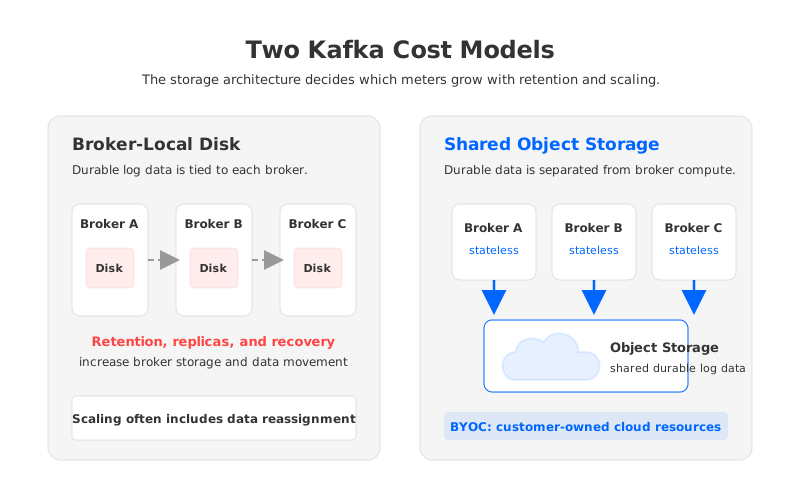
AutoMQ should enter the pricing discussion only after the cost drivers are visible. The key architectural question is whether broker compute and durable storage must remain tightly coupled. Traditional Kafka stores log segments on broker-local disks and uses replication between brokers for durability. In cloud environments, that can make storage growth, broker replacement, and capacity scaling move together.
AutoMQ takes a different path: it is Kafka-compatible, but it uses shared storage backed by object storage and designs brokers to be more stateless. In a pricing model, this changes the worksheet in several ways:
- Storage retention can map more directly to object storage economics instead of requiring every retained byte to live on broker-local block storage across multiple replicas.
- Broker scaling can focus more on compute and network demand, because durable log data is not anchored to a specific broker's local disk.
- Recovery and rebalancing can reduce large broker-to-broker data movement, which matters when cross-AZ traffic is a material cost driver.
- BYOC deployment can keep infrastructure and data in customer-owned cloud resources, giving platform and FinOps teams more direct control over cloud discounts, tagging, security boundaries, and procurement rules.
This does not mean the bill becomes one line or that object storage is free. Object storage has storage, request, retrieval, and data-transfer rules. Brokers still need compute, and private connectivity still needs planning. The difference is that the cost model becomes less dominated by the need to bind durable data to a fixed set of stateful brokers.
For a CTO or principal architect, that distinction matters more than a marketing claim about savings. If your largest Kafka cost is over-provisioned broker storage, cross-zone replication traffic, and slow recovery from broker failures, a shared-storage design deserves serious evaluation. If your workload is small and short-retention, convenience may matter more.
5Managed Kafka Pricing Worksheet
A useful pricing worksheet is boring in the best possible way. It turns a vague evaluation into a repeatable budget model across SaaS, cloud-provider managed Kafka, BYOC Kafka-compatible platforms, and self-managed clusters.
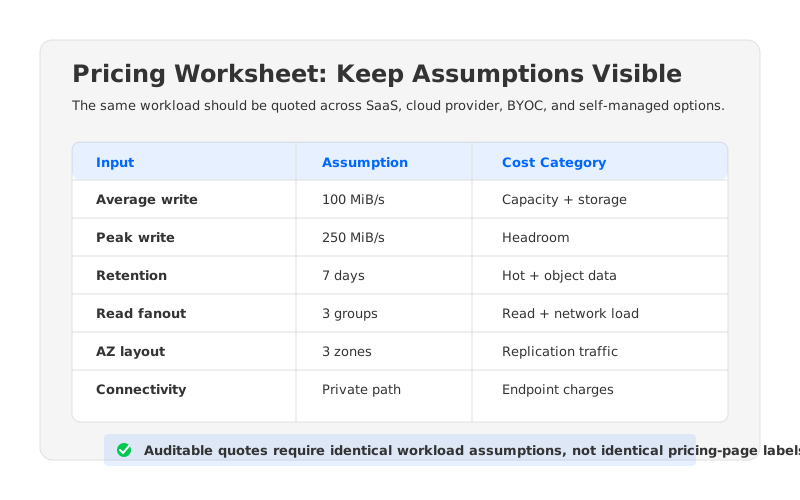
| Input | Example assumption | Notes |
|---|---|---|
| Average write throughput | 100 MiB/s | Use sustained traffic, not a one-hour peak. |
| Peak write throughput | 250 MiB/s | Capacity usually follows peak plus maintenance headroom. |
| Retention | 7 days | Separate hot local retention from object-storage retention if tiering exists. |
| Replication or durability model | RF=3 or shared storage | Do not compare physical copies without understanding architecture. |
| Read fanout | 3 full-stream consumer groups | Reads can dominate broker and network load. |
| Availability zones | 3 | Model cross-zone placement for producers, brokers, and consumers. |
| Disaster recovery | None, active-passive, or active-active | DR can double storage, network, and operational complexity. |
| Private connectivity | Required or optional | Include endpoints, data processing, and operational ownership. |
| Support tier | Business-critical | Procurement should compare support scope, not only base service. |
| Ops ownership | Vendor, shared, or customer | Internal labor is still part of TCO. |
After filling the inputs, calculate cost by category rather than by vendor page:
- Compute or capacity: broker nodes, service units, throughput units, agents, controllers, or capacity commitments.
- Storage: hot block storage, retained data, object storage, requests, retrieval, compaction overhead, and backup copies.
- Network: producer ingress paths, replica traffic, consumer egress, cross-zone traffic, cross-region replication, and public internet egress.
- Platform and support: SaaS fee, control plane fee, enterprise support, private connectivity feature charges, connectors, and monitoring add-ons.
- Operations: upgrades, scaling, incident response, security reviews, cost allocation, and migration work.
The worksheet should include assumptions beside every calculated number. "Kafka costs $X per month" is less useful than "under 100 MiB/s sustained write throughput, 7-day retention, 3 consumer groups, 3 AZs, no cross-region DR, and business support, this architecture creates these five cost categories." That phrasing makes the model auditable and prevents a low base price from hiding a high fanout or network bill.
6How To Compare Vendors Without Fooling Yourself
When comparing Confluent Cloud, Amazon MSK, Aiven, Redpanda Cloud, WarpStream, AutoMQ, or another hosted Kafka option, make each vendor answer the same workload. Do not let one quote assume one consumer group while another assumes five. Do not compare one-zone dev pricing with multi-AZ production pricing.
Good procurement questions sound specific:
- What meter changes when retention grows from 7 days to 30 days?
- What happens when read fanout grows from 3 consumer groups to 10?
- Which costs appear on the vendor invoice, and which appear in our cloud account?
- Are cross-AZ, cross-region, and private connectivity charges included, passed through, or billed by the cloud provider?
- How does the service scale during a broker failure, partition rebalance, or traffic spike?
- Can we tag, attribute, and govern the infrastructure costs inside our own cloud account?
The answer may point to different choices for different teams. A small product team may value SaaS simplicity. A regulated enterprise may prefer customer-owned data-plane resources. A platform team with heavy retention may care most about storage architecture. The right managed Kafka pricing decision is the one that matches the cost driver you actually have.
7References
- Confluent Cloud pricing
- Amazon MSK pricing
- Aiven for Apache Kafka pricing
- Redpanda Cloud billing metrics
- WarpStream pricing
- AutoMQ pricing
- AWS Data Transfer pricing concepts
- AWS S3 pricing
- AWS EBS pricing
- Azure Bandwidth pricing
- Azure Blob Storage pricing
- Google Cloud network pricing
- Google Cloud Storage pricing
8FAQ
8.1What is the main driver of managed Kafka pricing?
The main driver is usually the combination of capacity, retention, replication, read fanout, and network placement. Base service pricing matters, but Kafka bills often grow when retained data, cross-zone traffic, private connectivity, or consumer fanout expands beyond the original sizing assumptions.
8.2Is managed Apache Kafka pricing cheaper than self-managed Kafka?
Not automatically. Managed Kafka can reduce internal operations work, upgrade effort, and incident burden, but the vendor invoice may include platform and support fees. Self-managed Kafka can expose more raw cloud infrastructure control, but internal labor, reliability engineering, and operational risk still count as TCO.
8.3Why does retention make Kafka expensive?
Retention turns throughput into stored data. A workload writing 100 MiB/s generates about 8.4 TiB of logical data per day. With multiple replicas, hot local storage, indexes, and spare capacity, the physical footprint can become much larger than the logical write volume.
8.4How should I compare cloud Kafka pricing across vendors?
Use the same workload assumptions for every vendor: write throughput, peak throughput, retention, partition count, read fanout, availability zones, private connectivity, DR, support tier, and operational ownership. Then compare compute, storage, network, platform, support, and operations as separate categories.
8.5Where does BYOC fit in managed Kafka pricing?
BYOC can place infrastructure and data-plane resources in the customer's cloud account while the vendor provides software, automation, support, or control-plane services. This can improve cost visibility, tagging, procurement alignment, and data control, but it also requires teams to model customer-owned cloud resources directly.
8.6How does AutoMQ affect Kafka TCO?
AutoMQ changes the cost model by using object-storage-backed shared storage and stateless broker scaling while remaining Kafka-compatible. That can reduce the coupling between retained data and broker-local disks, make capacity scaling more compute-oriented, and give BYOC users clearer control over customer-owned cloud resources.


