
Table of Contents
Table of Contents
Managed Kafka PrivateLink is rarely requested because teams dislike public IP addresses in the abstract. It usually appears after a security review finds that application traffic, Kafka credentials, DNS records, or operational evidence must stay inside a controlled cloud network path. For many platform teams, private connectivity is the difference between a managed Kafka service that can pass production approval and one that remains limited to non-sensitive workloads.
The catch is that Kafka is not a typical single-endpoint API. A client may bootstrap from one address, then receive broker-specific endpoints through metadata responses. Those endpoints must be reachable from every producer, consumer, connector, stream processor, and admin client that will use the cluster. When a provider adds AWS PrivateLink, Azure Private Link, Google Cloud Private Service Connect, or a similar private endpoint pattern, the network design has to preserve Kafka's listener model rather than hide it behind a generic private URL.
Private connectivity solves a real problem: it avoids routing Kafka traffic over the public internet path and gives security teams a clearer network boundary. But it is not the same as bring-your-own-cloud Kafka. With PrivateLink, the service often still runs in the provider account, while the customer consumes private endpoints from its VPC, VNet, or project. BYOC changes a different boundary: the Kafka data plane can run in the customer's cloud account and private network. Architects should compare both models before treating "private" as a checkbox.
1What PrivateLink Solves for Managed Kafka
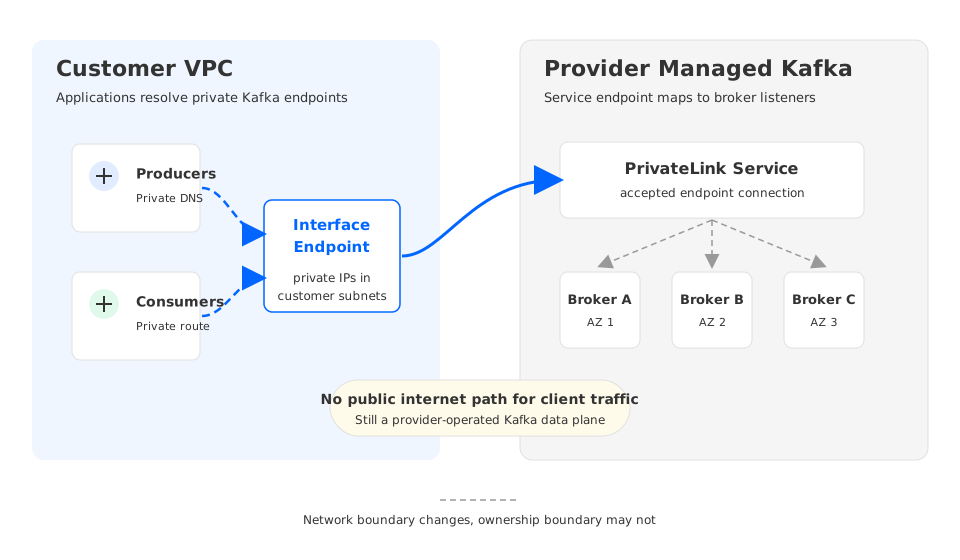
Private connectivity for managed Kafka starts with one practical goal: keep client-to-service traffic on private cloud networking instead of exposing broker access through public endpoints. AWS PrivateLink implements this through interface VPC endpoints powered by elastic network interfaces in the consumer VPC. Azure Private Link uses private endpoints with private IP addresses from the customer's virtual network. Google Cloud Private Service Connect lets consumers reach producer services through private service connectivity. The names differ, but the architectural intent is similar: applications connect to a private address in their own network, while the cloud provider handles the service-side attachment.
For Kafka, this matters in several ways:
- Security posture. Security groups, network security groups, firewall rules, route tables, and private DNS can become part of the Kafka access control story alongside SASL, TLS, ACLs, and IAM-style identities.
- Traffic path. Client traffic does not need to traverse a public internet path to reach the managed Kafka provider. This can simplify review for regulated workloads and reduce exposure to accidental public endpoint use.
- Operational consistency. Platform teams can treat Kafka like other private dependencies: databases, internal APIs, service meshes, and data lake ingestion paths.
- Segmentation. Different application VPCs or VNets can consume private endpoints under separate policies, making it easier to isolate business units, environments, or risk tiers.
The important word is "path." Private connectivity changes how clients reach the service, not every property of the service itself. The provider may still own broker infrastructure, storage, control plane operations, patching, and incident response. The customer may still depend on provider DNS conventions and endpoint lifecycle. That can be exactly right for teams that want managed operations, but it is a narrower boundary than BYOC.
2Why Kafka Private Connectivity Is Not a Single Endpoint Problem
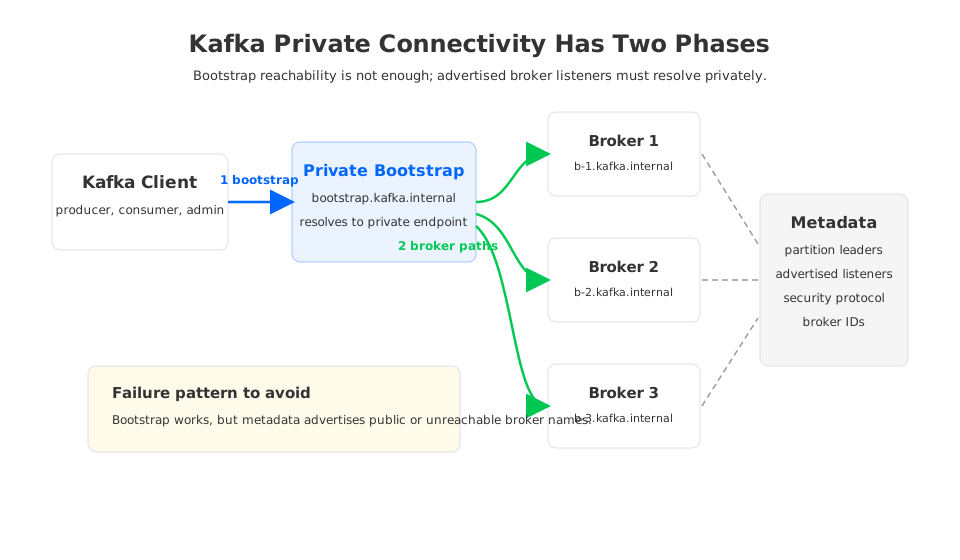
A REST API can often be represented as one private endpoint and one DNS name. Kafka is different because the bootstrap address is only the first step. After the initial connection, the client asks the cluster for metadata and learns which broker is leader for each partition. The broker endpoints returned in that metadata are controlled by Kafka listener configuration, especially listeners, advertised.listeners, and listener security mappings.
That distinction is easy to miss in architecture reviews. A diagram with "client -> PrivateLink -> Kafka" may look complete, but it hides the most common failure mode: the bootstrap server is reachable, yet the advertised broker addresses are not reachable from the client network. The result is a confusing incident. Port checks may pass on the bootstrap address, TLS may partially work, and the application still fails when it tries to produce or fetch records from a broker-specific endpoint.
Private managed Kafka providers solve this by mapping Kafka's broker identity model into private DNS and private endpoint routing. Depending on the provider, that may involve broker-specific DNS names, wildcard records, endpoint services per zone, or a network attachment that preserves zonal affinity. Amazon MSK's multi-VPC private connectivity, for example, is built on AWS PrivateLink and exposes private connectivity across VPCs while preserving the managed MSK cluster model. Confluent Cloud Private Link similarly requires cloud-specific private networking configuration so clients can reach Confluent clusters privately.
For architects, the design question is not "does it have PrivateLink?" It is "what exactly is advertised to clients, how is it resolved, and where does each broker-specific connection terminate?"
3DNS, Listener Names, and Client Placement
DNS is part of the Kafka data path. In a private connectivity design, private DNS must resolve broker endpoints to private addresses that are meaningful from the client network. That can be simple when all clients live in one VPC and one region. It becomes more delicate when applications run across multiple accounts, hub-and-spoke networks, shared services VPCs, Kubernetes clusters, hybrid DNS forwarders, or multiple cloud providers.
Three checks prevent many private Kafka outages:
| Design area | What to verify | Why it matters |
|---|---|---|
| Bootstrap resolution | The bootstrap name resolves to private addresses from every approved client network | A public fallback can violate policy or create asymmetric behavior |
| Broker metadata | Every advertised broker endpoint is reachable through the private path | Kafka clients connect to brokers after metadata discovery, not only to the bootstrap host |
| Zonal routing | Clients in each availability zone can reach the intended private endpoint or service attachment | Cross-zone routing can add latency, data transfer cost, and failure coupling |
Client placement should be reviewed with the same seriousness as broker placement. If a stream processor runs in a different VPC from the application tier, it may need its own endpoint, DNS rule, and security policy. If Kafka Connect workers run in Kubernetes, the node subnet, pod networking mode, DNS policy, and egress controls all affect whether private broker endpoints work. If developers use a bastion or VPN for admin operations, that path must be intentional rather than discovered during an incident.
Multi-region designs deserve extra caution. PrivateLink-style services are often regional constructs. A private endpoint in one region does not automatically create a resilient multi-region Kafka access pattern. If consumers in Region B read from a cluster in Region A through private connectivity, teams still need to model latency, egress or inter-region charges, DNS failover, and disaster recovery behavior. Private routing does not remove distance.
4Cost and Latency Tradeoffs
Private connectivity is a security and architecture feature, not a free abstraction. Cloud providers typically charge for private endpoints, endpoint hours, and data processing or transfer in some form. Managed Kafka providers may also charge for private networking features, dedicated capacity, or enterprise networking tiers. The exact numbers change by cloud, region, and provider contract, so the right practice is to model cost drivers rather than memorize a single rate.
The main cost drivers are predictable:
- Endpoint footprint. How many VPCs, VNets, projects, accounts, regions, and zones need private access?
- Traffic volume. Kafka is throughput-heavy. Private endpoint data processing fees can matter at sustained hundreds of MiB/s or GiB/s workloads.
- Cross-zone and cross-region paths. Private does not always mean local. A private endpoint can still send traffic across zones or regions depending on placement and provider implementation.
- Operational duplication. Separate endpoints for dev, staging, production, regulated environments, and business units may be justified, but they should be visible in the bill.
Latency is similarly nuanced. Avoiding a public internet path can reduce exposure and improve predictability, but PrivateLink does not magically place brokers next to every client. The path still includes client subnet routing, endpoint ENIs or private endpoints, provider-side load balancing or service attachments, TLS handshakes, broker leader placement, and consumer fetch behavior. Tail latency problems often come from cross-zone hops, overloaded clients, DNS misconfiguration, or partition leadership distribution rather than from the private endpoint mechanism alone.
For high-throughput Kafka workloads, network design and Kafka design must be reviewed together. A topic with many hot partitions may force clients to connect to several broker endpoints. A consumer group spread across zones may create different endpoint paths for different members. A connector cluster placed in a central shared services VPC may become a traffic concentrator. Private connectivity makes these paths more controllable, but it also makes hidden topology mistakes more visible.
5Incident Debugging Changes Under Private Connectivity
Private Kafka failures often look like application failures first. Producers time out. Consumers rebalance repeatedly. Admin clients cannot describe topics. A connector reports authentication errors even though credentials were not rotated. The underlying issue may be DNS, endpoint policy, security group drift, route propagation, TLS name mismatch, or provider-side endpoint status.
SRE teams should build a runbook that separates Kafka-layer symptoms from network-layer evidence:
- Confirm that the bootstrap name resolves to the expected private records from the affected client subnet or pod.
- Use Kafka client metadata tools to list advertised broker addresses and verify each one resolves privately.
- Check endpoint health, endpoint service acceptance, security groups, network ACLs, firewall rules, and DNS forwarding paths.
- Compare affected and unaffected zones. A single-zone endpoint or DNS record failure can look like partial Kafka unavailability.
- Correlate client errors with provider events, certificate changes, broker maintenance, and endpoint lifecycle operations.
This is where private connectivity can both help and hurt. It helps because the path is more explicit and auditable. It hurts when ownership is split across application teams, network teams, Kafka platform teams, and a managed service provider. A good architecture review assigns operational ownership for endpoint creation, DNS changes, certificate renewal, client onboarding, and emergency break-glass access before production traffic moves.
6PrivateLink vs BYOC Kafka
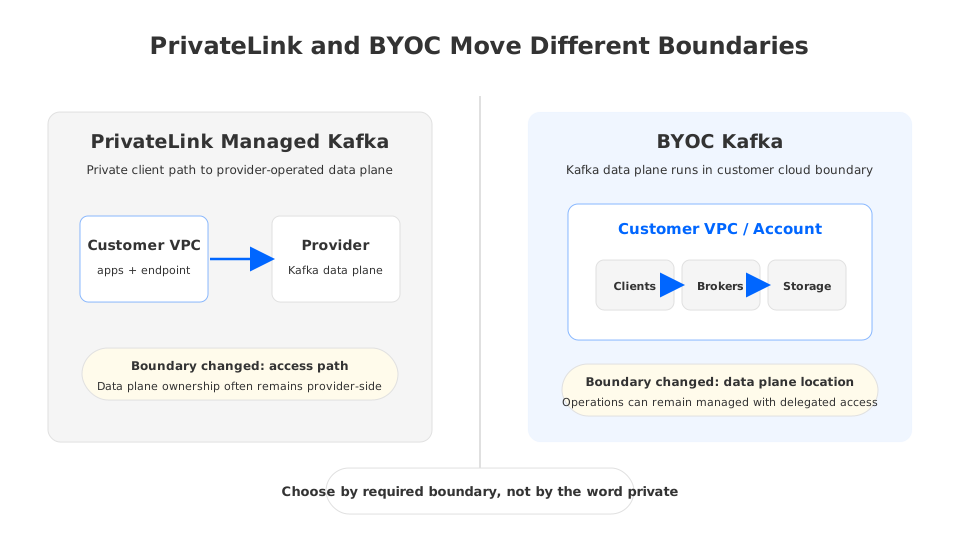
PrivateLink and BYOC answer different questions. PrivateLink asks, "Can my clients reach a provider-operated Kafka service through a private network path?" BYOC asks, "Can the Kafka data plane run inside my own cloud account and VPC while still receiving managed operational support?"
That distinction changes the security boundary:
| Requirement | PrivateLink-style managed Kafka | BYOC Kafka |
|---|---|---|
| Client traffic avoids public internet path | Usually yes, when configured correctly | Yes, clients can often stay inside the customer VPC |
| Kafka data plane location | Typically provider-controlled environment | Customer cloud account, VPC, VNet, or project |
| Durable data placement | Provider architecture and contract define it | Customer-owned cloud resources can hold data plane storage |
| Network ownership | Shared: customer endpoints plus provider service | Customer network boundary is central to the deployment |
| Operational model | Provider-managed service | Managed or co-managed, depending on BYOC design |
AutoMQ BYOC fits into this discussion as a Kafka-compatible deployment model where the Kafka data plane can run in the customer's cloud environment. AutoMQ documentation describes BYOC environments in which resources are deployed in the user's cloud account and VPC, with data plane access designed for private network use. That does not make PrivateLink obsolete. In many enterprises, PrivateLink is still a useful way to connect application VPCs, shared services networks, or cross-account clients. The difference is that BYOC moves the Kafka runtime boundary closer to the customer, while PrivateLink mainly changes the access path to a provider-operated service.
7A Practical Design Checklist
Private connectivity should be reviewed as a Kafka architecture, not as a procurement feature. Before approving managed Kafka PrivateLink for production, ask these questions:
- Which networks can resolve the bootstrap endpoint, and do they resolve it to private addresses only?
- Are all broker-specific advertised listeners reachable from every approved client location?
- Does the provider use one endpoint, broker-specific endpoints, zonal endpoints, or another mapping pattern?
- How are private DNS zones, wildcard records, split-horizon DNS, and hybrid resolvers managed?
- What happens when a broker is replaced, a zone is impaired, or a private endpoint is recreated?
- Which team owns endpoint lifecycle, DNS changes, security rules, and incident escalation?
- Are private endpoint hourly and data processing charges included in the Kafka TCO model?
- Do cross-zone and cross-region paths appear in both latency testing and cloud billing?
- Can Kafka Connect, Kafka Streams, Flink, Spark, CI/CD runners, and admin clients all use the same private path?
- If the requirement is data-plane ownership, would BYOC be a cleaner model than provider-hosted PrivateLink?
The best managed Kafka PrivateLink designs are boring in production because the hard questions were answered early. They treat DNS, listeners, private endpoints, zones, cost, and incident ownership as one system. For teams whose requirement is private access to a provider-run Kafka service, PrivateLink-style connectivity can be the right fit. For teams whose requirement is that the Kafka data plane itself stays in their cloud account and VPC, BYOC options such as AutoMQ deserve a separate architecture review rather than being evaluated as another endpoint feature.
Private connectivity is not the finish line. It is the point where Kafka architecture becomes visible to the network.
8References
- AWS PrivateLink documentation
- Amazon MSK multi-VPC private connectivity
- Azure Private Link overview
- Google Cloud Private Service Connect
- Apache Kafka broker configuration: advertised.listeners
- Apache Kafka listener configuration
- Confluent Cloud AWS PrivateLink documentation
- AutoMQ Cloud environment overview
- AutoMQ Cloud overview and BYOC model
- AutoMQ BYOC AWS VPC preparation
9FAQ
9.1Is Kafka PrivateLink the same as private Kafka?
No. Kafka PrivateLink usually means clients connect to a managed Kafka service through private cloud networking. Private Kafka can mean a broader set of models, including dedicated clusters, private cloud deployments, or BYOC deployments where the Kafka data plane runs in the customer's cloud account.
9.2Why do advertised listeners matter for PrivateLink?
Kafka clients use the bootstrap server to discover broker metadata. If the brokers advertise endpoints that are not reachable through the private path, clients may connect initially and then fail when producing, fetching, or running admin operations.
9.3Does PrivateLink eliminate cross-zone Kafka cost?
Not by itself. PrivateLink changes the access path, but Kafka traffic can still cross zones depending on client placement, endpoint placement, broker leadership, and provider implementation. Teams should test traffic paths and review cloud billing dimensions.
9.4Should every managed Kafka deployment use private connectivity?
Not always. Public endpoints with strong authentication and TLS may be acceptable for lower-risk workloads. Private connectivity is most valuable when security policy, compliance, data sensitivity, or enterprise network architecture requires private access.
9.5When should a team consider AutoMQ BYOC instead of PrivateLink?
Consider BYOC when the requirement is not only private access, but also data-plane placement inside the customer's cloud account and VPC. AutoMQ BYOC keeps Kafka compatibility while shifting the network and resource boundary closer to the customer's environment.


