
Table of Contents
Table of Contents
Teams searching for managed Kafka providers are usually past the tutorial stage. They already know why Kafka matters. The harder question is which operating model should own production risk: SaaS, cloud-provider service, BYOC, private software, or internal Kafka platform.
That distinction matters more than any feature table. Two services can both call themselves a Kafka managed service while placing data, network access, cost exposure, upgrade control, and incident responsibility in very different places. A platform team choosing among Confluent Cloud, Amazon MSK, Redpanda Cloud, WarpStream, Aiven, Upstash-style serverless options, AutoMQ, or self-managed Kafka is not buying "Kafka hosting." It is choosing a responsibility boundary.
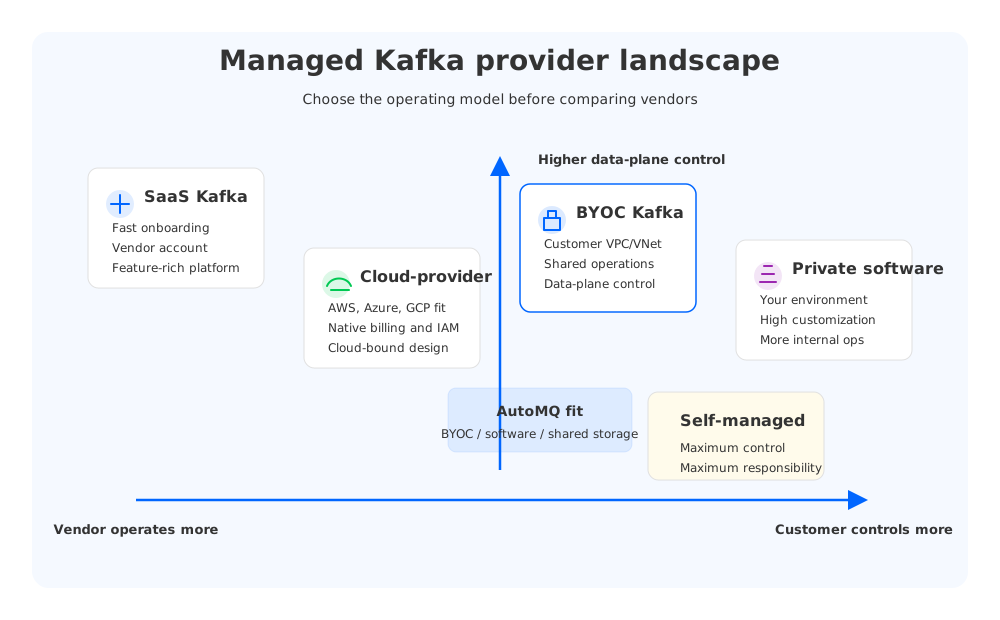
The practical way to compare managed Apache Kafka options is to start with deployment categories, then pressure-test each category against workload and governance constraints.
1Quick comparison of managed Kafka provider categories
The managed Kafka market can be grouped into six operating models:
| Category | Where the data plane runs | Who operates Kafka infrastructure | Usually fits |
|---|---|---|---|
| SaaS Kafka | Vendor cloud account | Vendor | Teams that value speed, rich ecosystem features, and minimal infrastructure ownership |
| Cloud-provider Kafka | Your cloud provider environment or provider-managed VPC integration | Cloud provider | Teams standardized on AWS, Azure, or GCP procurement and networking |
| BYOC Kafka | Your cloud account or VPC/VNet | Shared between vendor and customer | Regulated teams that need data locality and managed operations |
| Private cloud / software | Your Kubernetes, VMs, or private environment | Customer, sometimes with vendor support | Organizations that need maximum control, custom policy, or on-prem deployment |
| Serverless Kafka-like service | Provider abstraction | Provider | Spiky, lightweight, API-first workloads where full Kafka semantics may not be required |
| Self-managed Kafka | Your infrastructure | Your team | Teams with deep Kafka skill, strict customization needs, or internal platform economics |
This categorization prevents a common procurement mistake: comparing a fully hosted SaaS cluster to a BYOC product as if both made the same promise. SaaS removes operational work. BYOC moves the data plane and cloud bill back into the customer environment while preserving part of the managed experience. Software and self-managed deployments preserve control but reintroduce operational responsibility.
2What "managed Kafka" actually means
Managed Kafka should reduce toil around broker provisioning, patching, monitoring, failover, and capacity operations. It does not remove architecture decisions. You still need to choose topic layout, partition counts, producer durability, consumer group behavior, schema governance, retention, private connectivity, and disaster recovery.
The most important managed-service question is not "Who has the longest feature list?" It is "What happens during failure, growth, audit, and migration?"
For a production Kafka platform, those events expose the real boundary:
- During a broker failure, does the provider replace infrastructure only, or does it also prevent long data recovery windows?
- During traffic growth, do you scale capacity units, broker instances, partitions, storage, or object-storage-backed throughput?
- During an audit, can you prove where data resides, who can access it, and how keys are managed?
- During migration, can existing Kafka clients, Kafka Connect, Kafka Streams, and operational tools move with limited code change?
- During cost review, can FinOps explain idle capacity, inter-zone traffic, storage replication, support charges, and private networking fees?
SaaS providers such as Confluent Cloud are attractive when teams want a managed data streaming platform with integrated ecosystem services, multiple cluster types, elastic capacity options, and private networking choices documented across AWS, Azure, and Google Cloud. The tradeoff is that provider account boundaries, pricing dimensions, and feature tiers become central to architecture.
Cloud-provider services such as Amazon MSK are attractive when a team wants Kafka close to existing cloud identity, VPC, billing, and procurement. AWS documents MSK Provisioned, MSK Serverless, MSK Connect, MSK Replicator, IAM integration, encryption, and multi-VPC private connectivity. The tradeoff is that multi-cloud portability and non-AWS operating patterns require additional design.
BYOC and private-cloud products serve a different buyer. Redpanda Cloud BYOC documents a model where the data plane runs in the customer's cloud environment while Redpanda manages provisioning and operations. WarpStream documents a diskless, Kafka-compatible architecture where stateless Agents run in the customer's cloud and object storage is the primary storage layer, with a managed control plane. Aiven documents managed Kafka and diskless options. AutoMQ fits this same architectural conversation when teams want Kafka compatibility, stateless brokers, and object-storage-backed shared storage deployed in a customer cloud, VPC, or software environment.
Upstash is worth mentioning for historical context, not as a default production Kafka shortlist item. Upstash publicly announced that it was deprecating Upstash Kafka and discontinuing support. Provider comparisons must be checked against current official product pages, not stale vendor roundups.
3Responsibility boundaries decide risk
The word "managed" can hide a lot. A service may manage the control plane but ask you to operate nodes. Another may manage brokers but leave connector runtime, schema governance, private network path, or cross-region replication to your team.
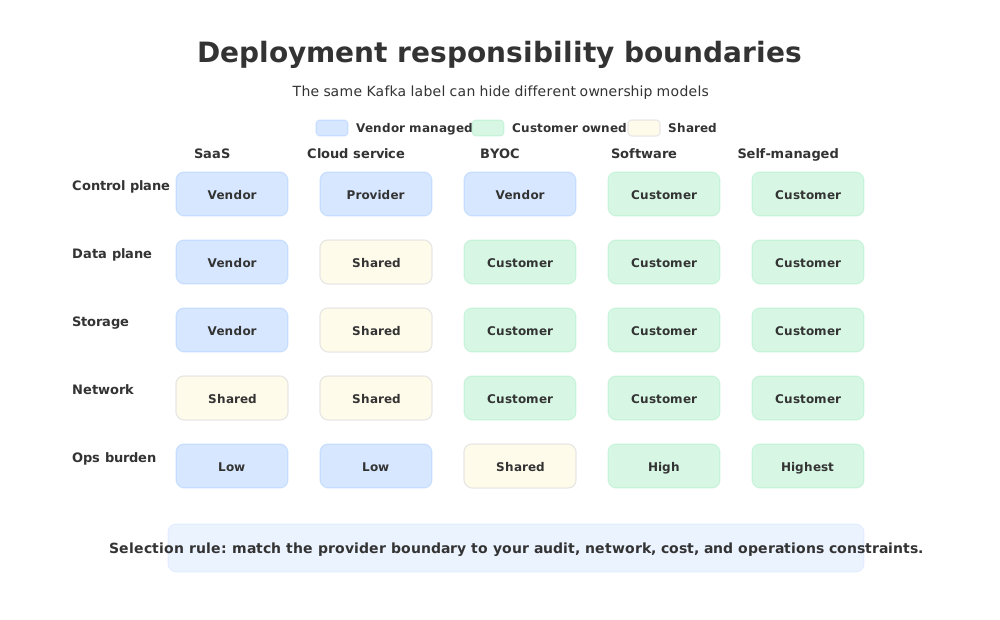
For architects and CTOs, the cleanest evaluation is to map each provider into a responsibility model:
| Area | SaaS Kafka | Cloud-provider Kafka | BYOC Kafka | Private software | Self-managed Kafka |
|---|---|---|---|---|---|
| Data plane location | Vendor account | Cloud-provider managed environment | Customer cloud account | Customer environment | Customer environment |
| Broker operations | Vendor | Cloud provider | Vendor or shared | Customer or shared | Customer |
| Network design | Provider options plus customer routing | Native cloud networking | Customer VPC/VNet plus vendor control channel | Customer designed | Customer designed |
| Data control | Provider-governed | Cloud-account aligned | Strong customer-cloud control | Strongest customer control | Strongest customer control |
| Customization | Tier-dependent | Service-dependent | Usually constrained by managed model | High | Highest |
| Time to start | Fast | Fast inside one cloud | Medium | Medium to long | Long |
There is no universally superior row. SaaS may fit an analytics platform that values rapid onboarding. BYOC may fit a financial services platform that cannot move the data plane outside its cloud account. Self-managed Kafka may be rational for a hyperscale team with a large Kafka SRE group. The mistake is choosing a provider before identifying which risks must remain internal.
4Evaluation criteria for production Kafka
Once the category is clear, compare managed Kafka vendors through criteria that survive a real production review.
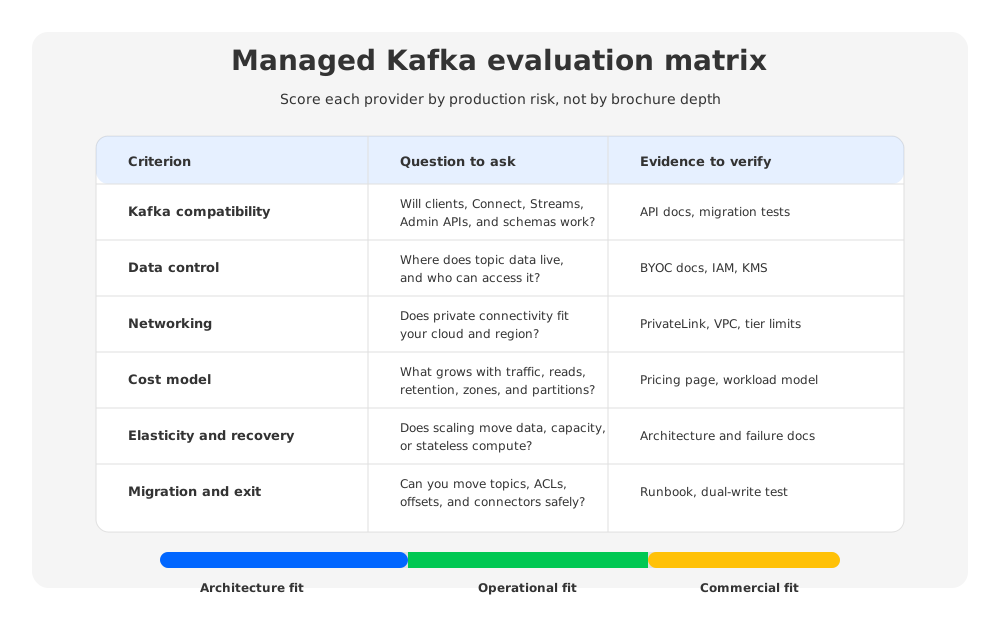
4.1Kafka compatibility and ecosystem fit
"Kafka-compatible" can mean protocol compatibility for producers and consumers, support for Kafka Admin APIs, compatibility with Kafka Connect, schema registry integrations, Kafka Streams behavior, transactions, consumer offsets, or operational tooling. A provider that is good enough for event ingestion may not satisfy transactional producers, Connect-heavy CDC pipelines, or strict schema workflows.
Ask for evidence at the API and workload level:
- Which Kafka client versions are supported?
- Are Admin APIs, consumer group coordination, transactions, idempotent producers, and topic configuration semantics supported?
- Can existing Kafka Connect connectors run unchanged, or does the provider supply a separate connector model?
- How are schema registry, access control, audit logs, and governance integrated?
- Is there a documented migration path from Apache Kafka or another provider?
This is where Kafka-compatible shared-storage systems such as AutoMQ become relevant. The buying question is whether existing Kafka clients and operating assumptions remain valid while the storage architecture changes.
4.2Data plane location and control
For procurement and compliance, the location of the data plane is often decisive. SaaS models can provide encryption, private networking, audit controls, and key management, but the data plane typically lives in the vendor's cloud environment. Cloud-provider services align with the customer's chosen cloud, although the exact VPC and service boundary still need official verification. BYOC and software deployments move the data plane into the customer account or private environment, often leaving a vendor control plane outside.
The right question is concrete: can your security team describe which identities can access topic data, which cloud account owns storage, which network path carries client traffic, which keys protect data at rest, and what access the vendor has during support events?
4.3Networking and private connectivity
Kafka networking is unforgiving because clients need stable broker metadata, not only a single endpoint. PrivateLink, VPC peering, Private Service Connect, VNet Peering, public endpoints, cross-account access, and overlapping CIDR ranges all affect deployment effort. Confluent Cloud documents public and private connectivity across major clouds. Amazon MSK documents private connectivity inside AWS, including multi-VPC private connectivity. Redpanda BYOC and WarpStream BYOC move the data plane into the customer's network, but still require control-plane connectivity and IAM design.
Do not treat "supports PrivateLink" as a yes-or-no checkbox. Validate the exact cluster tier, region, cloud, authentication mode, connector path, admin console access, and cross-region replication path.
4.4Cost model and elasticity
Managed Kafka pricing is not one number. It is a mix of capacity units, broker hours, partition hours, storage, retained data, write throughput, read throughput, inter-zone traffic, private connectivity, connector runtime, support, and sometimes committed spend. Entry pricing can change sharply when retention grows, fan-out increases, private networking is enabled, or partitions multiply.
Traditional Kafka cost is shaped by local broker disks and replication. Object-storage-backed designs change that structure. WarpStream documents a diskless model built directly on object storage. Aiven documents diskless Kafka options. AutoMQ uses object storage as shared primary storage with stateless brokers, reducing the pressure associated with local disk ownership, broker replacement, and partition reassignment. Model write throughput, read fan-out, retention, partitions, zones, and recovery targets.
4.5SLA, support, and failure model
SLA numbers should be read with their conditions. Check official docs for cluster tier, region, multi-zone configuration, private networking, maintenance windows, support response, and exclusions. Also ask what work is required after failure.
If a broker disappears, a classic local-disk Kafka design may need replica catch-up, data movement, or partition reassignment pressure. A stateless or diskless design changes the recovery problem because durable data is not bound to a broker-local disk. That is why systems such as WarpStream and AutoMQ are not only pricing alternatives; they represent a different failure model.
4.6Migration and exit path
The provider that is easiest to enter is not always easiest to leave. Migration planning should cover topic creation, ACLs, schemas, offsets, consumer groups, connector configuration, MirrorMaker or cluster linking, DNS cutover, dual writes, observability, and rollback. A good managed Kafka comparison includes exit risk because Kafka often becomes central business infrastructure.
Prefer providers that document migration mechanics, API compatibility, and operational limits clearly. Avoid options where migration proof depends on sales claims rather than published mechanics or tests.
5Where AutoMQ fits in the managed Kafka landscape
AutoMQ is most natural in the BYOC, private cloud, and software part of the comparison. It is Kafka-compatible, but its architectural thesis is different from a classic broker fleet: object-storage-backed shared storage moves durable data away from broker-local disks, and stateless brokers handle compute without owning persistent partitions.
That matters for three common buyer profiles:
- A platform team wants Kafka compatibility but does not want broker-local disks to dominate scaling, recovery, and retention planning.
- A security or compliance team wants the data plane in its own cloud account, VPC, or private environment rather than a generic SaaS account.
- A FinOps team wants to restructure Kafka cost around object storage and elastic compute instead of over-provisioned brokers and replicated local disks.
This is not a reason to force AutoMQ into every Kafka decision. If a team needs a broad SaaS data streaming platform with minimal infrastructure ownership, Confluent Cloud may be a better category fit. If a team is all-in on AWS, Amazon MSK deserves close evaluation. Redpanda and WarpStream should also be reviewed on their own merits. AutoMQ becomes compelling when Kafka compatibility, customer-cloud control, storage-compute separation, and cost restructuring are all first-class requirements.
6Decision table by workload and organization type
| Situation | Strong candidates to evaluate | Main diligence question |
|---|---|---|
| Fast product team launching Kafka with limited ops staff | SaaS Kafka or cloud-provider Kafka | Does the managed tier support required networking, connectors, and throughput? |
| AWS-centered platform with existing IAM, VPC, and procurement standards | Amazon MSK | Do MSK Provisioned or MSK Serverless limits, pricing dimensions, and migration paths fit the workload? |
| Regulated enterprise requiring data plane in its own account | BYOC Kafka or private software | What exactly can the vendor access, and how is the control plane isolated? |
| Retention-heavy or high fan-out workload under FinOps pressure | Object-storage-backed Kafka-compatible architecture | How do write, read, storage, and recovery costs behave at target scale? |
| Team with deep Kafka SRE expertise and unusual configuration needs | Self-managed Kafka or private software | Is the internal platform cost lower than provider cost after on-call and upgrades? |
| Existing Kafka estate needing lower operational friction without app rewrites | Kafka-compatible BYOC or cloud-native Kafka | Which clients, connectors, schemas, offsets, and admin workflows move cleanly? |
For a serious vendor evaluation, build a weighted scorecard instead of a flat checklist. Weight data control, compatibility, private networking, cost predictability, operational burden, migration risk, and support. Then test the top options with the same workload model and client configuration. Kafka provider selection becomes clearer when every vendor faces the same traffic, retention, security, and failure assumptions.
7References
- Confluent Cloud cluster types
- Confluent Cloud networking overview
- Amazon MSK features
- Amazon MSK pricing
- Redpanda Cloud BYOC documentation
- Redpanda BYOC architecture
- WarpStream architecture
- WarpStream pricing
- Aiven for Apache Kafka documentation
- Upstash announcement on Kafka deprecation
- AutoMQ architecture overview
- AutoMQ stateless broker documentation
8FAQ
8.1What is a managed Kafka provider?
A managed Kafka provider operates some or all infrastructure required to run Kafka or a Kafka-compatible platform. The provider may handle provisioning, patching, monitoring, scaling, upgrades, failover, and support. The boundary depends on the model: SaaS, cloud-provider service, BYOC, private software, or self-managed Kafka with vendor support.
8.2Is Confluent Cloud the same category as Amazon MSK?
Not exactly. Confluent Cloud is a vendor-operated data streaming platform available across major clouds, with multiple Kafka cluster types and ecosystem services. Amazon MSK is AWS's managed Apache Kafka service, aligned with AWS networking, IAM, billing, and service integration. Both can be valid, but they optimize for different operating models.
8.3When should BYOC Kafka be considered?
BYOC Kafka is worth evaluating when data control, VPC/VNet placement, cloud-account ownership, committed cloud discounts, or compliance boundaries are major requirements. It can preserve more control than SaaS while reducing more operational work than self-managed Kafka.
8.4Why do object-storage-backed Kafka architectures matter?
Classic Kafka binds durable topic data to broker-local disks and replicates it across brokers. Object-storage-backed architectures move durable data into cloud object storage and make brokers or agents more stateless. That can change scaling, recovery, retention, and cost behavior.
8.5How should FinOps compare managed Kafka vendors?
Model the workload rather than comparing list prices. Include write throughput, read fan-out, retained data, partitions, zones, connector runtime, private networking, support, and expected idle capacity. Then compare cost, recovery behavior, and operational labor under the same assumptions.
8.6Where does AutoMQ fit among managed Kafka providers?
AutoMQ fits when teams want Kafka compatibility, a customer-cloud or private deployment model, stateless brokers, and object-storage-backed shared storage. It is especially relevant for teams evaluating BYOC or software options because they want to keep Kafka semantics while changing the infrastructure economics and operational model underneath.


