
Table of Contents
Table of Contents
Teams search for market data distribution kafka when a feed has become shared production infrastructure. The same quote, trade, order book update, or derived signal may have to reach a pricing engine in milliseconds, remain replayable for compliance, feed model features, and land in analytical systems. Kafka is attractive because it gives those teams an event log, independent consumer groups, offsets, and a large client ecosystem. The difficult question is not whether Kafka can carry market data. It is whether the chosen Kafka-compatible platform can keep delivery, replay, governance, and cloud cost under control when the market gets noisy.
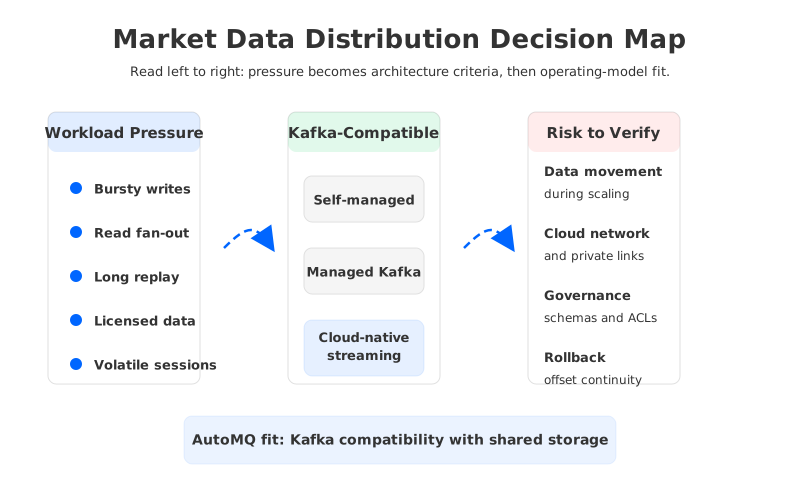
Market data distribution is unforgiving because pressure is uneven. A normal trading window can turn into a burst during a market open, index rebalance, vendor reconnect, or volatility event. A few instruments can dominate writes, while a historical consumer scans older data and a live consumer waits at the tail. If capacity changes require large broker-local data movement, the operating model becomes part of the risk profile.
1Why Teams Search for market data distribution kafka
The search phrase usually comes from a team that already understands event streaming. They are not looking for a definition of a topic or a producer. They are trying to answer a production design question: how do you distribute high-value, bursty, regulated data to many applications without turning the central stream into a bottleneck or a governance blind spot?
Kafka maps naturally to this problem. A topic can represent raw venue events, normalized prices, reference data changes, order events, or derived risk signals. A partition gives ordering within a key such as instrument, venue, account, or product. Consumer groups let pricing, surveillance, analytics, and application teams consume independently, while committed offsets give each group a recovery position.
The architecture becomes harder after the first successful deployment. Retention grows because audit, model training, and incident reconstruction need longer replay windows. Fan-out grows because every team wants the same feed with a different purpose. Governance grows because licensed market data, derived signals, customer context, and internal decisions should not have the same access policy.
That is where a simple producer-to-topic-to-consumer diagram stops helping. Platform teams need to make concrete decisions:
- Which keys preserve business ordering without creating hot partitions during volatile sessions?
- Which consumers need the live tail, which need replay, and which can read from a downstream analytical store?
- How much retention belongs in the streaming platform, and which part should move to object storage or another archival layer?
- What happens to live consumers when a historical consumer reads aggressively?
- How quickly can the platform add capacity without moving broker-local retained data?
- Which schemas, ACLs, audit trails, and topic ownership rules keep the stream governed?
These are not edge cases. They are signs that the market data platform has become important enough to need an operating model, not only a messaging API.
2The Production Constraint Behind the Problem
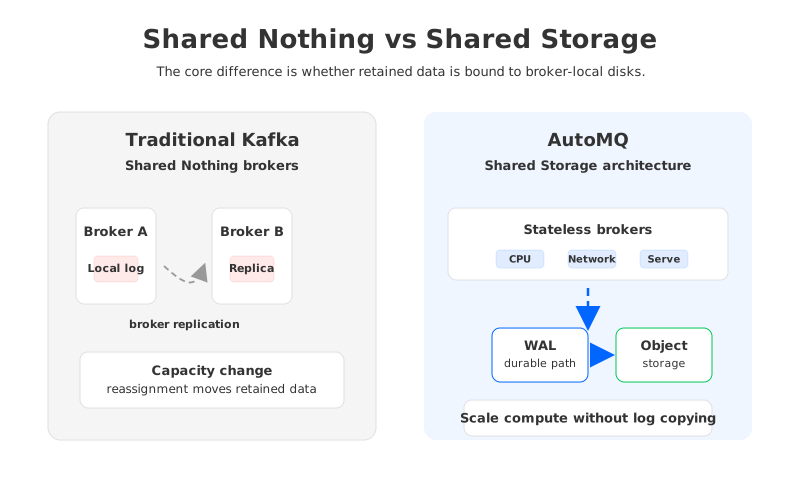
Traditional Apache Kafka uses a shared-nothing broker model. Each broker owns local storage for the partitions assigned to it, and replicas are spread across brokers for durability and availability. That design is proven and well understood. It also couples several things that cloud platform teams often want to manage independently: compute capacity, local disk capacity, partition placement, replication traffic, and broker recovery.
In a market data distribution system, that coupling shows up in awkward places. If a few hot instruments increase write pressure, adding brokers may require partition reassignment before the extra capacity is useful. If retention expands for audit or replay, broker storage sizing becomes part of a business requirement. If a broker fails during a volatile period, recovery can become a data movement and throttling event.
Tiered Storage improves one part of this picture by moving older log segments to remote storage. It can reduce local disk pressure when the main problem is long retention. The important distinction is that Tiered Storage does not make brokers stateless. Recent data, partition leadership, broker-local disk, and reassignment behavior remain central to the operating model. For teams distributing market data, that distinction matters because the same platform often needs long replay windows and fast capacity response during bursts.
The cloud cost model adds another layer. Multi-AZ Kafka deployments commonly create cross-AZ movement through broker replication and client placement. Cloud providers publish pricing for data transfer and private connectivity, but the cost is rarely visible in the Kafka architecture diagram. Market data workloads can make those lines material because throughput is continuous, read fan-out is high, and retained data grows with regulatory or analytical demand.
3Architecture Options and Trade-Offs
A practical evaluation separates the application contract from the storage and operations model. The application contract is Kafka compatibility: producer and consumer behavior, offsets, transactions where needed, admin APIs, Kafka Connect integration, authentication, and client version support. The storage and operations model is how the platform persists data, scales brokers, handles failures, controls network movement, and supports governance.
Those two dimensions should be scored independently. A platform that exposes a Kafka-like API but breaks consumer behavior or migration tooling creates application risk. A platform that preserves Kafka client compatibility but keeps the same stateful storage constraints may reduce little operational risk. The right platform is the one whose compatibility and operating model match the workload.
| Option | Strong Fit | What to Test |
|---|---|---|
| Self-managed Kafka | Teams with mature Kafka operations, strict internal control, and workloads that fit known broker sizing patterns | Upgrade process, partition reassignment, local disk growth, multi-AZ traffic, and operational staffing |
| Managed Kafka service | Teams that want to offload cluster provisioning and routine infrastructure work while keeping a familiar Kafka model | Scaling limits, storage expansion rules, network charges, private connectivity, and service-specific constraints |
| Kafka-compatible cloud-native streaming | Teams that need Kafka semantics but want a different storage, scaling, or cost model | Real client compatibility, migration/rollback path, failure recovery, governance boundary, and data residency |
This table does not imply that one category always wins. A stable feed with short retention and limited fan-out can run well on conventional Kafka. A regulated market data backbone with bursty ingest, many consumer teams, long replay windows, and strict cloud boundaries should put more weight on storage architecture and operations. The workload determines which trade-off matters.
The same discipline applies to stream processing and data integration. Kafka Connect can simplify movement into databases, lakehouses, search systems, and warehouses, but connectors also become part of the operating surface. Consumer groups need lag SLOs and ownership. Transactions and idempotent producers reduce duplicate or partial-write risk where workflows need them, but they increase compatibility requirements during platform selection.
4Evaluation Checklist for Platform Teams
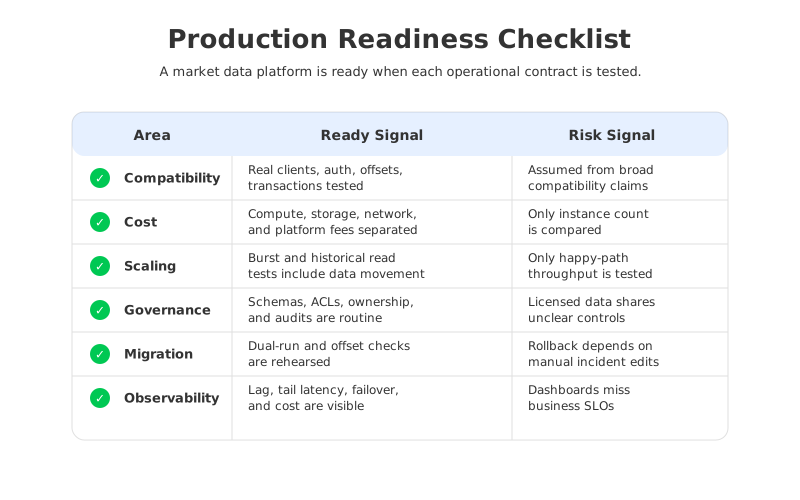
The most useful checklist is the one an SRE or architect can use before a migration, not after an incident. It should force the team to connect business behavior to Kafka mechanics and cloud infrastructure.
| Area | Decision Question | Healthy Signal |
|---|---|---|
| Compatibility | Do real producers, consumers, admin tools, and connectors behave the same way on the target platform? | Test results cover client versions, auth, offsets, transactions, and Kafka Connect jobs used by the team |
| Partitioning | Does the key preserve the ordering the business needs without permanent hot spots? | Hot instruments, venue bursts, and replay scans are modeled before production cutover |
| Retention | Which data needs low-latency replay, and which data should move to colder storage or analytical systems? | Retention policies are tied to audit, recovery, and feature-generation requirements |
| Scaling | What happens when writes double or a historical consumer starts scanning? | Scaling tests include data movement, not only broker count or advertised throughput |
| Cost | Which lines grow with write rate, read fan-out, retention, private connectivity, and idle headroom? | Cost dashboards separate compute, storage, network, object-storage requests, and platform fees |
| Governance | Who owns schemas, topics, ACLs, and data classification? | Topic lifecycle, schema review, and access audit are operational routines |
| Migration | Can the team dual-run, validate offsets, switch traffic, and roll back without manual heroics? | Rollback is rehearsed before regulated or latency-sensitive consumers move |
This checklist prevents a common mistake: optimizing for ingestion throughput while ignoring distribution quality. A market data platform creates value when many teams can act on the same event at the right time and with the right confidence.
5How AutoMQ Changes the Operating Model
Once the evaluation framework is clear, the architectural question becomes sharper: can a Kafka-compatible system preserve the application contract while changing the storage and scaling model underneath it? AutoMQ is built for that category. It is a Kafka-compatible cloud-native streaming platform that uses a Shared Storage architecture, stateless brokers, S3-compatible object storage, and a WAL layer instead of binding durable retained data to broker-local disks.
The practical effect is not that platform teams stop caring about Kafka design. They still need good partition keys, topic ownership, schema governance, and observability. The change is that broker lifecycle becomes less tied to retained data placement. When persistent data lives in shared storage, replacing or adding brokers becomes more about traffic placement and metadata than copying retained partition data from one local disk estate to another.
That difference matters for market data distribution. Capacity can respond more directly to workload pressure because compute and storage are no longer sized as one unit. Longer retention can be planned around object-storage-backed durability instead of every replay requirement becoming a broker disk exercise. AutoMQ's self-balancing capabilities address hot partitions and changing traffic patterns by continuously changing placement instead of making rebalancing a separate manual project.
AutoMQ's deployment model is relevant for regulated or licensed data. AutoMQ BYOC runs in the customer's cloud account and VPC, while AutoMQ Software targets customer-controlled data center environments. For market data teams, that boundary is not a detail. Licensed feeds, derived trading signals, customer activity, and compliance workflows often need explicit control over where data, metadata, credentials, and operational access live.
The cost model changes for the same reason the operations model changes. Traditional multi-AZ Kafka moves data between brokers for replication, and cloud networks can charge for some cross-AZ movement. AutoMQ's architecture is designed around regional shared storage and AZ-aware traffic placement, reducing Kafka data replication movement across availability zones. The accurate claim is not that every network cost disappears. Control traffic, client placement, private connectivity, and surrounding systems still matter.
6Migration Path: Keep the Application Contract Boring
The safest migration path for market data is conservative where the business risk is highest. Keep producers and consumers boring. Move one traffic class at a time. Run dual paths long enough to compare delivery, ordering, lag, replay, and downstream decisions. Make rollback executable by the on-call team.
A practical readiness scorecard should look like this:
| Migration Area | Ready | Not Ready |
|---|---|---|
| Producers | Source adapters, serializers, auth, and idempotency settings are inventoried | Venue adapters or gateway clients are unknown or hard to change |
| Consumers | Consumer groups, lag SLOs, and replay expectations are documented | Live, batch, and audit readers share unclear ownership |
| Data Model | Schemas and topic ownership are explicit | Raw and derived events are mixed without lifecycle rules |
| Operations | Failover, scaling, and replay tests are rehearsed under load | Recovery behavior is assumed from small functional tests |
| Rollback | Offset continuity and traffic switch-back are tested | Rollback depends on manual offset edits during an incident |
For AutoMQ evaluations, Kafka Linking can be part of the migration discussion when the source environment and target instance meet documented prerequisites. Treat that as an engineering workflow, not a magic bridge. Define success metrics, reserve capacity for synchronization, compare live and replay behavior, and decide which discrepancies stop the cutover.
7Closing Guidance
Market data distribution with Kafka-compatible infrastructure should be evaluated as a production system of record for events, not as a streaming demo. The strong design starts with the data contract: keys, ordering, schemas, offsets, retention, and consumers. It then tests the infrastructure contract: scaling behavior, storage placement, failure recovery, cloud cost, governance, and rollback. The platform that wins is the one that keeps both contracts understandable when the market is at its loudest.
AutoMQ is worth evaluating when your team wants Kafka compatibility but does not want broker-local retained storage to define every scaling and recovery decision. Start with the neutral checklist above, then test the parts that matter for your own feed: real clients, real consumer groups, real replay windows, and real cloud boundaries. To explore the architecture and deployment path, open the AutoMQ Cloud entry point and compare it with your current market data runbook.
8References
- Apache Kafka Documentation
- Apache Kafka Consumer Design
- Kafka Connect Documentation
- Apache Kafka Tiered Storage
- AutoMQ Architecture Overview
- AutoMQ Compatibility with Apache Kafka
- AutoMQ WAL Storage
- AutoMQ Continuous Self-Balancing
- AWS EC2 On-Demand Pricing: Data Transfer
- AWS PrivateLink Pricing
9FAQ
9.1Is Kafka a good fit for market data distribution?
Yes, Kafka is a strong fit when the system needs independent producers and consumers, ordered processing within keys, replay, and integration with stream processing or data integration tools. The hard work is in partitioning, retention, governance, and operations rather than in the basic event-streaming model.
9.2What is the biggest architecture risk?
The biggest risk is coupling live delivery to heavy storage movement. If scaling, recovery, or retention changes require large broker-local data movement, the platform can become fragile during exactly the bursts that made additional capacity necessary.
9.3When should a team consider Kafka-compatible cloud-native streaming?
Consider it when Kafka compatibility is required but the team wants a different operating model for storage, elasticity, recovery, or deployment boundaries. The evaluation should include real client compatibility tests, cost modeling, and a migration rehearsal.
9.4Does Shared Storage architecture remove the need for good topic design?
No. Shared Storage changes broker lifecycle and storage economics, but topic ownership, partition keys, schema evolution, access control, and observability remain platform responsibilities.
9.5How should teams test migration risk?
Use dual-running, live/replay comparison, consumer lag tracking, offset validation, and an executable rollback plan. Migration confidence should come from rehearsed operational behavior, not from a compatibility statement alone.


