
Table of Contents
Table of Contents
Teams searching for real time stock data kafka flink usually have a concrete problem already in motion. A trading desk, market-data team, risk platform, or customer analytics group needs to ingest high-volume price updates, normalize them, process them with event-time logic, and expose results before the signal has gone stale. Kafka and Flink are a natural pair for that job: Kafka gives the pipeline durable ordered topics and independent consumers, while Flink gives the team stateful stream processing, windows, joins, and checkpointed recovery.
The first architecture is usually straightforward: market feeds enter a source layer, producers write to Kafka, Flink reads topics and maintains state, and downstream systems consume derived topics or query materialized outputs. The hard part begins when the pipeline becomes a production dependency. Replay windows grow for backtesting, consumer groups multiply, and failures need clean recovery because a bad transform should not force the team to skip records or rebuild everything by hand.
That is where the search phrase becomes an infrastructure question rather than a tutorial question. The right platform is not the one that can run a demo with stock ticks. It is the one that keeps latency, replay, governance, and cost under control while the number of feeds, partitions, consumers, and retained records keeps changing.
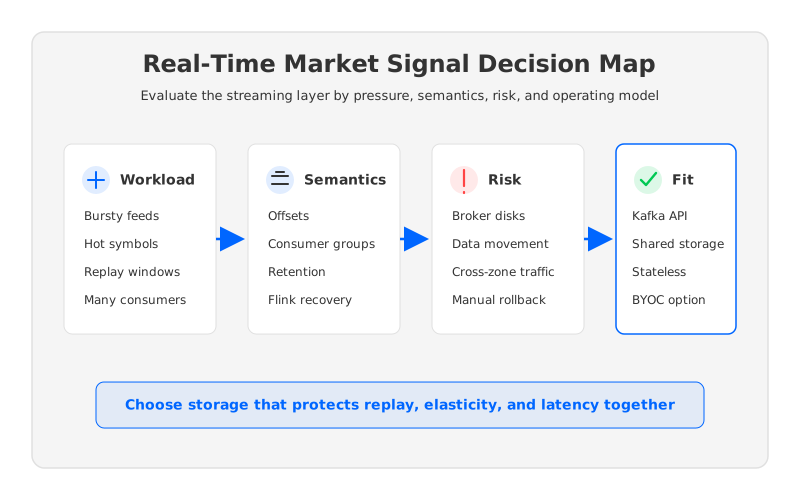
1Why Teams Search for real time stock data kafka flink
Market-signal pipelines sit in an awkward middle ground. They are too dynamic for batch ingestion and too important to treat as throwaway messaging. A delayed price update can be irrelevant. A lost correction can make a downstream position calculation wrong. A replay that takes hours can block incident recovery, model validation, or a regulatory audit.
Kafka fits the center of this design because it separates event production from event consumption. Producers publish market events into topics, consumers progress through offsets at their own pace, and consumer groups allow multiple applications to read the same stream independently. That matters when a Flink job, alerting service, lake sink, and operational dashboard all need the same feed with different latency and retention expectations.
Flink adds the processing model that raw topics do not provide. It can compute rolling windows, join reference data, handle late events, maintain keyed state, and recover from checkpoints. In a real-time stock-data pipeline, that means the team can build derived streams such as enriched quotes, abnormal-spread alerts, liquidity summaries, or portfolio exposure updates without turning every consumer into a bespoke state machine.
The pipeline starts to strain when these responsibilities are mixed together:
- Feed ingestion: Source connectors or custom producers must handle rate bursts, malformed records, symbol metadata changes, and upstream reconnects without creating duplicate or missing events.
- Stream processing: Flink jobs need stable event-time semantics, checkpoint storage, controlled parallelism, and backpressure visibility.
- Serving and analytics: Downstream systems may need low-latency reads, long replay windows, or table-style query access, but each access pattern creates different storage and network pressure.
- Governance: Market data often carries licensing, retention, lineage, and entitlement constraints. Kafka topics make distribution easy, but easy distribution still needs policy.
This is why a "Kafka plus Flink" decision should include the storage and operating model underneath Kafka. The API surface gives the application team a familiar contract; the broker architecture determines how expensive that contract becomes when the workload grows.
2The Integration Constraint Behind the Pipeline
A low-latency market pipeline has two clocks. The first clock is application latency: how quickly a record moves from feed handler to processed result. The second clock is recovery latency: how quickly the platform returns to a correct state after a job restart, broker failure, schema mistake, or consumer lag incident. Many teams optimize the first clock and discover the second one during an outage.
Traditional Kafka Shared Nothing architecture binds durable log data to broker-local storage. That design has served the industry well, but its side effects show up early in market-signal streams. Retention planning becomes disk planning, broker replacement becomes data movement, partition growth becomes rebalancing work, and Multi-AZ durability can turn replication into a visible networking concern.
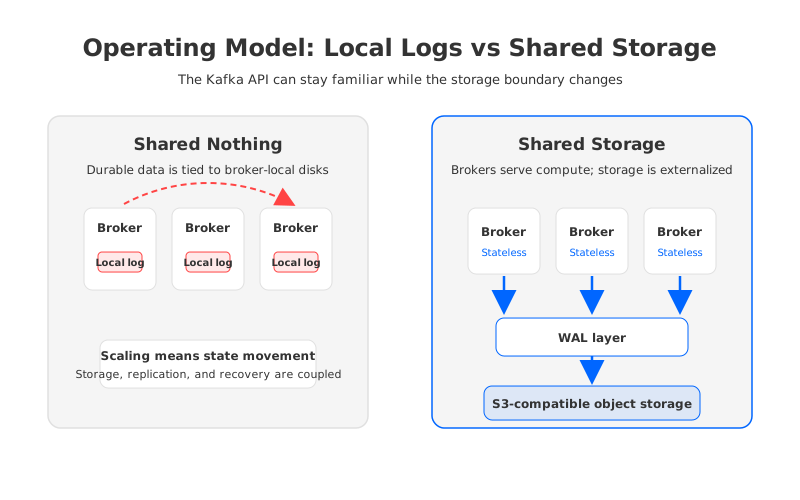
The deeper issue is coupling. A broker is not only serving reads and writes; it is also the place where durable data lives. When hot partitions move, data needs to move or be re-replicated. When retention expands for backtesting, broker storage expands with it. When teams add new consumers for analytics, reads can compete with the same broker resources used for fresh ingestion.
That coupling affects Flink too. A Flink job can recover from checkpoints, but it still depends on Kafka to replay input from the correct offsets at the required speed. If a broker is saturated, a replay storm can slow normal ingestion. If retention is too short, a failed job may not have the records it needs. If topics are repartitioned without a clear plan, state alignment and operational confidence suffer.
The integration constraint is simple: Kafka and Flink give the team strong semantics, but production quality depends on the platform's ability to preserve those semantics under growth, failure, and replay.
3Connector, Schema, Replay, and Stream Processing Trade-Offs
The cleanest architecture treats the market feed as a data product, not as a pipe. Each topic should have an owner, a schema policy, a retention policy, and a recovery plan. Without those boundaries, a low-latency pipeline becomes a set of hidden assumptions spread across producers, Flink jobs, connectors, and downstream dashboards.
Three decisions deserve attention before the first production cutover. Key design affects partition skew and Flink state because keys often represent symbols, instruments, venues, or account entities. Schema evolution decides whether a new exchange field, corrected timestamp, or entitlement marker breaks consumers. Replay policy defines whether the goal is to rebuild the latest view, re-run historical windows, or prove application-level processing correctness.
The trade-off matrix below is a useful way to keep the conversation grounded:
| Decision area | What to validate | Production failure mode |
|---|---|---|
| Topic and key design | Partition count, symbol skew, ordering boundary, compaction needs | Hot partitions and uneven Flink state |
| Schema governance | Compatibility rules, required fields, null semantics, metadata versioning | Consumers fail or silently misread records |
| Replay window | Retention, offset reset policy, backfill speed, downstream idempotency | Incident recovery depends on manual rebuilds |
| Flink processing | Checkpoints, state backend, event-time watermarks, restart strategy | Restart works technically but violates business timing |
| Connector operations | Source retries, sink idempotency, dead-letter handling, credentials | Bad records or target failures block the stream |
| Observability | Lag, checkpoint duration, broker saturation, end-to-end freshness | Teams see symptoms after the signal is already stale |
This table also prevents a common mistake: treating Flink as a way to hide platform problems. Flink can manage state and recover processing logic, but it cannot repair missing Kafka retention, unclear ownership, or broker storage pressure. The streaming substrate still has to provide durable input, predictable replay, and enough elasticity to absorb irregular market activity.
4Evaluation Checklist for Data Platform Teams
A useful evaluation starts with workload behavior instead of vendor features. A market-signal stream has predictable daily rhythms, unpredictable volatility bursts, and occasional historical replay needs. Steady-state throughput rarely exposes the risk that matters most.
Use this checklist before choosing or redesigning the Kafka-compatible layer:
- Compatibility: Validate the exact Kafka clients, serializers, admin operations, security mechanisms, Flink connectors, and Kafka Connect plugins used by the estate.
- Latency and freshness: Measure end-to-end event freshness, not only broker produce latency. Include feed handling, Kafka writes, Flink checkpoints, downstream sinks, and consumer lag.
- Elasticity: Test what happens when throughput doubles, partitions are added, or a hot symbol causes skew. The important question is how much manual data movement or reassignment work is required.
- Cost model: Separate compute, storage, network, object storage requests, connector runtime, and observability costs. A low broker-hour price can still be expensive if it forces over-provisioned disks and cross-zone traffic.
- Governance: Confirm topic ownership, schema review, ACLs, retention rules, lineage, and market-data entitlement boundaries before adding more consumers.
- Migration and rollback: Prove offset preservation, dual-running, cutover checkpoints, and rollback behavior with real topics. A migration plan that ignores consumer progress is incomplete.
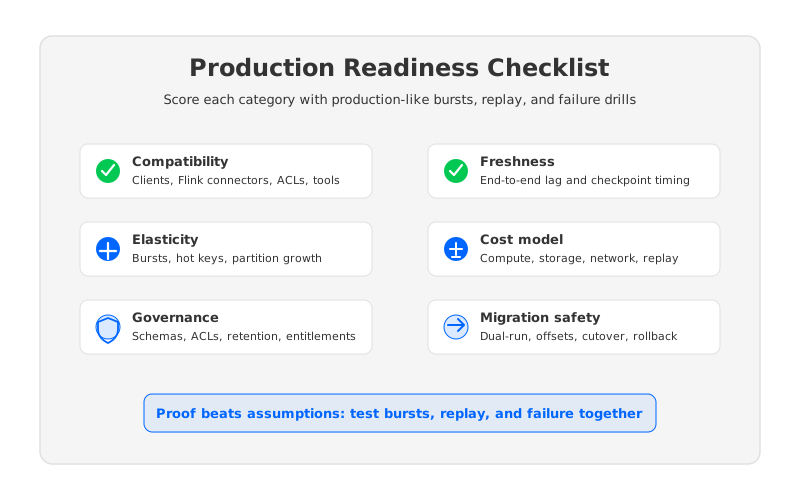
The output should be a decision memo, not a generic benchmark. If the workload combines low latency, long replay windows, many independent consumers, and unpredictable bursts, storage architecture becomes a first-order design choice.
5How AutoMQ Changes the Operating Model
After that neutral evaluation, the architectural requirement becomes clearer: keep Kafka-facing semantics stable while reducing the operational work tied to broker-local durable state. AutoMQ fits that category as a Kafka-compatible, cloud-native streaming platform built around Shared Storage architecture and stateless brokers.
The important point is where the change happens. Producers, consumers, Kafka Connect, Flink Kafka sources, offsets, topics, and consumer groups continue to use the Kafka-compatible interface. Under that interface, AutoMQ separates broker compute from durable stream storage. Brokers handle request processing, caching, and ownership, while persistent data is written through a WAL layer and stored in S3-compatible object storage through S3Stream shared storage.
For market-signal pipelines, that changes several operating assumptions. Scaling broker compute no longer has to mean moving large local log segments. Retention growth becomes an object-storage capacity question rather than a broker-disk planning exercise. Failure recovery can focus more on ownership and metadata because durable data is not trapped on the failed broker's local disk.
The model is not magic, and it still needs proof with the team's workload. WAL choice matters for latency. Object-store behavior matters for replay and retention. Cache sizing matters for read-heavy consumers. Network boundaries matter for regulated data. Those are measurable engineering questions, which is exactly why they are easier to reason about than an overloaded broker that is simultaneously compute node, storage node, and recovery boundary.
AutoMQ is also relevant around the edges of the pipeline. AutoMQ BYOC can keep the deployment inside the customer's cloud boundary, which matters when market data licensing or internal policy limits where data can move. AutoMQ Linking can help teams plan migration from existing Kafka-compatible clusters while preserving topic and consumer progress semantics. Table Topic can support analytical access by materializing streams into Apache Iceberg tables, while Flink remains the right tool for complex stateful processing, joins, and event-time logic.
For a real time stock data kafka flink architecture, the question is not whether Kafka and Flink are useful. They are. The stronger question is whether the Kafka-compatible layer can keep their semantics affordable and operable as feeds, consumers, replay windows, and governance requirements expand.
6Readiness Scorecard
A short scorecard can expose weak spots faster than a long architecture debate. Give each item a score from 1 to 5, where 1 means "unproven" and 5 means "tested under production-like failure."
| Category | Score question |
|---|---|
| Feed reliability | Can producers recover from reconnects, duplicates, malformed records, and bursty upstream behavior? |
| Kafka compatibility | Have the exact clients, Flink connectors, admin tools, and security settings been tested? |
| Replay confidence | Can the team replay the required window without starving fresh ingestion? |
| Flink recovery | Do checkpoints, state size, and restart strategy meet business timing, not only technical correctness? |
| Cost control | Are compute, storage, network, retention, and replay costs visible as separate line items? |
| Governance | Are topic ownership, schema rules, ACLs, and data entitlements documented and enforced? |
| Migration safety | Can the team dual-run, preserve offsets, cut over gradually, and roll back without losing consumer position? |
A low score does not mean the architecture is wrong. It means the next proof should be specific: replay a hot window, add a skewed symbol burst, restart Flink during peak input, expand retention, or move one consumer group. The result will tell the team more than a generic throughput chart.
Market-signal streams reward systems that behave predictably under pressure. The first diagram gets records moving; the production design keeps teams from discovering during a volatile trading window that latency was only one of the clocks they needed to optimize.
To evaluate the shared-storage Kafka-compatible path with your own producers, Flink jobs, retention windows, and failure drills, start with the AutoMQ console and run one market-signal pipeline end to end.
7References
- Apache Kafka documentation
- Apache Flink Kafka connector documentation
- Apache Flink state and fault tolerance documentation
- AutoMQ compatibility with Apache Kafka
- AutoMQ architecture overview
- AutoMQ S3Stream shared streaming storage
- AutoMQ WAL storage
- AutoMQ Kafka Connect overview
- AutoMQ migration overview
- AutoMQ Table Topic overview
8FAQ
8.1Is Kafka plus Flink a good architecture for real-time stock data?
Yes, when the team needs durable streams, independent consumers, replay, stateful processing, and event-time logic. Kafka provides the streaming log and consumer isolation. Flink provides stateful computation, windowing, joins, checkpoints, and recovery. The architecture still needs topic design, schema governance, retention planning, and platform operations.
8.2What is the biggest production risk in a market-signal streaming pipeline?
The biggest risk is usually not the first write path. It is recovery under pressure. Teams need to know whether Kafka retention is long enough, Flink checkpoints recover within business timing, consumers can replay without starving fresh ingestion, and bad records or schema changes can be isolated without blocking the entire pipeline.
8.3How should teams evaluate Kafka-compatible infrastructure for this use case?
Evaluate the exact workload: feed burst behavior, key skew, partition count, retention window, replay speed, Flink state size, connector failures, security boundaries, and migration requirements. Compatibility should be tested with real clients and operational tools, not inferred from protocol claims alone.
8.4Where does AutoMQ fit in a Kafka and Flink architecture?
AutoMQ fits when teams want Kafka-compatible semantics while changing the storage operating model underneath Kafka. Its Shared Storage architecture separates broker compute from durable stream storage, which can reduce the operational coupling between scaling, retention, broker replacement, and data movement. Teams should still test WAL choice, latency, replay behavior, and network boundaries with their own workloads.
8.5Can Table Topic replace Flink?
No. Table Topic is useful when the goal is to materialize Kafka topics into analytical tables such as Apache Iceberg. Flink remains the right choice for complex stateful processing, event-time windows, joins, custom transformations, and business logic that cannot be expressed as simple stream-to-table materialization.


