
Table of Contents
Table of Contents
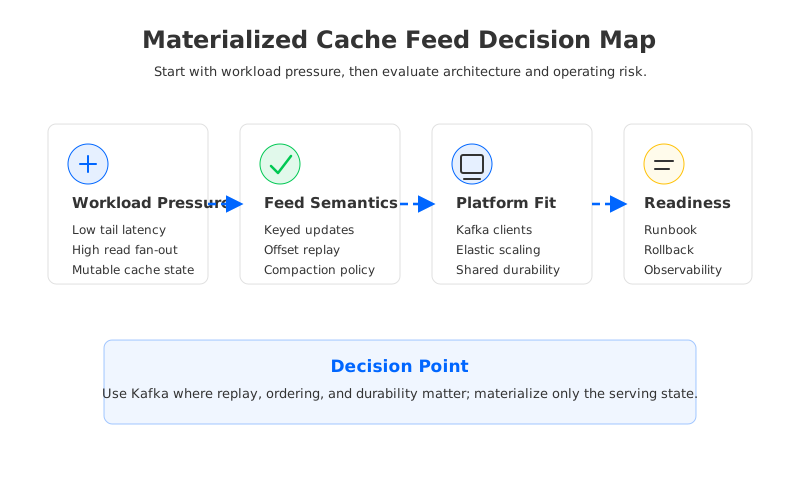
Low-latency applications often start with a simple cache and end with a distributed state problem. A product page wants fresh inventory, a risk engine wants the latest account limits, and a personalization service wants updated user features before the next request arrives. The harder question sits upstream: how does that cache receive ordered, replayable updates without turning every application team into a mini data platform team?
That is why engineers search for materialized cache feed kafka. The search phrase is awkward, but the intent is precise. Teams are not asking whether Kafka can move events. They are asking whether a Kafka-compatible stream can become the dependable feed that keeps low-latency serving state current, rebuildable, and auditable while still fitting cloud cost and operations constraints.
The answer is usually yes, but not by treating Kafka as a magic cache. Kafka is the durable change log, not the serving index. The cache is the materialized view, optimized for request-time reads. The feed between them is the contract that determines whether the cache can be rebuilt, rolled back, validated, and scaled.
1Why Teams Search for materialized cache feed kafka
The cache-feed pattern appears when a database query is too slow, too expensive, or too coupled to serve every request directly. Instead of asking the online application to join several systems at request time, the platform publishes changes into a stream and lets each serving tier materialize the subset it needs. Kafka is attractive because it already gives teams a familiar model for ordered records, consumer groups, offsets, replay, retention, and stream processing.
The hard part is that a materialized cache feed has a different failure profile from an analytics pipeline. If a batch job runs late, the dashboard is stale. If a cache feed runs late, the user-facing application may make a wrong decision. A fraud rule may evaluate against old limits. A pricing service may show inconsistent discounts. An operational dashboard may hide an active incident because the cache looks healthy while the feed is actually lagging.
That difference changes the architecture review. The team asks whether the feed can preserve update order per key, whether consumers can resume from known offsets, whether replay can rebuild the cache without overwhelming downstream systems, and whether the platform can explain which state version was visible during an incident.
A useful mental model is to separate three responsibilities:
- System of record: The authoritative database or service that owns the business entity. It may emit change events directly, through CDC, or through an application outbox.
- Durable feed: The Kafka-compatible log that stores ordered updates and lets consumers replay from offsets. This is the recovery and governance layer.
- Serving materialization: The cache, embedded store, search index, or key-value table that is optimized for request-time lookup rather than long-term history.
Confusing these layers creates brittle systems. If the cache becomes the sole recoverable state, a cache loss becomes a data loss event. If the feed does not carry enough information to rebuild deterministically, replay becomes an unreliable repair. If the source system has no stable event contract, the stream becomes a collection of accidental side effects.
2The Production Constraint Behind the Problem
The production constraint is not raw latency in isolation. It is freshness under change. A cache feed must keep p99 request latency low while writes, schema changes, deployments, node failures, consumer restarts, and traffic spikes continue around it.
Kafka helps because it makes the feed explicit. A consumer can fall behind and catch up. A stream processor can compute derived state. A team can inspect offsets and lag. A compacted topic can retain the latest value per key for rebuild scenarios.
| Design area | Question that matters | Common failure mode |
|---|---|---|
| Event shape | Can one record update one cache key deterministically? | Consumers need hidden database lookups during rebuild. |
| Ordering | Is ordering scoped to the entity that the cache reads by? | Cross-partition updates produce inconsistent cache state. |
| Compaction | Is the latest value per key enough, or is history required? | Rebuild succeeds but audit and debugging become impossible. |
| Backfill | Can the cache rebuild from the feed without hurting production traffic? | Recovery competes with live serving traffic. |
| Ownership | Who owns schema, compatibility, and rollback? | Application teams change events faster than consumers can adapt. |
The table prevents a common trap. Many teams design for the happy path where live events flow into an already warm cache. Real incidents happen on the cold path: a region failover, a bad deployment, a corrupted materialization, or a replacement cache cluster that must rebuild from scratch. If the feed cannot support that path, low latency becomes a false comfort.
Design the feed as if the cache will be deleted at the worst possible time. The system should still know where to start, how fast to replay, how to validate the rebuilt state, and how to switch traffic back without guessing.
3Architecture Options and Trade-Offs
There are several ways to implement a materialized cache feed. A direct application publisher fits services that can emit domain events as part of the write path. CDC is useful when the database is the sole practical source of change truth. Stream processing is appropriate when the cache state is derived from joins, windows, or aggregations.
The serving side has similar choices. Redis or another remote cache works when many stateless application instances need shared lookup state. An embedded store can remove a network hop when each application instance can own a shard of state. A search index fits query-heavy access patterns.
The Kafka platform underneath the feed still matters. Traditional Kafka couples broker compute with local log storage. That design is proven and familiar, but cloud operations expose a cost: scaling, recovery, and rebalancing often involve moving data between brokers and disks. A cache-feed workload can amplify that cost because it mixes steady writes, many read consumers, replay traffic, and bursty rebuilds.
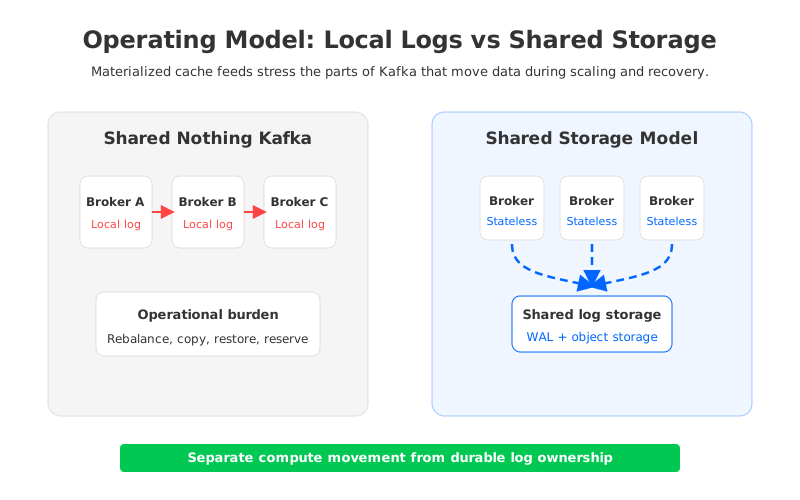
For a small feed, local storage movement may be acceptable. For a platform that supports dozens of application teams, the operational model becomes visible. Rebuilding a cache should not require overprovisioning brokers for rare catch-up reads. Adding compute for more consumers should not imply a long partition reassignment window.
This is where cloud-native Kafka-compatible infrastructure becomes relevant. A platform team should compare options against the operational properties the cache feed actually needs:
- Compatibility: Existing Kafka clients, serializers, ACLs, offset management, and stream processing integrations should keep working with minimal change.
- Elasticity: Compute should scale for live traffic and catch-up traffic without turning every scale event into a storage migration.
- Durability: The feed must survive broker, node, zone, and deployment failures according to the application's recovery objectives.
- Cost visibility: Storage, inter-zone traffic, private connectivity, and replay traffic should be visible before the workload grows.
- Governance: Schema evolution, access control, audit trails, and data retention should be controlled at the feed level, not hidden in cache code.
- Migration safety: A team should be able to dual-run, compare lag, validate state, and roll back without losing offset history.
The most expensive design is not always the one with the largest cluster. It is the one where every incident requires custom judgment. A materialized cache feed deserves repeatable runbooks because it sits between durable business facts and low-latency user experience.
4Evaluation Checklist for Platform Teams
A cache-feed architecture review should start with the data contract, not the technology logo. The platform may be Kafka, a managed Kafka-compatible service, or a cloud-native implementation, but the feed has to answer the same production questions. If the event contract is weak, a better broker will not fix it.
Use this checklist before putting a feed on a critical request path.
| Readiness area | What to verify |
|---|---|
| Key model | Each cache entry maps to stable event keys. |
| Replay path | A new cache can rebuild from a known offset or snapshot. |
| Freshness SLO | Lag and event age are measured as user-facing risk. |
| Schema control | Producers and consumers have compatibility rules. |
| Failure handling | Poison records, retries, and dead-letter paths are explicit. |
| Cost model | Live reads, catch-up reads, storage, and network traffic are estimated separately. |
| Security | Cache feeds enforce least privilege and encryption boundaries. |
| Migration | Cutover and rollback protect offsets and cache state. |
The checklist is intentionally concrete. "Kafka handles replay" is not enough. Replay from what offset? At what throughput? Into which cache cluster? Who decides whether the rebuilt cache is correct? These questions separate a designed recovery path from a late-night reconstruction effort.
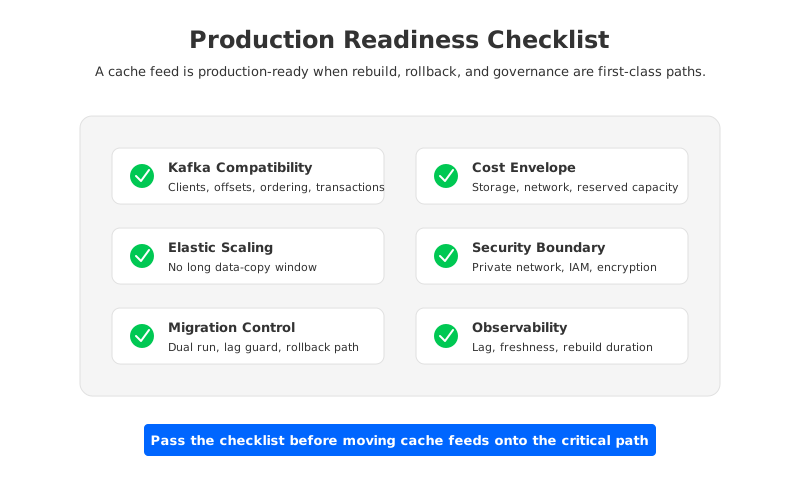
The same checklist also prevents overengineering. Some feeds do not need exactly-once processing, multi-region active-active serving, or complex stream joins. A product catalog cache may tolerate minute-level freshness. A payment risk cache may require stricter guarantees. The point is to make the tier explicit before the feed becomes invisible infrastructure.
5How AutoMQ Changes the Operating Model
Once the evaluation reaches platform operations, the architecture underneath Kafka-compatible APIs becomes important. If brokers own both compute and durable local log storage, adding more brokers does not fully solve the cache-feed problem. It may increase throughput, but it can also increase the amount of data that must be copied, balanced, and protected during scaling and recovery.
AutoMQ approaches this category as a Kafka-compatible, cloud-native streaming platform built around Shared Storage architecture. Brokers are stateless from an operational perspective, while durable stream data is backed by cloud storage through AutoMQ's storage layer. For cache-feed workloads, the question shifts from "how much broker-local data will move when the cluster changes?" to "how do we scale compute while keeping durable log ownership stable?"
That distinction matters during cold paths. A cache rebuild can create heavy catch-up reads. A traffic spike can require more broker capacity. A failed node should not force the platform team to wait on large broker-local data movement before the feed becomes healthy again.
AutoMQ also keeps the Kafka API surface in the discussion. Cache feeds often sit across application, data, and platform teams, so a migration that requires every producer and consumer to adopt another protocol turns an infrastructure improvement into an application rewrite.
For cloud cost, the relevant mechanism is separation. When compute and storage scale independently, platform teams can reason about steady ingest, retention, replay, and burst capacity as different cost drivers. AutoMQ documentation also describes approaches for reducing inter-zone traffic in cloud deployments, which matters because cache-feed workloads can produce read amplification through fan-out consumers and rebuild jobs.
There is still no shortcut around application design. AutoMQ can improve the infrastructure layer, but it cannot make an ambiguous event contract deterministic or decide whether compaction is sufficient for audit. The right use of a platform like AutoMQ is to remove avoidable infrastructure friction after the team has defined the feed semantics clearly.
6Migration and Rollout Pattern
The safest rollout is incremental. Define the event contract and produce it alongside the existing path. Let a shadow consumer build the cache without serving production traffic. Compare cache values against the current source of truth, measure lag, and record rebuild duration before shifting reads.
Rollback should be a first-class operation. If the feed produces incorrect state, the team needs a clean path back to the old serving mode. If the platform migration changes the Kafka-compatible backend, producers and consumers should be dual-run or shifted in controlled groups.
A practical rollout sequence looks like this:
- Define the cache key, value schema, tombstone behavior, and freshness target.
- Publish the feed while the old cache path continues to serve traffic.
- Build a shadow materialization and compare it with source-of-truth reads.
- Run a timed rebuild from a known offset or snapshot.
- Shift a small read cohort and monitor lag, event age, error rate, and business correctness.
- Expand traffic after rollback has been tested, not merely documented.
This sequence may feel slower than wiring a topic to a cache client. It is faster than discovering during an outage that the cache cannot be rebuilt, the feed cannot be replayed safely, and no team can explain which state was served.
If materialized cache feeds are becoming shared infrastructure rather than a one-off application optimization, review the architecture with the same rigor you would apply to any production data plane. AutoMQ's Kafka-compatible Shared Storage architecture is one option to evaluate when scaling, rebuild speed, and cloud operating cost are part of that review: explore AutoMQ.
7References
- Apache Kafka Documentation for consumers, offsets, compaction, transactions, and configuration.
- Kafka Streams Interactive Queries for state stores and queryable materialized views.
- AutoMQ Architecture Overview for Shared Storage architecture.
- AutoMQ Compatibility with Apache Kafka for Kafka protocol compatibility.
- AutoMQ Inter-Zone Traffic Overview for cloud deployment considerations.
- AutoMQ Migration from Apache Kafka for migration planning.
- AWS PrivateLink Documentation for private connectivity design.
- Amazon S3 Pricing for current object storage pricing dimensions.
8FAQ
8.1Is Kafka itself the materialized cache?
Usually no. Kafka is the durable feed and recovery log. The materialized cache is the serving state built from that feed, such as Redis, an embedded state store, or a search index. Keeping that separation clear makes rebuild and rollback easier to reason about.
8.2Should a materialized cache feed use a compacted topic?
A compacted topic is useful when the latest value per key is enough to rebuild serving state. Some workloads also need time-based history for audit, debugging, or temporal reconstruction. The decision should follow the business requirement, not a generic rule.
8.3How should teams measure freshness?
Consumer lag is only one signal. Measure event age, processing delay, cache update time, and user-visible correctness. A consumer may have low offset lag while still serving stale state.
8.4Where does AutoMQ fit in this architecture?
AutoMQ fits at the Kafka-compatible streaming infrastructure layer. It is relevant when the team wants Kafka protocol compatibility while changing the cloud operating model through Shared Storage architecture, stateless brokers, and independent compute and storage scaling.
8.5What is the first step before adopting this pattern?
Define the feed contract. Identify the cache key, event schema, ordering scope, tombstone behavior, replay source, freshness target, and rollback path.


