
Table of Contents
Table of Contents
An MCP server looks harmless when it is wired to a single internal tool. It receives a request from an AI application, exposes a resource or action through the Model Context Protocol, and returns a response. The pressure starts when that server becomes part of a production workflow: tool calls affect tickets, orders, alerts, customer records, code review queues, or data access decisions. At that point, the event trail around the MCP server becomes part of the control plane for AI behavior.
That is why teams search for mcp server event pipeline kafka. They are not looking for another queue diagram. They are asking how to keep AI context fresh enough for useful automation while making every prompt, tool decision, policy check, and downstream side effect durable, replayable, and governable. A batch audit table can explain what happened after the fact. It cannot always help an agent choose correctly while the workflow is still alive.
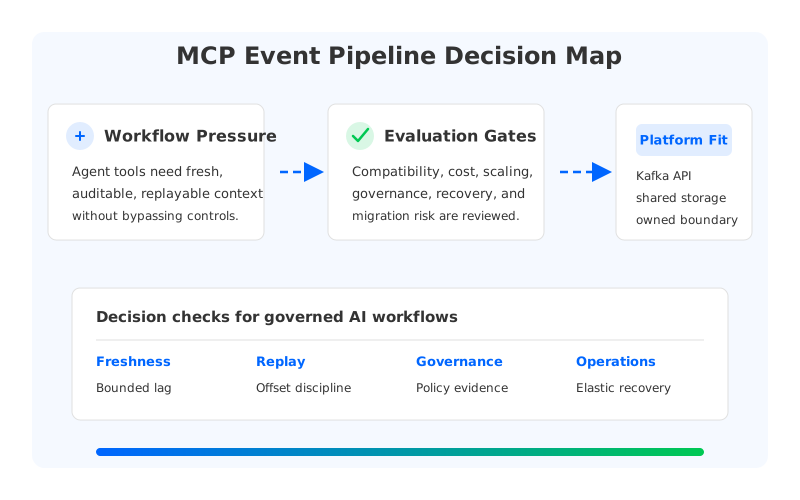
The event pipeline behind an MCP server has a different shape from a classic web application log stream. It carries user intent, retrieved context, tool metadata, policy decisions, model outputs, approval state, and outcome signals. Treating all of them as disposable logs is how AI workflows become fast but unaccountable.
1Why Teams Search for mcp server event pipeline kafka
The Model Context Protocol gives AI applications a structured way to connect to external systems through servers that expose capabilities such as tools, resources, and prompts. That interface is useful precisely because it standardizes the boundary between the model-facing application and the enterprise systems behind it. The boundary also becomes a governance point. If an agent can read a sensitive resource or call a tool that changes state, the platform needs an event record that survives process restarts, server redeployments, and downstream outages.
Kafka enters the discussion because the operating requirement is not "send one callback." It is durable fan-out. Security wants policy events, data teams want context streams, SREs want lag and failure traces, and application teams want replay from a known point after a bug fix. A Kafka-compatible event pipeline gives these teams a shared backbone without coupling every MCP server directly to every downstream system.
The catch is that AI workflows amplify the parts of streaming platforms that are easiest to ignore during a prototype:
- Freshness pressure. Tool outputs and retrieved context can become stale while an agent is still deciding what to do. The pipeline needs bounded lag, not overnight reconciliation.
- Replay pressure. Teams must reconstruct why a model selected a tool, which resource version it saw, and which approval or policy result was applied.
- Governance pressure. The same event may need to serve product analytics, security audit, incident response, and model evaluation, each with a different access pattern.
- Cost pressure. AI context streams can grow through fan-out, retries, enriched metadata, and long retention. The cloud bill follows the data movement, not the original architecture sketch.
These pressures explain why a general-purpose queue is rarely enough. The platform needs durable ordering, offsets, consumer isolation, backpressure visibility, and a migration path that does not force a client rewrite at production scale.
2The Freshness and Governance Problem Behind AI Event Streams
Governed AI workflows are caught between two failure modes. If the platform optimizes only for freshness, the AI system can act on current context but leave weak evidence behind. If the platform optimizes only for audit, the evidence may be complete but too late to influence the active workflow. Production systems need both: a low-latency path for current decisions and a durable path for later reconstruction.
The hard part is that MCP server events are not all equal. A tool invocation may need strict correlation with the prompt, resource snapshot, approval result, and downstream response. A retrieval event may be useful for model quality analysis but less important for command rollback. Once these categories share a streaming backbone, topic design, headers, schemas, retention, and access control become governance decisions rather than convenience settings.
Kafka's consumer group and offset model is useful here because it lets different teams consume the same event stream at their own pace. A security consumer can preserve an audit trail, a feature pipeline can build online context, and an observability consumer can track workflow health. The platform still has to design the contract carefully. If events do not carry stable correlation IDs, policy version references, and resource version metadata, replay becomes guesswork with a durable transport underneath.
This is where many architectures drift. Teams start with an MCP server writing logs, then add a connector, an audit table, and a side channel for model evaluation. Each addition is reasonable in isolation. The combined result is a governance surface that no team fully owns. A governed event pipeline should make ownership boring: producers define event contracts, platform teams operate the streaming backbone, and consumers prove their read and replay behavior.
3Architecture Options for Durable, Replayable AI Context
There are three common ways to move MCP server events into a production data plane. The first is direct service-to-service delivery, where the MCP server calls every downstream system that needs a copy. This keeps the first version small, but it turns every downstream outage into application logic and every additional consumer into a producer change. The second is a database-first design, where events are written to an operational store and extracted later. That can work for audit, but freshness and fan-out tend to suffer.
The third option is an event backbone: MCP servers publish structured events into Kafka-compatible topics, and downstream systems consume through independent groups. This option moves governance work to contracts, topic policy, schema evolution, retention, and consumer readiness. For teams that already use Kafka clients, Kafka Connect, stream processors, or lakehouse sinks, compatibility is often more important than the broker implementation itself.
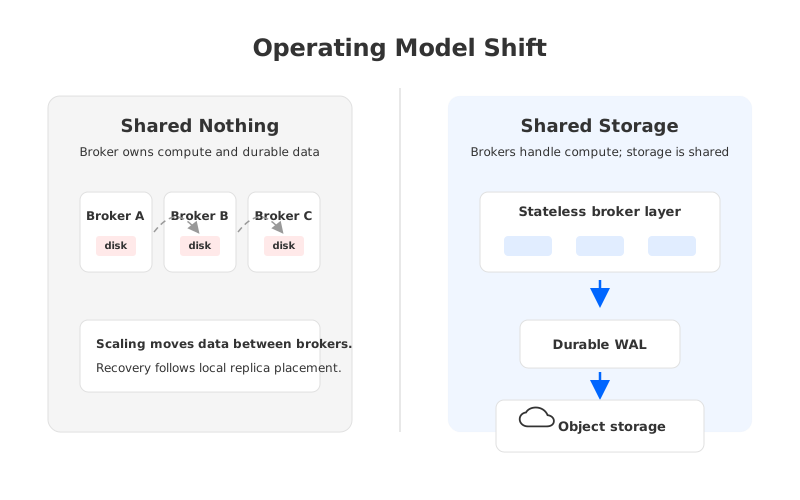
Traditional Kafka deployments are usually built around a Shared Nothing architecture. Each broker owns local storage for the partitions assigned to it, and durability comes from replication across brokers. That model is mature and widely understood, but it couples scaling and recovery to broker-local data placement. When AI event streams grow, the platform may need more capacity, retention, replay throughput, or consumer fan-out. In a broker-local design, those needs can translate into reassignment, replica movement, disk planning, and cross-zone data movement.
Tiered Storage can help by moving older log segments to remote storage, but it does not make the active broker layer stateless. The hot write path and recent data still depend on broker-local ownership. That distinction matters for MCP pipelines because fresh context and replayable evidence live in the same system. If the platform reserves broker disk and network capacity for worst-case replays, backfills, and retention growth, the AI workflow inherits an infrastructure planning problem unrelated to prompt quality.
4Evaluation Checklist for Platform Teams
Before selecting infrastructure, write down evaluation criteria that application, security, and operations teams can all review. A comparison that starts with throughput claims will miss the real risk: whether the platform preserves MCP workflow semantics when traffic spikes, consumers fall behind, credentials rotate, or a bad event contract reaches production.
| Evaluation area | What to verify | Why it matters for MCP server events |
|---|---|---|
| Compatibility | Kafka clients, Admin APIs, consumer groups, transactions where used, Connect behavior, ACLs, schemas, and monitoring tools | AI platforms rarely get a clean rewrite window; existing ecosystem components need a testable path. |
| Freshness | End-to-end lag under normal traffic, burst traffic, and consumer recovery | Stale context can cause bad actions even when every component is technically available. |
| Replay | Offset handling, retention, compaction strategy, correlation IDs, and event versioning | Audit and model evaluation depend on reconstructing the decision path, not merely storing bytes. |
| Cost | Compute, storage, cross-zone traffic, endpoint traffic, idle capacity, and replay reads | AI event fan-out can make hidden data movement larger than the original write path. |
| Governance | Network boundary, IAM, encryption, audit evidence, policy events, and tenant separation | The pipeline often carries sensitive resource references and tool side effects. |
| Migration | Dual-write or linking strategy, consumer cutover, rollback plan, and validation queries | A pipeline that cannot be migrated safely becomes another production constraint. |
The checklist also prevents a common mistake: treating Kafka compatibility as a yes-or-no label. Compatibility has to be tested against the features you use: consumer groups, offset commits, producer idempotence, transactions, ACLs, Connect connectors, schema tooling, and monitoring exporters. The right question is whether your MCP event contracts and consumers behave the same way during cutover and rollback.
Cost deserves the same discipline. Cloud pricing pages separate compute, storage, networking, endpoint, and API request costs, but a streaming architecture combines them through data movement. A topic that looks small at ingest can become large after enrichment, fan-out, replay, and long retention. Model the traffic paths before the governance review, not after.
5How AutoMQ Changes the Operating Model
Once the evaluation framework is explicit, the architectural question becomes narrower: can the platform keep Kafka-facing compatibility while reducing the broker-local storage burden that makes scaling and recovery heavy? AutoMQ fits into that category as a Kafka-compatible, cloud-native streaming platform built around Shared Storage architecture. It keeps Kafka protocol compatibility while moving durable stream storage behind stateless brokers through WAL storage and object storage.
The difference is operational rather than cosmetic. In a Shared Storage design, brokers are no longer the long-term containers for durable data. They process Kafka protocol requests, route traffic, cache hot data, and coordinate ownership, while the storage layer provides the persistence boundary. For an MCP server event pipeline, scaling compute is less entangled with moving primary data between broker disks.
AutoMQ's WAL layer is important because object storage alone is not a latency plan. Incoming records are first protected through a write-ahead path, then stream data is written to object storage. That separation lets the platform use object storage for durability and elastic capacity without pretending every workload has the same latency profile. Teams still need to test write latency, consumer lag, and replay behavior, but the architecture gives them a different cost and operations envelope to evaluate.
The deployment boundary matters for governed AI as much as the storage model. In customer-controlled deployment models such as AutoMQ BYOC and AutoMQ Software, teams can evaluate a Kafka-compatible event backbone while keeping runtime resources within their own cloud account, VPC, or private environment. That boundary is relevant when MCP events include resource identifiers, user intent, authorization decisions, or operational evidence.
AutoMQ should still go through the same checklist as any other platform. Test client behavior, connector paths, offsets before and after migration, consumer recovery under active producers, and cost under your retention, read fan-out, and replay assumptions. The point is not to skip due diligence because the architecture is different. The point is that Shared Storage and stateless brokers give platform teams another way to satisfy the same production criteria.
6Migration and Readiness Scorecard
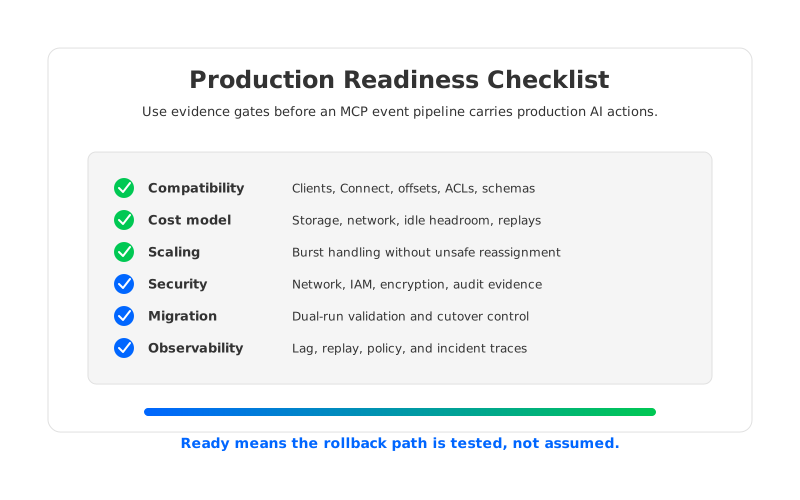
An MCP event pipeline is ready when the rollback path is documented and tested. That sounds strict until the first bad tool event reaches production. If consumers cannot distinguish an old event schema from a current one, replay will reintroduce the bug. If offsets cannot be compared between source and target, cutover confidence becomes a meeting opinion.
Use a scorecard that forces evidence into the review:
- Green means the team has tested the behavior under live-like traffic and has artifacts to prove it.
- Yellow means the design is plausible but the proof is incomplete, so production exposure should be limited.
- Red means the workflow depends on an assumption that has not survived a drill.
The first production slice should be narrow enough to observe but meaningful enough to fail honestly. A useful pilot is one MCP server, a small set of tools, a few event types with stable schemas, and two or three independent consumers. Include one consumer that cares about freshness, one that cares about audit, and one that cares about analytics or model evaluation.
If your team is building MCP server event pipelines for governed AI workflows, start with the scorecard before picking infrastructure. Then test a Kafka-compatible backbone against your event contracts, retention requirements, consumer behavior, and security boundary. To evaluate the Shared Storage operating model in that context, start from the AutoMQ Cloud entry point and run the checklist against a representative workflow.
7References
- Model Context Protocol specification
- Apache Kafka documentation
- Apache Kafka Connect documentation
- Apache Kafka producer configuration
- Apache Kafka consumer configuration
- AWS PrivateLink documentation
- Amazon S3 pricing
- AutoMQ compatibility with Apache Kafka
- AutoMQ WAL storage
8FAQ
8.1Does every MCP server need Kafka?
No. A small internal MCP server with low risk and a single downstream system may be fine with direct writes or a simpler queue. Kafka becomes more relevant when events need durable fan-out, independent consumers, replay, offset control, and ecosystem integration across security, analytics, observability, and AI platform teams.
8.2What events should an MCP server publish?
Start with the events needed to reconstruct a decision: request identity, prompt or task reference, resource identifiers, tool selection, policy result, model output reference, downstream action, response status, and correlation IDs. Avoid publishing sensitive payloads by default. Store references and governed metadata when full payload retention would create avoidable privacy or compliance risk.
8.3Is Kafka compatibility enough for a governed AI workflow?
Kafka compatibility is necessary when the organization depends on Kafka clients and tooling, but it is not sufficient. The platform must also pass governance, cost, replay, migration, observability, and rollback checks. Compatibility tells you whether the ecosystem path is viable; readiness tells you whether the workflow can survive production incidents.
8.4How should teams handle schema evolution for MCP events?
Treat MCP event schemas as product contracts. Add fields in a backward-compatible way, version policy-sensitive fields, keep correlation IDs stable, and test consumers against current and prior schema versions. A schema registry or equivalent validation process helps, but rollout and rollback discipline matters more than the tool name.
8.5Where does AutoMQ fit in the architecture?
AutoMQ fits when a team wants Kafka-compatible APIs with a Shared Storage operating model, stateless brokers, object-storage-backed durability, and customer-controlled deployment boundaries. It should be evaluated with the same scorecard as any production streaming platform: client behavior, offsets, connectors, security controls, cost paths, recovery, and migration evidence.


