
Table of Contents
Table of Contents
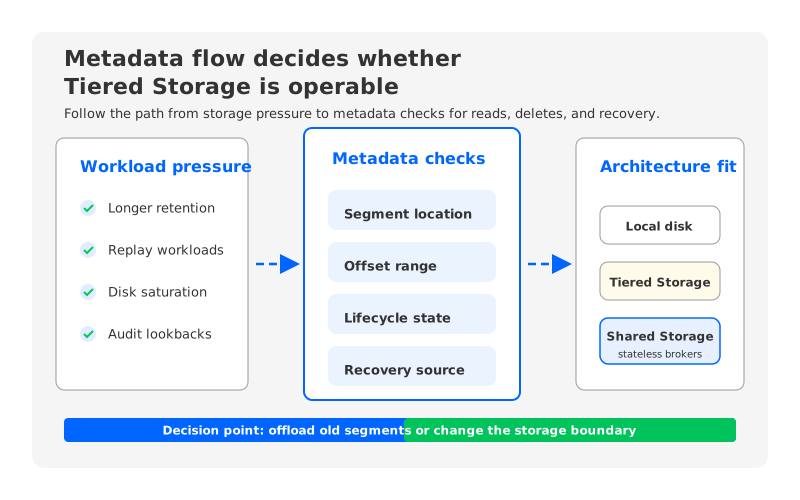
Kafka operators usually meet Tiered Storage through a capacity problem. Retention is getting longer, disks are filling faster, and adding brokers only to hold old segments feels wasteful. The search for tiered storage metadata flow kafka starts when the team realizes that offloading bytes is not the whole design; the hard part is knowing which broker owns which segment, where that segment lives, and what happens when metadata is stale during failure or reassignment.
That distinction matters because Tiered Storage changes the storage path without removing Kafka's core operating model. It can reduce pressure on local disks and make longer retention practical, but it also adds a metadata plane that must stay consistent with the local log, the remote object store, the controller, and the consumers that may request old offsets at any time. Operators who treat it as a storage checkbox miss the part that decides whether recovery, deletion, scaling, and audits remain predictable.
1Why metadata flow becomes the real design question
Traditional Kafka is straightforward to reason about at the broker boundary. A partition replica lives on a broker's local disk, the leader appends records to a local log segment, followers replicate from the leader, and the controller tracks replica placement. When a consumer fetches an offset, the serving broker looks at its local log and returns the data if the offset is available. The model is operationally heavy, but the metadata path and data path largely point to the same place: the broker that owns the replica.
Tiered Storage splits that mental model. Recent data stays in local storage so tailing reads can remain close to the hot write path, while older segments are copied to remote storage. A read for an older offset turns into a metadata lookup: identify the remote segment, resolve the object location, verify the range, fetch or cache the bytes, and return records in Kafka protocol shape.
The operational question is no longer "Did we move old data to object storage?" It becomes "Can every component agree on the lifecycle of each segment?" A production design has to answer at least five questions:
- Who publishes remote segment metadata? The write path must record enough information for future reads, deletes, and recovery to locate each offloaded segment.
- Where is that metadata stored and replicated? Metadata that lives only beside the broker-local log can become fragile during broker replacement or reassignment.
- How do readers handle misses and stale entries? Historical fetches should degrade predictably instead of turning cold reads into incident triggers.
- When is a remote segment safe to delete? Retention, compaction, and legal hold requirements all depend on lifecycle metadata being correct.
- How is metadata audited? Operators need a way to reconcile local state, controller state, and object-store contents when the system has been running for years.
These questions do not make Tiered Storage a bad idea. They make it an architecture choice rather than a disk setting. A team that understands the metadata flow can use Tiered Storage deliberately; a team that ignores it may trade one capacity bottleneck for a different operational boundary.
2Local disk, Tiered Storage, and Shared Storage are different operating models
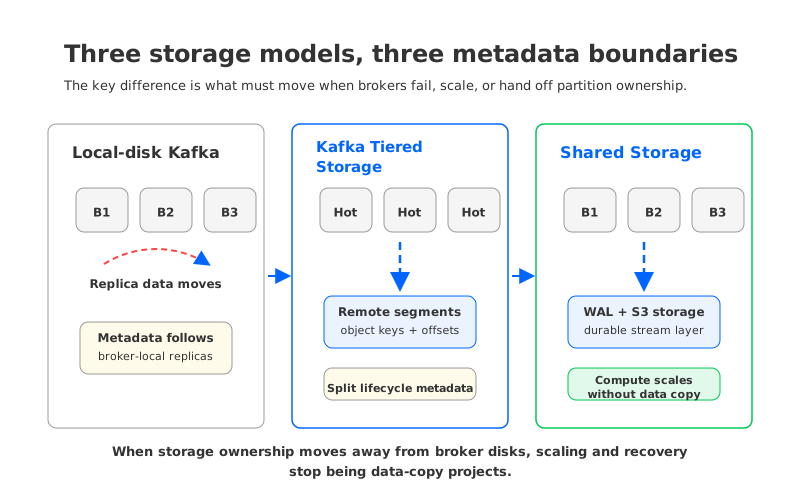
The clearest way to compare Kafka storage architectures is to ask what must move when capacity, traffic, or ownership changes. In a Shared Nothing architecture, brokers own persistent local data. Scaling out adds compute capacity, but it also creates a data placement problem because partitions must be reassigned and replicas must be copied. Tiered Storage reduces long-retention data on those disks, yet the broker still remains the unit of ownership for active replicas and local recovery.
Shared Storage architecture changes the boundary more aggressively. Instead of using object storage as an archive for old segments, the streaming storage layer is built around shared object storage from the beginning. Brokers become compute nodes that handle the Kafka protocol, coordination, caching, and serving path, while durable data is no longer bound to broker-local disks. The metadata flow is still important, but it describes shared storage objects rather than an offload side path attached to local replicas.
| Question | Local-disk Kafka | Kafka Tiered Storage | Shared Storage architecture |
|---|---|---|---|
| Primary durability boundary | Broker-local replicas | Local replicas plus remote segments | Shared object storage plus WAL |
| Scaling friction | Data movement during reassignment | Less historical data on disk, but active data still tied to brokers | Compute can scale without moving partition data |
| Cold read path | Local broker disk if retained | Broker resolves remote segment metadata and fetches from object storage | Broker reads shared objects through the storage layer |
| Failure recovery | Replica catch-up and leader election | Replica recovery plus remote metadata correctness | Replace broker and recover ownership from shared storage metadata |
| Main operator risk | Disk pressure and rebalance load | Metadata consistency across local and remote lifecycle | Storage-layer configuration, cache behavior, and object-store access |
This table is not a ranking. Tiered Storage is a practical bridge for teams that want longer retention without redesigning the entire platform. Shared Storage is a stronger architectural shift for teams that want compute elasticity, lower data movement, and a cleaner failure boundary.
3The write path: metadata must be created before it is needed
The write path in Tiered Storage carries a future obligation. As records accumulate into log segments, the broker eventually rolls a segment and copies it to remote storage. That upload is only useful if the system also persists metadata that describes the segment's topic, partition, offset range, epoch, object key, size, and lifecycle state. A future consumer reading an old offset will rely on that metadata long after the local segment may have been deleted.
This is where many operational surprises start. Upload success, metadata commit, and local deletion are separate events. If the broker uploads an object but fails before publishing metadata, the object may exist but be invisible to readers. If local deletion runs ahead of metadata reconciliation, recovery becomes harder because the local fallback disappeared before the remote path was trustworthy.
The safer mental model is to treat remote segment metadata as part of the commit protocol for storage lifecycle. Operators should look for explicit answers to three design checks:
- Atomicity boundary: What does the system consider committed: the object upload, the metadata record, or both together?
- Retry behavior: Can repeated uploads create duplicate objects, conflicting segment metadata, or orphaned data that retention cannot see?
- Reconciliation path: Is there a supported way to compare metadata records with object-store contents and repair drift?
These checks sound mundane, but they decide how the system behaves at 2 a.m. after a broker restart, a controller failover, or an object-store access policy change. Metadata flow is not only about where a pointer is stored; it is about whether lifecycle transitions are observable, replayable, and reversible.
4The read path: cold fetches expose metadata quality
Cold reads are where Tiered Storage becomes visible to applications. A consumer that has fallen behind, a replay job, or an audit pipeline may request offsets that are no longer local. The serving broker has to resolve the offset to a remote segment, fetch the relevant range, possibly cache it, and continue returning records through the normal Kafka fetch response. If the metadata is correct and the cache is warm enough, the application sees higher latency but not a different API.
That "same API, different path" property is valuable, but it can hide risk during testing. A happy-path replay over a small topic proves that old records can be fetched. It does not prove that the platform can handle uneven replay jobs, object-store throttling, compaction edge cases, and retention deletes running at the same time.
For production readiness, test cold reads with the same suspicion you apply to leader election:
- Start consumers from offsets that span local and remote segments, then verify ordering, lag behavior, and retry patterns.
- Run replay traffic while producers continue writing, so the broker has to serve hot and cold paths together.
- Trigger retention while cold reads are active, and confirm that segments are deleted only after they are no longer addressable.
- Replace or restart brokers during replay, then check whether readers resume without manual metadata repair.
The result should be a latency envelope and an operational runbook, not a binary pass or fail. Tiered Storage usually makes old data more cost-effective to keep, but historical reads still consume broker resources, object-store requests, network bandwidth, and cache capacity.
5The evaluation checklist operators should use
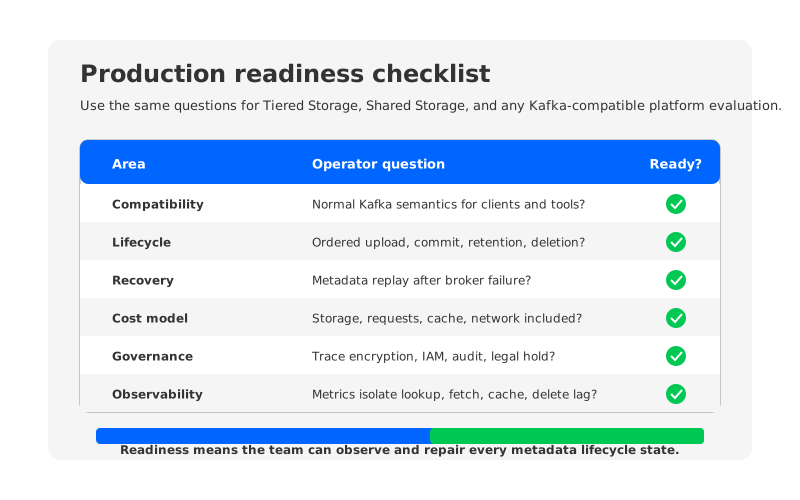
A good Tiered Storage evaluation separates feature availability from operating confidence. Feature availability asks whether a Kafka distribution supports remote log storage. Operating confidence asks whether your team can explain the metadata lifecycle well enough to debug it.
Use this checklist before moving a regulated, high-retention, or replay-heavy workload:
| Area | What to verify | Why it matters |
|---|---|---|
| Compatibility | Kafka client behavior, fetch semantics, offset handling, and tooling expectations | Applications should not need special cold-read logic |
| Metadata durability | Where remote segment metadata is stored, replicated, backed up, and replayed | Metadata loss can make durable objects operationally unreachable |
| Lifecycle ordering | Upload, metadata commit, local deletion, remote deletion, and compaction sequence | Incorrect ordering creates orphaned objects or missing reads |
| Failure recovery | Broker restart, leader change, controller failover, and object-store timeout behavior | Recovery paths expose hidden assumptions in the metadata design |
| Cost model | Storage, requests, cache, cross-zone traffic, and replay network usage | Remote storage reduces one cost line while adding others |
| Governance | Encryption, IAM boundaries, audit logs, retention policies, and legal holds | Long-retention data often has stricter compliance requirements |
| Observability | Metrics for offload lag, remote fetch latency, cache hit ratio, and delete backlog | Operators need leading indicators before users report slow replays |
This is where procurement and architecture conversations should meet. A platform can look cost-effective on storage alone and still be expensive to operate if every scaling event requires careful rebalance planning.
6How AutoMQ changes the operating model
Once the evaluation reaches the root issue, the next question is whether Tiered Storage is enough or whether the platform needs a different storage boundary. AutoMQ is a Kafka-compatible streaming platform built around Shared Storage architecture: it preserves Kafka protocol compatibility while moving durable stream storage to S3-compatible object storage and making brokers stateless.
That design changes the metadata flow from "local log first, remote tier second" to "shared streaming storage as the durability layer." AutoMQ's S3Stream storage layer uses object storage for durable stream data and a WAL for low-latency persistence, while brokers handle compute responsibilities without owning persistent local disks.
The practical effect is not that metadata disappears. It is that metadata describes a storage system designed for shared ownership from the start. Operators still need to understand object-store configuration, WAL storage choices, cache behavior, access control, and observability, but they no longer have to reason about a split lifecycle where old segments are offloaded while active replicas remain tied to broker disks.
For teams evaluating tiered storage metadata flow kafka, AutoMQ is worth considering when the requirement has moved beyond longer retention. If the real goal is to reduce rebalance load, simplify failure recovery, scale compute independently from storage, and keep Kafka-compatible clients, Shared Storage architecture addresses the operating model rather than only the archive tier.
7Migration and readiness guidance
The safest migration plan starts with workload classification. A topic with short retention and predictable throughput may not justify a storage architecture change. A topic with long retention, large replay jobs, bursty traffic, and strict recovery expectations deserves deeper analysis because metadata correctness becomes part of the user-facing reliability story.
Classify each workload by the behavior that stresses storage:
- Hot streaming topics need stable produce and tailing-read latency. The storage design should not add jitter to the critical path.
- Replay-heavy topics need predictable cold-read throughput, cache controls, and clear object-store request budgeting.
- Compliance-retention topics need retention, deletion, encryption, and audit behavior that can be explained to security teams.
- Burst-heavy topics need scaling paths that do not turn traffic spikes into partition reassignment projects.
After classification, run a proof of concept that tries to break the metadata assumptions. Include broker restarts, consumer replays, retention changes, and object-store permission tests. The goal is to learn which operational states your team can observe and repair.
This is where architecture diagrams should turn into runbooks. If a cold read slows down, which metric tells you whether the issue is metadata lookup, object-store latency, cache miss rate, or broker saturation? If a broker disappears during upload, can you tell whether the segment is committed, retrying, or orphaned? A storage architecture is production-ready when those questions have routine answers.
If metadata lifecycle, broker replacement, and storage economics are blocking decisions, test the architecture directly with the AutoMQ BYOC console.
8References
- Apache Kafka documentation: Tiered Storage
- Apache Kafka KIP-405: Kafka Tiered Storage
- Apache Kafka documentation: KRaft
- AutoMQ documentation: What Is AutoMQ
- AutoMQ documentation: Difference with Tiered Storage
- AutoMQ documentation: S3Stream shared streaming storage
- AWS documentation: Amazon S3 data consistency model
9FAQ
9.1Is Tiered Storage the same as Shared Storage architecture?
No. Tiered Storage keeps Kafka's broker-local storage model for active data and moves older segments to remote storage. Shared Storage architecture uses shared object storage as the main durability boundary, so brokers are not the long-term owners of persistent partition data.
9.2Why does metadata matter if the data is already in object storage?
Object storage can durably hold bytes, but Kafka clients read by topic, partition, and offset. The system needs metadata that maps those offsets to remote objects, tracks lifecycle state, and decides when data is safe to delete. Without that metadata, durable objects may still be hard to find or unsafe to serve.
9.3What should teams test before enabling Tiered Storage for production?
Test cold reads across local and remote segments, broker restarts during offload, retention changes during replay, object-store throttling, and observability for remote fetch latency and offload lag. A small happy-path replay is not enough for production confidence.
9.4When should a team consider AutoMQ instead of adding Tiered Storage to Kafka?
Consider AutoMQ when the main problem is broader than disk capacity: slow reassignment, broker-local recovery, compute and storage coupling, cross-AZ replication traffic, or the need to scale Kafka-compatible compute without moving partition data. In those cases, Shared Storage architecture addresses the operating model directly.


