
Table of Contents
Table of Contents
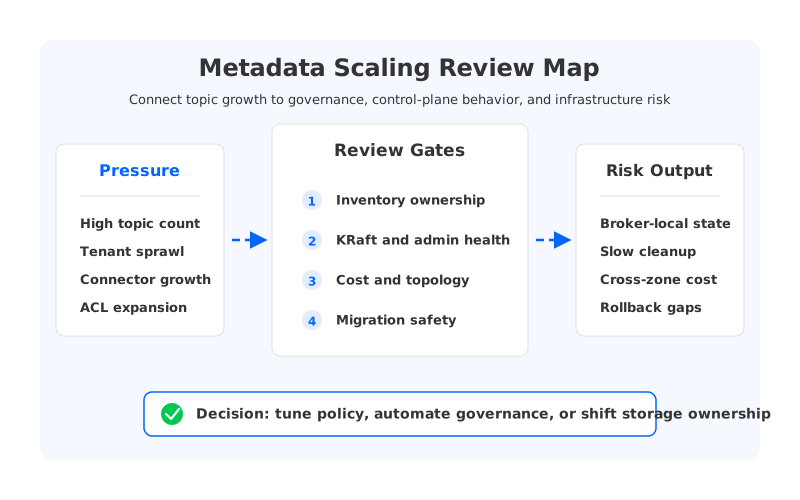
Teams rarely search for metadata scaling review kafka while everything is calm. The search usually starts after topic count has become a platform concern rather than an application detail. A few hundred topics turn into thousands. Tenant teams ask for self-service provisioning. Connect jobs multiply. Consumer groups appear and disappear with CI environments, data products, and backfills. The brokers still move records, but the platform discussion has shifted toward metadata, control-plane behavior, governance, and the operational work required to keep the estate understandable.
That shift matters because Kafka metadata is not decorative information around the data plane. Topic configurations, partition leadership, ISR state, client identities, ACLs, offsets, transactions, connectors, quotas, and retention policies all shape how the cluster behaves. A high-topic-count estate can have moderate throughput and still be hard to operate if the metadata surface grows faster than the team’s review process.
The mistake is to treat metadata scaling as only a controller or KRaft question. Apache Kafka’s KRaft mode removes the ZooKeeper dependency and puts metadata management inside Kafka’s own quorum. But a production review has to go wider than controller mechanics. It should ask how metadata growth affects broker storage, partition movement, cloud networking, governance controls, deployment boundaries, and migration risk.
1Why teams search for metadata scaling review kafka
High-topic-count Kafka estates often grow for good reasons. A platform team may separate topics by tenant, product domain, data classification, environment, or retention policy. Security teams may require different ACL scopes. Data engineering teams may want domain-owned streams instead of a small number of shared topics with overloaded schemas. These choices make ownership cleaner, but they also expand the number of objects that Kafka and the platform team must track.
The pain becomes visible in small operator interactions. Topic creation needs guardrails because one team’s partition default can become another team’s incident. ACL reviews become slow because permissions are spread across thousands of resources. Connector failures are harder to triage because source and sink jobs are bound to topic naming patterns. Consumer group lag dashboards become noisy because abandoned groups look similar to broken ones. Metadata is now part of the production workload.
The cluster may still pass a throughput benchmark. That is why metadata scaling reviews feel confusing. Brokers can have CPU headroom and healthy produce latency while the platform team is struggling with leadership churn, slow audits, topic sprawl, or risky rebalances. Kafka did not stop being Kafka. The estate has more things to reason about than the original operating model assumed.
2The production constraint behind the problem
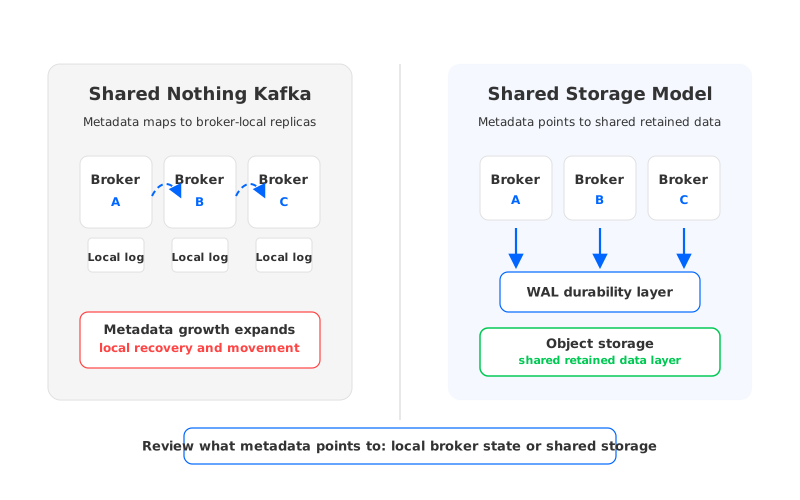
Traditional Kafka uses a Shared Nothing architecture. Brokers own local log data for their assigned partitions, and the cluster coordinates leaders, followers, offsets, and other metadata around that assignment. This design is mature and widely understood. It also couples metadata decisions to broker-local state. Adding topics and partitions is not merely adding names to a catalog; it expands the set of leaders, replicas, log segments, configs, and recovery paths that brokers must maintain.
KRaft improves the metadata plane by replacing ZooKeeper with a Kafka-native metadata quorum. That change reduces one major operational dependency, but it does not make every metadata scaling issue disappear. Partition count still affects broker work. Topic sprawl still affects governance. Consumer group and offset behavior still affects recovery and migration planning. Connector inventories still need ownership, secrets, versioning, and rollback discipline.
The storage layer amplifies the constraint. In a broker-local design, metadata decisions eventually point to physical data ownership. A topic with many partitions creates more log directories, more replica assignments, more local recovery work, and more movement when capacity changes. When that estate runs across Availability Zones, replication and client placement can also turn topology decisions into network cost. The metadata review must therefore connect the catalog view of Kafka to the physical operating model underneath it.
3Architecture options and trade-offs
A useful review starts by separating three layers that are often blended together in incident conversations. The first layer is Kafka protocol behavior: producers, consumers, offsets, transactions, consumer groups, admin APIs, Connect, and client compatibility. The second layer is metadata governance: who can create topics, which defaults apply, how naming and ownership work, and how teams audit access. The third layer is the infrastructure model: how brokers store data, how partitions move, and where cloud network traffic is generated.
Once those layers are separated, platform teams can compare architecture options without turning the discussion into a feature checklist.
| Option | What it helps | What still needs review |
|---|---|---|
| Tune the existing Kafka estate | Keeps current clients, runbooks, and operational habits intact | Topic sprawl, partition movement, broker-local data growth, and governance drift remain team responsibilities |
| Consolidate topic and tenant policy | Reduces unmanaged metadata growth and makes ownership clearer | Does not change the cost or recovery model underneath broker-local storage |
| Add automation around provisioning | Improves self-service, guardrails, and auditability | Bad defaults become fast defaults if review gates are weak |
| Move to shared storage architecture | Reduces broker-local data ownership and changes scaling mechanics | Requires compatibility validation, migration planning, and storage-layer observability |
The first three options are often necessary even when the team later changes architecture. A messy topic catalog does not become clean because the storage layer changes, and a missing ownership model does not appear because the cluster is easier to scale. Governance has to be designed.
Architecture still matters because it defines the cost of mistakes. In a broker-local Kafka estate, a topic policy mistake can create long-lived partition and storage obligations. A tenant that asks for too many partitions may create leadership and recovery overhead that follows the platform team for months. In a shared storage architecture, the same metadata mistake still needs cleanup, but brokers are less likely to carry the full retained data burden as local state.
4Evaluation checklist for platform teams
The strongest metadata scaling reviews look boring from the outside. They are not built around a single heroic benchmark. They are built around repeatable questions that every Kafka-compatible option must answer before the platform team expands topic count, adds tenants, or changes infrastructure.
Start with the estate inventory. Count topics and partitions, but do not stop there. Count owners, naming patterns, retention classes, compaction usage, ACLs, groups, Connect jobs, transactional producers, quotas, and idle resources. The point is not to produce a vanity dashboard. The point is to find metadata objects that lack ownership or have defaults nobody wants to defend during an incident.
Then connect inventory to control-plane behavior. KRaft controller health, metadata quorum operations, leader election behavior, and admin API latency matter because they determine how quickly the platform can change safely. A high-topic-count estate with slow or fragile administrative operations becomes hard to govern. Teams stop cleaning up because cleanup feels risky, and the estate keeps growing.
The next review area is compatibility. Kafka estates rarely use only produce and consume APIs. A realistic test includes:
- Client semantics. Validate idempotent producers, transactions where used, consumer group rebalancing behavior, offset commits, and admin tooling against the candidate platform.
- Connector and stream-processing workloads. Kafka Connect, Flink, Kafka Streams, and internal jobs often depend on topic naming, offset behavior, credentials, and error topics.
- Security and governance. ACLs, SASL or TLS configuration, audit trails, encryption boundaries, and key-management ownership need the same review as performance.
- Operational tooling. Dashboards, alert rules, runbooks, Terraform modules, topic provisioning workflows, and incident scripts must work with the metadata model the team actually uses.
Cost comes after behavior because a lower infrastructure bill is not useful if the platform loses control. Still, the model should be explicit. Topic and partition growth can increase broker count, attached storage, snapshots, cross-zone replication traffic, object storage requests, private connectivity charges, and operator time. Cloud providers publish storage and network pricing pages, but the Kafka-specific cost depends on placement: where clients run, where brokers run, where retained data sits, and how often partitions or consumers force data across boundaries.
The migration review is the part teams often postpone. A high-topic-count migration is not only a data copy. It is a metadata migration. Topic configs, ACLs, offsets, connector state, transactional producers, schemas, quotas, DNS, advertised listeners, and rollback rules all need a cutover plan. The larger the metadata surface, the less acceptable it is to rely on manual cleanup during the maintenance window.
5How AutoMQ changes the operating model
After the neutral review, one architectural question becomes clear: is broker-local data ownership the part that makes metadata growth expensive? If the answer is yes, shared storage belongs in the evaluation. AutoMQ is a Kafka-compatible cloud-native streaming platform that keeps Kafka protocol semantics while replacing the traditional broker-local storage layer with a shared storage architecture backed by object storage and a WAL layer.
The practical difference is not that metadata becomes irrelevant. It is that metadata no longer points to the same kind of broker-local data obligation. In traditional Kafka, a partition assignment is tied to local log replicas and the movement required to rebalance or recover them. In AutoMQ’s shared storage architecture, brokers can be treated more like stateless compute nodes while retained data lives in shared object storage.
For a high-topic-count estate, this matters in several places. Topic growth still requires naming, ownership, ACLs, and lifecycle discipline, but it does not have to imply the same growth in broker-attached storage. Partition movement still needs careful operation, but the heavy retained data path is no longer modeled as broker-to-broker local disk relocation. Multi-AZ deployment still needs topology review, but AutoMQ’s documentation describes a design intended to eliminate broker-to-broker replica traffic across Availability Zones and reduce inter-zone client traffic with proper placement.
The compatibility boundary is the reason this architecture is relevant to Kafka teams rather than only to greenfield systems. AutoMQ’s docs describe native compatibility with Apache Kafka clients and ecosystem behavior while reworking the storage layer beneath the Kafka interface. Platform teams care about that cut point: change storage ownership without asking every application team to rewrite producers, consumers, and operational habits.
This does not remove the need for a metadata review. It changes what the review can optimize for. Instead of spending the whole conversation on broker disk sizing and partition reassignment risk, the team can ask whether the shared storage model fits its latency profile, whether the WAL option matches durability and write requirements, whether object storage governance matches compliance needs, and whether existing Kafka tooling passes compatibility tests.
6A practical review scorecard
The final review should be concrete enough that different stakeholders can sign off on the same artifact. SREs should see failure modes. Security should see access boundaries. Application teams should see compatibility gates. Finance should see cost drivers. Executives should see migration risk without reading every Kafka config.
| Review gate | Pass condition | Evidence to collect |
|---|---|---|
| Metadata inventory | Topics, partitions, groups, ACLs, connectors, quotas, and owners are documented | Exported inventory plus stale-resource report |
| Control-plane health | Admin operations and controller behavior stay predictable under planned growth | KRaft metrics, leader election tests, admin API latency |
| Compatibility | Real clients and ecosystem tools pass workload tests | Producer, consumer, transaction, Connect, and stream-processing test results |
| Cost model | Storage, network, private connectivity, requests, and labor are modeled together | Cloud pricing assumptions and placement diagrams |
| Governance | Naming, ownership, retention, deletion, encryption, and audit rules are enforceable | Policy-as-code, ACL review, and lifecycle evidence |
| Migration safety | Configs, offsets, ACLs, connectors, rollback, and DNS cutover are rehearsed | Dry-run results and rollback criteria |
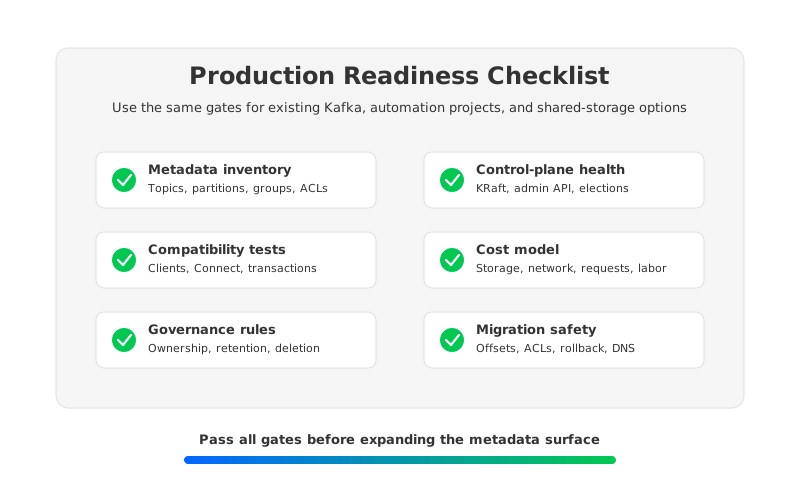
The scorecard prevents a familiar failure pattern. A team declares that Kafka metadata is “under review,” but the review becomes a controller upgrade plan, a topic cleanup project, or a storage sizing spreadsheet. Each can be useful. None is sufficient alone.
If your Kafka estate is reaching the point where topic count changes how the platform operates, review metadata as part of the full production system. Start with inventory and governance, then test the architecture that carries those decisions into storage, networking, recovery, and migration. If broker-local state is the constraint you keep running into, include AutoMQ’s shared storage architecture in the evaluation and use the AutoMQ architecture documentation as the next technical checkpoint.
7References
- Apache Kafka documentation: KRaft
- Apache Kafka documentation: Consumer configuration
- Apache Kafka documentation: Producer configuration
- Apache Kafka documentation: Replication design
- Apache Kafka documentation: Kafka Connect overview
- AutoMQ documentation: Architecture overview
- AutoMQ documentation: Native compatibility with Apache Kafka
- AutoMQ documentation: Migrating from Apache Kafka to AutoMQ
- AWS documentation: Amazon S3 user guide
- AWS pricing: AWS PrivateLink pricing
- Google Cloud documentation: VPC network pricing
8FAQ
8.1What is a Kafka metadata scaling review?
A Kafka metadata scaling review is a structured evaluation of how topic count, partition count, consumer groups, ACLs, connector state, topic configuration, and ownership rules affect production operations. It should include controller behavior, governance, cost, migration, and storage architecture rather than focusing only on raw throughput.
8.2Is KRaft enough to solve Kafka metadata scaling?
KRaft removes ZooKeeper from Kafka metadata management and is important for Kafka operations. It does not by itself solve topic sprawl, weak ownership, broker-local data growth, partition movement, cloud network cost, or migration risk. Those areas still need a production review.
8.3How many topics are too many for Kafka?
There is no universal number because workload shape, partition count, retention, controller health, broker sizing, and operations discipline all matter. The warning sign is not a single topic count. It is when metadata objects grow faster than provisioning, audit, cleanup, observability, and recovery processes.
8.4What should be included in a high-topic-count Kafka checklist?
Include topic and partition inventory, owner mapping, retention classes, ACL patterns, consumer groups, Connect jobs, transactional producers, quotas, stale resources, controller metrics, admin API latency, cost assumptions, migration plans, and rollback criteria.
8.5When should AutoMQ be part of the evaluation?
AutoMQ is worth evaluating when broker-local state is the recurring constraint: slow scaling, expensive cross-zone replication traffic, heavy partition movement, long retention on attached storage, or high operational risk during migration. It should still be tested against your Kafka clients, governance model, and rollback plan.


