
Table of Contents
Table of Contents
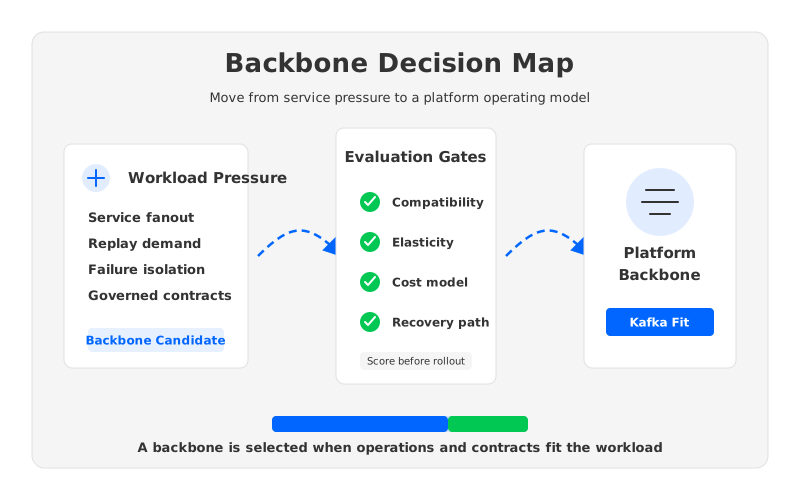
Teams usually search for microservice communication backbone kafka after the service graph has already become hard to reason about. A checkout service emits order events, fraud scoring consumes them, inventory reacts to them, analytics needs the same stream, and a billing workflow cannot afford to miss the final state transition. The first version often works with direct API calls and a few queues, but the pressure changes once dozens of services need the same facts with different timing, replay, and ownership requirements.
That is the moment when Apache Kafka starts to look less like a messaging tool and more like a communication backbone. The question is not whether a broker can move bytes. The harder question is whether the platform can become the durable, replayable, governed contract between services without turning every release, scaling event, and cloud bill review into a platform incident.
1Why Teams Search for microservice communication backbone kafka
Microservices create a social problem before they create an infrastructure problem. Each team owns its service, its deployment cadence, and its local database, but business workflows still cross those boundaries. Synchronous APIs make the dependency visible and immediate: service A waits for service B, then service B waits for service C, and the user path inherits every downstream failure. Event-driven communication moves that dependency into a shared log, where producers publish facts and consumers process them at their own pace.
Kafka fits this pattern because it gives teams a persistent commit log, consumer groups, offset tracking, partitioned ordering, replay, and client libraries across common languages. Those mechanics matter in production. Consumer groups let a service scale horizontally without every instance reading every record. Offsets let consumers resume from a known point after failure. Transactions can coordinate writes when exactly-once style processing is required for a specific workflow, although teams still need to design idempotent consumers and operational guardrails around that capability.
The backbone metaphor is useful only when it includes ownership. A communication backbone is not a bucket where every service dumps events. It is a set of contracts: topic naming, schemas, retention, access control, replay expectations, compatibility rules, and incident ownership. Without those contracts, Kafka becomes a faster way to create hidden coupling.
Three signals usually show that the organization has outgrown ad hoc service communication:
- Multiple services need the same event stream, but each wants a different processing schedule, replay window, or failure tolerance.
- A single business workflow crosses enough service boundaries that direct calls amplify partial outages and retry storms.
- Platform teams can no longer separate application incidents from broker capacity, partition movement, connector health, and network cost.
The last signal is the one that surprises teams. A Kafka-based backbone can simplify service integration while making platform operations more demanding. The architecture has moved complexity out of the application graph, but it has not made that complexity disappear.
2The Production Constraint Behind the Problem
Traditional Kafka clusters use a Shared Nothing architecture: brokers own partitions, store logs on attached disks, and replicate data between brokers for durability and availability. This design is proven and still a reasonable fit for many environments. It also ties compute, storage, and data placement together. When a broker fills disk, loses a node, or needs rebalancing, the platform often has to move partition data across brokers before the cluster is truly settled again.
That coupling matters for microservice communication because the backbone has uneven demand. A flash-sale workflow may spike producer traffic for minutes. A batch analytics consumer may replay hours of history. A product team may create a topic that starts small and becomes business-critical months later. In a broker-local storage model, the platform team has to keep enough headroom for data growth, recovery, and rebalancing, not only for steady-state throughput.
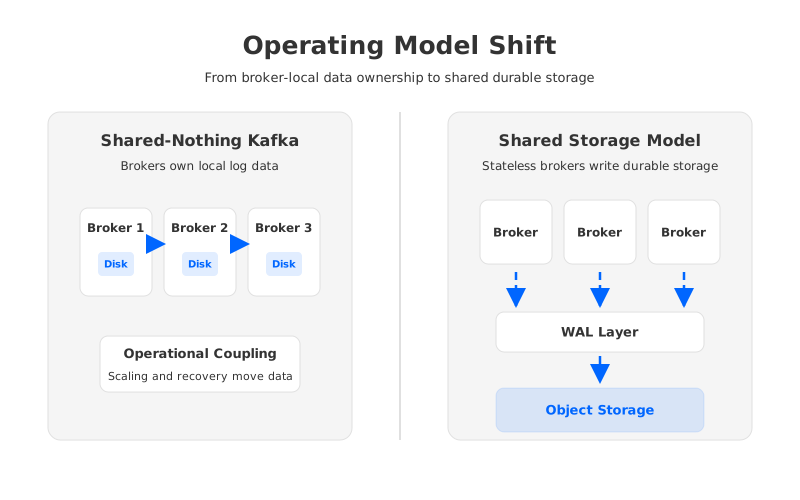
The operational pressure usually shows up in four places. First, capacity planning becomes conservative because storage and broker count are linked. Second, broker replacement and partition movement consume network and operational attention. Third, multi-AZ durability can create cross-zone replication traffic that appears as a real line item in cloud environments. Fourth, governance work spreads across topics, connectors, service credentials, schemas, and deployment pipelines.
None of these issues mean Kafka is the wrong backbone. They mean the team needs to evaluate Kafka as a platform boundary, not as a library choice. A service owner might ask, "Can I publish an event and replay it later?" A platform owner has to ask, "Can we preserve that guarantee when the cluster grows, a zone fails, a broker is replaced, and the finance team asks why network transfer moved?"
3Architecture Options and Trade-Offs
The first architecture choice is whether Kafka is the backbone of record or only a transport layer between other systems. If Kafka is only a transport layer, teams often keep short retention and push long-term state into databases, data lakes, or object storage. If Kafka is the backbone of record for service events, retention, replay, and topic governance become first-class design constraints. The same technology can support both patterns, but the operating model is different.
The second choice is deployment responsibility. A self-managed cluster gives teams control over broker configuration, upgrade cadence, network boundaries, and integration with internal tooling. A managed service reduces direct broker administration but may still leave teams responsible for topic design, client behavior, schema compatibility, connector operations, cost forecasting, and cross-account networking. A Kafka-compatible platform with a different storage architecture can change some of those trade-offs, but only if the compatibility and migration story holds up under real client workloads.
The practical evaluation looks like this:
| Decision area | What to inspect | Why it matters for microservices |
|---|---|---|
| Compatibility | Kafka protocol support, client versions, transactions, consumer groups, admin APIs | Service teams should not rewrite client behavior to adopt the backbone. |
| Data contract | Schema evolution, topic ownership, retention, replay windows | Events become product interfaces between teams. |
| Elasticity | Broker scaling, storage growth, partition reassignment behavior | Demand spikes should not turn into long operational projects. |
| Failure recovery | Zone failure behavior, broker replacement, offset recovery, rollback path | The backbone should degrade predictably when infrastructure fails. |
| Cost model | Storage, compute, cross-AZ traffic, connector runtime, private networking | The platform must be explainable to engineering and FinOps teams. |
| Governance | ACLs, auditability, environment separation, deployment boundaries | A shared backbone needs guardrails that do not block delivery. |
This table is intentionally neutral. Some teams will prioritize managed operations over infrastructure control. Others will accept more operational responsibility to keep data in their own cloud account. The mistake is to choose a backbone by comparing broker feature lists while ignoring the coupling between data placement, capacity, recovery, and team boundaries.
4Evaluation Checklist for Platform Teams
A useful readiness checklist starts with the service graph, not the broker. Pick one workflow that matters to the business and trace the events it would publish, the services that would consume them, and the replay behavior each team expects after failure. If the workflow cannot be described in those terms, adding Kafka will likely create a shared dependency before the organization has a shared contract.
Use the following checklist before treating Kafka as the microservice communication backbone:
- Define topic ownership. Each topic should have an owning team, a lifecycle policy, and a compatibility rule for event changes.
- Separate producer and consumer failure modes. A producer outage, consumer lag, and broker incident should trigger different runbooks.
- Decide retention by use case. Short retention for transport and longer retention for replay serve different operational goals.
- Test client compatibility early. Consumer group behavior, transactions, admin operations, and security settings should be tested with real application clients.
- Model cloud costs before rollout. Include storage, compute, inter-zone data transfer, private networking, and connector runtimes where applicable.
- Practice rollback. A communication backbone is not production-ready until teams know how to pause producers, replay consumers, and recover from a bad event.
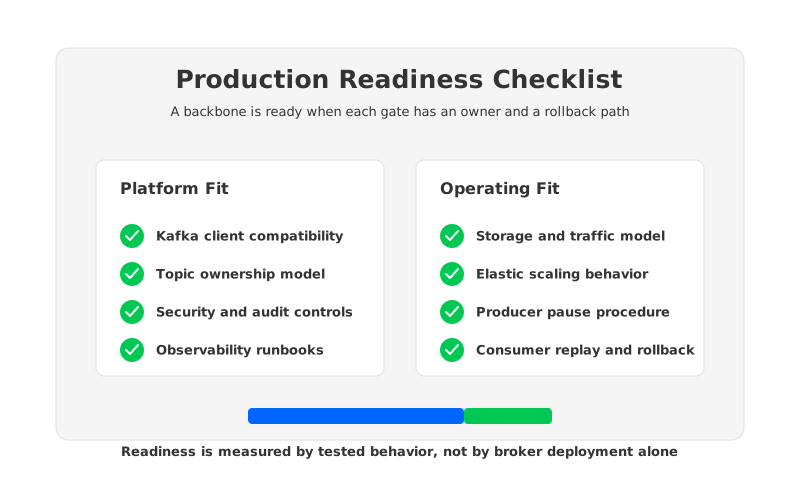
The checklist is deliberately blunt because the risks are not evenly distributed. Missing a nice dashboard is inconvenient. Missing a rollback path for a bad event can corrupt downstream state across many services. Underestimating cross-zone traffic may not break the system, but it can make the backbone politically fragile when the monthly bill arrives.
5How AutoMQ Changes the Operating Model
Once the evaluation reaches storage coupling, a different architecture becomes relevant. AutoMQ is a Kafka-compatible, cloud-native streaming system that uses a Shared Storage architecture to move Kafka log durability to shared object storage while keeping brokers stateless. The important part is not that object storage exists in the design. The important part is that broker compute and durable log storage are no longer tied to the same machine lifecycle.
In that model, brokers can scale for request handling while durable data remains in shared storage. AutoMQ uses a write-ahead log layer for low-latency writes and object storage for durable log segments, so broker replacement does not require the same broker-local data ownership model. For a microservice backbone, this changes the everyday operating questions: adding capacity is less about moving partition data between local disks, and recovery is less about rebuilding a broker's private storage state.
The cost model changes as well. In a traditional multi-AZ Kafka deployment, replica traffic between brokers can create cross-zone transfer. AutoMQ documents a zero cross-AZ traffic architecture for cloud deployments, which is relevant when a backbone carries high-volume service events across availability zones. That does not remove the need to model costs. It narrows the cost questions to the real workload: write throughput, read fanout, retention, object storage, compute, and deployment boundaries.
The migration argument still has to be earned. Kafka compatibility should be validated against the clients and features a team actually uses: producer settings, consumer group behavior, transactions where required, admin operations, security configuration, connectors, and observability integrations. A cloud-native storage layer reduces certain operational constraints, but it does not replace disciplined topic design, schema governance, or incident practice.
For organizations that want the backbone inside their own cloud account, AutoMQ BYOC is the deployment boundary to evaluate. For teams that prefer software deployment control, AutoMQ Software is another path. The shared architectural question is the same: can the platform preserve Kafka semantics while reducing the broker-local storage work that makes a communication backbone harder to operate at scale?
6A Decision Framework You Can Use
The cleanest decision is not "Kafka or no Kafka." It is "which workloads deserve a durable event backbone, and which communication paths should stay synchronous?" Request/response APIs still fit queries, commands that need immediate answers, and workflows where the caller must know the outcome before proceeding. Kafka fits facts that multiple services need to consume, histories that need replay, and workflows where producers and consumers should fail independently.
From there, score each candidate workflow across four dimensions:
| Score | Question | Strong signal |
|---|---|---|
| Fanout | How many services need the same event? | Three or more independent consumers. |
| Replay | Will teams need to reprocess history? | Debugging, analytics, model features, or state repair depend on replay. |
| Coupling | Do synchronous calls amplify failures? | Retries or downstream outages regularly affect the user path. |
| Governance | Can the event become a stable contract? | The owning team can version, document, and test compatibility. |
High scores point toward a Kafka backbone. Low scores often point toward a simpler API, queue, or database integration. The framework also protects the platform team from becoming the default answer to every integration request. A backbone earns its place when it reduces coupling at the service level without creating unbounded operational coupling at the platform level.
Return to the search phrase that started the problem: microservice communication backbone kafka. The word "backbone" is doing most of the work. It implies load-bearing infrastructure, long-term contracts, and failure behavior that many teams will depend on. If you are evaluating that kind of platform and want to see how a Kafka-compatible Shared Storage architecture changes the cost and operations model, schedule an AutoMQ demo with your target workload, retention window, and cloud boundary in hand.
7References
- Apache Kafka documentation
- Apache Kafka tiered storage operations
- Red Hat Streams for Apache Kafka MirrorMaker 2 documentation
- AutoMQ architecture overview
- AutoMQ zero cross-AZ traffic overview
- AutoMQ BYOC installation on AWS
- AutoMQ usage-based billing
8FAQ
8.1Is Kafka always the right backbone for microservices?
No. Kafka is a strong fit when multiple services need durable events, replay, independent consumption, and ordered processing within partitions. Synchronous APIs remain a better fit for request/response interactions where the caller needs an immediate answer and the interaction does not create broad failure coupling.
8.2What is the main risk of using Kafka as a microservice communication backbone?
The main risk is hidden coupling. Teams may believe they have decoupled services because producers and consumers no longer call each other directly, but they can still create shared failure modes through topic contracts, schema changes, consumer lag, retention settings, and broker capacity.
8.3How should platform teams evaluate Kafka-compatible alternatives?
Start with protocol compatibility and client behavior, then inspect the operating model. A useful evaluation covers consumer groups, transactions where used, admin APIs, security, observability, scaling behavior, storage growth, recovery, networking cost, and migration rollback.
8.4Where does shared storage help?
Shared Storage architecture helps when broker-local data ownership makes scaling, recovery, and capacity planning harder than the application workload itself. By separating durable log storage from broker compute, a Kafka-compatible Shared Storage architecture can reduce data movement during broker replacement and scaling events.


