
Table of Contents
Table of Contents
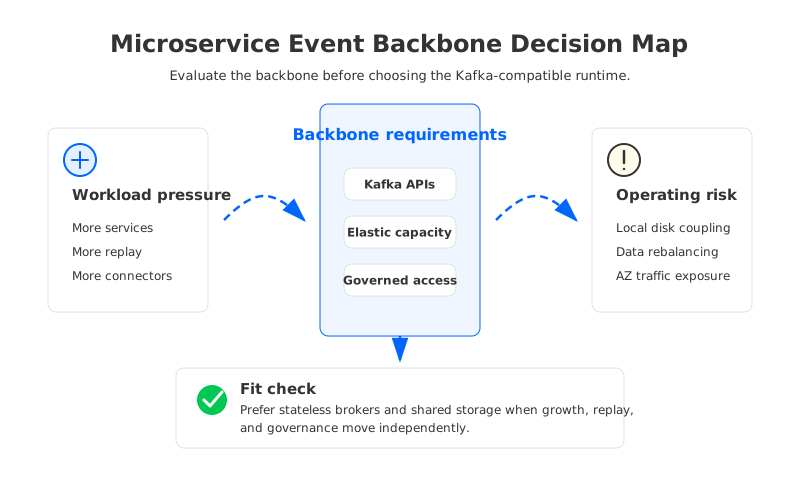
Teams usually search for microservice event backbone kafka after the first version of their event-driven architecture has already worked. Services are publishing domain events, Kafka topics have become integration contracts, and a handful of connectors are moving data into warehouses, search systems, or operational databases. The uncomfortable part starts when this backbone stops being one pipeline and becomes the shared nervous system for product teams that move at different speeds.
That is when a Kafka-centric architecture becomes more than a broker choice. It becomes a decision about replay boundaries, ownership, schema evolution, consumer lag, cloud networking, security policy, and who gets paged when a connector blocks an important downstream workflow. The search query sounds simple, but the real question is harder: can your Kafka-compatible infrastructure support many microservices without turning every operational change into a storage, network, and governance project?
1Why Teams Search for microservice event backbone kafka
The appeal of Kafka in microservice architectures is clear. It gives teams a durable commit log, independent consumers, ordered partitions, and a protocol ecosystem that many client libraries, stream processors, and connectors already understand. A service can publish OrderCreated once, while fraud detection, billing, inventory, analytics, and customer support consume it at their own pace. This is cleaner than a mesh of synchronous calls where each service needs to know who depends on it.
The problem is that an event backbone has a different failure shape than an application queue. A queue often serves one producer-consumer relationship; an event backbone serves many teams and many histories. One topic may carry production traffic, analytical replay, backfill jobs, and compliance-driven retention at the same time. A consumer group reset that looks harmless to one team can become a sudden read surge for the platform team.
Kafka gives you the primitives to manage this: consumer groups, offsets, partitions, transactions, and connectors. It does not remove the need to decide how those primitives map to team boundaries. A practical architecture starts by separating three concerns that are often mixed together during early adoption:
- Event ownership. The service that owns a business fact should own the meaning and compatibility of the event, even when the platform team owns the cluster.
- Consumption independence. New consumers should not require producer changes, but they still need quotas, schema discipline, and lag visibility.
- Operational isolation. Connector failures, backfills, and replay-heavy jobs should not destabilize transactional service traffic.
Those concerns are not abstract design hygiene. They directly affect how much capacity you reserve, how much cross-zone traffic you pay for, and how quickly you can recover from a broker, zone, or deployment failure.
2The Integration Constraint Behind the Pipeline
Many Kafka backbones begin as integration projects. A team connects microservices to a data lake, then adds Kafka Connect, then routes selected topics into stream processing. The architecture diagram still looks like a neat left-to-right pipeline, but the actual system behaves more like a shared substrate. Data engineers care about replay and format evolution. SREs care about hot partitions and disk pressure. Application teams care about latency and not breaking downstream consumers.
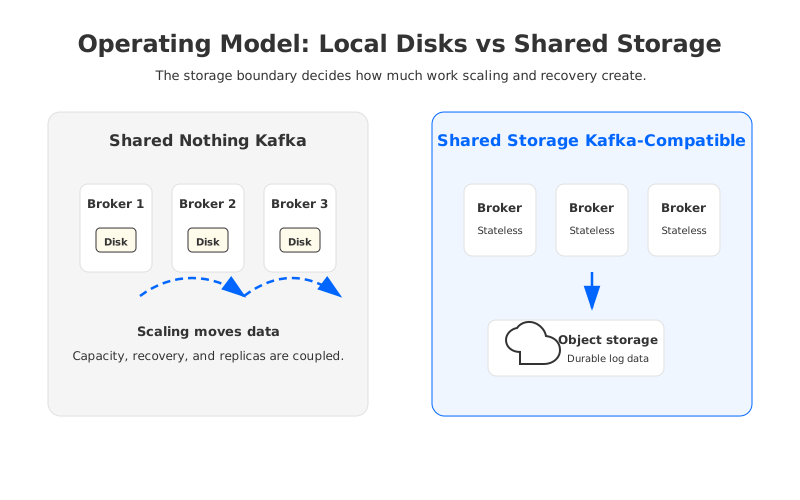
This is where traditional shared-nothing Kafka can become operationally expensive in the cloud. In the classic model, brokers own local log segments and replicate data between brokers for durability. That design is coherent: Kafka was built to use sequential disk IO efficiently, and replication gives consumers a fault-tolerant log. The cloud changes the economics around that design because storage, compute, and network traffic are metered and scaled through separate services.
When broker storage is local to the broker, capacity planning tends to follow the largest retained topic, not the average CPU need. When a broker is replaced or partitions are rebalanced, the system must move log data across brokers. When replicas are spread across availability zones, the platform may also expose itself to cross-zone data transfer charges, depending on the cloud and traffic path. None of this makes Kafka a poor fit for microservices; it means the event backbone must be evaluated as infrastructure, not as a library choice.
The real integration constraint is therefore not "can Kafka move events?" It can. The constraint is whether the platform can absorb different growth curves without forcing every curve through the same broker-local storage model. Producer throughput, retention, connector fan-out, stream processing state, and analytical replay rarely grow together. Treating them as one capacity unit creates the operational drag that teams feel later.
3Connector, Schema, Replay, and Stream Processing Trade-Offs
Kafka Connect is often the first pressure multiplier because it turns the event backbone into a data movement platform. Source connectors bring database changes and SaaS events into Kafka. Sink connectors send selected streams to warehouses, object storage, search indexes, and operational stores. This is useful precisely because it standardizes the integration path, but it also means connector behavior becomes part of the platform's reliability envelope.
Three trade-offs deserve attention before the backbone becomes shared infrastructure:
- Connectors are applications, not plumbing. They have offsets, tasks, retries, dead-letter handling, credentials, and version lifecycles. Treating them as invisible transport hides real failure modes.
- Schema governance is an availability concern. A breaking field change can be as disruptive as a broker failure when dozens of consumers depend on the same event contract.
- Replay is a product feature and a platform load event. The ability to reset offsets is valuable, but replay traffic competes with live traffic unless quotas, isolation, and capacity planning account for it.
Stream processing adds another layer. Flink, Kafka Streams, and similar systems often read from many topics, maintain state, and write derived topics back into the backbone. This creates a loop: microservices publish facts, processors derive state or alerts, and other services consume the derived streams. The loop is powerful, but it makes event semantics and platform operations inseparable. If retention is too short, recovery becomes fragile. If retention is too long on broker-local disks, storage cost and rebalancing time become painful.
This is also why "Kafka-compatible" should be interpreted carefully. Compatibility is not only whether a producer can connect. It includes client behavior, consumer group semantics, transactions where needed, Connect compatibility, observability, ACLs, and operational procedures such as rolling upgrades and disaster recovery. A buyer evaluating a microservice event backbone should ask how much of the existing Kafka ecosystem remains unchanged and which operating assumptions change underneath it.
4Evaluation Checklist for Data Platform Teams
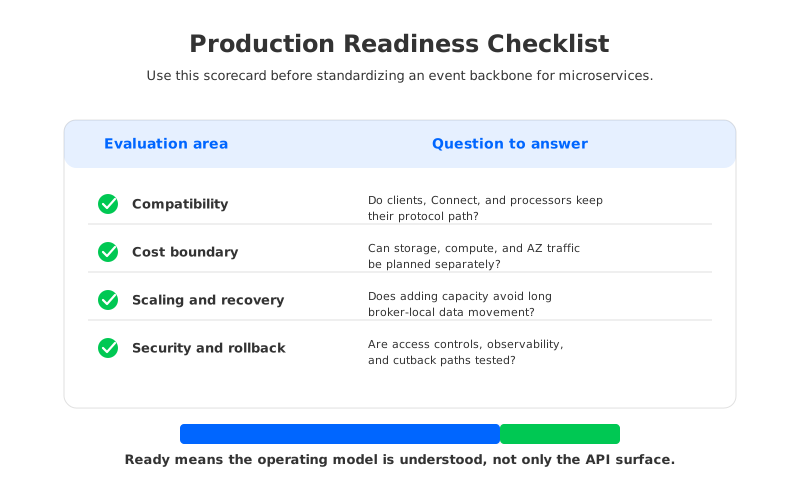
The right evaluation framework starts with neutral requirements, not with a vendor shortlist. A microservice event backbone has to preserve Kafka semantics where applications depend on them, while reducing the operational coupling that appears when traffic, retention, and team count grow. A good platform decision makes the common path boring and the exceptional path rehearsed.
| Evaluation area | What to verify | Why it matters |
|---|---|---|
| Kafka compatibility | Producers, consumers, Connect workers, stream processors, and admin tooling behave as expected. | Microservice teams should not rewrite integration code during infrastructure modernization. |
| Cost boundary | Compute, storage, retention, replay, and cross-zone traffic can be reasoned about separately. | Shared backbones produce mixed workloads; one growth vector should not force overprovisioning everywhere. |
| Scaling behavior | Adding brokers or capacity does not require long, risky data movement in the hot path. | Backbones need elastic response to launches, backfills, and incident recovery. |
| Governance model | Topic ownership, schema compatibility, ACLs, quotas, and auditability are explicit. | The backbone becomes a contract surface between teams, not a private platform detail. |
| Recovery and rollback | Broker loss, zone impairment, connector failure, and bad deployment paths are tested. | Event systems fail through history and replay, not only through current request errors. |
| Migration risk | Dual-write, mirroring, consumer cutover, and rollback procedures have clear boundaries. | Platform migrations should not force a big-bang change across microservices. |
| Observability | Lag, throughput, partition skew, connector health, storage pressure, and network cost are visible together. | Separate dashboards hide the causal chain during incidents. |
The table matters because it prevents a common mistake: choosing a Kafka service based only on cluster provisioning speed. Provisioning is the first hour. The event backbone lives in the next several years of schema changes, retention exceptions, tenant onboarding, connector upgrades, compliance reviews, and cloud cost reviews.
5How AutoMQ Changes the Operating Model
Once the evaluation reaches storage coupling, a different architecture category becomes relevant: Kafka-compatible streaming with shared storage and stateless brokers. AutoMQ is in this category. It keeps Kafka protocol compatibility as the application-facing contract, while changing the broker storage model underneath so durable log data is backed by object storage rather than tied to broker-local disks.
The important shift is operational, not cosmetic. In a shared-nothing cluster, a broker is both a compute process and a storage owner. In a shared-storage architecture, brokers can be treated more like stateless compute because durable data is decoupled from broker lifetime. This changes how platform teams think about scaling, recovery, and capacity planning. Adding compute capacity is less entangled with moving retained log data, and storage growth follows object storage economics instead of broker disk sizing.
For microservice event backbones, that separation addresses the pressure points described earlier:
- Replay and retention stop dominating broker sizing. Historical data can grow without forcing every broker decision to follow the largest retained topic.
- Elasticity becomes less invasive. Compute changes do not need to carry the same data movement burden as broker-local storage expansion.
- Cross-zone traffic can be reduced by architecture. AutoMQ documents a zero cross-AZ traffic design pattern for cloud deployments, which is relevant when a multi-AZ Kafka backbone otherwise turns durability into network spend.
- Deployment boundaries stay customer controlled. Teams evaluating regulated or enterprise environments can keep the Kafka-compatible runtime inside their chosen cloud and networking model.
This does not mean every team should replace a working Kafka deployment immediately. If your event backbone is small, retention is short, replay is rare, and operational ownership is centralized, traditional Kafka may remain a reasonable choice. The architectural question changes when the backbone becomes a multi-team platform and the bottleneck is no longer producing or consuming messages. At that point, the storage model decides how expensive ordinary operations become.
6A Practical Migration Path
The safest way to modernize an event backbone is to make the migration smaller than the platform. Start with topic classes rather than the whole estate. High-retention analytical topics, connector-heavy integration topics, and replay-heavy streams are often better candidates than low-volume transactional topics with simple consumers. This lets the team validate compatibility, observability, and rollback without asking every service owner to move at once.
A realistic migration plan usually has four workstreams. First, inventory topics by owner, retention, throughput, partition count, consumer groups, connector dependencies, and schema compatibility. Second, define acceptance tests that represent real behavior: produce, consume, rebalance, reset offsets, run connectors, restart processors, and verify lag recovery. Third, choose a cutover method such as mirroring or controlled producer movement. Fourth, keep rollback criteria concrete, including the point at which old consumers or producers can be safely retired.
The migration goal is not to prove that a new cluster can receive messages. The goal is to prove that the event backbone can preserve service contracts while changing the operating model underneath.
This framing keeps teams honest. A successful backbone migration should be almost boring for application developers and very interesting for platform owners: fewer storage-bound operations, clearer cost boundaries, and less coupling between retention growth and broker lifecycle.
7The Checklist to Use Before Standardizing
Before declaring Kafka the event backbone for all microservices, require an answer to these questions:
- Which teams own the producer contracts, and how are breaking schema changes blocked?
- Which topics are business facts, derived streams, integration copies, or temporary processing artifacts?
- Which workloads can replay aggressively, and how are they isolated from live service traffic?
- Which connectors are business critical enough to need deployment, alerting, and rollback standards?
- Which cloud network paths generate material cost, and can the architecture avoid unnecessary cross-zone movement?
- Which compatibility tests prove that existing clients and processors can move without code changes?
- Which operational playbooks cover broker failure, connector failure, bad schema release, and consumer lag spikes?
The teams that answer these questions early tend to keep Kafka as a product accelerator. The teams that postpone them usually rediscover the same issues during incidents, when the answer space is smaller and the blast radius is larger.
If your Kafka-centric backbone is starting to feel less like an integration layer and more like shared infrastructure, evaluate whether shared storage and stateless brokers fit your next phase. AutoMQ provides a Kafka-compatible path for that model; you can review the architecture and discuss a migration plan through the AutoMQ demo page.
8References
- Apache Kafka Documentation
- Apache Kafka KRaft documentation
- Apache Kafka Tiered Storage documentation
- AWS documentation: Understanding data transfer charges
- AutoMQ documentation: Shared Storage architecture
- AutoMQ documentation: Compatibility with Apache Kafka
- AutoMQ documentation: Save cross-AZ traffic costs with AutoMQ
9FAQ
9.1Is Kafka still a good event backbone for microservices?
Yes, when the team treats Kafka as shared infrastructure rather than a per-application queue. Kafka's log, consumer group, and connector ecosystem fit event-driven microservices well, but the operating model must include schema governance, replay controls, ownership boundaries, and cloud cost visibility.
9.2What makes a Kafka event backbone different from a message queue?
A message queue usually coordinates one workflow or a small set of consumers. A Kafka event backbone becomes a durable event history for many teams, where consumers can replay, derive new streams, and integrate data into external systems. That history is useful, but it also raises the importance of retention, compatibility, and operational isolation.
9.3When should a team consider shared storage for Kafka-compatible streaming?
Shared storage becomes worth evaluating when retention, replay, connector fan-out, or multi-team adoption starts to make broker-local storage the limiting factor. The goal is not novelty; it is reducing the coupling between compute capacity, durable log storage, and recovery operations.
9.4Does moving to a Kafka-compatible platform require rewriting services?
It should not require a broad rewrite if compatibility is real and validated. The migration plan should test existing producers, consumers, Kafka Connect workers, stream processors, ACLs, and operational tooling before production cutover.


