
Table of Contents
Table of Contents
Migrating from Amazon MSK is not mainly a topic-copying project. Topic data is the visible part of the move, but production safety depends on the state wrapped around that data: consumer group offsets, ACLs, schemas, connector pipelines, DNS, private networking, dashboards, and rollback ownership. If those pieces are not moved deliberately, the target cluster can receive every record and still fail the first real cutover.
That is why "zero downtime" needs careful wording. A migration can avoid application-visible downtime when the source, target, replication path, authentication model, offset strategy, and client rollout plan all support that outcome. Without those conditions, the safer goal is controlled downtime or bounded duplicate processing, with explicit rollback gates.
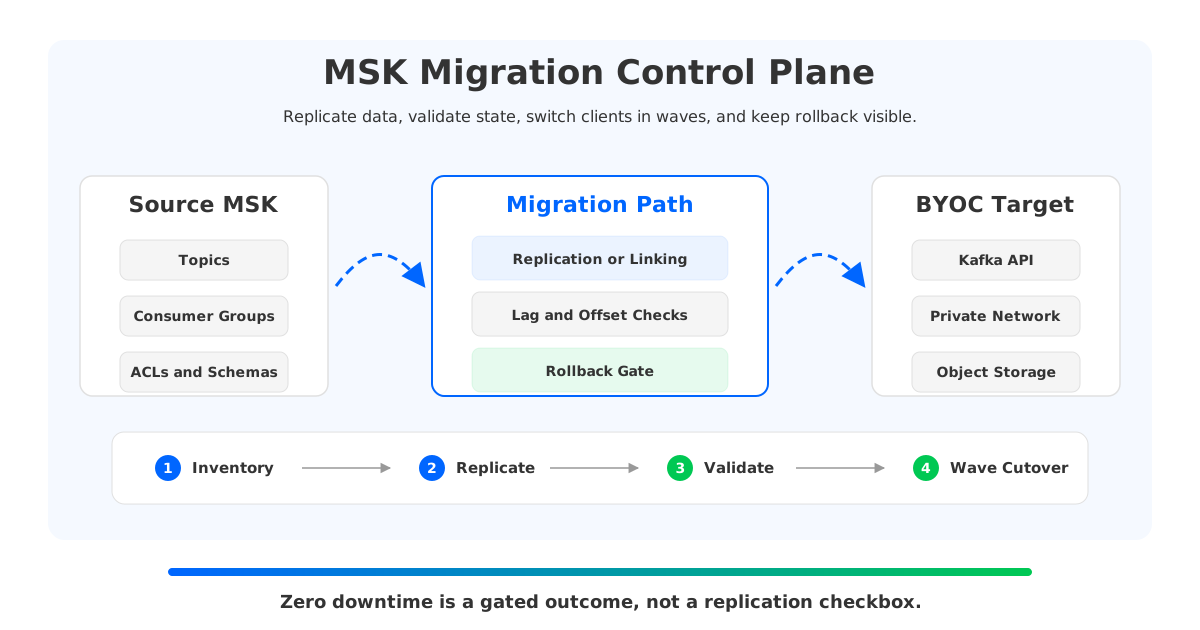
The practical question is not whether Kafka can replicate bytes between clusters. It can. The harder question is whether your applications can switch from MSK to a Kafka-compatible BYOC platform while preserving the behaviors they already depend on.
1What Has to Move Besides Topic Data
An MSK cluster usually has more migration surface area than the first inventory export suggests. Topic names, partition counts, retention settings, and cleanup policies are the starting point, but the production contract includes the way applications authenticate, commit offsets, handle rebalances, and recover from downstream failures. A target cluster that only recreates topics is a partial environment, not a migration-ready one.
The inventory should separate "Kafka objects" from "operating objects." Kafka objects are things like topics, configs, ACLs, consumer groups, schemas, and connector definitions. Operating objects are the pieces that make the cluster usable in production: broker endpoints, DNS names, certificates, SASL mechanisms, IAM paths, VPC routing, observability, runbooks, quota policies, and ownership tags.
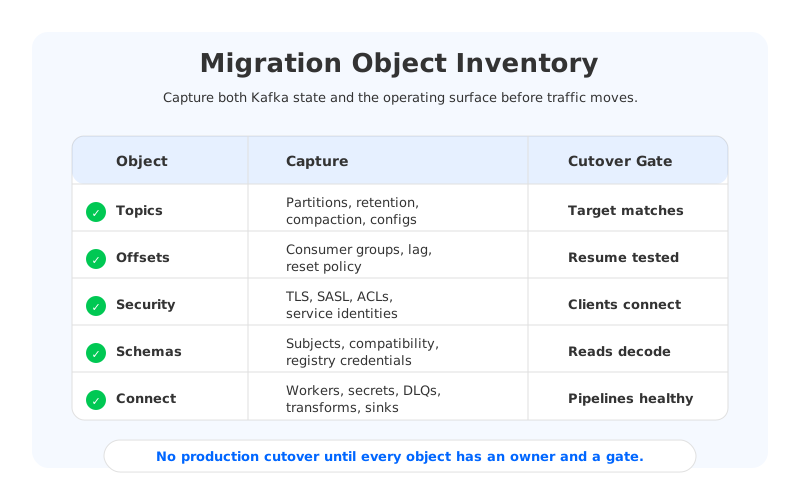
Use the inventory to identify risk, not only volume. A high-throughput topic with replay-safe consumers may be easier to migrate than a low-throughput topic that feeds a stateful Flink job, a payment workflow, or a sink connector with side effects. The second case has less data and more migration risk because offset behavior and duplicate handling matter more than raw throughput.
| Object | What to capture | Cutover risk if missed |
|---|---|---|
| Topics | Partitions, replication factor, retention, compaction, min ISR, message size | Target accepts data but behaves differently under retention or compaction |
| Consumer groups | Current offsets, lag, reset policy, owner service, replay tolerance | Consumers restart from the wrong point or reprocess unexpectedly |
| Security | ACLs, TLS certificates, SASL mechanism, principal mapping, IAM dependencies | Clients connect in staging but fail in production |
| Schemas | Registry endpoint, compatibility mode, subject naming, credentials | Consumers read bytes but fail deserialization |
| Connectors | Source and sink configs, transforms, DLQs, worker placement, secrets | Replication succeeds while integration pipelines stall |
| Operations | Metrics, alerts, dashboards, DNS, runbooks, rollback approvers | The target cluster works during the first incident |
This inventory also tells you what not to migrate mechanically. Some MSK-specific IAM or networking assumptions may need to become native Kafka ACLs, Kubernetes secrets, VPC endpoint policies, or cloud-account roles in the BYOC environment. Treat those as design decisions, not copy-paste chores.
2Choose a Replication or Linking Strategy
AWS documentation positions MSK Replicator as a fully managed feature for replication across MSK clusters, with support for asynchronous data replication, consumer group offsets, topic configurations, and ACLs between supported MSK scenarios. AWS also states that for migrations from non-MSK clusters or cross-account MSK clusters, teams must use Apache MirrorMaker 2.0. That distinction matters for a move off MSK: MSK Replicator may help in MSK-to-MSK or inbound-to-MSK patterns, but a BYOC target outside MSK usually requires a more general Kafka replication or target-side migration tool.
MirrorMaker 2 is the default open source answer because it works at the Kafka protocol layer. It can replicate topics and synchronize consumer group progress through its connector set, but the tradeoff is operational responsibility and offset semantics. AutoMQ Open Source documentation recommends MirrorMaker 2 for cluster migration and explicitly notes that asynchronous synchronization can cause duplicate consumption or minor reordering during switchover.
That leaves three common choices for an MSK-to-BYOC project:
- MSK Replicator for supported MSK-boundary moves. This is strongest when both ends are MSK clusters in supported AWS patterns. It is less likely to be the final answer when the target is a third-party BYOC Kafka-compatible platform.
- MirrorMaker 2 for general Kafka-to-Kafka replication. This is portable and well understood, but teams must operate the Connect workers, monitor lag, plan offset translation, and accept duplicate-processing risk unless the application design absorbs it.
- Target-side linking when the target platform provides it. AutoMQ Cloud provides Kafka Linking for migrations from Kafka distributions, including AWS MSK under supported authentication conditions, with byte-to-byte replication, synchronized consumer progress, and a producer proxy path for non-stop producer switching.
The tool choice should follow the workload, not the other way around. If consumers are idempotent and can replay safely, MirrorMaker 2 may be enough. If the workload includes stateful processors that depend on exact offsets, a linking mechanism that preserves offsets becomes more important. If the source MSK cluster uses IAM role authentication, check the target migration tool's support before assuming it can connect; AutoMQ's Kafka Linking documentation says MSK IAM Role authentication is not supported and native ACL authentication is required for that scenario.
3Build the Target Kafka-Compatible Environment
A Kafka-compatible BYOC target changes the control boundary. Instead of consuming a managed MSK endpoint inside AWS, the platform runs in infrastructure you control or in a vendor-operated environment inside your cloud account. That can improve data-plane ownership and cost transparency, but it also means the target has to pass AWS, networking, security, and operations review before data replication begins.
For an AWS-based BYOC environment, the checklist usually includes:
- VPC and subnet design across Availability Zones, with private routing from producer and consumer workloads.
- DNS names and bootstrap endpoints that can be rolled out without editing every application at once.
- TLS certificates, SASL or ACL configuration, service identities, and secret rotation paths.
- Object storage, IAM roles, Kubernetes or compute runtime, and maintenance access for the target platform.
- Metrics, logs, alerts, audit trails, and incident runbooks that match production expectations.
This is where AutoMQ's architecture becomes relevant as a target, not as a migration slogan. AutoMQ is a Kafka-compatible streaming platform built on object storage. Its documentation describes compatibility with Kafka APIs and ecosystem components, while its storage model separates broker compute from durable data. For MSK teams, the important evaluation is whether that target preserves the Kafka contract while changing the storage and operations model that made the team consider leaving MSK.
Do not start replication into an environment that has not passed these gates. A target cluster can be technically reachable and still be production-incomplete if it lacks alerting, backup expectations, IAM approval, or rollback access. Migration pressure tends to expose those gaps at the worst possible time.
4Validate Offsets and Consumer Lag
Replication lag is a necessary signal, but it is not a sufficient migration signal. A lag graph approaching zero tells you that data is catching up. It does not prove that a consumer can resume from the correct point, that schemas resolve, that ACLs match, or that downstream systems can tolerate the cutover.
Validation should happen in layers. Start with record-level checks: are expected topics present, are partition counts correct, are message keys and headers preserved, and does the replicated data match the source for sampled windows? Then test consumer state: can a representative consumer group resume on the target without skipping, duplicating beyond the planned tolerance, or falling into an unexpected reset policy? Only after that should application-level validation decide whether the migration wave is safe.
For each migration batch, define the acceptance criteria before the batch starts:
- Source and target topic configs match or intentionally differ with documented approval.
- Replication lag stays within the agreed window for a full observation period, including peak traffic if possible.
- Consumer offsets are synchronized, translated, or deliberately reset according to the chosen tool.
- Schema Registry, Kafka Connect, and client authentication work from the same network paths production will use.
- Duplicate-processing behavior is tested for consumers and sinks that cannot be made exactly-once across clusters.
Offset validation is where many "zero-downtime" plans become honest. MirrorMaker 2 can synchronize checkpoints, but offset sync is asynchronous and cutover can still create duplicate consumption. AutoMQ Kafka Linking is designed to keep offsets aligned through byte-to-byte replication and synchronized consumption progress under supported conditions. Those are materially different migration properties, so they should be tested with the exact consumer groups that carry business risk.
5Cut Over with Rollback
A safe cutover is a series of controlled waves, not a single dramatic flip. Start with low-risk consumers that can replay, then move critical consumers, then move producer traffic once the downstream side has proved it can keep up. The source MSK cluster should remain available until the target has survived normal traffic, operational monitoring, and at least one planned rollback rehearsal.
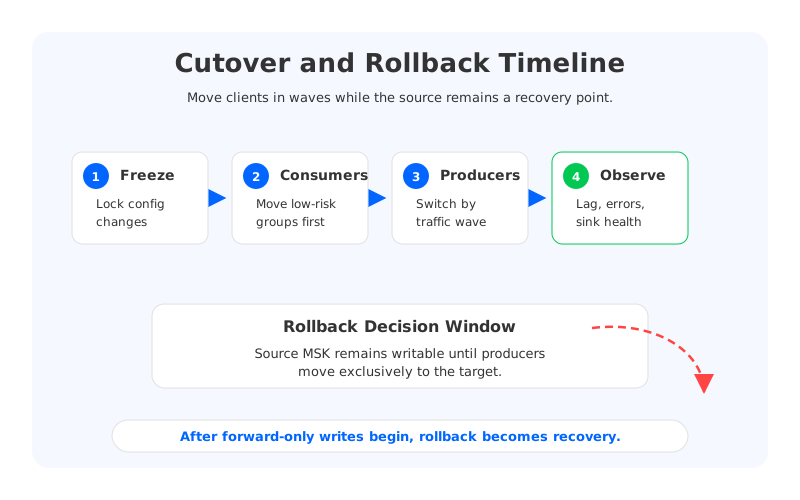
For MirrorMaker 2 based migrations, producer cutover often requires a stricter write freeze because dual-writing to the source and target can create ordering and duplication problems. AutoMQ's migration documentation describes stopping source producers before switching them when using MirrorMaker 2, and notes that Kafka Linking can provide a smoother producer switching path through its producer proxy. That is the difference between a replication tool and a migration control plane.
Rollback rules should be written in advance and attached to each wave. The most useful rules are concrete:
- Roll back if consumer lag on the target exceeds the agreed threshold for the agreed duration.
- Roll back if a critical sink detects duplicate side effects beyond the tested tolerance.
- Roll back if authentication, schema, or network failures affect more than the allowed percentage of clients.
- Stop rollback eligibility after producers write exclusively to the target and the source is no longer a complete recovery point.
The last rule is uncomfortable, which is why it matters. Once producers have written data that cannot be reverse-synchronized to MSK, the source cluster is no longer a clean rollback target. At that point the plan changes from rollback to forward recovery, and everyone involved should know that boundary before the cutover starts.
6Where AutoMQ Fits
AutoMQ fits when the MSK exit is driven by a desire to keep Kafka while changing the platform boundary. The application contract remains Kafka: producers, consumers, topics, consumer groups, Kafka Connect, and the surrounding ecosystem. The target architecture changes underneath that contract, with object storage as the durable data layer and stateless brokers as the compute layer.
AutoMQ Cloud migration documentation is especially relevant for MSK teams because it calls out AWS MSK as a supported source for Kafka Linking under native ACL authentication. It also describes byte-to-byte copy, synchronized consumer progress, and a producer proxy path for non-stop producer switching. Those capabilities are useful when the migration risk sits in offsets and cutover mechanics rather than basic protocol compatibility.
AutoMQ should still be evaluated like any production target. Run representative clients, connectors, schemas, security settings, and failure scenarios before moving core workloads. The benefit is not that migration risk disappears. The benefit is that a Kafka-compatible BYOC target with a purpose-built linking path can reduce the amount of application change and cutover uncertainty compared with a generic replicate-and-restart plan.
For teams that are ready to compare the migration path against their own MSK estate, the next useful artifact is not another product overview. It is a batch plan: which topics move together, which consumer groups must preserve offsets, which producers can tolerate a freeze, and which rollback window the business can accept. AutoMQ's team can help evaluate that plan against the actual source cluster constraints.
7Production Readiness Gates
Before production traffic leaves MSK, the migration owner should be able to answer these questions without hunting through Slack history:
| Gate | Ready means | Owner |
|---|---|---|
| Inventory | Every topic, consumer group, ACL, schema, connector, endpoint, and dashboard has a migration disposition | Platform team |
| Replication | Lag, backlog, failed records, and connector health are monitored from both source and target views | Streaming operations |
| Offset plan | Each consumer group has a resume, replay, or reset decision with tested behavior | Application owners |
| Security | TLS, SASL, ACLs, IAM, DNS, and private routes are approved for production traffic | Security and cloud platform |
| Cutover | Client waves, rollback triggers, freeze windows, and escalation paths are written before execution | Migration lead |
| Exit | Source MSK decommission timing, retained data, audit needs, and cost overlap are approved | Platform and finance |
The migration is ready when these gates feel almost boring. MSK replacement should not rely on heroics at cutover time. It should feel like moving traffic through a system of checks that has already told you what will happen if something fails.
8Sources
- AWS: Amazon MSK Replicator
- AWS: MSK Replicator migration scenarios
- AWS: Migrate Kafka workloads to an Amazon MSK cluster
- Apache Kafka: Geo-Replication and cross-cluster data mirroring
- AutoMQ: migration overview
- AutoMQ Cloud: migrate to AutoMQ overview
- AutoMQ: what is AutoMQ
9FAQ
9.1Can I migrate from Amazon MSK without changing application code?
Often, yes, if the target platform is Kafka-compatible and your applications use standard Kafka client behavior. You still need to update endpoints, credentials, certificates, or network paths, and you must test any MSK-specific IAM, ACL, connector, or schema assumptions before calling the migration code-free.
9.2Does MSK Replicator move data from MSK to any Kafka-compatible BYOC target?
Do not assume that. AWS documentation describes MSK Replicator primarily for supported MSK replication patterns and inbound migrations to Amazon MSK Express brokers. For an MSK-to-external-BYOC target, evaluate MirrorMaker 2 or the target platform's migration tool.
9.3Is MirrorMaker 2 enough for a zero-downtime MSK migration?
MirrorMaker 2 can be enough for workloads that tolerate replay, duplicate processing, or a controlled producer pause. For stricter offset preservation and non-stop producer switching, you need additional tooling or a target-side linking capability, and the result still depends on authentication, network, and application behavior.
9.4What should be migrated first?
Start with a low-risk batch that includes real producers, real consumers, and at least one operational dependency such as Schema Registry or Kafka Connect. A synthetic topic proves connectivity, but it does not prove that the production estate can survive cutover.
9.5When can the source MSK cluster be decommissioned?
Only after the target has run through the agreed observation period, rollback is no longer required, retained data and audit requirements are satisfied, and all producers write exclusively to the target platform. Decommissioning too early turns a reversible migration into a forward-only incident response plan.


