
Table of Contents
Table of Contents
A Confluent Cloud to BYOC Kafka migration usually fails in the places that look least like Kafka. The record log may replicate correctly, but the cutover still stalls because one consumer group resumed at the wrong offset, one private endpoint was planned for the wrong VPC, one schema context was forgotten, or one connector was treated like a stateless application when it was actually carrying source-system position. The technical question is not "Can Kafka data be copied?" It is "Can the team move identity, network reachability, schemas, topic state, consumer progress, connectors, producers, and rollback control as one system?"
That is why the exit plan should start before any replication job runs. Confluent Cloud is a strong managed Kafka platform, and many teams use it precisely because it removes infrastructure work. Moving to BYOC Kafka changes the operating boundary: the data plane moves closer to your cloud account and private network, but the platform team owns more of the migration choreography. The practical goal is to reduce that choreography into gates that can be tested before production traffic depends on them.
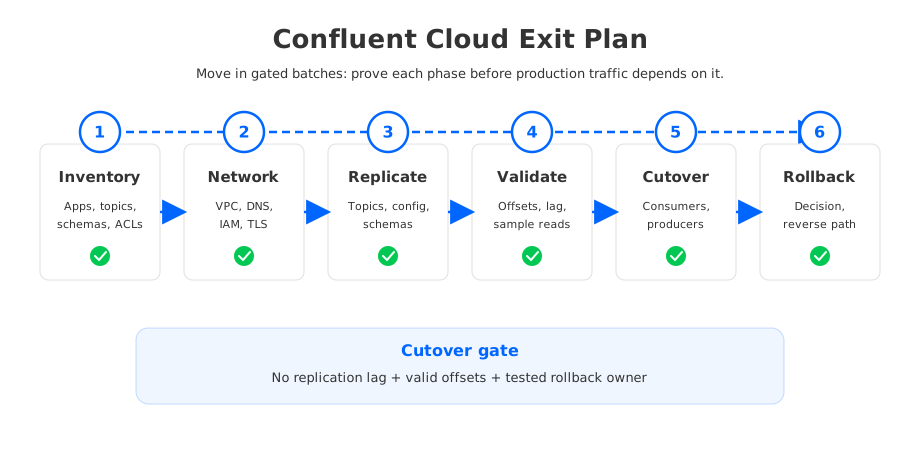
1What makes Confluent Cloud migrations risky
The difficult part is not the existence of migration tools. Confluent documents Cluster Linking for data migration, Apache Kafka has MirrorMaker2 lineage through KIP-382, and several BYOC Kafka platforms provide their own replication or linking layer. The risk comes from assuming these tools define the whole migration. They move bytes and sometimes offsets; they do not automatically decide which applications switch first, whether connector offsets are portable, whether the target network path can reach every producer, or whether governance features tied to Confluent Cloud have an equivalent landing zone.
Confluent Cloud also has cluster and networking choices that matter during an exit. Its current cluster types include Basic, Standard, Enterprise, Dedicated, and Freight, with different limits, networking capabilities, and Cluster Linking support according to the Confluent Cloud cluster types documentation. Its networking options vary by cloud provider and include public connectivity plus private patterns such as AWS PrivateLink, VPC Peering, Transit Gateway, Azure Private Link, Azure VNet Peering, Google Cloud Private Service Connect, and Google Cloud VPC Peering. Confluent's networking overview also notes that a cluster cannot be changed between public and private networking after provisioning, which is exactly the kind of detail that can turn a migration rehearsal into a redesign.
Treat the migration as a dependency graph, not a copy job. Kafka topics are the visible part. The hidden part is the contract around those topics: producer authentication, ACLs, service accounts, schema IDs, subject names, stream processing state, connector source offsets, consumer group progress, monitoring, quotas, and runbooks.
2Inventory before you replicate anything
The inventory phase should answer one uncomfortable question: what would break if this topic appeared in the target cluster with the same name but a different operational environment? For each topic batch, capture the producer owners, consumer groups, schemas, retention settings, compaction settings, ACLs, connector dependencies, and downstream systems that assume a specific bootstrap server, Schema Registry endpoint, or cloud network path.
Use a table like this before choosing a replication tool:
| Inventory item | Why it matters during exit | Cutover gate |
|---|---|---|
| Topic configuration | Replication tools may preserve names and partitions, but config drift changes retention, compaction, and throughput behavior. | Target topic config reviewed against source. |
| Producer identity | BYOC targets usually require new credentials, DNS, certificates, or private endpoint routes. | Each producer has a tested target bootstrap path. |
| Consumer groups | A group that consumes from both clusters can commit confusing progress. Confluent warns that a consumer group should consume from one cluster at a time during migration. | Group ownership and stop/start order are assigned. |
| Schema Registry | Schema IDs, subjects, and contexts may be part of runtime serialization assumptions. | Schemas and compatibility settings are migrated or intentionally replaced. |
| Connectors | Source connectors carry offsets in external systems; sink connectors may need target topic, credentials, DLQ, and retry behavior checked. | Connector state plan is documented per connector. |
| Observability | Lag, error rate, broker metrics, and connector status need equivalent target dashboards before cutover. | Target alerts exist before production traffic moves. |
This phase feels slow, but it is what lets you migrate in batches instead of betting the entire estate on a single maintenance window. A good first batch is boring: a non-critical topic with one producer, one consumer group, one schema family, and no connector chain. The purpose is not to prove throughput. The purpose is to prove that the team can execute the runbook, observe both clusters, roll forward, and roll back.
3Design the BYOC network and security boundary
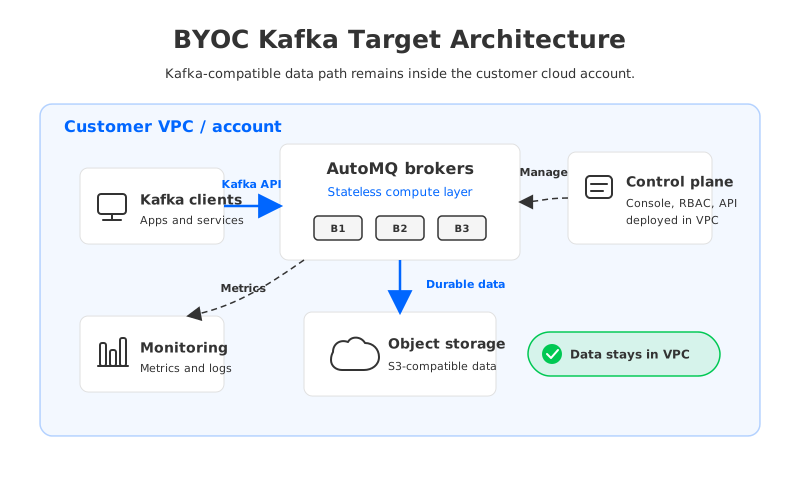
BYOC Kafka is attractive because the data plane can run in your cloud account, under your network controls, close to your applications and data systems. That does not make the network simple. It moves the network design from "connect clients to Confluent Cloud" to "connect every client, connector, monitoring system, and administrator to the new Kafka boundary without weakening controls."
Start with the current Confluent Cloud topology. If the source uses public endpoints, the replication path and the target bootstrap path have different security assumptions than a private Confluent Cloud network. If the source uses private networking, Confluent's documentation says that direct on-premises connectivity to Confluent Cloud private networking is not supported without routing through a customer-owned shared services VPC or VNet and then connecting from there. That matters for a migration worker, a BYOC control plane, or any validation tool that sits outside the same cloud network.
For the BYOC target, draw three separate paths:
- Data path: producers, consumers, Kafka brokers, object storage if the target uses Shared Storage architecture, and connector traffic.
- Control path: console, API, Terraform, RBAC, certificate rotation, upgrades, and administrative access.
- Observability path: metrics, logs, traces, audit logs, and incident access.
The mistake is to secure only the data path. During cutover, the control path is how you pause connectors, update ACLs, roll credentials, and revert traffic. The observability path is how you decide whether the cutover is succeeding. If either path needs an emergency firewall change during the production window, the migration plan was not ready.
4Replicate topics and validate offsets
Confluent Cluster Linking is useful to understand as a reference model even if the target is not another Confluent cluster. In Confluent's model, a mirror topic can be promoted when there is no mirroring lag, config sync lag, or consumer offset lag, and the source is reachable for the check. Confluent also documents consumer offset edge cases, including offset clamping when promoted mirror topics or moved consumer groups encounter offsets beyond the target log end offset. Those details are a reminder that "offset sync enabled" is not the same as "safe to cut over."
For a non-Confluent BYOC Kafka target, you generally choose between MirrorMaker2-style replication and a target-platform migration tool. MirrorMaker2 is based on Kafka Connect concepts and can replicate topics with configurable topic and group filters. It is widely understood and vendor-neutral, but the target offsets may not be byte-identical unless the chosen configuration and replication policy preserve the behavior your applications require. A target migration tool may provide stronger offset preservation, but you should verify the source matrix, authentication support, topic limits, and rollback semantics against current docs.
The validation rule is simple: never infer consumer readiness from replication throughput alone.
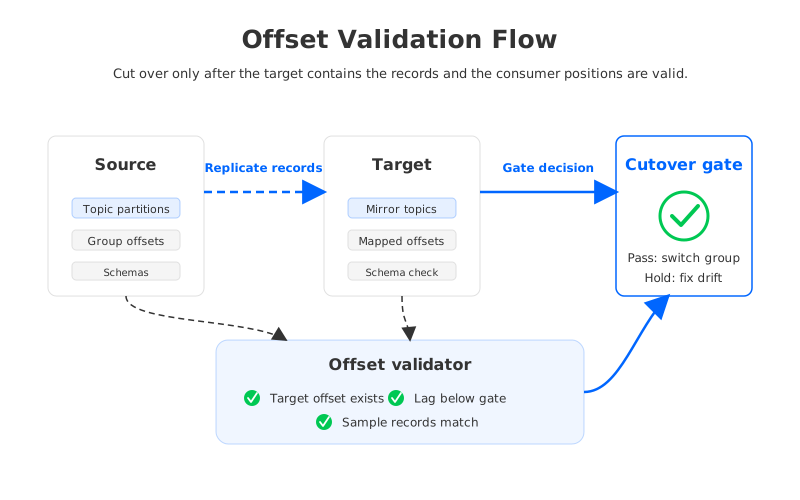
A practical offset validation gate has four checks:
- Compare source and target topic shape. Partition counts, topic names, retention, compaction, and message format assumptions must match the migration design.
- Check replication lag at the partition level. Aggregate lag can hide a single hot partition that will break a consumer after cutover.
- Validate consumer group offsets against target log end offsets. A consumer should resume from an offset that exists and matches the intended record position.
- Run a shadow consumer or deterministic sample check. For critical topics, compare key ranges, timestamps, record counts over bounded windows, and application-level invariants.
Schema migration deserves the same discipline. Confluent's Schema Linking documentation explains contexts and exporters and notes that Schema Linking can be used with Cluster Linking to keep schemas and topic data in sync. If the BYOC target does not use Confluent Schema Registry, confirm whether your serializers depend on Confluent-compatible APIs, schema IDs, subject naming strategies, compatibility levels, or broker-side schema ID validation. The safe path is to test serialization and deserialization with real producer and consumer builds, not only with exported schema files.
5Cut over producers, consumers, and connectors safely
Cutover order is a product decision hiding inside an infrastructure project. If consumers move first, they may read from a replicated target while producers still write to the source. If producers move first, consumers on the source may need reverse replication or a defined drain window. If connectors move at the wrong time, they may duplicate writes to sinks or miss source-system changes.
A conservative sequence works well for most teams:
- Freeze the batch. Stop adding topics, schemas, ACLs, and connectors to that migration batch unless the migration owner approves the change.
- Start replication. Keep source producers and consumers running while the target catches up.
- Validate offsets and schemas. Do not cut over while offset, schema, or partition checks are still "probably fine."
- Move consumers by group. Stop a group on the source, verify committed progress, start it on the target, and watch lag plus application metrics.
- Move producers by application. Update bootstrap servers, credentials, certificates, and client configs through the normal deployment path.
- Reconcile connectors. Recreate, migrate, or replace source and sink connectors with explicit offset and duplicate-handling plans.
- Hold rollback readiness. Keep source topics, credentials, and observability available until the business owner accepts the target.
Connectors are worth special attention because Confluent Cloud's fully managed connectors remove infrastructure work but also create platform-specific state. Confluent documents fully managed source and sink connectors, managed connector offsets, provider integrations, limitations, and cloud networking behavior. During an exit, do not assume a connector can be recreated from visible configuration alone. A Debezium source connector, an S3 sink, and a BigQuery sink all have different state, idempotency, DLQ, and duplicate-write behavior.
Rollback should be designed before the cutover starts. The cleanest rollback is often per batch, not global: stop target consumers, stop or redirect target producers, confirm whether any writes occurred only on the target, and decide whether to replay, reverse-replicate, or discard according to the application owner. If the workload uses transactional producers or exactly-once processing, rollback needs application-level review rather than a generic Kafka command.
6Where AutoMQ simplifies the target architecture
If the exit plan is driven by data control, cloud cost, or scaling friction, AutoMQ is one BYOC Kafka target to evaluate. AutoMQ BYOC places both control plane and data plane resources in the customer's cloud account VPC according to the AutoMQ Cloud overview, while AutoMQ's Kafka compatibility documentation describes compatibility with Apache Kafka clients, Kafka Connect, and other ecosystem components through changes concentrated in the storage layer.
The architecture difference matters after the migration, not only during it. AutoMQ uses Shared Storage architecture: brokers are stateless, and durable data lives in S3-compatible object storage rather than broker-local disks. In a BYOC exit, that gives the target design a different operational profile from a traditional broker-and-disk cluster. Scaling, replacement, and partition reassignment become less tied to copying local log segments between brokers.
For migration tooling, AutoMQ documents two paths. AutoMQ Open Source recommends MirrorMaker2 for cluster migration. AutoMQ commercial editions provide Kafka Linking, which the migration overview describes as supporting byte-to-byte message synchronization and consistent offsets in supported scenarios. The more detailed Kafka Linking overview lists source support and authentication constraints, so treat that matrix as a project input rather than a footnote. For a Confluent Cloud source, confirm the exact source support, authentication mode, networking route, and offset behavior with the AutoMQ team before committing to a cutover design.
AutoMQ does not remove the need for inventory, offset validation, or rollback. It can simplify the target architecture when the goal is Kafka compatibility plus customer-cloud control, but migration still succeeds only when the team proves the operational gates topic by topic.
7Cutover readiness checklist
Before the production window, every migration batch should pass these gates:
- Source and target topic configs are reviewed, including partition counts, retention, compaction, and message size limits.
- Producer and consumer owners have approved the deployment order and rollback behavior.
- Target networking is tested from the same subnets, VPCs, service accounts, and private endpoints that production will use.
- Schemas, subject naming strategy, compatibility settings, and serializer behavior are tested with real application builds.
- Consumer group offsets are validated against target log end offsets, not only against aggregate lag.
- Connectors have per-connector state plans, including source offsets, sink idempotency, DLQ behavior, and credentials.
- Dashboards and alerts exist for both source and target during the parallel-running period.
- Rollback has a named owner, a decision deadline, and a known treatment for target-only writes.
The point of the checklist is not bureaucracy. It gives the migration lead permission to say "not ready" before customers or downstream systems pay for an assumption.
8FAQ
8.1Can I use Confluent Cluster Linking to migrate directly to any BYOC Kafka target?
Cluster Linking is a Confluent feature. It is useful for Confluent-to-Confluent migration and disaster recovery patterns, and its mirror topic and promote semantics are helpful design references. For a non-Confluent BYOC Kafka target, plan around MirrorMaker2, Kafka Connect-based replication, or the target platform's migration tooling.
8.2Do Kafka-compatible clients need to be rewritten?
Usually not if the target is truly Kafka-compatible and your applications use standard Kafka producer, consumer, and admin APIs. You still need to change configuration: bootstrap servers, authentication, TLS certificates, ACLs, Schema Registry endpoints, retries, timeouts, and observability hooks. Confluent Cloud clients require TLS and supported authentication mechanisms, and the BYOC target will have its own security profile.
8.3Is zero downtime realistic?
It can be realistic for some workloads, but it should be a tested property, not a slogan. Producer proxying, byte-preserving replication, dual-read validation, and staged consumer movement can reduce downtime. Workloads with strict ordering, transactions, external side effects, or connector-managed state need more careful cutover and rollback design.
8.4What should be migrated first?
Start with low-criticality topics that exercise the full path: schema, producer, consumer group, metrics, and rollback. Avoid choosing an isolated test topic that proves only that replication starts. The first batch should be small, but it should be real enough to expose the operational edges of the exit plan.
8.5When should AutoMQ be evaluated?
Evaluate AutoMQ when your exit goal is Kafka compatibility, customer-cloud data control, and a target architecture that separates compute from storage. Review the Kafka compatibility documentation, validate migration tooling against your Confluent Cloud source configuration, and run a batch migration rehearsal before deciding on a production cutover. For a guided BYOC assessment, use the AutoMQ contact CTA.


