
Table of Contents
Table of Contents
Teams usually start searching for "migrate from MSK" after Amazon Managed Streaming for Apache Kafka has already done part of its job. The cluster is running, Kafka clients work, and operations are less manual than self-managed brokers. The problem is that the workload has outgrown the capacity model: storage expansion, partition growth, broker sizing, multi-AZ cost, and failover testing all still need engineering attention. Calling the next platform "serverless Kafka" is useful only if it reduces those burdens without breaking Kafka semantics.
That is the real migration question. You are not moving from one endpoint to another; you are changing the operational contract around Kafka. The safest MSK migration plans treat the target as a Kafka-compatible system first, then evaluate whether it is serverless enough for the workloads that matter. Downtime, recovery point objective (RPO), and recovery time objective (RTO) depend on replication lag, producer cutover control, consumer offset handling, DNS/client behavior, and rollback discipline. No responsible migration plan should promise a universal number before those variables are measured.
1What "serverless Kafka" should mean in practice
AWS defines MSK Serverless as a cluster type that runs Apache Kafka without requiring teams to manage and scale cluster capacity; AWS also says it automatically provisions and scales capacity while managing topic partitions. That is a useful baseline, but architecture teams often use serverless Kafka more broadly: an elastic Kafka-compatible data plane where compute, durable storage, and operational ownership are less tightly bound than in broker-local-disk Kafka.
The definition matters because MSK Serverless has product-specific rules. AWS documents that MSK Serverless requires IAM access control and does not support Apache Kafka ACLs. AWS also publishes per-cluster quotas for serverless clusters, including partition and throughput limits. Those limits may be fine for many workloads, but they must be checked before cutover.
A practical evaluation uses five criteria:
| Criterion | Migration question | Why it matters |
|---|---|---|
| Kafka API compatibility | Do existing producers, consumers, Kafka Streams apps, Connectors, and admin tooling work with limited code change? | Protocol compatibility reduces application migration risk. |
| Elastic capacity | Can the target absorb bursty ingress, egress, and partition growth without broker-by-broker planning? | Serverless value disappears if every growth event becomes a capacity project. |
| Durable storage model | Is retention tied to broker-local disks, tiered storage, or shared object storage? | Storage architecture shapes cost, recovery, and scale-out behavior. |
| Network and identity model | Does the target support your VPC, IAM/SASL/TLS, private connectivity, and DNS patterns? | Most cutover failures are integration failures, not Kafka theory failures. |
| Data control and cost model | Where does data live, who owns the cloud account, and how are storage, traffic, and compute charged? | CTO, SRE, and FinOps teams need the same answer before approving migration. |
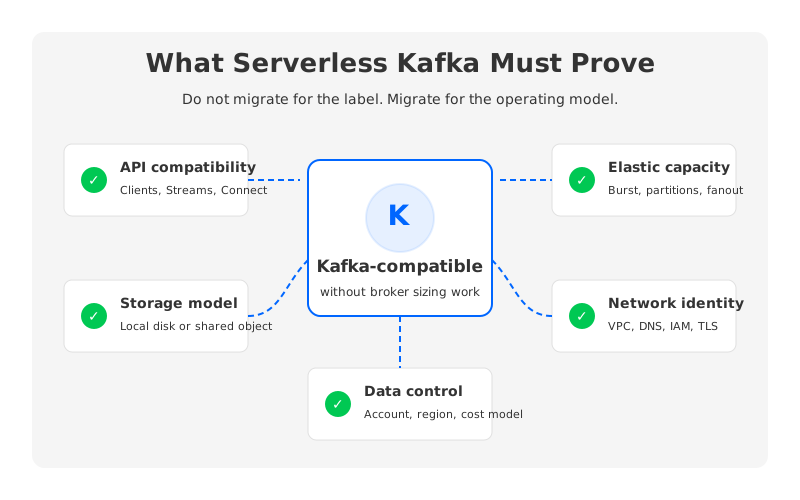
This framing separates two target categories. MSK Serverless keeps the workload inside Amazon MSK but changes the cluster type and capacity model. An elastic Kafka-compatible platform such as AutoMQ changes the storage and deployment architecture as well. The migration mechanics overlap, but the outcome is different.
2Before migration: inventory your MSK workloads
Start with workload inventory, not a replication tool. A migration plan built from the cluster outward often misses the application contracts that make Kafka hard to move: consumer group ownership, idempotent producer behavior, transactions, connector state, schemas, topic naming, and runbooks. MSK can host all of these, but the migration risk lives in how teams use them.
Capture at least these items:
- Topic shape: topic count, partitions, cleanup policy, compaction, retention, record size, and topic-level overrides.
- Client behavior: idempotence, transactions, compression, batching, retries, rebalancing protocol, offset reset policy, and client versions.
- Ecosystem dependencies: Kafka Connect, Schema Registry, stream processors, ACL automation, and observability dashboards.
- Network and security assumptions: bootstrap DNS, TLS certificates, SASL/IAM, private subnets, security groups, and secret distribution.
- Recovery requirements: duplicate tolerance, replay tolerance, maximum cutover lag, rollback window, and downstream gap detection.
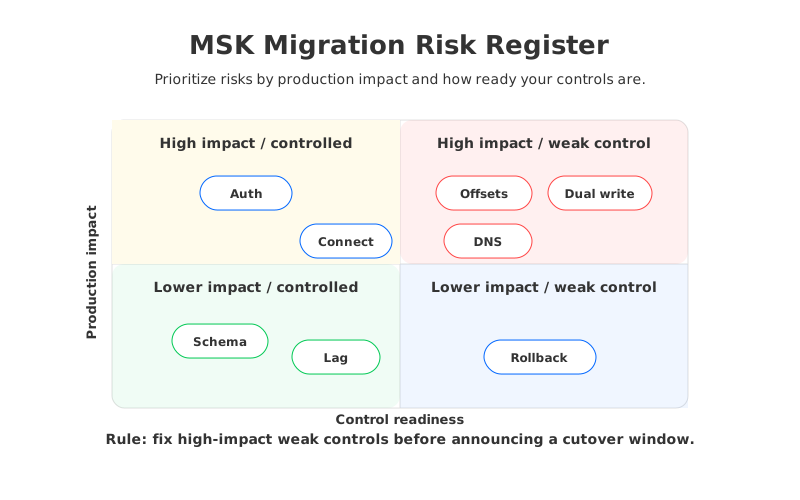
This is where many "zero downtime" claims become less useful. A read-only analytics pipeline with idempotent sinks and low replication lag can be cut over differently from a payment workflow using transactions and strict ordering assumptions. The latter needs a deliberate producer freeze or a controlled single-writer switch.
3Build the target Kafka-compatible environment
The target should be production-shaped before replication begins: deployed in the intended VPC topology, configured with the intended authentication model, wired into monitoring, and tested with representative clients. A target cluster created only for data copy is a staging area, not a migration destination.
For MSK Serverless, validate compatibility against AWS's documented constraints. IAM access control is required, Kafka ACLs are not supported, and service quotas need to match the topic and throughput profile. If the current workload depends on ACL mirroring, non-IAM authentication, or quota values above default boundaries, design changes may be required before replication.
For an elastic Kafka-compatible target such as AutoMQ, validate a different set of assumptions. AutoMQ documents migration from Apache Kafka using its migration tooling and describes migration of topics, ACLs, consumer groups, and offsets, with separate guidance for MSK. AutoMQ also positions its service around Kafka compatibility and BYOC deployment, where the data plane can run in the customer's cloud environment.
The architecture should make rollback visible:
| Layer | Primary design decision | Rollback concern |
|---|---|---|
| Producers | Single-writer cutover, dual-write, or proxy/DNS switch | Dual-write can create ordering and deduplication issues; DNS switches depend on client refresh behavior. |
| Replication | MSK Replicator, MirrorMaker 2, vendor migration tool, or managed service path | Async replication means target state is behind source until lag reaches the agreed threshold. |
| Consumers | Offset translation, fresh groups, or controlled replay | Incorrect offsets cause data gaps or duplicate processing. |
| Connect and stream apps | Recreate connector configs and state carefully | Connectors may have external offsets or sink-side state beyond Kafka. |
| Security | IAM/SASL/TLS/ACL mapping | A technically complete data copy can still fail if clients cannot authenticate. |
4Replicate topics and validate offsets
AWS MSK Replicator is a managed feature for replicating data across MSK clusters in the same or different AWS Regions. AWS describes it as asynchronous and states that it can replicate data and consumer group offsets between MSK clusters, along with metadata such as topic configurations and ACLs. That makes it relevant for MSK-to-MSK migration and disaster recovery patterns, but applicability depends on source and target cluster types, Regions, accounts, authentication, and quotas.
Apache Kafka's MirrorMaker 2 is the open-source reference point for cross-cluster mirroring. It is built on Kafka Connect and supports replication flows, heartbeats, checkpoints, and offset-sync mechanisms, but it is not magic tape over two clusters. You still need capacity for replication workers, monitoring for lag, topic-configuration review, and an offset validation procedure that application owners trust.
Offset handling deserves its own gate because "the data was copied" can still become "the application is wrong." Kafka consumer offsets represent the position a consumer group has committed for partitions. During migration, there are three common strategies:
- Translate or sync offsets so consumers resume near the last processed records on the target.
- Start new consumer groups from a known timestamp or offset and accept replay under idempotent processing.
- Drain source consumers, freeze writes or stop producers, let replication catch up, then start consumers on the target after validation.
The right strategy depends on duplicate tolerance and downstream side effects. If a sink writes to an idempotent table keyed by event ID, replay may be acceptable. If a consumer triggers external actions, offset precision becomes stricter. RPO is bounded by the last records that have reached the target and been verified; RTO is bounded by how quickly clients can switch, authenticate, and resume after the agreed gate is met.
5Cutover and rollback plan
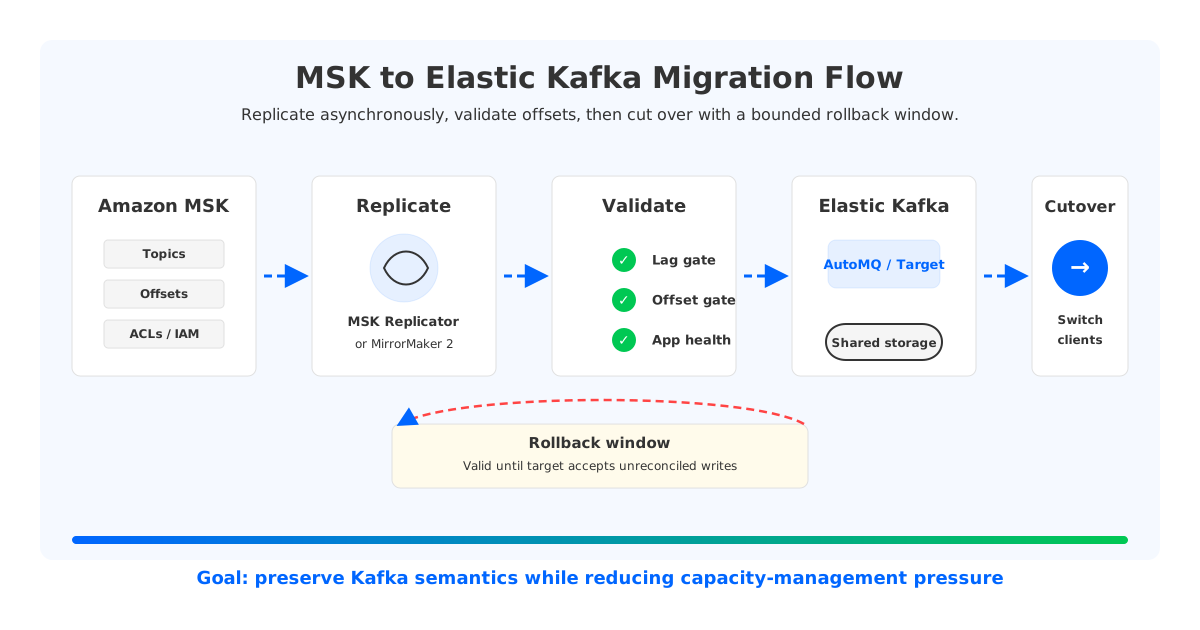
A good cutover is boring. The source cluster is healthy, the target is monitored, replication lag is below the agreed threshold, and every application team knows whether it is switching producers, consumers, or both. The change window should come from measured client restart time, DNS behavior, authentication checks, and replication catch-up behavior in your environment.
Use a staged runbook:
- Freeze high-risk topology changes. Do not repartition topics, rotate authentication schemes, or change connector versions during the migration window.
- Stop or redirect producers according to the chosen pattern. Single-writer cutover is easier to reason about than dual-write, especially for ordered topics.
- Wait for replication to catch up to the defined condition. For async replication, "caught up" should be measured by lag metrics and application-level record checks.
- Validate target reads. Confirm topic counts, partition counts, configs, sample record continuity, consumer group offsets, authentication, and application health.
- Start consumers and stream processors on the target. Watch lag, error rate, throughput, end-to-end latency, and downstream duplicate indicators.
- Keep rollback time-boxed. Once producers write exclusively to the target for too long, rolling back to source becomes a data reconciliation project, not a switchback.
Rollback must be designed before cutover because async replication direction matters. If the source remains the system of record until the final producer switch, rollback is often a controlled client revert. If the target accepts new writes, rollback requires reverse replication, dual-write reconciliation, or a decision to keep the target as the new source of truth. Downtime, RPO, and RTO are conditional outcomes: with a single-writer cutover, low measured lag, validated offsets, and pre-tested clients, interruption can be minimized; without those conditions, any number is theatre.
6Why AutoMQ is a practical MSK migration target
AutoMQ fits this discussion when the migration goal is broader than moving from provisioned MSK to another AWS-managed SKU. Some teams want Kafka compatibility plus the storage and scaling behavior of a cloud-native streaming system. In that architecture, brokers are closer to stateless compute and durable data is backed by shared object storage rather than bound to broker-local disks.
That design changes what a platform team is trying to achieve after it moves off MSK. Instead of treating broker storage expansion and partition reassignment as recurring projects, the target architecture separates compute elasticity from durable data placement. In BYOC-style deployments, the model can also align with organizations that want Kafka infrastructure in their own cloud account or VPC boundary.
Evaluate AutoMQ with the same discipline as any other target:
- Run protocol and client compatibility tests against your actual producer, consumer, Streams, and Connect versions.
- Test migration of topics, ACLs, consumer groups, and offsets with the documented AutoMQ migration tooling before production.
- Confirm network routing, security groups, DNS, TLS/SASL/IAM mapping, and observability integration in the target environment.
- Benchmark workload-specific throughput, latency, retention, and recovery behavior instead of relying on generic architecture claims.
- Model cost under your own write throughput, read fanout, retention, and cross-AZ/network assumptions.
AutoMQ is not a shortcut around migration mechanics. It is a target architecture choice for teams that want Kafka compatibility, elastic operations, shared storage, and AWS data control to be evaluated together.
7Migration checklist
Before production cutover, require evidence rather than optimism:
| Gate | Pass condition |
|---|---|
| Compatibility | Representative clients pass produce, consume, admin, auth, schema, and error-handling tests. |
| Data copy | Topics, configs, and representative records are present on the target; replication lag behavior is understood. |
| Offsets | Consumer groups resume at expected positions or replay is explicitly accepted by owners. |
| Ordering | Ordered topics have a single-writer plan and no uncontrolled dual-write path. |
| Security | Authentication, authorization, certificate rotation, and secret delivery are tested. |
| Observability | Dashboards and alerts exist for target broker health, client errors, lag, and throughput. |
| Rollback | The rollback path is valid only until a defined point, and that point is written in the runbook. |
Kafka migration touches application behavior, cloud networking, and operating model at the same time. The more serverless the target claims to be, the more important it is to verify the parts that are not abstracted away: compatibility, identity, quotas, offsets, and failure handling.
8FAQ
8.1Can I migrate from Amazon MSK to MSK Serverless directly?
Yes, but the path depends on workload compatibility, authentication, quotas, and available tooling. MSK Serverless requires IAM access control and does not support Kafka ACLs, so security design is often a gating item.
8.2Is MSK Replicator enough for an MSK migration?
MSK Replicator can be a strong option for supported MSK replication patterns because AWS manages the replication infrastructure and documents asynchronous replication of data and consumer group offsets. It is still not a complete migration plan; you also need lag monitoring, offset validation, client cutover, security mapping, and rollback rules.
8.3Should I use MirrorMaker 2 instead?
MirrorMaker 2 is useful when you need open-source Kafka-based replication or when your source/target pattern is outside a managed replicator's supported scope. It also leaves you responsible for Kafka Connect worker capacity, configuration, monitoring, checkpoints, and failure handling.
8.4Can an MSK migration be zero downtime?
It can be close to non-disruptive for some workloads, but only when replication lag is below the agreed threshold, producers have a controlled switch path, consumers can resume from validated offsets or tolerate replay, and clients reconnect cleanly. Stricter workloads may need a short write pause or maintenance window.
8.5What is the biggest risk when moving from MSK to serverless Kafka?
Offsets and application semantics usually create more risk than raw data replication. A copied topic is not enough if consumers resume at the wrong position, sinks process duplicates incorrectly, or dual-write breaks ordering.
8.6Where does AutoMQ fit compared with MSK Serverless?
MSK Serverless is an AWS-managed MSK cluster type focused on removing capacity management inside Amazon MSK. AutoMQ is a Kafka-compatible cloud-native streaming platform with shared storage and BYOC-oriented deployment options. The right choice depends on whether you want to stay inside the MSK product family or change Kafka's storage and elasticity model.
9References
- AWS Documentation: Amazon MSK Replicator
- AWS Documentation: What is MSK Serverless?
- AWS Documentation: Amazon MSK quota
- Apache Kafka Documentation: Geo-Replication / Cross-Cluster Data Mirroring
- Apache Kafka Documentation: Consumer configuration and offset behavior
- AutoMQ Documentation: Migrate to AutoMQ overview
- AutoMQ Documentation: Executing migration
- AutoMQ Documentation: Compatibility with Apache Kafka
- AutoMQ Documentation: BYOC environment overview


