
Table of Contents
Table of Contents
A migration from WarpStream to AutoMQ is not primarily a storage migration. It is a workload-continuity project for Kafka clients, topic contracts, offsets, schemas, connectors, security policies, observability, and rollback windows. Treating it as a simple endpoint swap is how teams discover late that consumer groups were not validated, retention assumptions changed, or a producer rollback path requires more coordination than the maintenance window allows.
The planning surface is familiar to Kafka operators. WarpStream exposes a Kafka-compatible interface through agents and stores data in object storage rather than broker-local disks. AutoMQ is also Kafka-compatible and uses an object-storage-backed shared-storage architecture, with stateless brokers and S3Stream moving durable data into customer-owned object storage. The migration work is about proving that the operational contract around Kafka survives the move.
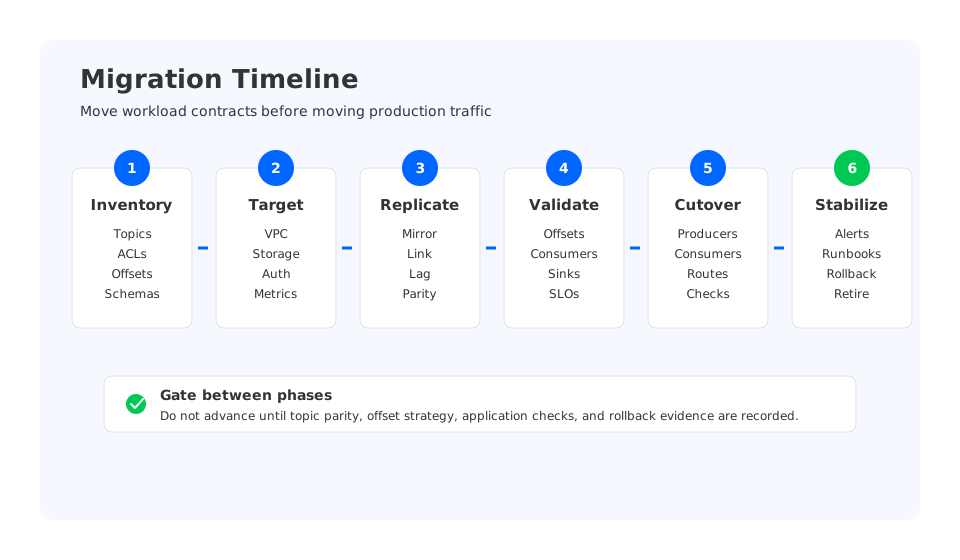
Confluent announced its acquisition of WarpStream on September 9, 2024, so some teams now evaluate migration as part of a broader platform-standardization or exit-planning discussion. That business context may create urgency, but it should not change the technical discipline. The plan starts with inventory, builds an AutoMQ target environment, runs replication and validation in parallel, cuts producers and consumers in controlled waves, and keeps rollback executable until the target platform has carried real traffic long enough to earn trust.
1What Must Survive the Migration
The first deliverable is a contract inventory that names every Kafka behavior the target platform must preserve. Without it, the migration team can only measure whether messages moved, not whether the workload kept its guarantees.
Start with topic shape: names, partition counts, retention, cleanup policy, compression, min.insync.replicas, message size limits, timestamp type, and application-specific overrides. Then capture client behavior: idempotence, transactions if used, isolation level, retry settings, batching, linger, compression, and offset commits. Kafka compatibility reduces the migration surface, but it does not remove the need to compare configuration, quota, and operational semantics.
The second layer is the ecosystem around the topics:
- Consumer groups and offsets: group IDs, committed offsets, lag profiles, reset policies, and restart expectations.
- Schema contracts: Schema Registry compatibility mode, subject naming strategy, and whether schemas are referenced by connectors or application release pipelines.
- Security model: authentication, ACLs, network access, encryption, IAM roles, secret distribution, and audit requirements.
- Connectors and stream processors: Kafka Connect tasks, Flink or Spark jobs, transactions, exactly-once assumptions, and sink-side idempotency.
- Operational dependencies: dashboards, alerts, SLOs, runbooks, autoscaling rules, backup expectations, and incident-response ownership.
Production Kafka is larger than retained records. A migration that preserves bytes but breaks a connector credential, consumer group expectation, or alerting rule still creates an outage. Every item that cannot be exported, reproduced, or validated becomes a named migration risk.
2Migration Phases
The most reliable migration plan uses overlapping phases rather than a single weekend switch. A platform team should be able to explain which phase is active, what evidence is required to exit it, and how to return to the previous phase if the evidence is weak.
| Phase | Primary goal | Exit evidence |
|---|---|---|
| Inventory | Define the source workload contract | Topics, configs, clients, offsets, schemas, ACLs, and runbooks are captured |
| Target setup | Build the AutoMQ environment | Networking, object storage, authentication, observability, and baseline topics are ready |
| Replication | Move live data into the target | Lag is bounded, topic mapping is verified, and representative consumers can read |
| Validation | Prove application behavior | Consumer offsets, schemas, ordering expectations, and sink behavior are checked |
| Cutover | Move production traffic | Producers and consumers operate on AutoMQ within the agreed window |
| Stabilization | Retire migration risk | Alerts are clean, rollback window is closed, and source dependencies are decommissioned |
This phase model avoids promising zero downtime or automatic offset preservation. Those outcomes depend on tooling, workload behavior, application tolerance, and the cutover pattern. AutoMQ documentation describes migration approaches including AutoMQ Kafka Linking and MirrorMaker 2-style replication, while Apache Kafka documents MirrorMaker 2 as a geo-replication and cluster-linking mechanism.
2.1Inventory and Compatibility Audit
The inventory phase should produce a machine-readable snapshot wherever possible. Export topic configuration, ACLs, consumer groups, connector configs, schema subjects, client versions, and traffic patterns. For each item, mark whether it is copied, recreated, tested, or retired.
For WarpStream, pay attention to where configuration and operational behavior are defined. WarpStream's public architecture documentation describes agents deployed in the customer's environment and a control plane that coordinates cluster operations, with object storage used as the main storage layer. Migration planning should separate Kafka workload state from platform-specific deployment state.
Ask these questions before the first replication job runs:
- Which topic configurations are part of the application contract, and which are source-platform defaults?
- Which consumer groups must preserve committed offsets, and which can restart from a timestamp or from latest?
- Which producers are safe to dual-write during validation, and which require a single writer to avoid duplicate side effects?
- Which sinks are idempotent, and which need a replay guard or manual reconciliation step?
- Which schema, ACL, and connector changes are owned by the platform team versus application teams?
The output should be a migration workbook, not a slide. Each row needs an owner, validation method, rollback note, and final disposition. If a team cannot assign an owner to a topic or consumer group, keep that workload out of the first wave.
2.2Target Environment Setup
The target AutoMQ environment should be built before replication begins. In AutoMQ's architecture, Kafka-compatible brokers are designed to be stateless from a storage-ownership perspective, while durable stream data is handled through S3Stream and object storage. In a BYOC deployment, the control plane, data plane, networking, and storage resources can be deployed in the customer's cloud account and VPC, which makes the target environment reviewable through familiar cloud controls.
Do not treat target setup as an infrastructure-only task. Create topics, configure authentication and authorization, define network paths for clients and replication workers, connect observability, and verify object storage policies, encryption, lifecycle settings, and access logs. Then run baseline tests with representative clients before the migration path carries real data.
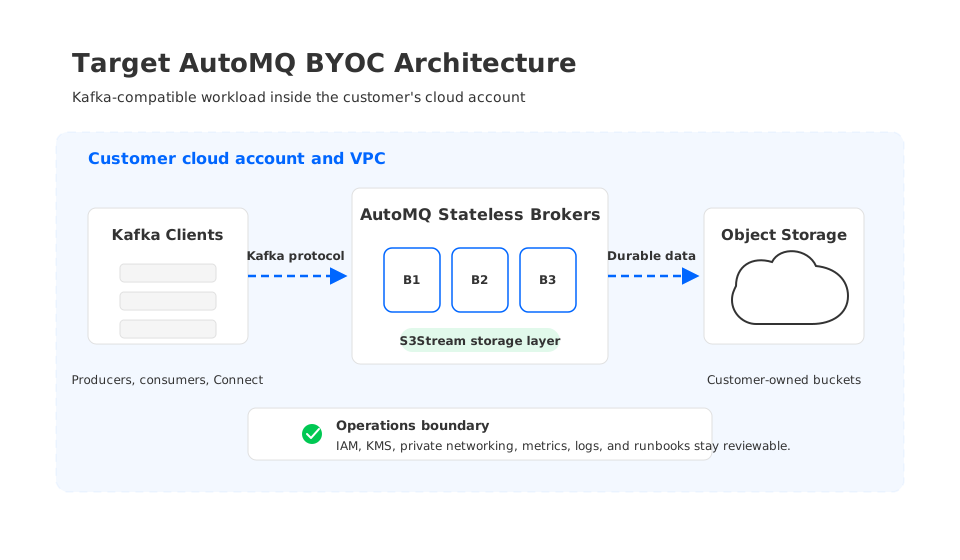
A useful target-readiness review covers four boundaries:
| Boundary | What to verify |
|---|---|
| Kafka protocol | Client versions, authentication mechanisms, topic configs, consumer groups, and admin tooling |
| Cloud account | VPC routes, private endpoints, security groups, IAM roles, KMS keys, and object storage ownership |
| Operations | Metrics, logs, alerts, runbooks, upgrade path, and support escalation |
| Cost and capacity | Broker sizing, object storage request pattern, network paths, retention, and expected read fan-out |
If the migration goal is to keep Kafka clients and ecosystem tools while moving to a shared-storage design with customer-owned cloud infrastructure, AutoMQ is a natural target to evaluate. The PoC still has to prove workload fit, especially for latency-sensitive consumers, heavy replay workloads, and applications with strict offset behavior.
2.3Replication, Validation, and Cutover
Replication creates the bridge, but validation decides whether the bridge is safe to drive production traffic across. Kafka teams usually choose between a replication tool such as MirrorMaker 2, AutoMQ Kafka Linking where appropriate, or a workload-specific bridge that writes to both clusters for a controlled period. The correct choice depends on topic count, required offset continuity, tolerance for duplicate delivery, schema and ACL migration needs, and whether producers can be changed independently from consumers.
The validation flow should include data, offsets, and application behavior:
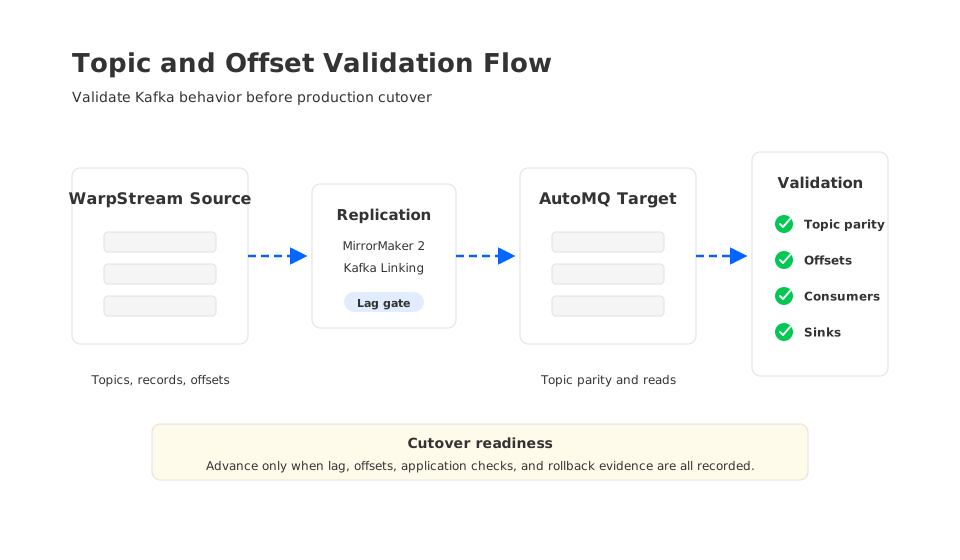
First, verify topic parity: partitions, key distribution, message format, headers, timestamps, compression, retention, and cleanup policy. Second, verify lag and ordering expectations. A topic can be "caught up" by byte volume while still violating key-order or timestamp-window assumptions if the mapping is wrong. Third, verify consumer behavior with representative consumer groups rather than synthetic readers only.
Offset validation deserves its own gate. Some workloads can reset consumers to a timestamp and tolerate bounded replay. Others require preserving committed offsets or coordinating a pause-drain-resume sequence. Stateful processors may need checkpoint alignment. Sink connectors may require idempotent writes, deduplication keys, or a temporary write freeze. State the chosen offset strategy per workload, with a test result attached.
A conservative cutover sequence often looks like this:
- Freeze topic and ACL changes on the source for the migration wave.
- Confirm replication lag is within the agreed threshold and stable.
- Stop or pause selected consumers where offset coordination is required.
- Move producers to AutoMQ for the selected topics, or switch traffic through a routing layer if one exists.
- Start consumers against AutoMQ using the validated offset strategy.
- Compare lag, error rates, throughput, sink counts, and application-level checks.
- Keep the source readable until rollback is no longer required.
This sequence is intentionally boring. The team should be watching known metrics and executing rehearsed commands, not inventing offset policy while customer traffic waits.
3Rollback Planning
Rollback is not a sentence in the change ticket. It is a reverse path with explicit data consequences. The plan must say what happens to messages produced after cutover, whether producers can be pointed back to WarpStream, whether those messages must be replicated back, and how consumers avoid double-processing.
The hardest rollback decisions are usually about writes. If producers have already written to AutoMQ, moving them back to WarpStream can create a split-brain history unless there is reverse replication or application-level reconciliation. If sinks are not idempotent, replaying from an earlier offset can create external side effects.
Use a rollback matrix before production cutover:
| Failure condition | Detection signal | Rollback action | Data consequence |
|---|---|---|---|
| Producer errors after switch | Error rate or timeout SLO breach | Restore producer bootstrap to source | Messages accepted by AutoMQ need reconciliation |
| Consumer lag grows unexpectedly | Lag, processing latency, sink backlog | Pause target consumers and resume source group | Offset mapping must be checked before resume |
| Schema or serialization failure | Deserialization errors, DLQ growth | Stop affected apps and restore previous config | Failed records need replay or DLQ handling |
| Sink duplication risk | External count mismatch | Freeze sink, compare checkpoints, resume one path | Requires idempotency or manual cleanup |
| Platform instability | Broker, network, or object storage alarms | Stop cutover wave and keep source active | No decommission until stability window passes |
Rollback shapes the cutover schedule. Smaller waves reduce blast radius but keep two platforms active longer. Larger waves simplify coordination but make reversal more expensive. For high-volume or business-critical workloads, rehearse with noncritical topics first.
4Why AutoMQ Is a Natural WarpStream Replacement Candidate
The architectural overlap between WarpStream and AutoMQ is the reason this migration question exists. Both speak to teams that want Kafka compatibility without returning to a traditional broker-local-disk operating model. Both place object storage at the center of durable data economics. Both are relevant when Kafka operators want to reduce the operational drag of storage-heavy brokers.
The differences matter for migration planning. WarpStream documentation describes a diskless model where agents use object storage and a cloud control plane coordinates operations. AutoMQ positions the target around Kafka-compatible stateless brokers, S3Stream, and shared object storage, with BYOC deployments designed around customer-owned cloud infrastructure. That makes AutoMQ especially relevant when the migration goal includes Kafka compatibility, object-storage-backed durability, customer-account control, and an open path to inspect architecture before standardizing.
AutoMQ should not be selected because a team wants a different vendor name on the same risk register. It should be evaluated when the target operating model is clear:
- Existing Kafka clients, Kafka Connect pipelines, stream processors, and admin workflows should remain broadly familiar.
- Durable data should live in customer-owned object storage rather than being tied to broker-local disks.
- Brokers should be easier to replace and scale because compute is less coupled to local persistent storage.
- The deployment boundary should be explainable to security and platform teams in terms of VPCs, IAM, object storage, and observability.
- The migration plan should be testable through replication, offset validation, application checks, and staged cutover.
A migration from WarpStream to AutoMQ is not won by declaring one architecture universally superior. It is won by proving that the target architecture preserves the workload contract while improving the operating model the team cares about: storage economics, scaling behavior, data control, operational visibility, or platform independence.
5Migration Readiness Checklist
Before scheduling a production cutover, require evidence for each checkpoint:
- Source inventory covers all topics, configs, ACLs, schemas, connectors, client owners, and consumer groups in the migration wave.
- AutoMQ target networking, authentication, object storage, observability, and topic configuration are validated with representative clients.
- Replication or linking is tested with production-like traffic shape, not only a small synthetic topic.
- Each consumer group has a documented offset strategy: preserve, translate, timestamp reset, drain-and-resume, or restart from latest.
- Each sink has a duplicate-handling strategy and a reconciliation method.
- Producers have a tested bootstrap or routing change, with a clear owner for every application.
- Dashboards compare source and target throughput, lag, errors, and application-level counts during the migration window.
- Rollback has been rehearsed for at least one workload in the wave.
- Decommission steps are delayed until the stabilization window is complete.
If your team is planning to replace WarpStream with AutoMQ, use the first PoC to validate migration mechanics. Prove topic parity, offset strategy, cutover behavior, rollback, and cloud-account boundaries on a representative slice of the workload. To evaluate AutoMQ as the target platform, start with the AutoMQ migration overview and the AutoMQ Cloud BYOC overview, then turn the checklist above into a workload-specific test plan.
6FAQ
6.1Can teams migrate from WarpStream to AutoMQ without changing Kafka clients?
In many cases, Kafka-compatible clients can continue using the Kafka protocol, but the migration still requires validation. Authentication, bootstrap endpoints, topic configuration, offset strategy, schema dependencies, and client-version behavior should be tested before production cutover.
6.2Does a WarpStream to AutoMQ migration require MirrorMaker 2?
Not always. MirrorMaker 2 is a common Kafka replication option, and AutoMQ also documents Kafka Linking as a migration approach. The right mechanism depends on topic count, offset requirements, change window, and tooling.
6.3Can consumer offsets be preserved automatically?
Do not assume that. Some tools can help translate or synchronize offsets under specific conditions, but each consumer group needs a validated strategy. For some workloads, a timestamp reset or drain-and-resume plan is safer.
6.4What should be tested first in an AutoMQ PoC?
Test the workload contract first: representative producers, consumers, topic configs, ACLs, schemas, replication lag, offset behavior, and rollback. Benchmarks are more useful after the team knows the application can migrate safely.
6.5When is AutoMQ a good replacement candidate for WarpStream?
AutoMQ is worth evaluating when a team wants Kafka compatibility, object-storage-backed durability, stateless broker operations, and a BYOC model where infrastructure and data control can be mapped to the customer's account.


