
Table of Contents
Table of Contents
The renewal invoice arrives, and for the third year in a row the number is larger than the forecast the platform team sent to finance. The conversation that follows is always the same: someone suggests leaving, someone else asks what the plan is, and the room goes quiet. Leaving a managed Apache Kafka service is not an architecture problem, because the destination cluster is usually the part a team can stand up in an afternoon. It is a sequencing problem. Teams start late and without a checklist, so dual-write windows drift, consumer offsets stop matching between clusters, and the rollback story is invented on cutover day. Four phases make an exit a controlled project instead of a weekend rescue: inventory, dual-write, cutover, and rollback stand-down, each with an entry condition and an exit condition.
1Leaving is a project, treat it like one
A migration that gets treated as an engineering task fails on dependencies, not on data. Nobody gets blocked copying topics. Teams get blocked because a connector, a schema registry, or a private-link route stayed pointed at the old cluster and surfaced as a production incident weeks into the window. Treating the exit as a project flips the sequence: inventory everything that touches the cluster before moving any traffic, move traffic behind explicit gates, and keep the old cluster out of reach of deletion until a decommission window closes.
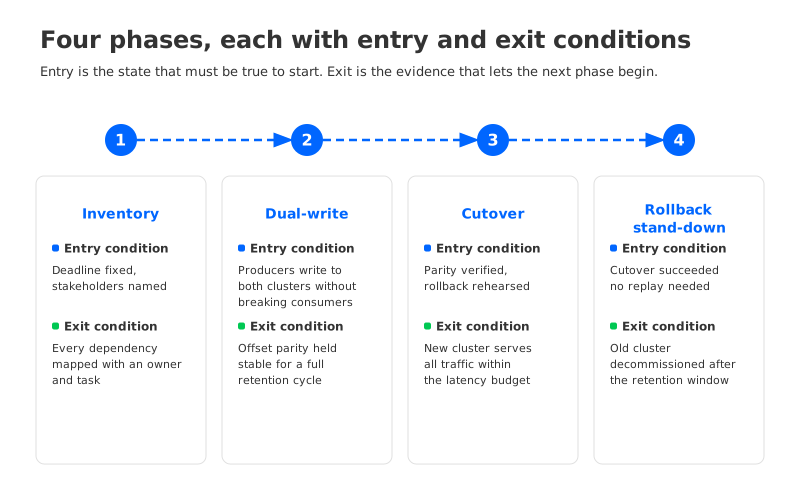
The four phases share one shape, the same one a chemical plant uses for a vessel handover. Each phase has an entry condition, the state that must be true before work starts; an exit condition, the evidence that lets the next phase begin; and a rollback position, the state the team returns to if the evidence fails. The discipline is not the diagram, it is refusing to start the next phase on a schedule. Cutover day does not arrive on the calendar. It arrives when the dual-write phase has exited.
| Phase | Entry condition | Exit condition |
|---|---|---|
| Inventory | Renewal deadline fixed and stakeholders named | Every dependency mapped with an owner and a migration task |
| Dual-write | Producers can write to both clusters without breaking consumers | Offset parity between clusters held stable for a full retention cycle |
| Cutover | Parity verified and rollback runbook rehearsed | All traffic served by the new cluster within the latency budget |
| Rollback stand-down | Cutover succeeded and no replay needed | Old cluster decommissioned after the retention window |
The exit conditions are deliberately measurable. "Stable for a full retention cycle" means the parity check survived the longest topic retention you run, so a record that lags for two weeks still has a matching copy on the new cluster before you commit. That single sentence does more work than a migration plan that names dates but never defines done.
2Phase one: inventory every dependency
The cluster is never the whole system. A managed Kafka service drags in Kafka Connect clusters, a schema registry, client bootstrap strings, identity and ACLs, metrics pipelines, and the private network paths that join them. Each one graduates on a different schedule, and scheduling them all for the same cutover window is how exits collapse.
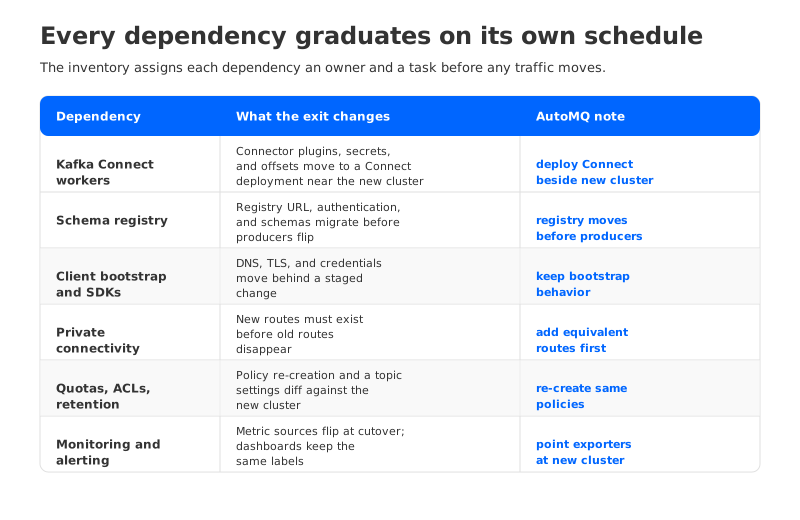
Build the inventory as a table, not a spreadsheet someone owns for a week. Every row needs the dependency, where it currently lives, who owns it, and what moving it changes. The table below is the minimum, not the ceiling; a team with compliance tooling or external consumers will add rows for audit exports and webhook sinks.
| Dependency | Where it lives today | What the exit changes |
|---|---|---|
| Kafka Connect workers | Managed connector fleet or sidecar cluster | Connector plugins, secrets, and offsets move to a Connect deployment near the new cluster |
| Schema registry | Provisioned with the managed service or self-hosted | Registry URL, authentication, and schemas migrate before producers flip |
| Client bootstrap and SDKs | Configuration in every producing and consuming app | DNS, TLS, and credentials move behind a staged change |
| Private connectivity | VPC endpoints, private links, peering routes | New routes must exist before old routes disappear |
| Quotas, ACLs, and retention | Managed console policies and topic settings | Policy re-creation and a topic settings diff against the new cluster |
| Monitoring and alerting | Managed metrics sinks and dashboards | Metric sources flip at cutover; dashboards keep the same labels |
Two rows deserve extra attention because they carry the migration's hidden schedule. Connectors do not migrate with the stream; they migrate with their own offsets and their own failure modes, so a source connector that has already committed the day's records to the old cluster cannot be re-pointed without a duplicate-or-gap decision. Private connectivity is the other one. A team that discovers on cutover day that its new cluster has no equivalent route is inventing a rollback, because the reversal path also used that route.
3Dual-write windows and offset parity
Dual-write is the phase most plans imagine correctly and execute carelessly. During the window, each producer writes the same record to the old cluster and the new cluster. Consumers keep reading the old cluster while the new one fills in the background. That buys time to validate lag, rebalances, and connector behavior without moving the reader fleet twice. The care comes from the fact that dual-write creates the migration's one true artifact: a claim that two streams are the same, which offset parity then has to prove.
Dual-write is the experiment. Offset parity is the proof that the experiment finished.
Parity has a precise meaning, and it is not "both clusters have messages." For every consumer group that will flip, the last committed offset on the old cluster must map to the same record position on the new cluster, within a lag tolerance the team writes down before the window opens. Build a mapping table of old-to-new partition assignments, snapshot each group's committed offsets from the old cluster, and translate them to the new one. The check runs on a schedule, not once: a parity gate that passes at 2 a.m. and breaks at 3 a.m. has done its job, which is to catch exactly that break.
Transactional workloads get one extra rule. Idempotent producers hide retries, but transactions must commit on the destination with the same boundaries or consumers will see a different set of committed records after the flip. Test the transactional path with a canary topic before promoting it to the full window.
The exit condition loops back to the inventory from phase one. Parity is only meaningful for the groups and connectors the inventory found, so a group that was never listed cannot be declared migrated. Teams that skip the inventory discover this when a forgotten batch job reconnects to the old cluster a month later and silently resumes at a stale offset.
4Cutover day and the rollback path
Cutover is short if the first three phases were honest. The shape that has survived production rounds is: freeze writes to the old cluster, let the dual-write drain through the read path, flip the reader fleet, flip the producers, observe, and then hold the old cluster in a rollback position through a full retention window. The order matters because readers flipping first gives the team a low-cost tripwire; a consumer that sees a bad offset on the new cluster fails before producers are changed.
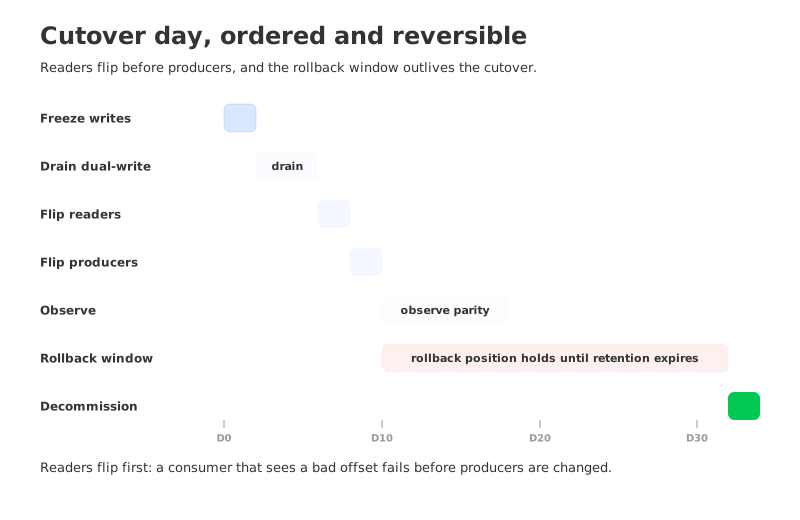
The rollback path is not a paragraph in the cutover runbook. It is a tested reversal, and it gets harder the longer the exit waits. Roll back the reader fleet to the old cluster and disable the flipped producers; the dual-write direction reverses, and the old cluster catches up from the records the new cluster received alone. The hard question is whether the team still knows how to do that three weeks after cutover. Rehearse the rollback against the staging environment with the same commands the on-call will run, because the runbook that was never rehearsed is a plan that was never finished.
The decommission decision is the last gate, and it should be boring. Hold the old cluster until the longest retention window has elapsed, confirm no consumer or connector has asked for it, and then delete it on a schedule someone pre-authorized. The renewal negotiation that started the whole project becomes the exit condition: finance wants the old service off the books, but it stays on the books one quarter longer because it is the only rollback position left.
5Lock-ins that are actually integration debt
The lock-ins that bind a team to a managed service rarely look like contracts. They look like properties the platform acquired over time: a private endpoint that every VPC trusts, a schema registry wired into a dozen pipeline repos, connectors whose secrets live in the managed console, and alerting tuned to the managed provider's metrics. None of these blocks an exit individually. Together they form a schedule, and they will not fit on the same day.
The way out is to treat each one as integration debt to be refinanced during the migration rather than a wall to be climbed. Refinancing a lock-in means replacing it with an equivalent the team controls before it is needed:
- A private endpoint becomes a route on the new cluster's network.
- A managed schema registry becomes a registry deployment run beside the brokers.
- A connector fleet becomes a Connect deployment with its plugins and secrets in the team's own infrastructure.
Each swap is a small project with a test, and the inventory table from phase one is where each swap gets a row and an owner.
If the destination is a Kafka-compatible platform, the same inventory applies unchanged, and AutoMQ is one way to work it. AutoMQ preserves the Kafka protocol, so clients, SDKs, and tooling keep their bootstrap behavior in the migration, while Connect and schema registry are planned separately as the inventory rows they always were. Its compatibility with Apache Kafka and architecture overview are the two references to add to the inventory's AutoMQ column before scoring the target.
The exit finishes at a decision gate, not at a deployment. A team leaves a managed Kafka service when the four phases have each exited, the rollback position has expired, and the inventory has no open rows. Everything before that gate is sequencing and hygiene. Run the same planning loop against the AutoMQ Open Source project, and start with the inventory table; the migration you can prove is the one you are allowed to finish.
6References
- Apache Kafka documentation
- Apache Kafka replication configuration
- Apache Kafka broker configuration, including min.insync.replicas
- Apache Kafka KIP-405: Kafka Tiered Storage
- AutoMQ compatibility with Apache Kafka
- AutoMQ shared streaming storage overview
- Operational readiness checklist for consumer offset validation
- Dual-cluster validation for low-risk streaming migration
- Kafka monitoring that finds problems before consumers do
7FAQ
7.1Why is leaving a managed Kafka service mostly a sequencing problem?
Because the destination cluster is rarely the hard part. The failure modes live in the dependencies that accumulate around the service: connectors with their own offsets, a schema registry wired into pipeline repos, private-link routes, and client bootstrap strings. Those move on different schedules, so an exit without an ordered plan collides them all onto one cutover day. Sequencing the phases with entry and exit conditions prevents that collision.
7.2What should a dual-write window actually prove before cutover?
It should produce offset parity, not merely duplicated traffic. For every consumer group that will flip, snapshot the committed offsets on the old cluster, translate them through a partition mapping to the new cluster, and confirm the positions match within a written lag tolerance. The check runs on a schedule so a parity break is caught when it happens, not discovered after the reader fleet has flipped.
7.3How do connectors migrate during a Kafka service exit?
Connectors move as their own workstream with their own offsets and failure modes. They are copied to a Connect deployment near the new cluster with the same plugins and secrets, then cut over per connector with a duplicate-or-gap decision documented. They do not ride along with the streams themselves, which is why the dependency inventory treats them as a first-class row rather than a footnote.
7.4When is it safe to delete the old cluster?
After the longest retention window has elapsed and no consumer or connector has requested the old cluster in that time. The old cluster is the only rollback position the team has, so it stays up, and billed, until the retention window confirms that no record needs to be replayed. Decommissioning comes from the pre-authorized schedule tied to that window, not from the day cutover succeeds.
7.5Does the same plan work when the destination is Kafka-compatible rather than self-managed?
Yes, with the same inventory unchanged. A Kafka-compatible destination that preserves the protocol keeps clients, SDKs, and tooling behaving as they do today, while Connect and schema registry remain separate workstreams in the inventory. The exit conditions for dual-write, parity, and rollback do not change with the destination's storage design.


