
Table of Contents
Table of Contents
Teams search for migration freeze window kafka when a migration has moved from architecture discussion to production risk. The new cluster may already be deployed. Replication may be running. Application teams may have tested a few consumers. The remaining question is harder than "can we move traffic?" It is "can we move traffic, observe the result, and still go back without inventing a recovery plan during an outage?"
A freeze window exists because Kafka cutovers change more than bootstrap servers. They change producer write paths, consumer group positions, connector task ownership, ACL enforcement, monitoring baselines, incident runbooks, and often the cost model behind storage and network traffic. The window is the period where teams deliberately reduce change so that one migration variable can be isolated. When the window is planned well, it creates confidence. When it is treated as a calendar hold, it becomes a narrow bridge with no guardrails.
The strongest migration plans do not assume the cutover will be perfect. They assume some part of the system will behave differently under real production load: a client library uses an older protocol path, a connector retries in a pattern that never appeared in staging, a consumer group shows lag because the destination cluster has different fetch behavior, or an observability dashboard misses the one metric the on-call engineer needs. Reversibility is the operating principle that keeps these surprises from becoming permanent.
1Why teams search for migration freeze window kafka
The search intent is usually urgent but not naive. The reader already understands Kafka well enough to know that a streaming migration is not a database dump and restore. Kafka is a live coordination system: producers keep appending records, consumers commit offsets, controllers manage partition leadership, connectors hold external system state, and applications often use the log as part of their availability story. Freezing changes is not about stopping the business. It is about narrowing the uncertainty during a controlled switch.
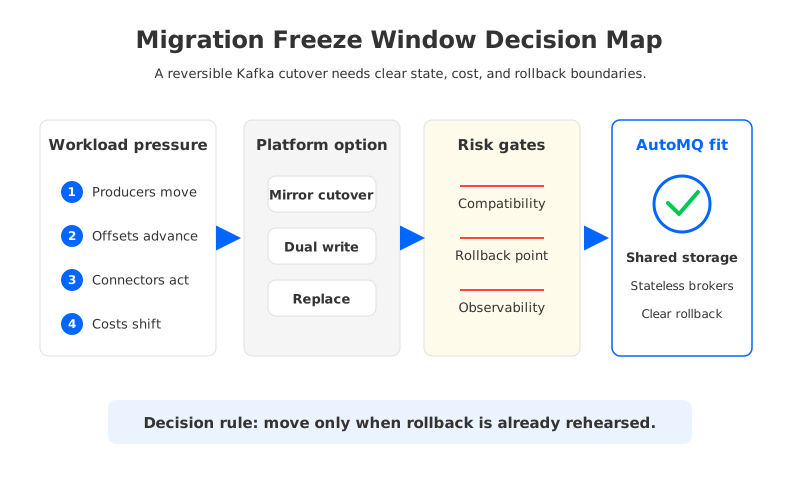
The pressure usually comes from one of four situations:
- A platform team is moving from self-managed Kafka to a Kafka-compatible service and needs an auditable cutover plan.
- An SRE team is replacing aging broker fleets, overloaded disks, or brittle cross-AZ replication patterns.
- A data engineering team must preserve consumer offsets and connector behavior while changing the cluster endpoint.
- A CTO or architecture review board wants rollback criteria before approving production traffic movement.
Those situations have different stakeholders, but the same failure mode: the migration plan focuses on forward motion and leaves rollback as a sentence in a runbook. "If something goes wrong, switch back" sounds reasonable until the team asks what happens to records produced after the switch, which consumer offsets are authoritative, whether connectors should rewind, and whether old brokers still contain the needed data.
2The production constraint behind the freeze window
Kafka's operational model makes cutovers sensitive because state is spread across several layers. Topic data lives in partition logs. Consumer progress is stored as offsets. Exactly-once workloads depend on transaction state. Connectors keep task state and interact with external systems. Metadata and controller behavior depend on the cluster's coordination layer, including KRaft-based Kafka deployments. A cutover that moves only client endpoints but ignores one of these state surfaces can appear successful for producers while consumers or downstream systems drift out of sync.
The freeze window should therefore define which state is allowed to change, which state must be mirrored, and which state becomes the rollback source of truth. If producer writes move to the destination cluster while some consumers still commit offsets to the source, the team has created a split-brain operational model even if no single component is broken. If connector tasks continue writing to external sinks from both clusters, rollback can duplicate side effects. If ACLs, quotas, and topic configurations differ, an incident may look like a migration bug when it is actually a governance mismatch.
A strong window design starts before the cutover hour. The team needs a known-good baseline for throughput, end-to-end latency, consumer lag, error rates, disk pressure, broker CPU, controller health, and network traffic. It also needs a rule for when to stop trying to fix forward and roll back. That rule should be written in operational language: "rollback if order ingestion lag remains above the agreed threshold for two consecutive checks" is useful; "rollback if things look bad" is not.
3Architecture options and trade-offs
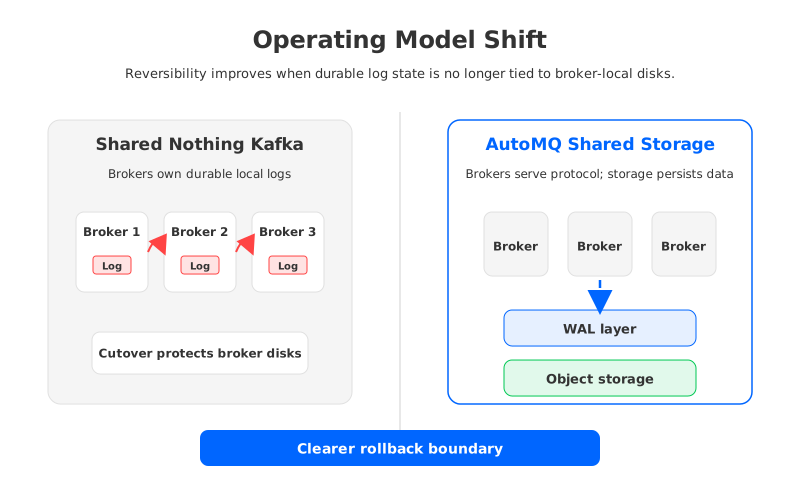
Traditional Kafka deployments use a shared-nothing architecture. Each broker owns local storage for the partitions it hosts, and durability comes from replication across brokers. This design is proven and widely understood, but it shapes the migration freeze window in concrete ways. Moving partitions means moving data. Scaling storage often means scaling brokers. Rebalancing can create additional disk and network pressure. Cross-AZ replication protects availability, but it also turns write traffic into inter-zone data movement that must be monitored during the migration.
Tiered Storage changes part of this model by offloading older log segments to remote storage, and it can reduce pressure on local disks for historical data. It does not automatically make brokers stateless during a cutover. The hot path, leader placement, replication, and local recovery behavior still matter. For a freeze window, that distinction is practical: if the rollback plan depends on broker-local data, the source cluster must remain healthy and sufficiently provisioned through the full validation period.
Kafka-compatible alternatives usually fall into three migration patterns. A replace-in-place plan keeps clients mostly unchanged but swaps the backend. A dual-write plan sends new records to both systems during validation, which can reduce data loss risk but increases application complexity and duplicate-handling requirements. A mirror-and-cutover plan copies topics and offsets to the destination, then changes traffic once lag and compatibility checks pass. None is universally correct; each trades implementation effort against rollback clarity.
| Migration pattern | What it protects | What it complicates | Freeze-window implication |
|---|---|---|---|
| Mirror and cut over | Topic continuity and staged validation | Offset translation, lag monitoring, final sync point | Best when rollback can point to a clear source of truth |
| Dual write | New writes during validation | Idempotency, ordering assumptions, duplicate side effects | Best for applications already designed for duplicate handling |
| Replace in place | Client simplicity | Backend compatibility and blast radius | Works when compatibility and rollback are heavily rehearsed |
The architecture decision should be tied to the business meaning of the streams. A metrics topic may tolerate replay. A payment event topic may not. A CDC stream feeding a warehouse has different rollback semantics from a command stream that triggers external actions. Freeze windows become safer when topics are grouped by recovery behavior instead of by team ownership alone.
4Evaluation checklist for platform teams
Before choosing a Kafka-compatible target, evaluate it through the migration window rather than only through steady-state benchmarks. A steady-state cluster can look excellent while still making cutovers hard because it lacks tooling for offset validation, makes network paths opaque, or requires storage movement before capacity changes take effect. The question is not only "will it run Kafka workloads?" The question is "will it let the team make a reversible production decision under pressure?"
Use this checklist as a readiness scorecard:
- Client compatibility: Validate producer, consumer, admin, and transaction behavior with the actual client versions in production, not only with a current client in a sample app.
- Offset and consumer group handling: Confirm how offsets are mirrored, translated, reset, or preserved, and test lag dashboards from the perspective of the application team.
- Connector behavior: Treat Kafka Connect separately from raw topics. Source connectors, sink connectors, task rebalance behavior, and external side effects need their own rollback procedure.
- Security and governance: Compare ACLs, quotas, authentication, encryption, topic policies, and audit trails before the window starts.
- Cost and capacity: Model broker compute, local disk, object storage, inter-zone traffic, private connectivity, and temporary double-running costs during the migration.
- Rollback boundary: Decide whether rollback means switching clients back, replaying records, pausing consumers, restoring connectors, or declaring the destination authoritative.
- Observability: Create dashboards that compare source and destination by topic, partition, consumer group, and client error category.
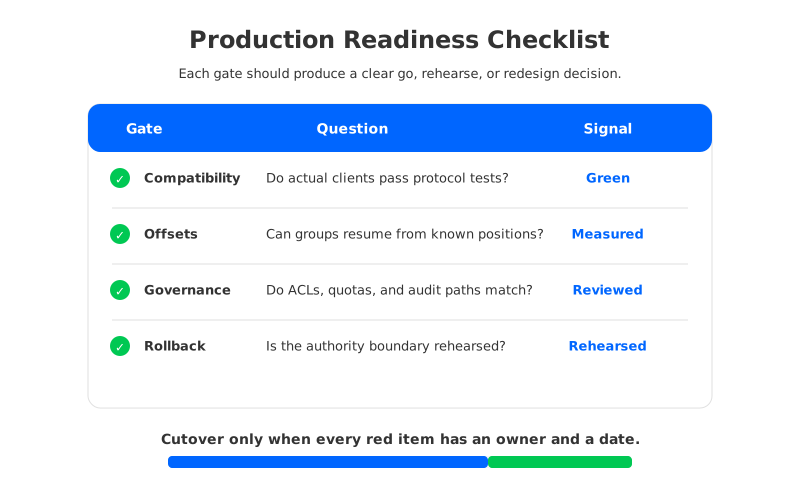
The checklist should produce a decision, not a feeling. One practical method is to assign each workload a readiness status: green for cutover, yellow for more rehearsal, red for architecture change required. The status should include the reason. "Yellow because connector rollback is untested" gives engineering leaders something to fix. "Yellow because the team is nervous" does not.
5How AutoMQ changes the operating model
Once the evaluation framework is clear, the architectural pattern that makes freeze windows shorter is straightforward: reduce the amount of broker-local state that must be protected during the cutover. AutoMQ is a Kafka-compatible streaming system built around shared storage, where brokers are designed to be stateless relative to durable log storage. Instead of treating broker disks as the long-lived data boundary, AutoMQ stores streaming data on object storage and uses a write-ahead log layer for the low-latency write path.
That shift changes migration operations in several ways. Compute and storage can scale independently, so capacity planning for the cutover does not have to overfit broker-local disk placement. Broker replacement is less tied to moving partition data from one machine to another. Object-storage-backed durability gives the team a clearer separation between the data plane's durable storage and the compute layer serving Kafka protocol requests. For a migration freeze window, that separation reduces the number of moving parts that must remain perfectly aligned while traffic is being switched.
AutoMQ also matters for cloud cost analysis because traditional Kafka replication can turn availability design into cross-AZ traffic. In a shared-storage architecture, the goal is to avoid unnecessary inter-zone replication traffic while preserving durability through the storage layer and WAL design. That does not remove the need for network modeling; private connectivity, client placement, and cloud region choices still matter. It does give platform teams a different set of levers than "add brokers, add replicas, and hope the bill is acceptable."
The migration story is still not magic. Teams must test client compatibility, validate offset behavior, rehearse rollback, and monitor real workloads. AutoMQ's value is that the underlying operating model is less dependent on broker-local storage, which means a migration can be evaluated around protocol compatibility, data correctness, governance, and application behavior rather than around large data movement between broker disks.
For teams planning a Kafka-compatible migration, the most useful next step is to test the exact workload class that drives the freeze window: one producer path, one consumer group, one connector or downstream dependency, and one rollback drill. AutoMQ's migration documentation is a practical starting point: review the migration path in the AutoMQ docs.
6A reversible Kafka cutover playbook
A migration freeze window should be designed as a sequence of gates. The first gate is readiness: all topic configs, ACLs, quotas, client versions, connector plans, and dashboards are reviewed before the window. The second gate is sync: replication lag, offset state, and destination health are checked against agreed thresholds. The third gate is traffic movement: producers, consumers, and connectors are switched in an order that matches the business risk of the workload. The final gate is authority: the team declares which cluster is the source of truth after validation.
Rollback belongs in every gate. Before traffic moves, rollback may mean delaying the cutover. During the first production traffic check, rollback may mean switching producers back and draining destination consumers. After the destination has accepted writes for a sustained period, rollback may require replay or reconciliation rather than a simple endpoint change. The plan should name that boundary clearly because it determines how long the source cluster must remain untouched.
Here is the operational test: if the incident commander asks "what do we do now?" during the freeze window, the answer should be a previously rehearsed branch in the runbook. The team should not need a whiteboard to decide whether offsets, connector side effects, or newly produced records make rollback unsafe. Reversibility is not the absence of risk; it is the presence of a decision path while production is moving.
7References
- Apache Kafka documentation: distribution and replication
- Apache Kafka documentation: Kafka Connect
- Apache Kafka documentation: KRaft mode
- Apache Kafka documentation: Tiered Storage
- Apache Kafka documentation: transaction protocol
- AutoMQ documentation: architecture overview
- AutoMQ documentation: S3 storage
- AutoMQ documentation: WAL storage
- AutoMQ documentation: migration overview
- AWS documentation: Amazon S3 user guide
8FAQ
8.1What is a Kafka migration freeze window?
A Kafka migration freeze window is a controlled period where teams limit unrelated production changes while moving or validating Kafka traffic. The goal is to isolate migration risk across producers, consumers, connectors, offsets, governance, and observability.
8.2How long should a Kafka cutover freeze window be?
The window should be based on workload validation time, not a generic duration. A low-risk metrics topic may need a short validation cycle, while a transactional or CDC workload may need longer observation, connector checks, and rollback rehearsal.
8.3What makes a Kafka cutover reversible?
A cutover is reversible when the team knows which cluster is authoritative, how offsets will be handled, what happens to records written after the switch, and how connector side effects will be controlled. Reversibility must be tested before the production window.
8.4Does Kafka Tiered Storage remove migration risk?
Tiered Storage can reduce pressure from historical data on local disks, but it does not automatically remove migration risk. Hot data, leader placement, replication behavior, offsets, transactions, connectors, and application compatibility still need explicit validation.
8.5Where does AutoMQ fit in a Kafka migration plan?
AutoMQ fits when a team wants Kafka protocol compatibility with a shared-storage architecture that reduces dependence on broker-local durable storage. It does not remove the need for migration discipline, but it can simplify the operating model behind cutover, scaling, and recovery decisions.


