
Table of Contents
Table of Contents
Teams searching for diskless kafka are rarely looking for a vocabulary lesson. They already know why broker-local disks are painful: storage is sized for retention peaks, partition movement takes operational attention, multi-zone replication has a network cost profile, and broker replacement is not as disposable as compute replacement should be. The question behind the search is whether Kafka-style streaming can keep its familiar contracts while durable data moves away from local broker disks.
That is a migration question before it is a product question. Apache Kafka KIP-1150 describes diskless topics as a direction where topic data is written through to remote storage while brokers retain compatibility with existing Kafka client behavior. The KIP is marked accepted, but acceptance does not mean every production Kafka estate can flip a switch. Platform teams still need guardrails for workload selection, semantic compatibility, cost modeling, rollback, and incident response.
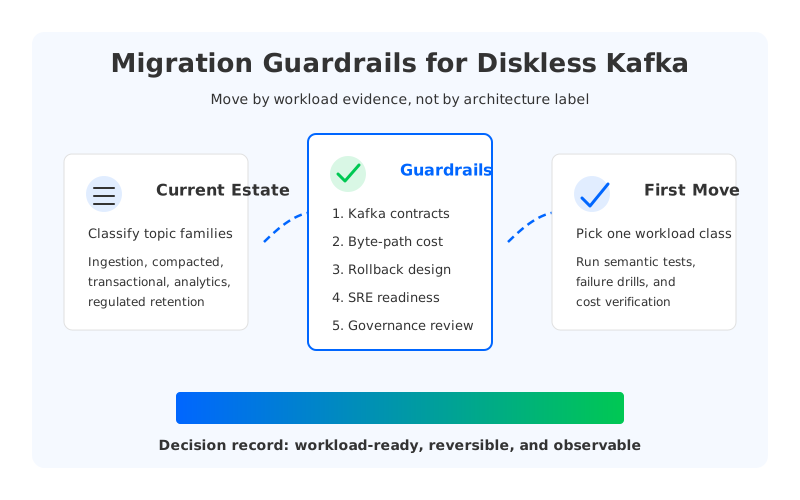
The useful migration plan starts with a sharper definition. "Diskless" does not mean a broker process never touches disk. Brokers may still use local resources for the operating system, metadata-related files, cache, logs, or temporary buffering. The meaningful shift is that broker-local disks stop being the primary durable home for user topic data. That one shift changes how the platform recovers, scales, serves reads, and accounts for infrastructure cost.
1Why Diskless Kafka Needs Guardrails
Classic Kafka combines request handling and durable log ownership in the broker. This design is familiar and battle-tested, but it makes storage an operational anchor. A broker is not only a compute unit; it also owns partition replicas, retention responsibility, and recovery state. When the estate grows, every capacity discussion turns into a combined CPU, memory, disk, network, and rebalance discussion.
Diskless Kafka tries to separate those concerns by moving durable topic data toward shared or remote storage. That can make compute more elastic and reduce the amount of data that must be copied between brokers, especially in cloud environments where inter-zone traffic and block storage are explicit line items. But the migration risk is also real because Kafka applications depend on behavior, not on architecture diagrams. Producers expect acknowledgments to mean something precise. Consumers expect offsets to remain meaningful. Security teams expect access control and auditability to survive the storage shift.
The first guardrail is therefore simple: never evaluate diskless Kafka as a storage replacement alone. Evaluate it as a change to the durability boundary behind Kafka semantics. If that boundary is unclear, the migration is not ready.
2Guardrail 1: Separate Workload Classes Before Choosing a Path
Most Kafka estates are not one workload. They are a portfolio of topic classes that happen to share a platform. A high-throughput clickstream topic, a compacted account-state topic, a Kafka Streams changelog, a transactional payment event stream, and a long-retention audit log do not carry the same migration risk.
Group topics by behavior before you group them by owning team:
- Append-heavy ingestion topics are often the first candidates because they depend mainly on ordered writes, durable replay, and scalable retention.
- Compacted topics and state stores require deeper validation because compaction timing, tombstones, and changelog recovery expose semantic edges.
- Transactional or idempotent producer workloads need explicit tests for fencing, abort behavior, retries, and recovery after broker loss.
- High fan-out analytics topics should be tested for cache behavior and remote-read amplification, not only for write throughput.
- Regulated retention topics need governance review for encryption, IAM, lifecycle policy, deletion behavior, and audit access.
This classification prevents an average from hiding the hard cases. A diskless architecture can be a strong fit for ingestion and replay while still requiring additional work for compacted or transactional workloads. A mature migration plan says which topics move first, which stay on classic Kafka, and which need a separate proof of concept.
3Guardrail 2: Do Not Confuse Tiered Storage With Diskless Durability
Tiered Storage and diskless Kafka both use remote storage, but they solve different parts of the problem. Tiered Storage offloads older log segments after they age out of the hot path. It helps with long retention and catch-up reads, while the active log can still depend on broker-local storage and traditional replication. Diskless Kafka changes the primary durability path for topic data, so broker disks are no longer the main system of record.
That distinction matters during migration. If the target problem is "we keep too much historical data on expensive broker disks," Tiered Storage may be enough. If the target problem is "broker-local durability makes scaling, recovery, and cloud traffic too expensive," diskless Kafka deserves evaluation. The wrong choice usually comes from using an architecture label instead of naming the operational pain.
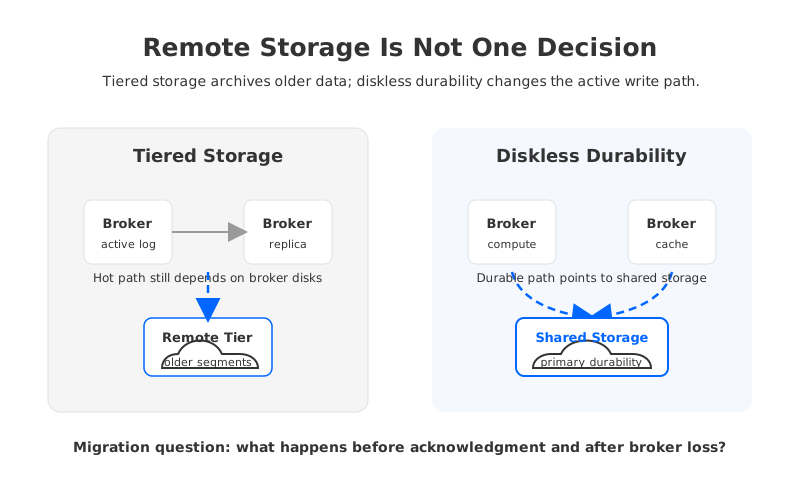
A review board should ask four questions before approving a diskless path: where is the first durable write, when is a produce request acknowledged, how are hot reads served, and how does recovery work when the broker that accepted the write disappears? Those questions expose whether the design is actually changing durability or merely adding a remote archive.
4Guardrail 3: Test Kafka Contracts, Not Only Throughput
Kafka migration failures often begin with a benchmark that was too narrow. Throughput and p99 latency matter, but they are not the whole contract. Kafka clients rely on ordering by partition, offset visibility, consumer group coordination, retention, compaction, idempotent producer behavior, transactions where used, ACLs, quotas, and admin APIs. Connectors, stream processors, schema tooling, and observability systems add their own assumptions.
Use a compatibility matrix that names the contract directly.
| Contract Area | Migration Test | Evidence to Keep |
|---|---|---|
| Producer semantics | Acks, retries, idempotence, transactions, error handling | Client logs, broker metrics, duplicate and loss checks |
| Consumer behavior | Rebalance, committed offsets, lag recovery, catch-up reads | Offset continuity, lag curves, cold-cache latency |
| Topic features | Retention, compaction, deletion, partition changes | Topic config diff and lifecycle test results |
| Security | Authentication, ACLs, encryption, audit access | Access test, IAM review, audit log sample |
| Operations | Scale-out, scale-in, broker loss, upgrade, rollback | Runbook timings and incident drill notes |
The table should be filled with representative workloads, not synthetic happy paths. If your estate uses older Java clients, Kafka Connect, Flink, MirrorMaker, or custom admin scripts, include them. The goal is to discover whether the migration is client-transparent enough for the workload class being moved. "Kafka-compatible" is a claim worth testing in the exact places where your platform already has history.
5Guardrail 4: Model Bytes, Not List Prices
Diskless Kafka cost analysis should follow bytes through the platform. Traditional Kafka often pays for block storage, replica traffic, broker headroom, rebalancing, and consumer egress. A shared-storage design changes the shape of those costs by reducing the need to move retained data with brokers and by making object storage part of the primary data path. It may also add costs for storage requests, WAL resources, cache misses, or private connectivity.
The model should separate at least five flows: producer ingress, durability writes, broker-to-broker or broker-to-storage movement, consumer reads, and operational churn from scaling or recovery. Cross-zone paths deserve special attention because AWS and other cloud providers price data movement separately from compute and storage. A migration case that ignores network topology is not a cost model; it is a storage comparison.
For each workload class, write the current and target byte path in one row. Then attach assumptions: write rate, read fan-out, retention period, average record size, compression ratio, client zone placement, cache hit expectation, and recovery frequency. This does not need to be a perfect financial forecast. It needs to show which costs are expected to fall, which costs are expected to appear, and which assumptions can break the business case.
6Guardrail 5: Design Rollback Before Cutover
Rollback is harder when the durable storage boundary changes. In a broker-local Kafka migration, rollback may mean redirecting clients to the old cluster after mirroring. In a diskless migration, the team must also reason about where acknowledged writes live, how offsets map, which system owns writes during the test window, and whether consumers can resume without double-processing or skipping records.
Treat rollback as a first-class design artifact. Define the write owner at every phase. Decide whether the source and target platforms run in active-passive, dual-write, mirror, or replay mode. Record the conditions that trigger rollback and the maximum acceptable data reconciliation window. Then rehearse the rollback with a workload that produces real offsets, not an empty topic.
The migration is not ready until the platform team can answer three questions under incident pressure: which cluster is authoritative for each topic, how clients return to the previous path, and how the team proves that no acknowledged data was lost. These answers matter more than the cutover automation because incidents usually happen when automation meets an exception.
7Guardrail 6: Put Operations and Governance in the Same Review
Diskless Kafka changes what SREs monitor and what security teams govern. Broker disk alerts may become less central, but object storage health, WAL behavior, cache efficiency, cloud identity policy, encryption keys, and storage request patterns become part of the streaming platform. That shift is healthy only if ownership is explicit.
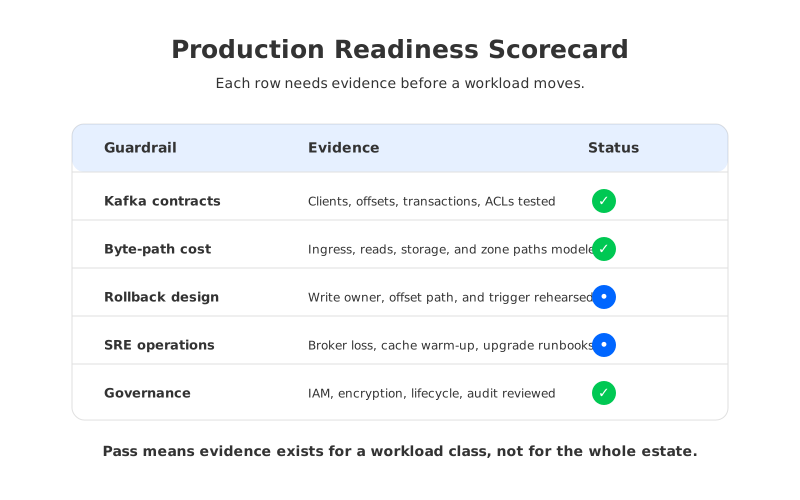
The scorecard should include:
- SRE readiness: replacement time, cache warm-up behavior, storage dependency alerts, zone-routing tests, and upgrade procedure.
- Security readiness: object storage IAM, encryption at rest and in transit, audit access, deletion policy, and least-privilege review.
- Data governance: retention enforcement, legal hold behavior, lifecycle configuration, and evidence for regulated workloads.
- FinOps readiness: current and target bill lines, network assumptions, storage request estimates, and scale-out cost behavior.
- Application readiness: client versions, failure semantics, dashboards, runbooks, and acceptance owners.
Keeping these reviews together avoids a common failure pattern: architecture approves the design, SRE discovers additional dependencies later, and security reviews object storage permissions after data has already moved. Diskless Kafka is a platform boundary change, so the approval path should match the boundary.
8Where AutoMQ Fits in the Evaluation
After the guardrails are clear, AutoMQ belongs in a specific evaluation category: Kafka-compatible streaming with a shared-storage architecture. AutoMQ keeps Kafka protocol compatibility as the user-facing contract while rebuilding the storage layer around object storage through S3Stream. Brokers are designed to be stateless with respect to durable user data, and WAL plus cache layers handle latency-sensitive writes and reads that raw object storage alone would not satisfy.
That architecture is relevant when the migration goal is to reduce the operational weight of broker-local disks without forcing application teams to abandon Kafka clients and ecosystem tooling. It also maps to the guardrails above: compatibility can be tested with existing clients, cost can be modeled around compute, object storage, WAL, and network paths, and operations can be drilled around broker replacement rather than large local-log recovery.
The right AutoMQ proof of concept should not be a generic demo. Pick one workload class, preserve its real client behavior, and run the full scorecard: produce and consume semantics, tail and catch-up reads, broker loss, zone placement, IAM, observability, and rollback. If the workload passes, the team has a decision record that is useful beyond AutoMQ itself. It explains why that topic class is ready for shared-storage Kafka-compatible streaming.
If local-disk operations and cloud traffic costs are now shaping your Kafka roadmap, start with the guardrails rather than the slogan. Build the workload matrix, test the contracts, and rehearse rollback before production cutover. For a concrete shared-storage implementation to evaluate, review AutoMQ's overview and deployment model with the same scorecard.
9References
- Apache Kafka KIP-1150: Diskless Topics
- Apache Kafka Documentation: Tiered Storage
- Apache Kafka Documentation: Design
- Amazon EC2 On-Demand Pricing: Data Transfer
- Amazon S3 Pricing
- AutoMQ Documentation: What is AutoMQ?
- AutoMQ Documentation: S3Stream Shared Streaming Storage
- AutoMQ Documentation: Eliminate Inter-Zone Traffic
10FAQ
10.1Does diskless Kafka mean brokers have no local disks?
No. It means broker-local disks are no longer the primary durable storage layer for user topic data. Brokers may still use local disk for cache, logs, temporary files, operating system storage, or metadata-related functions.
10.2Is diskless Kafka the same as Tiered Storage?
No. Tiered Storage usually offloads older segments while the active log still depends on broker-local storage. Diskless Kafka changes the primary durability path, which affects recovery, scaling, and cost behavior.
10.3Is KIP-1150 already a production migration plan?
No. KIP-1150 is accepted as an Apache Kafka design direction, but production readiness depends on implementation details, release support, operational tooling, and workload testing. Treat it as a signal for the category, not as a complete runbook.
10.4Which workloads should move first?
Append-heavy workloads with clear replay behavior, meaningful retention cost, and moderate latency sensitivity are usually better first candidates. Compacted, transactional, and high fan-out workloads need deeper validation before cutover.
10.5How should AutoMQ be evaluated?
Evaluate AutoMQ with the same guardrails used for any diskless Kafka candidate: Kafka client compatibility, write durability, read behavior, cost model, broker failure recovery, cloud identity, observability, and rollback.


