
Table of Contents
Table of Contents
MirrorMaker 2 is often the first answer when a Kafka team needs to copy data from one cluster to another. It is part of the Apache Kafka ecosystem, it is built on Kafka Connect, and it understands common replication use cases such as topic mirroring, checkpoints, and heartbeats. For many teams, that is enough to start a disaster recovery plan, a regional copy, or a migration rehearsal without buying another product.
The hard part is that a Kafka migration is rarely only a data-copy problem. A production cutover also has topic configuration, ACLs, certificates, schema dependencies, consumer group positions, connector ownership, monitoring, application rollout order, and rollback boundaries. A replication tool can move records while both clusters are alive. It cannot, by itself, prove that every consumer will resume at the intended business point or that every producer will move without duplicate writes.
That is why searches for a MirrorMaker 2 alternative usually come from a practical place. Operators are not asking whether MM2 is useful. They are asking whether MM2 is the right operating model for their topology, failure tolerance, cloud provider, target platform, and cutover window.
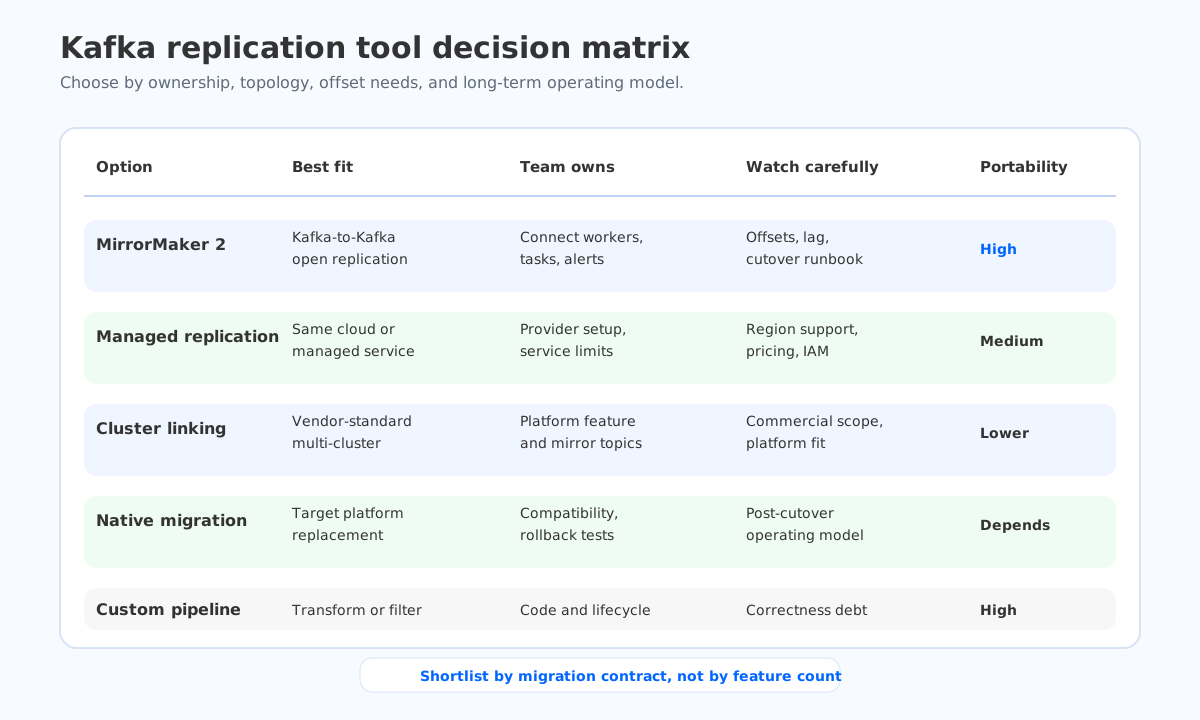
The right selection process starts with the migration objective, not the tool list. A one-time cluster replacement, an ongoing disaster recovery copy, an active-passive regional architecture, and a bidirectional active-active design place different pressure on offset handling, conflict management, observability, and ownership.
1When Kafka Teams Reach for MirrorMaker 2
MirrorMaker 2 replaced the older MirrorMaker approach with a Kafka Connect based architecture. Instead of running a simple consumer-producer copying loop, teams run Connect workers with dedicated connectors for source replication, checkpoint emission, and heartbeat topics. That design gives operators a more structured way to mirror topics between clusters and track cross-cluster replication state.
MM2 fits especially well when the source and target are both Kafka clusters and the team wants an open, Kafka-native mechanism they can run themselves. Common scenarios include:
- Replicating selected topics from one Kafka cluster to another for migration testing.
- Building an active-passive disaster recovery copy where the target cluster is normally idle or mostly read-only.
- Moving workloads between environments, accounts, regions, or hosting models while keeping the Kafka API.
- Maintaining a reporting or analytics cluster that reads replicated topics without placing extra load on the source cluster.
The appeal is clear: MM2 keeps the replication layer close to Kafka operations. Teams that already understand Kafka Connect, connector tasks, worker sizing, offset storage, and internal topics can inspect topics, tune connector properties, watch lag, scale workers, and integrate the process into existing runbooks.
That familiarity is also the boundary. MM2 is not a fully managed migration service. It does not remove the need to design network connectivity, capacity, topic allowlists, checkpoint policy, ACL replication strategy, schema handling, observability, or cutover validation. If the migration team does not already operate Kafka Connect reliably, MM2 may add another distributed system at the same moment the organization is trying to reduce migration risk.
2What MM2 Does and What Teams Must Still Operate
MM2 is best understood as a set of replication components that run on Kafka Connect. The source connector copies records from source topics to target topics. The checkpoint connector emits mappings that help with consumer offset translation. The heartbeat connector writes heartbeat records so teams can observe cross-cluster reachability and replication health. Internal topics hold connector state and metadata.
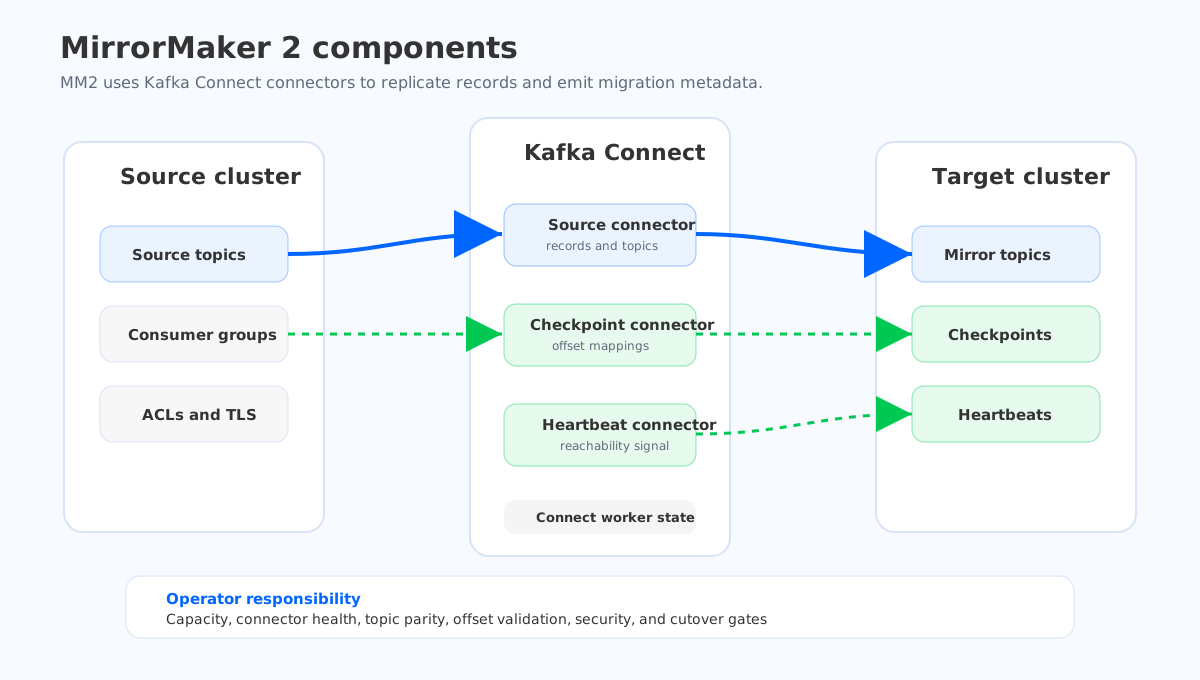
This architecture gives MM2 useful primitives, but production teams still own the surrounding system. They decide which topics are replicated, how topic names are transformed, how many tasks are assigned, how connectors authenticate to each cluster, how lag is monitored, how failures page the right team, and when a checkpoint is trustworthy enough for a consumer group move.
The distinction matters because many MirrorMaker 2 issues reported by operators are not failures of record copying alone. They are gaps between replication mechanics and migration guarantees:
| Operating surface | What MM2 can help with | What the team still owns |
|---|---|---|
| Topic replication | Copy records from source to target topics | Topic selection, naming policy, retention, compaction, and partition planning |
| Offset movement | Emit checkpoints for translated consumer positions | Validating that translated positions match application recovery requirements |
| Health signal | Heartbeat topics and Connect metrics | Alert routing, SLOs, stuck partition detection, and incident response |
| Security | Connector configuration for each cluster | Certificates, ACL parity, secrets rotation, and network policy |
| Cutover | Keep target data moving before switch | Client rollout order, duplicate handling, rollback gates, and stale writer prevention |
Offset handling deserves special caution. Kafka offsets are positions inside a partition, not universal record identities. If target topics have a different record set, partitioning, or naming policy, offset translation needs testing with real application behavior. Throughput is similar: MM2 can scale through Connect workers and tasks, but the path still depends on source reads, target writes, network bandwidth, security, and target storage performance.
3Evaluation Criteria for Kafka Replication Tools
A useful comparison of Kafka migration tools should not start with a vendor grid. Start with constraints that can be tested. The same tool may be a good fit for a steady disaster recovery copy and a poor fit for a short, high-pressure cloud migration if the team lacks operational ownership or offset confidence.
Evaluate each option against eight criteria:
- Topology: one-way replication, active-passive, bidirectional, hub-and-spoke, or many-to-one consolidation.
- Cutover model: shadow read, canary producer, consumer group move, dual write, DNS switch, or application redeploy.
- Offset strategy: no offset move, checkpoint-based translation, application-level replay, or manual reset by topic and group.
- Configuration parity: topic configs, ACLs, quotas, schema registry dependencies, Connectors, and monitoring labels.
- Operational owner: platform team, cloud provider, Kafka vendor, target platform, or application team.
- Failure recovery: restart behavior, duplicate risk, lag catch-up, paused partition handling, and rollback boundary.
- Observability: per-topic and per-partition lag, connector health, checkpoint age, heartbeat freshness, and alert integration.
- Long-term architecture: whether the tool is temporary migration scaffolding or part of the steady-state production design.
The last criterion is often missed. Some replication choices are reasonable as temporary scaffolding but expensive as a permanent architecture. If a team must keep a second cluster online, maintain Connect workers, monitor lag, and rehearse failover, the replication layer becomes a product surface with lifecycle, access-control, and budget ownership.
4Alternative Categories: Managed, Linking, Native, and Custom
MirrorMaker 2 is one category, not the whole market. The main alternatives are managed replication services, proprietary cluster-linking features, platform-native migration paths, and custom pipelines. The choice depends on whether the team wants to own the replication engine, outsource it to a provider, or choose a target platform that changes the migration and post-cutover operating model.
Managed replication services reduce the amount of infrastructure a team operates. AWS MSK Replicator, for example, is designed to replicate data between Amazon MSK clusters and can be attractive when both sides of the project live inside the supported AWS service envelope. The tradeoff is scope: provider-specific constraints, supported-cluster boundaries, regional rules, IAM models, and pricing dimensions must be checked before committing.
Cluster-linking features take a different path. Confluent Cluster Linking is a Confluent-specific mechanism for directly linking clusters and creating mirror topics. For organizations already standardized on Confluent, that can reduce the need to run a separate Connect-based replication layer. The tradeoff is portability and platform fit. It is not a generic Apache Kafka feature that can be assumed across every Kafka distribution.
Platform-native migration paths are most relevant when the target platform provides migration or linking capabilities as part of the replacement project. This category is not only about copying data; it is about reducing long-term Kafka operational work after cutover.
Custom pipelines remain useful in narrow cases. Some teams build application-level dual writes, Kafka Streams jobs, Flink jobs, or Connect-based custom replication when they need transformation, filtering, enrichment, or semantic validation that generic replication tools do not provide. The cost is obvious: custom migration logic becomes production code. It must be tested, observed, secured, upgraded, and retired without leaving hidden dependencies behind.
5Choosing by Migration Scenario
The most practical way to select a MirrorMaker 2 alternative is to map the scenario to the failure mode you most need to control.
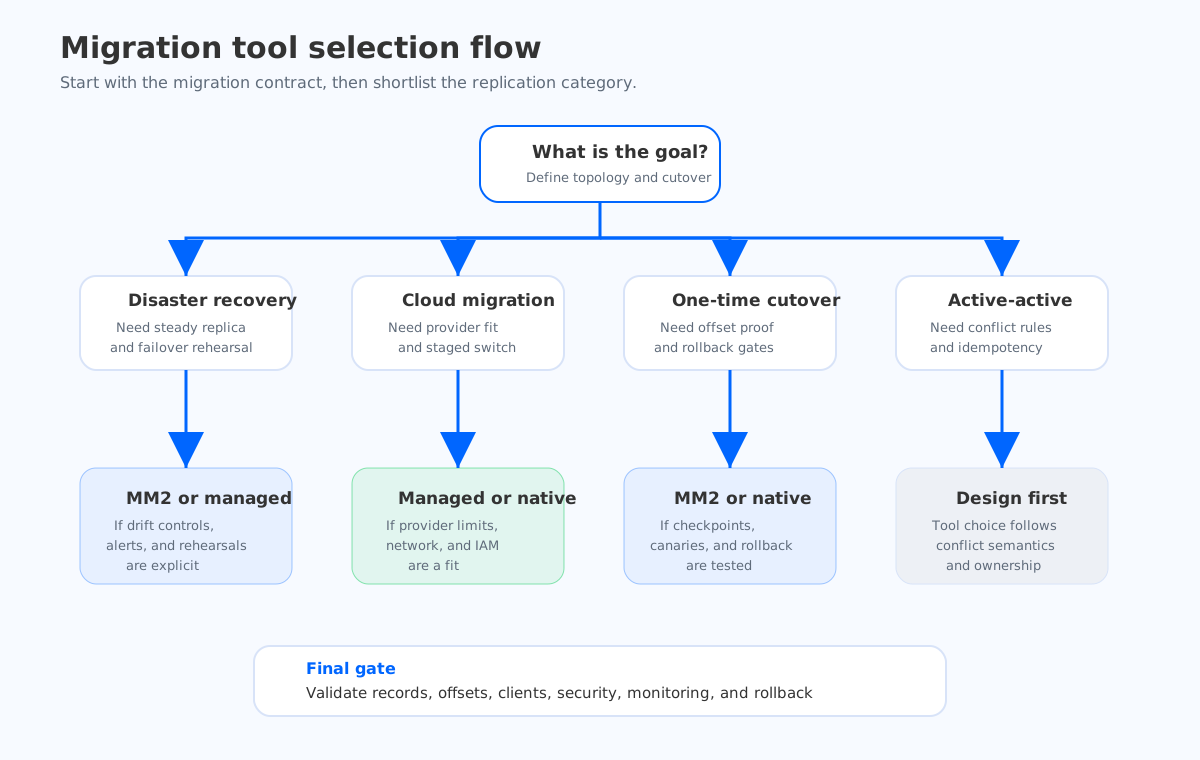
For a one-time cluster migration, the central risk is cutover correctness. MM2 may be enough if the team can operate Connect well and has time to rehearse. A managed or platform-native migration path may be better if simplicity and provider support matter more than tool portability.
For disaster recovery, the central risk is steady-state drift. The target cluster must stay usable while the source cluster changes over time, so topic configuration, ACLs, schema dependencies, quotas, client versions, and monitoring expectations must not silently diverge.
For active-active architectures, the central risk is conflict and ownership. Kafka replication can move records, but it does not automatically solve write conflicts, global ordering, duplicate processing, or application-level reconciliation. Teams should be very careful about treating bidirectional replication as a tool checkbox. Active-active usually requires workload design, deterministic keys, idempotent consumers, and explicit conflict semantics.
For cloud migration, the central risk is environmental mismatch. Network paths, private connectivity, IAM, certificates, inter-region traffic, broker sizing, storage behavior, and service quotas can dominate the project.
The selection flow is not meant to produce a universal winner. It is meant to prevent a common mistake: choosing the replication engine before defining the migration contract. Once the contract is clear, tool tradeoffs become visible instead of emotional.
6Where AutoMQ Fits in Kafka Migration Planning
After the replication mechanics are understood, the next question is what the target architecture should look like after migration. Many Kafka migrations start because the current cluster has become expensive to scale, slow to rebalance, difficult to recover, or painful to operate across cloud environments. If the target is another broker-local Kafka deployment with the same storage and balancing constraints, the migration may move the workload without removing the root cause.
AutoMQ fits this discussion as a Kafka-compatible streaming platform built around object-storage-backed shared storage and stateless brokers. In migration planning, teams can evaluate AutoMQ as a target that preserves Kafka protocol compatibility while changing the storage and scaling model underneath. The practical question becomes broader than "Which tool copies records?" It becomes "Which target reduces the operational work we are trying to escape?"
That distinction affects tool choice. A team may use MM2 or another replication mechanism for a staged migration into a Kafka-compatible target. In supported environments, platform-native migration or linking options may reduce parts of the cutover burden. Either way, the migration should still validate topic behavior, client compatibility, security, consumer progress, and rollback. Kafka compatibility lowers application rewrite pressure; it does not eliminate production testing.
AutoMQ should be evaluated where the migration goal includes long-term improvements after cutover:
- Reducing dependence on broker-local disks for retained Kafka data.
- Scaling broker compute without moving large volumes of local partition data.
- Lowering the operational cost of balancing, recovery, and storage growth.
- Keeping Kafka clients and ecosystem integrations while changing the underlying architecture.
This is not a reason to skip replication due diligence. It is a reason to connect tool selection with architecture selection. If the pain comes from the old cluster's operating model, the migration target matters as much as the migration pipe.
7A Practical Shortlist Framework
A final shortlist should include no more than three serious options. More than that usually means the team has not resolved its constraints. For most production projects, the shortlist falls into one of these patterns:
| If your situation is... | Start with... | Be careful about... |
|---|---|---|
| Kafka-to-Kafka migration with strong internal Connect skills | MirrorMaker 2 | Offset validation, Connect operations, and cutover runbooks |
| Same-provider managed Kafka on both sides | Managed replication | Service limits, region support, pricing, and provider lock-in |
| Confluent-to-Confluent topology | Cluster Linking | Platform scope, mirror-topic behavior, and commercial boundaries |
| Replacement target changes the Kafka architecture | Platform-native migration plus replication testing | Compatibility coverage, rollback, and post-cutover operating model |
| Workload needs transformation during migration | Custom pipeline | Long-term ownership, correctness, and retirement plan |
Before committing, run a rehearsal with real topic shapes and representative clients. Do not limit validation to aggregate throughput. Check per-partition lag, timestamp skew, message counts, consumer offsets, application output, schema compatibility, and security. Include rollback in the rehearsal.
The best MirrorMaker 2 alternative is not always the most feature-rich tool. It is the tool and target combination that makes the migration contract testable, keeps the operating model understandable, and leaves the platform in a better state after the cutover.
8References
- Apache Kafka documentation
- Apache Kafka KIP-382: MirrorMaker 2.0
- Amazon MSK Replicator documentation
- Confluent Cluster Linking documentation
- AutoMQ documentation
9FAQ
9.1Is MirrorMaker 2 still a good Kafka replication tool?
Yes, when the team wants an Apache Kafka ecosystem tool and is ready to operate Kafka Connect, connector tasks, internal topics, monitoring, and cutover validation. It is a strong default for many Kafka-to-Kafka replication projects, but it is not a complete migration service by itself.
9.2What is the main reason to choose a MirrorMaker 2 alternative?
The main reason is operational fit. Teams look elsewhere when they want provider-managed replication, platform-specific linking, a migration path built into the target platform, or less responsibility for Connect operations during a high-risk cutover.
9.3Does a replication tool preserve Kafka consumer offsets automatically?
Not universally. MM2 includes checkpointing features that can help with offset translation, but offsets still need workload-specific validation. Topic mappings, partitioning, commit behavior, and application side effects all influence whether a translated position is correct.
9.4Can Kafka replication support active-active across regions?
Replication can move data between regions, but active-active requires more than moving records. Teams must handle conflict ownership, duplicate processing, partition-key strategy, application idempotency, and reconciliation. Treat active-active as an application architecture decision, not only a replication feature.
9.5Where should AutoMQ be considered in a migration project?
AutoMQ is worth evaluating when the team wants Kafka compatibility but is migrating away from the operational pain of broker-local storage, slow balancing, and storage-bound scaling. It can be considered as the target architecture while the migration plan still validates replication, clients, offsets, security, and rollback.


