
Table of Contents
Table of Contents
MirrorMaker usually becomes visible when a Kafka migration stops being a copy job and turns into a production-risk discussion. The team is no longer asking whether records can be replicated from cluster A to cluster B. They are asking whether producers can switch safely, whether consumer offsets mean the same thing after cutover, whether schemas and ACLs follow the workload, whether lag is explainable, and whether rollback remains possible after the first production batch moves.
That is why "mirrormaker replacement planning kafka" is a high-intent search. It signals that a team has already accepted the need to move data between Kafka environments, but it is no longer satisfied with a tool-centric answer. MirrorMaker 2 can be useful for cluster replication and migration workflows, especially because it is built on Kafka Connect concepts. The harder question is whether the surrounding operating model is still the right one for the next platform.
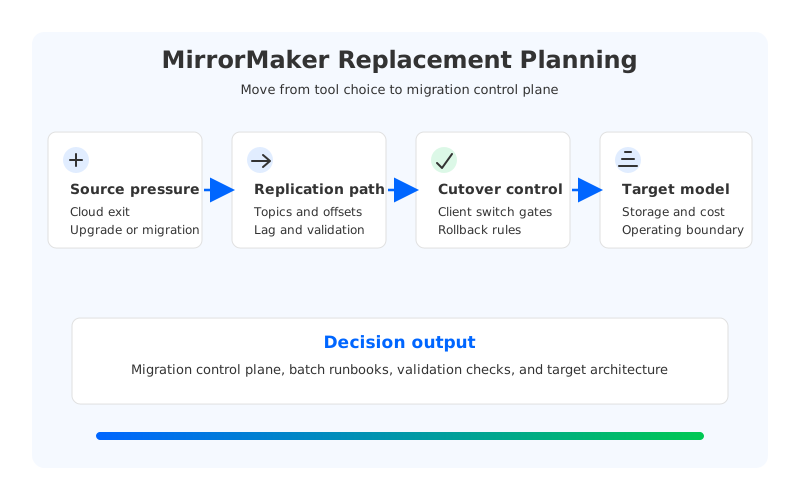
Replacement planning should start one layer above the replication tool. The real decision is about the target Kafka architecture, the cutover contract, the recovery path, and the cost model that will exist after the migration is finished. If the target environment recreates every storage, network, balancing, and governance burden from the source environment, the migration may succeed technically while leaving the platform team with the same operational ceiling.
1Why teams search for mirrormaker replacement planning kafka
The search rarely comes from a greenfield project. It usually comes from teams with a running Kafka estate: self-managed clusters approaching end-of-life, ZooKeeper retirement work, cloud migration, data-center exit projects, managed-service consolidation, or a requirement to move workloads into a customer-controlled cloud boundary. MirrorMaker appears because it is familiar, scriptable, and close to Kafka. The phrase "replacement planning" appears because familiarity is no longer enough.
At small scale, a migration can be described as "replicate topics, switch clients, monitor lag." At production scale, every noun in that sentence hides work. Topics have retention, compaction, partition counts, leader distribution, quotas, ACLs, schema dependencies, and downstream consumers that may treat offsets as a contract. Clients have retry behavior, idempotence settings, transaction semantics, DNS assumptions, and deployment calendars. Lag can come from source pressure, target pressure, network placement, connector capacity, or downstream application behavior.
The most useful planning mindset is therefore not "what replaces MirrorMaker?" It is "what migration control plane do we need?" That control plane may still include Kafka Connect, replication connectors, scripts, or one-time backfill jobs. But it must also define compatibility checks, data validation, ownership boundaries, observability, cutover gates, and rollback rules. The tool is one component inside a broader production system.
2The migration risk behind the workload
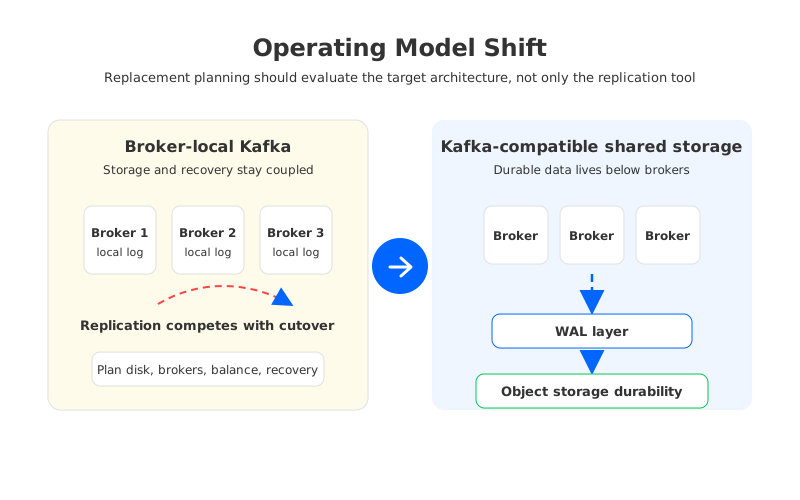
Traditional Kafka deployments make migration difficult because the broker fleet carries both the protocol surface and the storage responsibility. Data is placed on broker-local disks, replicated between brokers, balanced across partitions, and moved again during reassignment or broker replacement. During a migration, the source cluster must continue serving production traffic while it also feeds the target environment. That means replication traffic competes with writes, reads, and recovery headroom at the exact moment the team needs the platform to be predictable.
This coupling creates a planning trap. Teams often size replication by throughput alone, then discover that cutover safety depends on the slowest operational path. A topic with steady write traffic may still be hard to migrate if it has strict ordering expectations, many consumer groups, long retention, a compacted changelog pattern, or a downstream system that cannot tolerate duplicate processing. A cluster with acceptable average utilization may still become fragile when replication, backfill, and partition movement overlap.
The risk model should separate four planes:
- Data plane: Which topics, partitions, records, headers, timestamps, keys, and schemas must arrive in the target environment, and how will correctness be checked?
- Client plane: Which producers and consumers can switch together, which need dual-write or staged cutover, and which require offset translation or replay?
- Control plane: Which ACLs, quotas, topic configs, connector configs, certificates, and deployment rules must move with the workload?
- Recovery plane: What happens if target lag grows, validation fails, client errors rise, or a cutover must be reversed after partial traffic has moved?
The recovery plane is the one that changes the planning conversation. A migration without rollback is not a migration plan; it is a one-way release. The team should know exactly when the source cluster remains the system of record, when the target becomes authoritative, and how long consumer groups can be held in a reversible state.
3Compatibility, replication, rollback, and observability trade-offs
MirrorMaker 2 is attractive because it builds on the Kafka Connect framework and Kafka's client ecosystem. That means planning teams need to reason about connector capacity, task parallelism, internal topics, offset synchronization, topic naming, configuration replication, and the operational state of the Connect cluster itself. The replication layer can be technically sound while the migration still fails because ownership, observability, or rollback was under-specified.
A replacement evaluation should treat replication as one row in a wider matrix:
| Planning dimension | What to verify | Why it matters during cutover |
|---|---|---|
| Kafka API compatibility | Producer, consumer, admin, security, transactions, and client-version behavior. | Client changes are the most expensive part of a migration when compatibility is assumed instead of tested. |
| Topic and offset handling | Topic configs, partition counts, compaction, retention, group offsets, and replay windows. | Data arrival is not enough if consumers cannot resume or replay predictably. |
| Operational headroom | Source pressure, target pressure, replication lag, network path, and connector task capacity. | The migration should not consume the same capacity needed for incident response. |
| Governance and security | ACLs, authentication, encryption, tenant boundaries, quotas, audit trails, and secret rotation. | A working pipeline can still be blocked by compliance or platform ownership gaps. |
| Rollback and authority | Cutover gates, dual-read or replay strategy, validation checks, and source-of-truth timing. | Teams need a controlled failure mode, not a heroic weekend recovery. |
This matrix exposes an important point: the strongest replacement path may not be another stand-alone replication service. Some teams need a managed migration service, a Kafka-compatible target with documented client compatibility, a staged client cutover, and a temporary replication bridge. Others, especially those with active-active requirements or long-running regional replication, still need a persistent replication layer. The planning outcome depends on whether the team is doing migration, disaster recovery, workload isolation, or permanent multi-cluster operation.
Observability has to match that distinction. A migration dashboard should not stop at end-to-end lag. It should show source throughput, target produce latency, connector task health, consumer-group progress, error rates, validation results, and cloud boundary metrics. If those signals cannot be tied to application owners, the platform team will see a lag number without knowing who can safely cut over.
4Evaluation checklist for migration teams
The most reliable MirrorMaker replacement plans look like release engineering documents, not tool comparisons. They define entry criteria, batch scope, success metrics, rollback triggers, and ownership. They also acknowledge that not every topic deserves the same migration path. A payment event stream, an observability topic, and a feature-store changelog may all use Kafka, but their cutover risks are different.
Start with a workload inventory. For each topic family, capture producer owners, consumer owners, message size range, peak write rate, retention, compaction setting, partition key assumptions, schema dependencies, security requirements, and replay tolerance. Then group workloads into batches that can be validated together. Batching by application boundary is usually safer than batching by raw throughput because the rollback decision belongs to the application, not to the broker.
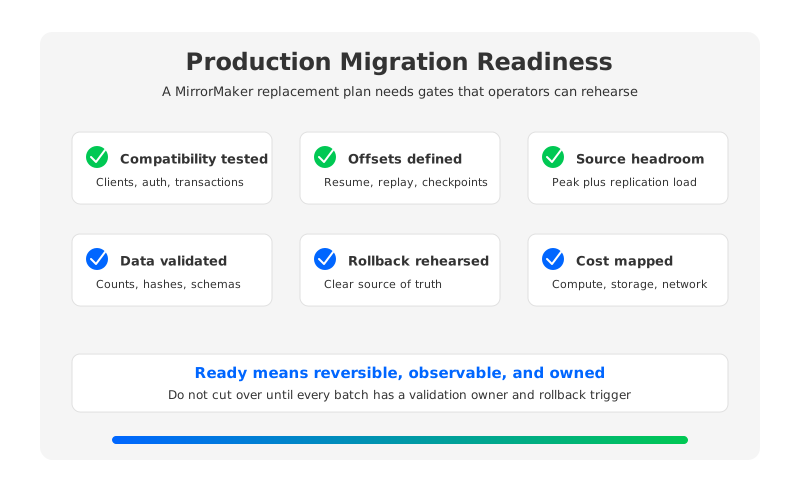
The checklist should force concrete answers:
- Can clients run unchanged? Test the actual producer and consumer versions, security settings, admin operations, idempotence, transactions, and error-handling behavior against the target platform.
- Can offsets be trusted? Define whether consumers will resume from translated offsets, replay from a timestamp, or restart from a controlled checkpoint.
- Can the source cluster survive the migration load? Measure replication traffic during a realistic window, including backfill, peak writes, and maintenance activity.
- Can the team prove data correctness? Compare counts, key ranges, timestamps, schema IDs, sampled payload hashes, and application-level invariants instead of relying on lag alone.
- Can rollback be rehearsed? Practice at least one failed batch where clients return to the source or consumers replay from a known boundary.
- Can cost be explained after migration? Map the target architecture to compute, storage, object storage, request, network, observability, and operational cost owners.
This is where architecture selection enters the plan. Broker-local Kafka, Kafka with Tiered Storage, and Kafka-compatible shared storage can all participate in migration stories, but they change different constraints. Broker-local Kafka keeps the familiar model, but the target cluster still needs local disk capacity, replica movement, and recovery headroom. Tiered Storage can reduce local retention pressure for older segments, but it does not make brokers stateless. Shared storage changes the relationship between brokers and durable stream data, which can alter how the team thinks about scaling, recovery, and retained data.
5How AutoMQ changes the operating model
Once the team has defined the migration control plane, AutoMQ becomes relevant as a Kafka-compatible shared-storage target rather than as a replication-tool slogan. AutoMQ keeps Kafka protocol compatibility while moving durable stream storage out of broker-local disks and into shared object storage through its S3Stream architecture and WAL layer. Brokers become more stateless, so compute planning, retained data, and recovery behavior can be evaluated with cleaner boundaries.
That matters for MirrorMaker replacement planning because many migration pains come from broker-local coupling. In a traditional target cluster, accepting traffic also means planning local storage, replica placement, balancing, and future broker replacement. In a shared-storage model, the target platform can separate more of the durable data responsibility from the broker lifecycle. The migration still needs validation, security, offsets, and rollback; those responsibilities do not disappear. But the target operating model no longer has to reproduce the same local-disk expansion and data-rebalancing path that motivated the migration in the first place.
AutoMQ's documentation also describes a zero cross-AZ traffic design for its shared-storage architecture. For migration teams, the lesson is not to assume any cost outcome without measurement. The useful planning move is to add cloud-boundary metrics to the migration dashboard: where producers connect, where consumers read, how object storage is accessed, and which traffic lines grow during replication or replay. A platform migration that reduces one bottleneck while hiding a network-cost surprise is still incomplete.
AutoMQ Linking and migration guidance can fit into this planning model when teams need controlled data movement into an AutoMQ environment. The key is to keep the migration framed around evidence: compatibility tests, workload batches, lag behavior, validation checks, and rollback gates. Product capability should support the release plan, not replace it.
6A practical replacement planning sequence
Begin with one representative workload family and write down the authority model before moving data. During discovery, the source cluster is authoritative. During synchronization, the target is a candidate. During cutover, authority may move by topic or application. After validation, the source may become a rollback reserve for a defined period. Those words matter because they tell operators which cluster to trust when metrics disagree.
Next, build a small proof batch that includes one producer, one or two consumer groups, a topic with realistic volume, and enough schema or ACL complexity to expose platform gaps. Run the batch through the full release path: create target topics, configure security, replicate or backfill, switch a consumer in a reversible way, validate results, switch a producer, monitor the target, and rehearse rollback. A proof batch that avoids security, offsets, or replay teaches very little.
After the proof batch, expand by application boundary. Each batch should have a runbook with pre-checks, a cutover window, owner approval, metric thresholds, and a rollback decision time. The most useful threshold is not one number; it is a combination. For example, the team might hold cutover if replication lag grows while target produce latency rises and validation samples stop matching. That combination points to target pressure or data-path errors more clearly than lag alone.
The final step is decommission planning. Many migrations stall because the old cluster remains "temporary" for months. Decommissioning should require proof that producers have stopped writing, consumer groups have moved or been intentionally retired, retention windows have expired, and no recovery scenario still depends on the source. Only then can the team remove replication tasks, credentials, DNS paths, and unused cloud resources.
If your MirrorMaker plan keeps expanding into storage sizing, broker replacement, cross-zone movement, and recovery rehearsals, the work is telling you something useful. You are not only replacing a replication tool; you are choosing the next operating model for Kafka. Use the migration to evaluate that model while the old environment still gives you a safety net. To compare a Kafka-compatible shared-storage target against your own workload baseline, start with AutoMQ's migration overview.
7References
- Apache Kafka documentation: geo-replication
- Apache Kafka documentation: Kafka Connect
- Apache Kafka documentation: consumer configuration
- Apache Kafka documentation: producer configuration
- Apache Kafka documentation: Tiered Storage
- AutoMQ documentation: migration overview
- AutoMQ documentation: compatibility with Apache Kafka
- AutoMQ documentation: AutoMQ architecture
- AutoMQ documentation: zero cross-AZ traffic
- AutoMQ documentation: Kafka Linking overview
8FAQ
8.1What is MirrorMaker replacement planning for Kafka?
MirrorMaker replacement planning is the process of deciding how Kafka workloads will move between clusters or platforms when a simple replication-tool setup is no longer enough. It includes data replication, client compatibility, topic configuration, consumer offsets, security, validation, cutover gates, rollback, and post-migration operations.
8.2Is MirrorMaker 2 still useful for Kafka migration?
MirrorMaker 2 can still be useful, especially for Kafka-to-Kafka replication workflows built around Kafka Connect. The planning question is whether it covers the full production requirement. Many teams need additional controls for ownership, validation, cloud cost, security, rollback, and target-platform operations.
8.3What should replace MirrorMaker in a production migration?
There is no universal replacement. Some migrations use a managed migration workflow, some use Kafka Connect-based replication, some use application-level dual writes, and some use platform-specific linking or migration tools. The right answer depends on the workload's compatibility requirements, cutover tolerance, replay model, and recovery plan.
8.4How should teams validate a Kafka migration?
Teams should validate both infrastructure and application behavior. Useful checks include replication lag, target produce latency, consumer progress, topic configuration parity, ACL coverage, schema compatibility, sampled payload comparison, count comparison, timestamp ranges, and application-level correctness signals.
8.5When should teams evaluate AutoMQ during migration planning?
AutoMQ is worth evaluating when the migration is also an opportunity to change the Kafka operating model. If broker-local storage, recovery movement, cross-AZ traffic, local disk sizing, or retained-data growth are central migration concerns, a Kafka-compatible shared-storage architecture can be compared against the current workload baseline.


