
Table of Contents
Table of Contents
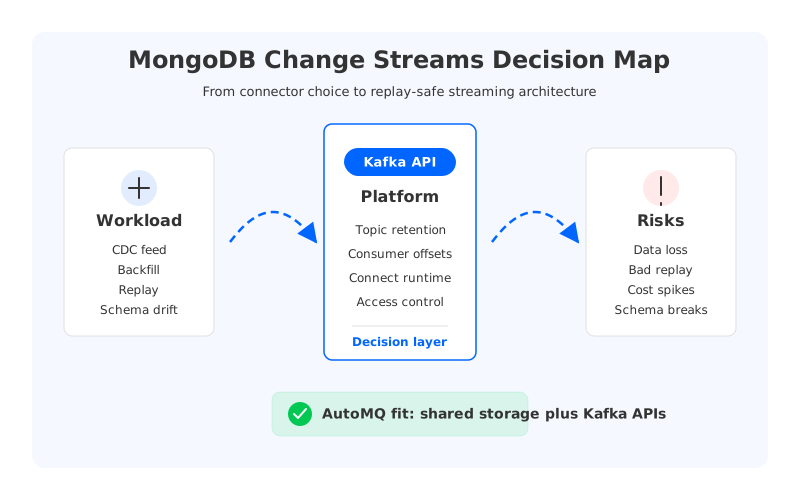
MongoDB change streams look simple until production replay. A source connector tails database changes, writes records into Kafka, and downstream services consume them at their pace. That shape is familiar to every data platform team, which is why searches for mongodb change streams kafka often start as connector questions. The hard part arrives later, when a schema mistake, a missed consumer deployment, or a historical rebuild turns a live CDC feed into an operational recovery exercise.
The central design question is not whether MongoDB can emit change events or whether Kafka can store them. Both systems give teams strong primitives. The question is whether the full pipeline can tolerate replay, schema evolution, bursty backfills, and tenant isolation without turning the streaming platform into a permanently overprovisioned cluster. If that answer is unclear, the connector is only the first piece of a larger architecture decision.
1Why teams search for mongodb change streams kafka
Most teams connect MongoDB to Kafka because they need operational data to move faster than nightly batch jobs. Orders need to reach fulfillment systems, inventory updates need to refresh search indexes, and product events need to land in analytics pipelines while the business context is still fresh. MongoDB change streams expose data changes from a collection, database, or deployment, and Kafka gives that stream a durable distribution layer.
That decoupling is where platform design becomes visible. A single MongoDB update can become a Kafka record, a schema registry subject, a Flink event, an Elasticsearch document, a data lake row, and an audit trail. Each consumer moves at a different pace and has a different tolerance for old data. A real platform handles this diversity without asking the source database to repeat work for every downstream team.
The first implementation choice usually feels tactical:
- Use MongoDB change streams directly from an application service when the consumer set is small and the logic is owned by one team.
- Use Kafka Connect or a CDC connector when the change feed becomes a shared platform dependency with multiple consumers.
- Use Kafka topics as replayable system-of-record streams when downstream teams need controlled reprocessing, branching, and independent retention.
- Use stream processing when raw change events need joins, filtering, enrichment, or stateful transformations before they become product-facing data.
The mistake is treating these options as mutually exclusive tools. In mature environments, they become layers: change streams capture the source mutation, Kafka stores and distributes the event, connectors move it between systems, and stream processors turn raw changes into usable domain streams. Once the architecture has that many responsibilities, the limiting factor shifts from connector syntax to operational behavior.
2The operational constraint behind connector-heavy platforms
Connector-heavy platforms create uneven load. Most of the time, a MongoDB change stream produces a manageable flow of inserts, updates, and deletes. Then a backfill, a consumer outage, or a schema migration creates a read storm against older Kafka data. The platform has to keep ingesting fresh changes while lagging consumers, replay jobs, and sink connectors read historical records. Traditional Kafka can do this, but the cost profile depends heavily on broker-local disk, replica movement, and reserved spare capacity.
The deeper constraint is that CDC workloads couple three kinds of pressure. The write path cares about low-latency durability. The replay path cares about long retention and high catch-up throughput. The governance path cares about who can read which topic, how schemas change, and how rollback works when a bad event shape has already been published. A platform that optimizes only the happy path will look fine in a demo and fragile during the first real incident.
| Platform concern | Why it matters for MongoDB change streams | Architecture question |
|---|---|---|
| Retention | Consumers may need hours, days, or weeks of replay capacity after a sink failure or application bug. | Can storage grow independently from broker compute? |
| Schema evolution | MongoDB documents can change shape faster than downstream systems can adapt. | Is there a governed compatibility process before records reach shared topics? |
| Backfill | Initial snapshots and repair jobs can compete with live CDC traffic. | Can catch-up reads avoid destabilizing fresh writes? |
| Isolation | Multiple product teams may consume the same change stream with different SLAs. | Can quotas, ACLs, and observability separate teams without duplicating pipelines? |
| Failure recovery | Connectors, brokers, and sinks can fail independently. | Can the team resume from a known offset and prove what was replayed? |
This table is useful because it separates connector capability from platform capability. A connector can expose resume tokens, publish records, and preserve ordering within a configured scope. The platform still has to decide how long those records remain available, how consumers discover schema changes, and how replay jobs are scheduled when the cluster is already busy.
3Failure handling, schema, and replay trade-offs
The most uncomfortable CDC failures are partial correctness failures. A sink connector writes malformed rows into a warehouse for 40 minutes, a service ignores a new optional field, or an enrichment job publishes a derived event that downstream teams now depend on. In those cases, "restart the connector" is not enough. The team needs to identify a safe offset, decide whether the original event is still valid, and replay a bounded range without duplicating side effects.
That requirement changes how you design Kafka topics for MongoDB change streams. Raw capture topics should preserve enough source context for repair work, including operation type, source namespace, document key, and timestamp metadata. Derived topics should have clearer domain contracts, because downstream teams should not have to understand every MongoDB document nuance. The boundary between raw and derived streams is where schema governance belongs.
Schema evolution deserves special attention because MongoDB's document flexibility is both a strength and a trap. Application teams can add fields without a database migration, but downstream consumers may still expect a stable event shape. A practical design treats the raw change stream as an internal integration feed and publishes curated Kafka topics for broader consumption. That gives platform teams a place to validate fields, normalize types, mask sensitive values, and introduce compatibility rules before the event becomes a shared contract.
Replay then becomes a first-class workflow instead of an emergency procedure. A well-designed pipeline can answer four questions quickly:
- What topic, partition, and offset range represents the affected time window?
- Which schema version or event contract was active when the bad records were produced?
- Which consumers need a rewind, and which sinks need an idempotent repair path?
- Which metrics prove that the replay completed without falling behind on live CDC traffic?
None of these questions are MongoDB-specific. They are streaming platform questions. MongoDB change streams make them visible because the source data is operational, mutable, and business-critical.
4Evaluation checklist for platform teams
A useful evaluation starts with compatibility, but it should not stop there. Kafka compatibility matters because it protects existing clients, connectors, tooling, and operational knowledge. Apache Kafka's own documentation covers the core concepts around topics, partitions, consumer groups, and Kafka Connect, and most organizations already have automation built around those APIs. Replacing the API surface is usually more expensive than replacing the storage architecture underneath it.
The next step is cost and elasticity. CDC traffic is rarely flat. Retail events spike during promotions, inventory feeds surge after catalog updates, and replay jobs appear precisely when something has already gone wrong. A platform that scales only by adding broker-local disks forces teams to buy enough capacity for the worst combined moment: live ingest plus retention plus catch-up reads. That is a reasonable trade-off for some environments, but it is expensive when replay is occasional and retention is large.
Security and governance sit beside cost, not after it. MongoDB change streams often carry customer, payment, or operational state. Platform teams need ACLs, network boundaries, encryption, schema review, and observability that align with the company's deployment model. In regulated or data-sovereign environments, the question is not only who manages Kafka. It is where the data plane runs, which cloud accounts hold the data, and how operational access is controlled.
The checklist below keeps the discussion grounded:
- Connector fit: Confirm whether the MongoDB source path supports the required deployment topology, snapshot strategy, delete handling, resume behavior, and format expected by downstream consumers.
- Kafka API compatibility: Verify producer, consumer, admin, Connect, security, and observability tooling against the platform, not only against a benchmark topic.
- Replay economics: Estimate storage retention, catch-up read bandwidth, and peak replay concurrency separately from steady-state write throughput.
- Schema governance: Define the boundary between raw CDC topics and curated domain topics, then decide where compatibility checks and masking happen.
- Operational ownership: Decide which team owns connectors, topic lifecycle, offset resets, sink repair playbooks, and incident metrics.
- Migration path: Test dual-write, mirroring, consumer cutover, rollback, and topic naming before the platform becomes the sole copy of critical changes.
The best architecture choice is the one that makes these trade-offs explicit. A team with a small internal feed may choose a direct connector and short retention. A platform team serving many product groups usually needs stronger replay economics, clearer governance, and a more elastic storage model.
5How AutoMQ changes the operating model
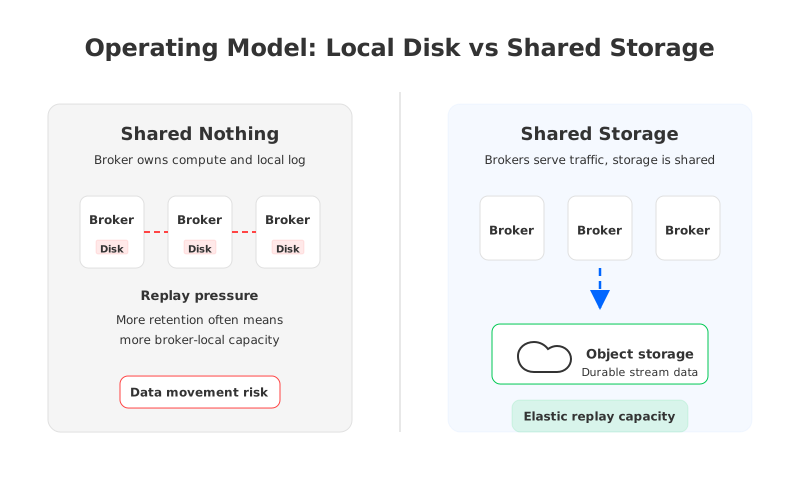
If the pressure comes from replay, retention, and elastic capacity, the storage model deserves more attention than the connector checkbox. Traditional Kafka keeps broker compute and primary log storage tightly coupled. That design is proven and widely understood, but in cloud environments it can make storage growth, partition movement, and recovery feel heavier than the CDC workload itself. The team adds brokers for disk, moves partitions to rebalance data, and reserves enough local capacity for traffic that may appear only during backfills or incident repair.
AutoMQ approaches the problem as a Kafka-compatible streaming platform built on shared object storage. The important point is not abstract storage pricing. The important point is that broker compute no longer has to be the long-term home of the log. Stateless brokers can focus on serving Kafka protocol traffic, while durable stream data is held in a shared storage layer. That changes the operating model for connector-heavy environments because retention and replay pressure no longer map one-to-one to broker-local disk pressure.
For MongoDB change streams, that difference shows up in practical ways. Long retention becomes easier to reason about because storage capacity can follow retained data rather than broker count. Catch-up reads can be treated as a planned workload instead of a cluster reshuffling event. Scaling decisions can focus on current compute demand, while the stored stream remains available for consumers that need to recover later.
AutoMQ's fit should still be evaluated with the same neutral checklist. The platform needs to preserve Kafka client semantics, support the connector and security tooling your team depends on, and meet your deployment boundary requirements. Where it becomes interesting is in BYOC and private deployment models, where teams want Kafka-compatible operations but still need data to remain in their own cloud environment. In that setting, shared storage and stateless brokers are not marketing details. They are the mechanism that lets the platform separate data ownership from broker lifecycle.
The result is a cleaner separation of concerns. MongoDB remains the operational database. Kafka topics become replayable integration streams. Connectors and processors handle movement and transformation. The streaming platform carries durability, retention, consumer isolation, and recovery economics without forcing every replay concern back onto broker-local disks.
6Migration and readiness scorecard
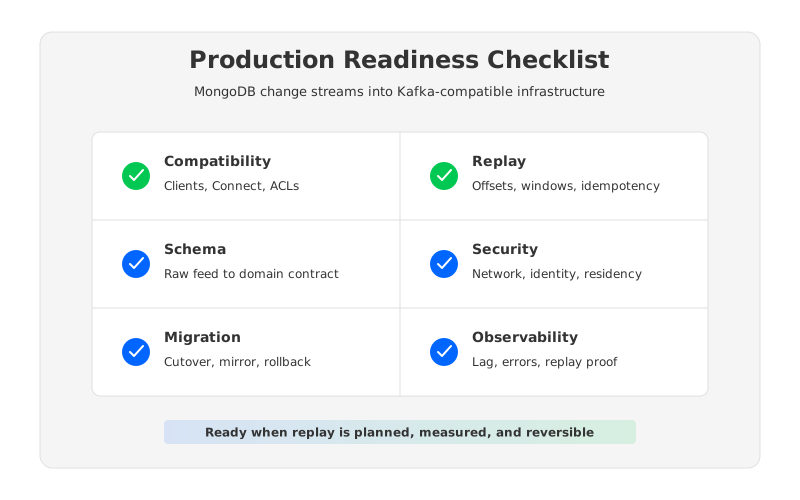
Before adopting any Kafka-compatible platform for MongoDB change streams, run a readiness exercise with one real collection and one real sink. Synthetic workloads miss what matters: document shape changes, delete semantics, late consumers, and imperfect downstream idempotency. A focused trial should include steady-state capture, initial snapshot or backfill, consumer rewind, connector restart, and a schema change downstream systems must tolerate.
Use the scorecard as a go/no-go discussion:
| Readiness area | Pass signal | Risk signal |
|---|---|---|
| Replay | A bounded offset range can be reprocessed with clear ownership and metrics. | Replay depends on ad hoc scripts and manual sink cleanup. |
| Schema | Raw and curated topics have different contracts and review paths. | Downstream systems consume raw document shapes directly. |
| Cost | Retention, compute, and catch-up reads are estimated separately. | Capacity planning uses only average ingest throughput. |
| Security | ACLs, network paths, and data residency are documented before launch. | Connector credentials and topic permissions are handled per team. |
| Migration | Cutover and rollback are tested with live producers and consumers. | The plan assumes a one-way switch with no rollback window. |
A good score is not perfect automation on day one. It is the absence of mystery. When replay is needed, the team knows which offsets to use, which schemas apply, which consumers are affected, and which platform limits matter. That clarity turns MongoDB change streams from an integration shortcut into production infrastructure.
If your team is evaluating Kafka-compatible infrastructure for CDC, replay, and cloud cost control, AutoMQ's architecture overview is a useful next step: read the AutoMQ docs. Start with the operating model, then test it against your connector workload.
7References
- MongoDB Manual: Change Streams, https://www.mongodb.com/docs/manual/changestreams/
- Apache Kafka Documentation: Kafka Connect, https://kafka.apache.org/documentation/#connect
- Apache Kafka Documentation: Consumers and Consumer Groups, https://kafka.apache.org/documentation/#consumerconfigs
- Debezium Documentation: MongoDB Connector, https://debezium.io/documentation/reference/stable/connectors/mongodb.html
- AutoMQ Documentation: What Is AutoMQ, https://docs.automq.com/automq/what-is-automq/overview
- AutoMQ Documentation: Shared Storage Architecture, https://docs.automq.com/automq/architecture/overview
- AutoMQ Documentation: Kafka Compatibility, https://docs.automq.com/automq/what-is-automq/compatibility-with-apache-kafka
- AutoMQ Documentation: Managed Kafka Connect, https://docs.automq.com/automq-cloud/kafka-connect/overview
8FAQ
8.1Should MongoDB change streams write directly to Kafka?
Direct writes can work when one application owns capture and consumption. Kafka Connect or a CDC connector is usually better for shared infrastructure because it gives the platform a clearer place to manage configuration, restarts, offsets, and ownership.
8.2How should teams handle schema evolution from MongoDB documents?
Treat raw change events and curated domain events as different contracts. Raw topics preserve source context for recovery, while curated topics normalize fields, types, masking rules, and compatibility expectations before broad consumption.
8.3What retention window is right for MongoDB change streams in Kafka?
The right window depends on recovery objectives, sink repair time, audit needs, and replay frequency. Model retention separately from live ingest because replay and catch-up reads often expose storage and broker capacity limits.
8.4Where does AutoMQ fit in a MongoDB CDC architecture?
AutoMQ fits after Kafka compatibility, replay, retention, and elastic cloud operations become platform requirements. Its shared storage architecture and stateless brokers are most relevant when teams want Kafka APIs while reducing coupling between broker compute, local disk capacity, and long-lived stream data.


