
Table of Contents
Table of Contents
Moving off Confluent Cloud is rarely blocked by the first replicated topic. The hard part is preserving the behavior that applications have learned to depend on: producer acknowledgments, consumer offsets, schema compatibility, connector delivery semantics, ACL boundaries, DNS paths, retry behavior, lag alarms, and rollback expectations. A migration can look green at the broker layer while still failing at the application layer.
That is why a practical Confluent Cloud migration checklist should start with continuity, not tooling. Confluent Cluster Linking, Apache Kafka MirrorMaker 2, Kafka Connect, Schema Registry export paths, and client configuration changes are all useful building blocks, but they do not replace a migration plan. The plan has to define what will be copied, what will be recreated, what will be validated, and what will cause the team to pause or roll back.
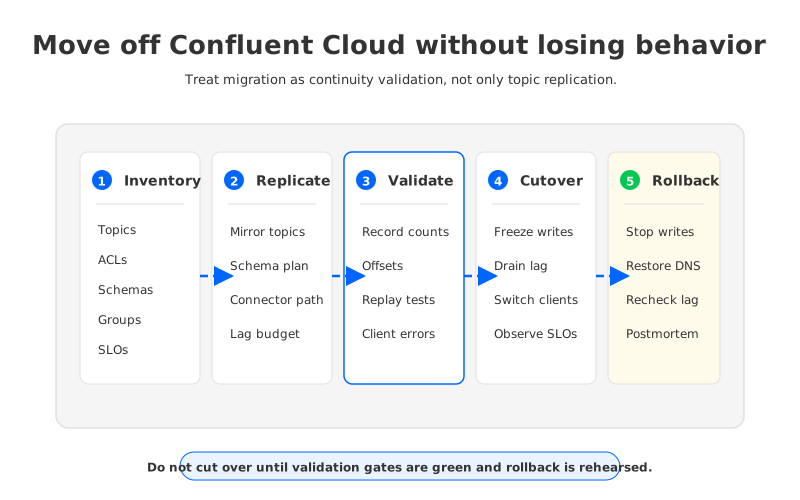
The checklist below is written for platform engineers, SREs, and architects who are already evaluating or executing a move from Confluent Cloud to another Kafka-compatible platform. It assumes the target platform supports Kafka clients and common Kafka ecosystem patterns. AutoMQ can be one such target when the migration goal includes Kafka compatibility, lower operational cost from shared storage, and more elastic scaling from stateless brokers, but the same validation discipline applies to any target.
1Before you migrate: inventory everything
The migration inventory is the contract between the old platform, the target platform, and every application team. If it is incomplete, the cutover window becomes a discovery session, which is an uncomfortable place to find a missing ACL or an untracked schema subject.
Create the inventory before choosing the cutover mechanism. At minimum, capture these fields for each workload:
| Area | Inventory fields to capture | Why it matters |
|---|---|---|
| Topics | Topic name, partition count, replication policy, retention, cleanup policy, compression, message size limits | Topic settings define producer behavior, replay windows, and storage expectations. |
| Producers | Client library, bootstrap.servers, acks, idempotence, transactions, retries, timeouts, batching, compression | A producer can switch endpoints but still change durability or latency behavior if defaults differ. |
| Consumers | Group ID, offset reset policy, commit pattern, max poll settings, lag SLO, replay tolerance | Consumer continuity depends on offset mapping and application-side idempotency. |
| Schemas | Registry URL, subject naming strategy, compatibility mode, schema IDs, references | Schema Registry behavior can affect serialization and deserialization even when Kafka records replicate. |
| Connectors | Connector type, source or sink, task count, offset storage, transforms, secrets, network access | Connectors are applications with their own state and side effects. |
| Security | API keys, ACLs, service accounts, SASL/TLS settings, network allowlists, private links | Authentication and routing issues often appear before Kafka protocol issues. |
| Operations | Dashboards, alerts, error budgets, runbooks, audit logs, escalation path | Cutover confidence depends on seeing the same failure modes after migration. |
Add two fields that teams often skip: owner and rollback dependency. Owner tells you who can approve a pause. Rollback dependency tells you whether the old path can remain writable, whether DNS can be reversed, and whether downstream systems can tolerate records written during the target window.
2Producer migration checklist
Producer migration starts with the write contract. Kafka producer behavior is shaped by client configuration, broker capabilities, and application error handling. The Apache Kafka producer configuration reference is the baseline for fields such as acknowledgments, retries, idempotence, delivery timeout, request timeout, batching, linger, compression, and security settings.
Do not treat endpoint replacement as the whole producer migration. Before cutover, validate these items:
- Map every producer to a target bootstrap endpoint and authentication mechanism.
- Confirm that required topic names, partitions, and ACLs exist on the target.
- Preserve intentional producer settings instead of relying on library defaults.
- Confirm idempotent or transactional producer behavior if the application depends on it.
- Run a shadow write or canary write path where business risk allows it.
- Measure produce error rate, request latency, throttling, and retry behavior under representative traffic.
- Decide whether producers will switch by config rollout, DNS change, service discovery, or application release.
The safest producer cutover pattern depends on write ownership. For append-only telemetry, teams may tolerate a short freeze while replication catches up. For payment, order, or inventory systems, the freeze window and retry behavior need application-owner signoff. No migration tool removes the need to decide which system is authoritative during the cutover interval.
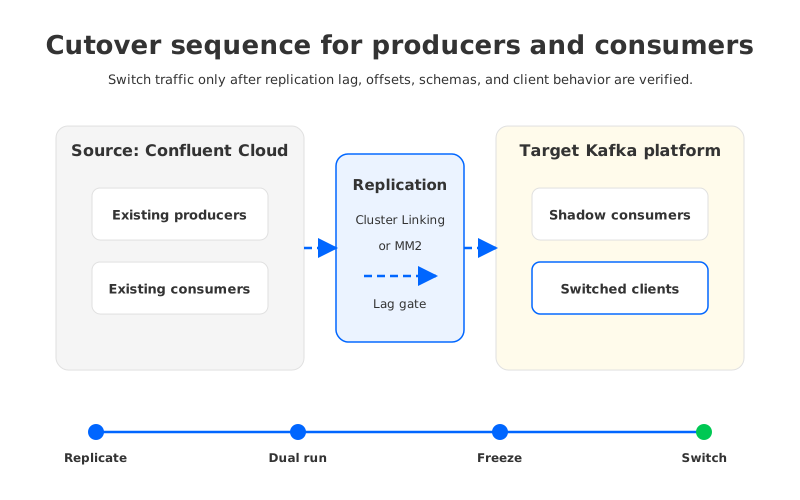
If producers write to the source and target at the same time, define how duplicates are detected. If producers switch once, define how failed writes during the switch are retried. If routing changes through DNS, set TTLs early enough that clients do not hold stale routes longer than the rollback window. The plan should be boring on purpose: one writer path, one validation gate, one rollback owner.
3Consumer and offset validation checklist
Consumer migration is where many Kafka moves become fragile. A topic can be fully replicated while consumer groups are still unsafe to move. Offsets are not business state by themselves; they are pointers into a stream. The target offset must correspond to a record position that the application can resume from without missing records or producing duplicate side effects beyond its tolerance.
Build an offset validation gate before the first major consumer cutover:
- Capture source group offsets, lag, and committed positions close to the migration window.
- Confirm how offsets are translated or recreated on the target path.
- Compare record counts, high watermarks, and sampled keys between source and target topics.
- Run shadow consumers on the target without committing production side effects.
- Validate replay behavior for applications that write to databases, search indexes, or external APIs.
- Confirm
auto.offset.resetbehavior so a missing offset does not silently start at the wrong position. - Define acceptable lag and error thresholds for proceeding.
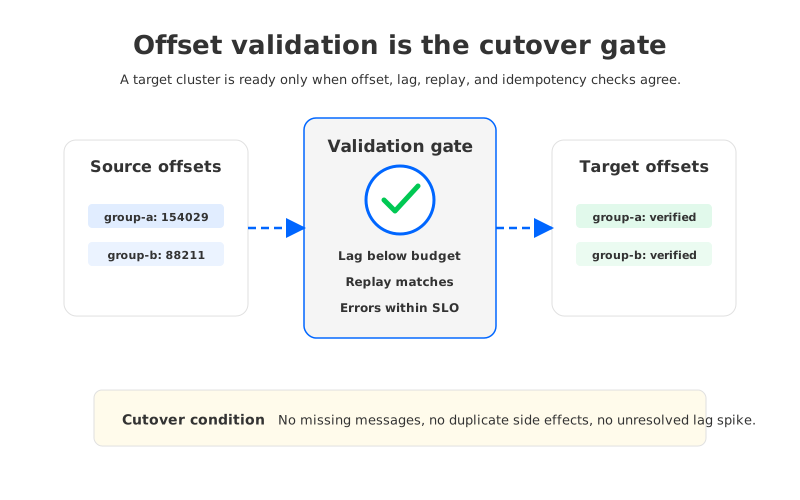
MirrorMaker 2 is part of the Apache Kafka project and is commonly used for cluster replication and migration scenarios. Confluent Cluster Linking is Confluent's managed approach for linking clusters and mirror topics across environments. Either route still requires validation of consumer behavior because replication status does not prove that every consumer can resume correctly.
For high-risk consumers, use a staged approach. Start with read-only shadow consumers. Move low-risk groups first. Keep the source cluster observable until the target path has passed the same lag, throughput, and error-rate SLOs for a full business cycle. If the consumer uses transactions, external offset storage, or manual commits tied to database transactions, involve the application owner early; the Kafka platform team should not guess at exactly-once assumptions from the outside.
4Schema Registry and connector migration checklist
Schema Registry migration is about compatibility semantics as much as schema files. A Confluent Cloud environment may have subject naming strategies, compatibility levels, schema references, and client-side serializer settings that are invisible to teams who look only at Kafka topics.
Before switching producers or consumers that use Avro, Protobuf, or JSON Schema, validate:
- Subject names and versions for every topic or record type.
- Compatibility mode at the global and subject level.
- Schema references and transitive dependencies.
- Serializer and deserializer registry URLs, authentication, and caching behavior.
- Whether schema IDs must be preserved or whether applications can tolerate re-registration.
- Failure behavior when a producer tries to register a schema during cutover.
Connectors need the same respect as application services. A source connector may own offsets in the external system it reads from. A sink connector may write records into a database where duplicates are expensive. The Confluent Cloud connector inventory should include connector class, task count, transforms, secrets, network reachability, offset state, dead-letter queue behavior, and destination idempotency.
For each connector, decide whether to migrate, recreate, replace, or retire it. A managed connector in Confluent Cloud may not map one-to-one to a connector runtime in the target environment. If you recreate a sink connector, test duplicate handling and ordering assumptions before enabling writes. If you recreate a source connector, make sure it starts from the intended position in the source system, not from an implicit default.
5Network, security, and rollback checklist
Kafka migrations often fail at layers outside Kafka. Private networking, TLS trust, SASL credentials, DNS, firewall rules, cloud routing, and service discovery all have to be ready before client traffic moves. Build this part of the checklist as a runbook, not as a note in a planning document.
The security and network checklist should include:
- Target bootstrap endpoints reachable from every producer, consumer, connector, and admin job.
- TLS certificate trust validated in each runtime environment.
- SASL mechanism and credentials tested with the actual client libraries.
- ACLs created for topic, group, transactional ID, and cluster-level operations where needed.
- Private link, VPC peering, firewall, or proxy rules tested from production-like subnets.
- DNS TTLs adjusted before the cutover window if DNS is part of the switch.
- Observability labels aligned so alerts distinguish source, target, and dual-run traffic.
Rollback should be designed before cutover, not after the first bad graph. A rollback path is viable only if the source path remains recoverable, clients can route back, and data written during the target interval can be handled. Some migrations can roll back by switching clients to the old endpoint. Others require reconciliation because target writes created side effects downstream.
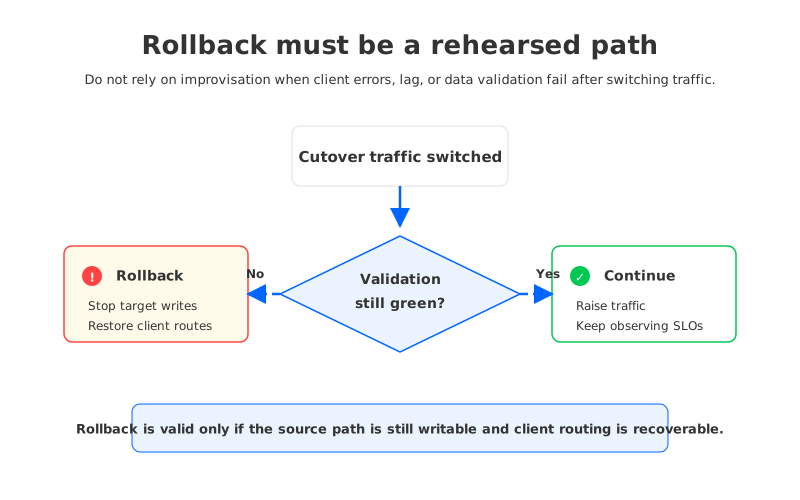
Use conditional language in the cutover plan. A near-zero interruption window may be possible when replication lag is within budget, clients can be drained cleanly, schema and offset validation have passed, and routing can be changed predictably. It is not a promise. If a workload cannot tolerate duplicate side effects, missed records, or extended retry storms, the cutover needs a stricter freeze, a smaller batch, or a different migration sequence.
6Where AutoMQ fits as a target Kafka platform
After the migration mechanics are clear, the target architecture matters. A Kafka-compatible target should let existing clients, topic-level operations, and ecosystem tooling move with minimal application change. It should also give the platform team a better operating model after the move; otherwise the migration effort only changes the vendor name.
AutoMQ is a Kafka-compatible streaming platform that separates storage from stateless brokers and uses shared object storage as the durable data layer. In a migration from Confluent Cloud, that positioning matters in two practical ways.
First, Kafka compatibility reduces the amount of application change that has to be mixed into the platform move. Teams can validate producers, consumers, ACLs, topic behavior, and client tuning against familiar Kafka semantics rather than redesigning event contracts during the same window.
Second, shared storage changes the post-migration cost and scaling model. Traditional Kafka operations often couple broker count, local disk, replication traffic, and rebalancing work. A stateless broker architecture backed by shared storage can make scaling and recovery less dependent on moving large amounts of local broker data. That does not eliminate migration validation, but it can improve the operating boundary the team lands on after the cutover.
AutoMQ's migration documentation describes prerequisites and execution steps for moving Kafka workloads to AutoMQ Cloud, and its compatibility documentation outlines Apache Kafka compatibility expectations. For teams leaving Confluent Cloud, those docs are useful as target-side validation material: they help turn the generic checklist into concrete endpoint, ACL, topic, client, and migration-run commands.
7A practical cutover sequence
A complete plan usually looks like this:
- Freeze the inventory and assign owners for every workload.
- Prepare target topics, ACLs, networking, monitoring, schemas, and connector runtimes.
- Start replication or linking and measure lag under normal and peak traffic.
- Run target-side shadow consumers and canary producers.
- Validate schema compatibility, offset mapping, record counts, and sampled payloads.
- Move a low-risk producer and consumer group first.
- Observe SLOs for an agreed interval.
- Move the next batch, keeping rollback conditions explicit.
- Stop source writes only when the target path has become authoritative.
- Keep source observability and access long enough to investigate late issues.
The sequence is intentionally conservative. The cost of extra validation is usually smaller than the cost of a confused cutover where producers, consumers, schemas, connectors, and dashboards all change at once.
8References
- Confluent Cloud Cluster Linking documentation
- Confluent Schema Registry documentation
- Confluent Cloud connectors documentation
- Apache Kafka documentation: geo-replication and MirrorMaker
- Apache Kafka producer configuration reference
- Apache Kafka consumer configuration reference
- AutoMQ Cloud migration overview
- AutoMQ Cloud migration prerequisites
- AutoMQ Cloud migration execution guide
- AutoMQ compatibility with Apache Kafka
9FAQ
9.1Can I move off Confluent Cloud with no downtime?
Sometimes a workload can cut over with little visible interruption, but it depends on replication lag, routing control, producer retry behavior, consumer offset validation, schema readiness, and rollback design. Treat no-downtime as an engineering outcome to validate, not as a default property of any migration tool.
9.2Should I use Confluent Cluster Linking or MirrorMaker 2?
Use the option that fits your source, target, network, operational ownership, and support model. Cluster Linking is documented by Confluent for linked clusters and mirror topics in Confluent environments. MirrorMaker 2 is part of Apache Kafka's replication tooling. In both cases, plan separately for schemas, connectors, security, client configs, and consumer validation.
9.3What is the biggest consumer migration risk?
The biggest risk is assuming that replicated records automatically mean safe consumer resumption. Consumer groups need offset validation, replay testing, and side-effect checks. If an application writes to an external system, duplicate handling matters as much as Kafka lag.
9.4Do schemas migrate automatically with Kafka records?
No. Kafka records and Schema Registry state are related but separate. You need a schema inventory, a subject strategy plan, compatibility checks, registry endpoint changes, and serializer/deserializer validation.
9.5Where does AutoMQ help in a Confluent Cloud migration?
AutoMQ can serve as a Kafka-compatible target platform. Its shared-storage and stateless-broker architecture can improve the post-migration cost and scaling model, while Kafka compatibility helps keep client and ecosystem changes focused. The migration still needs topic, ACL, schema, connector, offset, and rollback validation.


