
Table of Contents
Table of Contents
The first fear in a Redpanda exit plan is not the broker replacement. It is the application rewrite hiding behind it. If hundreds of services publish and consume through Kafka clients, the platform team does not want every product squad to relearn a messaging API, change serialization logic, and retest business workflows because the streaming platform changes underneath.
That fear is reasonable, but the answer needs precision. Redpanda exposes Kafka-compatible APIs for standard Kafka clients, and Apache Kafka clients already separate application code from cluster location through configuration such as bootstrap.servers. A move off Redpanda can often preserve producer and consumer code when the applications use standard Kafka protocol behavior. The work shifts to inventory, compatibility validation, security mapping, schema and connector dependencies, offset handling, staged cutover, and rollback.
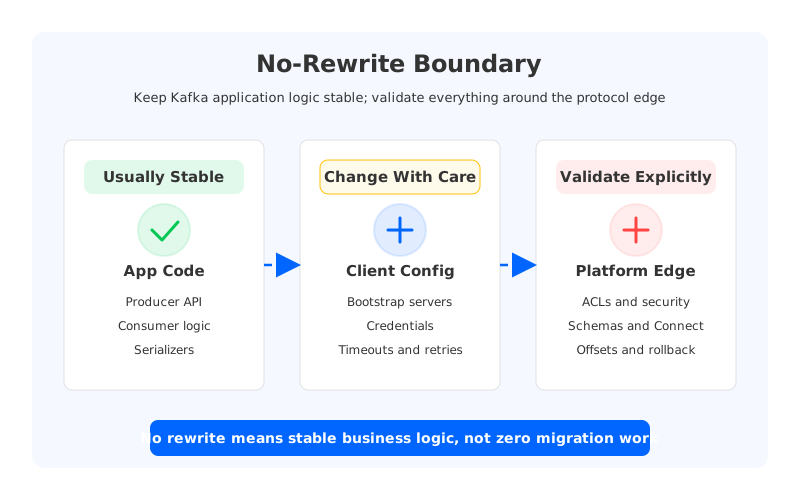
"No rewrite" is therefore a boundary, not a magic phrase. Your Java, Go, Python, or Node producer code may not change. Your consumer business logic may not change. But client configuration, credentials, ACLs, topic configs, monitoring queries, admin scripts, connector settings, and deployment runbooks still need deliberate migration work.
1What Can Usually Stay the Same
The strongest reason a no-rewrite path is possible is the Kafka protocol boundary. Apache Kafka defines producer, consumer, admin, and Connect APIs around concepts that Redpanda also supports: topics, partitions, offsets, consumer groups, record keys and values, timestamps, headers, and cluster metadata. Redpanda's documentation states that it is API-compatible with Kafka clients, with official guidance around supported client versions and compatibility exceptions. That gives migration teams a practical starting point: treat application code as a contract, then prove each dependency at the edges.
For standard producer and consumer workloads, these layers are the candidates to keep intact:
- Business logic. The code that builds records, assigns keys, deserializes payloads, handles idempotent downstream writes, and implements domain behavior should not know whether the endpoint is Redpanda or another Kafka-compatible cluster.
- Kafka client APIs.
KafkaProducer,KafkaConsumer, librdkafka-based clients, and other common clients usually continue to use the same produce, poll, commit, and subscribe patterns when the target is Kafka-compatible. - Topic and offset model. Topics, partitions, consumer groups, committed offsets, and lag remain the operational vocabulary, even though the migration process may need translation, synchronization, or approved reset points.
- Deployment interface. Many services can move through environment variables, Helm values, config maps, secret references, or service discovery changes rather than code changes.
That last point is where platform teams get leverage. A well-designed Kafka estate already keeps bootstrap endpoints, security material, and client tuning outside application code. If those values are embedded in source files, the migration is still possible, but the first task is configuration hygiene rather than broker cutover.
2What Still Needs Validation
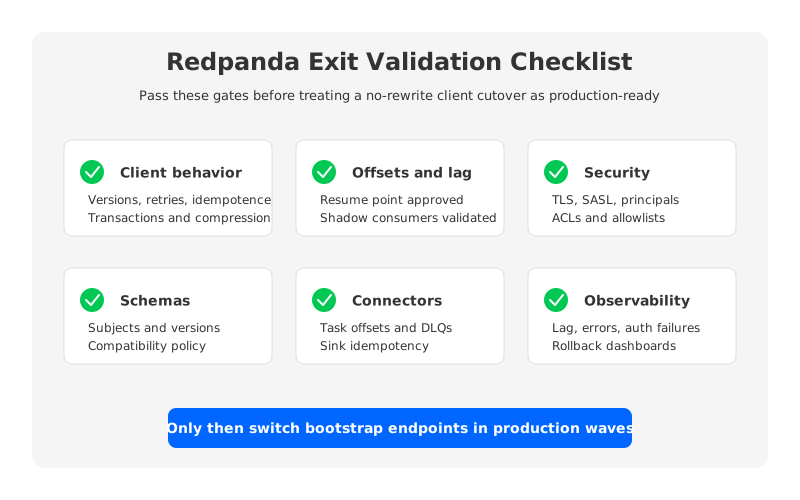
Kafka-compatible does not mean every operational assumption transfers automatically. A producer that can write a test record proves only the thinnest part of the contract. Production clients bring retries, compression, transactions, idempotence, custom partitioners, message size assumptions, quotas, interceptors, serializers, and deployment-time admin calls. Those details are where "no rewrite" plans either become credible or collapse into emergency patches.
Use this checklist to separate code stability from platform migration work:
| Surface | What to Validate | Why It Can Break a No-Rewrite Plan |
|---|---|---|
| Client versions | Library version, protocol features, compression, idempotence, transactions | Older or unusual clients may depend on behavior the target handles differently. |
| Producer configs | acks, retries, timeout, linger, batch size, max request size | Delivery guarantees and latency behavior can change under load. |
| Consumer configs | Group protocol, auto offset reset, commit mode, session timeout | Rebalances and resume points determine whether cutover is safe. |
| Admin tooling | Topic creation, config updates, ACL scripts, group inspection | Deployment pipelines often use admin APIs outside the main app code. |
| Security | TLS, SASL, mTLS, ACL principals, network allowlists | Authentication and authorization need explicit mapping. |
| Schema and serialization | Schema Registry endpoint, subject naming, compatibility level, references | Clients may be code-stable while serializers point to the wrong registry. |
| Connect and processors | Connector offsets, task configs, DLQs, Flink or Kafka Streams state | Adjacent runtime state can matter more than topic bytes. |
| Observability | Metrics names, lag dashboards, alert thresholds, audit logs | Operators need confidence before and after cutover. |
The useful discipline is to mark each row as one of three states: unchanged, configuration-only change, or code change required. Most rows should not require business logic changes, but pretending they do not exist is how a migration creates avoidable application work.
3Client Versions and Protocol Features
Start with a client inventory before moving data. Redpanda documents Kafka client compatibility, and Apache Kafka documents the producer, consumer, admin, security, and Connect APIs that define the ecosystem contract. The migration question is not whether Kafka clients exist; it is whether your exact client versions, configuration flags, and feature usage have been tested against the target.
Pay special attention to features that teams often miss during a happy-path produce/consume test. Idempotent producers and transactions have stricter expectations than simple append-only producers. Custom partitioners may assume partition counts or metadata refresh behavior. Consumers with cooperative rebalancing behave differently from simple stop-the-world rollout patterns. Large messages, compressed batches, header-heavy events, and strict delivery timeouts can expose differences long before the business logic does.
A practical compatibility test should replay production-like behavior without triggering production side effects. Produce representative records with the same key distribution, compression, headers, and serializer. Run consumers with the same group settings and commit cadence. Exercise admin operations that deployment systems perform, such as topic creation and config updates. Then deliberately restart clients, block network paths, rotate credentials, and watch whether the failure mode matches your rollback assumptions.
4Security and ACLs
Security is usually the first place where "no code changes" still means "real migration work." Redpanda and Kafka-compatible targets can both use Kafka security concepts, but the surrounding identity system may change. A Redpanda user, SASL credential, TLS certificate, mTLS principal, or ACL rule may need to become a different principal or secret in the target environment.
Map security in layers rather than as a flat export:
- Network reachability. Confirm VPC, subnet, DNS, private endpoint, firewall, and client routing behavior before testing authentication.
- Authentication. Recreate SASL, TLS, or mTLS credentials with rotation procedures that match production deployment.
- Authorization. Translate ACLs for topics, groups, transactional IDs, and cluster operations. Least privilege matters more during migration because temporary broad permissions are rarely removed on schedule.
- Secret distribution. Update Kubernetes secrets, CI/CD vault paths, runtime environment variables, and local runbooks together.
The goal is not to clone every Redpanda permission blindly. Use the migration to remove stale principals and topic access that no longer has an owner. That is a platform improvement, but it requires sign-off from application teams before the cutover window.
5Schemas, Connectors, and Monitoring
Schema Registry is often treated as part of the Kafka cluster even when it has its own endpoint, storage, compatibility policy, and subject naming rules. A producer can keep the same Kafka code and still fail because its serializer points to the wrong registry, cannot authenticate, or sees a different compatibility setting. Before moving producers, export the subject list, versions, references, compatibility levels, and client-side registry configuration.
Kafka Connect deserves the same respect. Connectors are not passive clients. They have task state, offsets, secrets, dead-letter topics, transforms, plugin versions, and sink-side idempotency behavior. A sink connector may reprocess records after cutover even if the topic offsets look perfect. A source connector may double-write if it runs against both clusters without a clear ownership boundary.
Monitoring also changes more than teams expect. Kafka client metrics may remain familiar, but broker metrics, quota metrics, log paths, and platform dashboards often differ. Build target-side dashboards before cutover, not after the first incident. At minimum, track produce error rate, consume error rate, consumer lag, authorization failures, schema lookup failures, connector task failures, and replication lag during the migration window.
6A No-Rewrite Migration Pattern
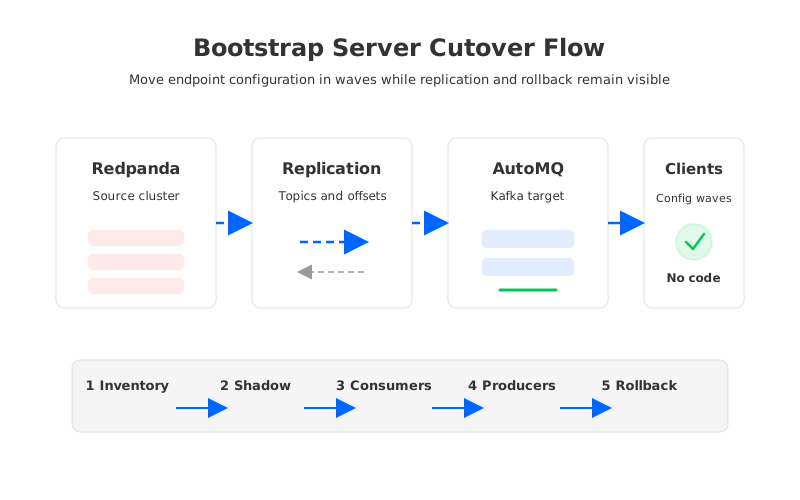
A no-rewrite migration is usually a staged endpoint migration. The platform team prepares the target, keeps application code stable, and moves services by changing configuration and deployment state. The safer pattern is boring on purpose: inventory, target setup, replication or linking, shadow validation, consumer cutover, producer cutover, rollback rehearsal, then decommission.
The exact replication mechanism depends on the target. Apache Kafka MirrorMaker 2 is the standard Kafka ecosystem reference for cross-cluster replication, but teams must understand its behavior around topic naming, checkpoints, offset sync, failover, and operational ownership. Some targets provide built-in migration capabilities. AutoMQ, for example, offers Kafka Linking for migration into AutoMQ; public AutoMQ materials describe migration with topic replication, consumer group offset handling, ACL synchronization, and staged client switching. Those capabilities can reduce custom migration plumbing, but they still need validation against your Redpanda source cluster and workload behavior.
A conservative runbook looks like this:
- Freeze the contract. Inventory topics, client versions, schemas, ACLs, connectors, admin scripts, and dashboards. Assign an owner to every high-risk dependency.
- Prepare the target. Create topics, credentials, ACLs, Schema Registry paths, connector environments, and observability before application traffic arrives.
- Replicate and compare. Mirror selected topics, compare counts or sampled checksums, validate schema compatibility, and measure replication lag.
- Shadow consumers. Run target-side consumers that deserialize and validate records without committing external business side effects.
- Move consumers in waves. Shift low-risk consumer groups first, confirm offsets or approved reset points, and keep rollback clear.
- Move producers last when feasible. Change bootstrap endpoints through deployment config, monitor both clusters, and stop writing to Redpanda only after downstream consumers are stable.
- Rehearse rollback. Prove that a service can return to Redpanda without duplicate side effects or lost downstream state.
Consumer-first cutover is not universal, but it is often safer because Redpanda can remain the write authority while the target proves read behavior. Producer-first cutover can work for append-only, idempotent pipelines, but it increases split-write risk when old consumers remain on the source.
7AutoMQ as a Kafka-Compatible Migration Target
Once the migration boundary is clear, the target architecture becomes the next decision. Moving off Redpanda only to inherit another storage-bound broker model may solve a vendor issue while leaving the same scaling and data movement problems in place. That is why teams evaluating a Kafka-compatible Redpanda replacement should ask two questions at the same time: can my clients keep the Kafka contract, and does the target change the operating model after migration?
AutoMQ belongs in the Kafka-compatible shared storage category. It preserves Kafka protocol and ecosystem compatibility while replacing broker-local durable storage with a storage layer based on WAL storage and S3-compatible object storage. In AutoMQ BYOC, the data plane runs in the customer's cloud environment, so the migration target can align with teams that want Kafka compatibility, cloud elasticity, and infrastructure ownership rather than a fully external hosted data plane.
This does not mean every Redpanda application needs no changes. Applications that use standard Kafka producer and consumer APIs are strong candidates for configuration-level cutover. Applications that depend on non-standard operational behavior, custom admin scripts, unusual security assumptions, or tightly coupled connector state need a narrower proof of concept. The responsible promise is not "everything moves untouched." It is "keep the Kafka application contract where it is standard, and make every dependency outside that contract explicit."
AutoMQ's Shared Storage architecture matters after the migration. Stateless brokers reduce the need to move durable partition data when compute capacity changes. Object storage changes retention and recovery economics. BYOC keeps the deployment boundary close to the customer's own cloud account. Those are platform-level reasons to evaluate AutoMQ, but they become persuasive only after the no-rewrite cutover plan has survived real workload tests.
8Redpanda Exit Plan Template
For teams turning this into an internal migration doc, keep the template short enough that application owners will actually complete it:
| Question | Owner | Evidence Required |
|---|---|---|
| Which producer and consumer clients are in scope? | App team | Library, version, config, deployment owner |
| Which features are used? | App + platform | Idempotence, transactions, compression, custom partitioner, large messages |
| How will offsets be preserved or approved? | Platform | Offset sync report, reset policy, shadow consumer output |
| What happens to schemas? | Data platform | Subject export, compatibility policy, registry endpoint plan |
| What happens to connectors and processors? | Data engineering | Connector offsets, state restore plan, DLQ behavior |
| How do we roll back? | App + platform | Tested redeploy path, duplicate-handling plan, data ownership rule |
This template is intentionally blunt. If no one owns a row, the migration is not ready. If the evidence is a verbal answer, the migration is not ready. No-rewrite migrations work because teams remove ambiguity before cutover, not because Kafka compatibility removes every operational detail.
9FAQ
9.1Can I move off Redpanda without changing producer and consumer code?
Often, yes, when applications use standard Kafka producer and consumer APIs and keep broker endpoints, credentials, and client configuration outside source code. You still need to validate client versions, security, schemas, topic configs, offsets, connectors, and monitoring. The cleaner phrase is "without rewriting business logic," not "without changing anything."
9.2Is changing bootstrap.servers enough?
Only for the simplest workloads. bootstrap.servers points clients at the target cluster, but it does not recreate ACLs, schemas, topic configs, connector offsets, dashboards, or rollback behavior. Treat the endpoint change as the final visible step after the compatibility work is complete.
9.3What is the highest-risk dependency in a Redpanda migration?
Consumer position is usually the most sensitive dependency because it controls duplicate processing, skipped records, and downstream side effects. Security and Schema Registry are close behind because failures there can look like application bugs even when the Kafka client code is unchanged.
9.4Should producers or consumers move first?
Consumers often move first when the source cluster can remain the write authority and the target can be validated through replicated data. Producers may move first for idempotent append-only pipelines or when the migration tool coordinates writes explicitly. The right order depends on duplicate tolerance, rollback behavior, and whether downstream systems can handle replay.
9.5Is AutoMQ a Kafka-compatible replacement for Redpanda?
AutoMQ is a Kafka-compatible streaming platform with shared storage and stateless brokers. It can be evaluated as a Redpanda replacement when the goal is to keep Kafka clients and ecosystem tools while changing the post-migration operating model. The migration still needs source-specific validation, especially around security, offsets, schemas, and connectors.
10References
- Redpanda documentation: Kafka client compatibility, API Reference, and authentication for the Kafka API
- Apache Kafka documentation: Producer, Consumer, Connect, and Admin APIs, client configuration, and security
- AutoMQ documentation: What is AutoMQ, Compatibility with Apache Kafka, and AutoMQ on GitHub
- AutoMQ migration material: Kafka Linking for Apache Kafka migration and replication
The Redpanda exit question starts with application rewrite fear, but it should end with a tested contract. Keep the Kafka client surface stable where it is standard, make the surrounding dependencies visible, and rehearse rollback before the endpoint switch. If your target evaluation includes Kafka-compatible shared storage and BYOC deployment boundaries, talk to the AutoMQ team with your client inventory and cutover requirements.


