
Table of Contents
Table of Contents
Moving transformations closer to the stream sounds like a small placement decision until the first production incident proves otherwise. A fraud score arrives after the transaction has already been approved. A CDC pipeline lands raw changes in the warehouse, but every downstream team rebuilds the same masking logic with different rules. A feature pipeline replays a week of events and quietly competes with customer-facing consumers for broker I/O. The harder question is where that logic belongs.
Kafka teams already know the usual answers: transform in the producer, transform in Kafka Streams or Flink, transform in Kafka Connect, transform after landing in a lakehouse or warehouse, or leave the raw topic untouched and let consumers decide. None of those answers is universally right. The right placement depends on latency, replay, governance, cost, ownership, and how much operational pressure the streaming platform can absorb without turning every pipeline change into a cluster project.
1Why move transformations closer to stream matters now
The search intent behind move transformations closer to stream is practical, not academic. Teams are dealing with latency targets, AI data freshness, compliance pressure, and platform cost that no longer fit a batch-first operating model. Once a transformation becomes part of a user-facing decision, the distance between the event and the transformation becomes visible.
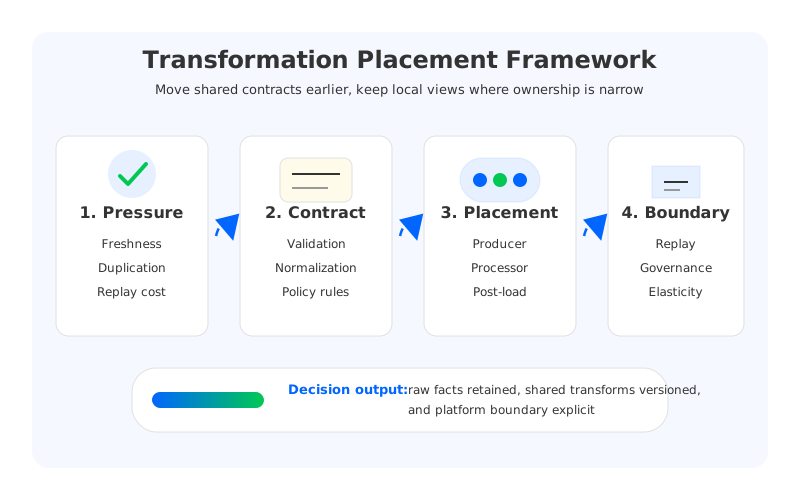
The first visible symptom is freshness. A transformation that runs after data lands in a warehouse can be elegant, versioned, and familiar to analytics teams, but it may not help an operational workflow that needs the result in seconds. Fraud checks, inventory reservations, anomaly detection, personalization, and AI context refresh all share the same discomfort: stale derived state can look authoritative while being wrong.
The second symptom is duplication. When raw streams feed many services, each consumer may implement its own decoding, filtering, enrichment, and masking. That gives teams freedom, but it also spreads data contracts across codebases. If one team treats a field as optional and another treats it as required, the topic has become a shared dependency without a shared transformation policy.
The third symptom is replay cost. Transforming later means you often keep more raw data, move it through more systems, and recompute more derived views. That flexibility is valuable, but large backfills, retention windows, and consumer catch-up workloads still land on the bill.
2The placement decision is a contract decision
A useful way to avoid religious arguments is to ask what contract the transformation creates. Some transformations are presentation choices. Others become data products that many teams depend on. Some are reversible and low-risk; others discard fields, mask sensitive attributes, or collapse many events into one aggregate. Moving logic closer to the stream makes sense when the transformation strengthens a shared contract; it is risky when it hides raw evidence downstream systems still need.
That gives platform teams a cleaner vocabulary than "streaming is faster than batch." The placement decision should separate five transformation classes:
- Validation and rejection. Invalid events should often be caught near ingestion because downstream systems cannot safely interpret them.
- Normalization. Stable schema cleanup, type coercion, and canonical field naming fit early transformation when many consumers need the same representation.
- Enrichment. Joining reference data into the stream can reduce consumer complexity, but it introduces state, freshness, and failure dependencies.
- Reduction. Aggregations, sampling, deduplication, and filtering can lower downstream cost, yet they may destroy replay value if raw history is not retained.
- Policy transformation. Masking, tokenization, and access-driven field removal should move earlier when governance requires consistent enforcement before broad fan-out.
The pattern is not "move everything earlier." The pattern is to move stable, shared, policy-sensitive logic earlier while preserving enough raw history to debug, rebuild, and prove correctness. That is where Kafka-compatible streaming becomes more than a transport layer. It becomes the boundary where teams decide which event facts are durable, which derived facts are shared, and which transformations remain local to a consumer.
3Where traditional Kafka gets stressed
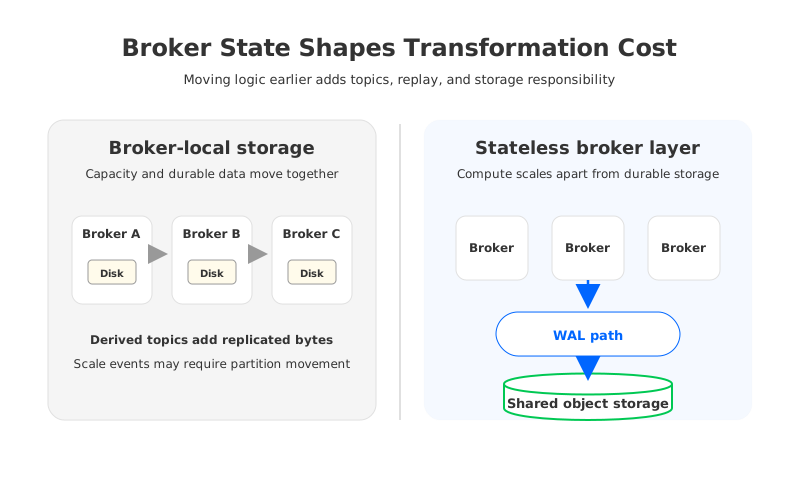
Traditional Apache Kafka is built around brokers that own local log segments. Partitions live on broker storage, and durability comes from replication across brokers. This architecture is mature and powerful, especially when workloads are stable and operators understand the capacity envelope. Kafka's consumer groups, offsets, log retention, replication, and transaction semantics are the foundation of a large ecosystem, which is why many teams want to preserve compatibility even as workload shape changes.
The stress appears when transformation placement increases both write-path and replay-path pressure. If a stream processor creates enriched topics, the cluster may carry raw topics, derived topics, state changelog topics, repartition topics, dead-letter topics, and connector internal topics at the same time. If the team retains raw history for replay while also serving low-latency consumers, broker storage and network behavior become part of the transformation architecture. If adding brokers requires moving partition data, the platform team may overprovision to avoid noisy rebalancing during business hours.
Tiered storage helps by moving colder log segments to remote storage. It can improve long-retention economics, and Kafka Improvement Proposal 405 defines the Apache Kafka tiered storage direction. But tiered storage does not automatically make brokers stateless. Hot data, partition leadership, local disk pressure, and catch-up behavior still need workload-specific testing. A transformation-heavy platform has to serve current reads and historical rebuilds at the same time.
This is why the placement question often becomes a storage architecture question. If transformations move closer to Kafka, Kafka becomes the place where more durable facts are created, retained, replayed, and governed. The streaming layer must support that responsibility without making every derived topic a long-term broker-local storage burden.
4Architecture patterns teams usually compare
The practical choice is not one engine against another. Most production designs combine Kafka-compatible storage, a stream processing runtime, connector infrastructure, and downstream analytical systems. The real comparison is about where each responsibility sits and which team owns the operational failure mode.
| Placement pattern | Good fit | Main risk | Platform requirement |
|---|---|---|---|
| Producer-side transformation | Required validation, small normalization, domain-owned logic | Producer coupling and inconsistent rollout across services | Strong schema governance and deployment discipline |
| Connector transformation | Simple routing, field projection, format conversion near source or sink | Connector workers become hidden business logic hosts | Observable connector state, retries, and dead-letter handling |
| Stream processor | Stateful enrichment, joins, windows, aggregates, real-time derived topics | More topics, checkpoints, state stores, and backfill paths | Replayable source history and isolated catch-up reads |
| Consumer-side transformation | Team-specific views and experimental logic | Duplication and inconsistent policy enforcement | Clear raw topic contracts and consumer ownership |
| Post-load transformation | Analytics modeling, historical correction, large batch recompute | Too late for operational workflows | Reliable landing, lineage, and raw data retention |
The table shows why "closer" is not a distance metric. A transformation is close enough when it can meet its latency target, preserve its audit path, and fail in a way the owning team can operate. A masking rule may belong near ingestion because policy enforcement should not depend on every consumer. A segmentation model may belong in a stream processor because it needs state and event-time behavior. A finance reconciliation model may belong after landing because correctness and historical rebuild matter more than second-level freshness.
The dangerous middle ground is accidental centralization. A team adds a small transform to reduce downstream work. Then another team depends on it. Then a third team asks for a field exception. Soon the streaming platform owns business semantics without versioning, replay policy, or staffing to support them. Moving transformations closer to the stream works when the platform treats transformed topics as products with contracts, not as temporary convenience outputs.
5Evaluation checklist for platform teams
Before moving a transformation earlier, test the operational envelope rather than the happy path. A demo that filters a stream is not evidence that the production system can own a shared transformation contract under replay, schema drift, and failure. The same questions apply whether the runtime is Flink, Kafka Streams, Connect, or a custom service consuming from Kafka.
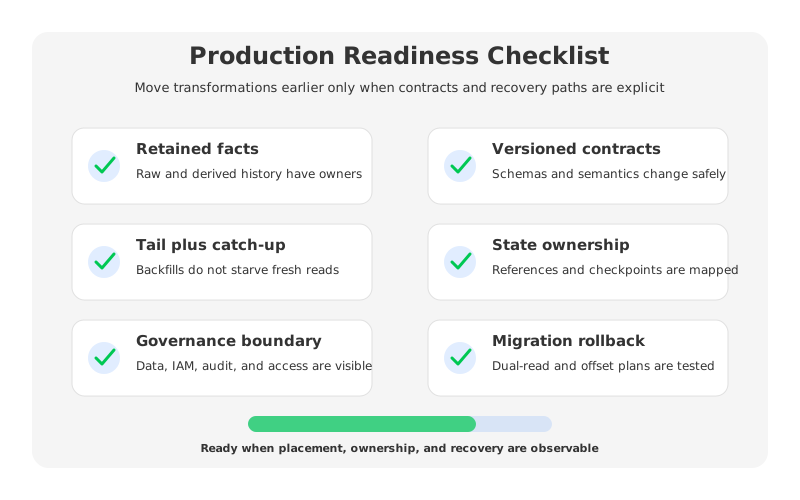
- Define the retained facts. Decide whether raw events, transformed events, or both are durable sources of truth. If a transformation drops fields or aggregates records, raw retention becomes the rollback path.
- Version the contract. Treat transformed topics as APIs. Schema compatibility, semantic changes, and deprecation windows matter as much as the code that computes the output.
- Measure tail and catch-up together. A platform that looks healthy for tail consumers can still struggle when a stream processor replays history. Test both at the same time.
- Model state ownership. Enrichment and joins depend on reference data, checkpoints, changelogs, and rebuild procedures. Document which system owns each state source.
- Trace governance boundaries. Sensitive-field masking, customer data residency, IAM, audit logs, and support access must be visible in the architecture, not buried in code.
- Prove migration and rollback. If a downstream service moves from raw to transformed topics, validate offset behavior, dual-read periods, reconciliation, and rollback before production cutover.
Cost deserves the same discipline. Moving transformations earlier can reduce downstream warehouse scans, duplicate consumer code, and late-stage recomputation. It can also increase Kafka topic count, retention needs, stream processor resources, object-store requests, checkpoint storage, observability cardinality, and private network traffic. The right cost model follows the byte through the system: original event, derived event, state update, replay read, sink write, monitoring signal, and retained copy.
6Where AutoMQ changes the operating model
Once the evaluation reaches storage, elasticity, and data-boundary questions, AutoMQ becomes relevant as a Kafka-compatible, cloud-native streaming platform built around compute-storage separation. AutoMQ keeps the Kafka-facing API familiar for producers, consumers, and ecosystem tools while using shared object storage as the durable stream storage layer. Its stateless brokers and write-ahead log path make broker compute less tightly coupled to durable data ownership.
That distinction matters for transformation-heavy platforms. If transformed topics become shared data products, the streaming layer needs retention and replay without forcing every capacity change through broker-local disk planning. If governance requires customer-controlled infrastructure boundaries, AutoMQ Cloud BYOC can place the data plane in the customer's cloud environment while the cloud control plane coordinates management.
AutoMQ is not a replacement for stream processing. Flink, Kafka Streams, Connect, and application services still own transformation logic. The architectural point is narrower: when moving transformations closer to Kafka increases the value of retained, replayable, governed topics, a Kafka-compatible shared-storage platform can change the operational cost of carrying those topics.
There are still trade-offs to test. Object storage has different latency, request, and failure characteristics than local disks. WAL configuration, cloud region choice, network path, topic count, retention profile, and processor behavior all affect results. The evaluation should use representative data sizes and consumer patterns rather than a single benchmark number.
7Decision table: when closer is the right direction
The decision becomes clearer when teams write down the reason for moving each transformation. If the reason is "downstream teams are annoyed," that may be a developer experience problem. If the reason is "regulated data must be masked before broad fan-out," the placement decision has a security basis. If the reason is "AI context must update before the next customer interaction," the latency budget is explicit.
| Move closer to the stream when... | Keep later or consumer-local when... |
|---|---|
| Many consumers need the same canonical fields | Only one team needs the derived view |
| Policy enforcement must happen before fan-out | Consumers are already isolated by access boundary |
| Freshness directly affects user-facing decisions | Batch correction and auditability matter more |
| Replay can rebuild derived topics from retained raw history | Raw history is unavailable or too expensive to keep |
| The platform can isolate backfills from tail reads | Catch-up reads regularly disturb production traffic |
| Ownership, schema versioning, and rollback are defined | The transform is still exploratory and unstable |
Reliable architectures keep both humility and structure. They move stable shared transformations toward the stream, keep raw evidence where the business needs replay, and avoid turning the streaming platform into an unowned semantic warehouse. Kafka compatibility keeps the ecosystem stable, stream processing makes derived data timely, and shared storage can make retention and elasticity less painful as derived streams grow.
If your team is debating where transformation logic belongs, start with one high-value pipeline and draw the contract boundaries: raw topic, transformed topic, state source, replay window, governance owner, and rollback path. Then compare your current Kafka operating model with a Kafka-compatible shared-storage design. The useful question is not whether transformations should be "near" or "far." It is whether the platform can make the chosen distance reliable, observable, and affordable. To evaluate that option, review the AutoMQ architecture materials and test the design against your retention, replay, and governance constraints.
8References
- Apache Kafka documentation: concepts and design
- Apache Kafka KIP-405: Tiered Storage
- Apache Flink documentation: stateful stream processing
- AutoMQ documentation: compatibility with Apache Kafka
- AutoMQ documentation: architecture overview
- AutoMQ documentation: S3Stream shared streaming storage
- AutoMQ Cloud documentation: BYOC environment overview
9FAQ
9.1Should every Kafka transformation move closer to the stream?
No. Move stable, shared, latency-sensitive, or policy-sensitive transformations closer to the stream. Keep experimental, team-specific, or audit-heavy transformations later until the contract is clear.
9.2Is Kafka itself a stream processing engine?
Kafka is the durable event log and coordination layer for many streaming architectures. Transformation logic usually runs in Kafka Streams, Flink, Kafka Connect, Spark Structured Streaming, or application services that consume from Kafka-compatible topics.
9.3How does moving transformations earlier affect replay?
It can improve replay if derived topics are versioned and raw events are retained. It can hurt replay if the transformation discards data and the raw stream expires before the team discovers an error.
9.4Where does AutoMQ fit in this architecture?
AutoMQ fits as the Kafka-compatible streaming backbone when teams want Kafka APIs, retained history, elastic broker compute, and object-storage-backed durability. Transformation runtimes still own the logic; AutoMQ changes the operating model underneath the log.
9.5What should platform teams test before changing placement?
Test tail latency, concurrent catch-up reads, raw and transformed retention, schema evolution, failure recovery, state rebuilds, governance controls, and rollback. A transformation placement decision is production-ready only when those behaviors are observable and repeatable.


