
Table of Contents
Table of Contents
MQTT-to-Kafka ingestion usually starts as a protocol bridge. A factory gateway, connected vehicle fleet, utility meter network, retail sensor estate, or edge analytics system already publishes MQTT messages, while the central data platform expects Kafka topics. The first implementation may look like a connector problem: subscribe to MQTT, transform the payload, publish records into Kafka, and let downstream teams consume events with familiar tooling.
That first bridge is rarely where the architecture breaks. The hard part appears when the pipeline becomes shared infrastructure. Device links are intermittent, payloads arrive in bursts, schemas evolve at the edge, and downstream teams want replayable Kafka topics instead of disposable telemetry. Integration glue now has to behave like a durable streaming platform.
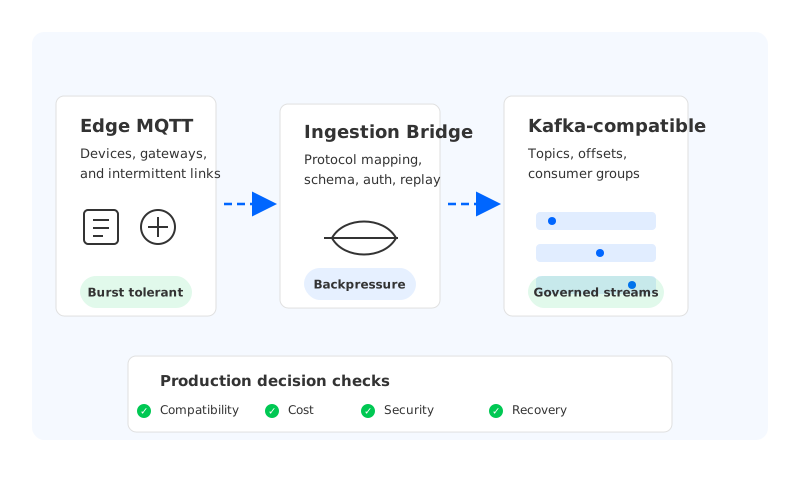
The useful question is not whether MQTT and Kafka can be connected. They can. The useful question is whether the ingestion path can absorb edge behavior without turning the Kafka side into a permanently over-provisioned, hard-to-rebalance cluster. That is where MQTT-to-Kafka ingestion becomes an architecture decision rather than a connector selection.
1Why Teams Search for MQTT to Kafka Ingestion
MQTT and Kafka solve different parts of the same telemetry problem. MQTT is well suited to constrained devices, low-bandwidth links, and publish-subscribe communication near the edge. Kafka is well suited to durable logs, consumer groups, replay, and integration with analytics, data engineering, and stream processing systems. The ingestion bridge exists because production IoT systems need both behaviors at once.
The search phrase mqtt to kafka ingestion usually hides a larger set of requirements. Architects want to normalize device traffic into Kafka topics without losing the properties that make Kafka useful: ordered records within partitions, durable retention, consumer offset management, and replay when downstream code changes. Data engineers want payloads that fit schema and quality rules. SREs want bounded failure domains, alertable lag, and documented recovery.
Those goals create a sharper design problem than "copy messages from A to B." The ingestion bridge has to decide how MQTT topics map to Kafka topics and keys, how device identity becomes an authorization concern, how MQTT delivery expectations translate into Kafka durability, and how backpressure moves across a protocol boundary.
The first design mistake is treating the bridge as stateless plumbing. It may not persist records for long, but it still carries state in subscriptions, retry queues, schema decisions, and mapping rules. If that state is invisible, recovery turns into guesswork. If it is visible but not coordinated with Kafka retention and consumer progress, replay becomes risky in practice.
2The Operational Constraint Behind Connector-Heavy Platforms
Connector-heavy platforms accumulate pressure in uneven ways. A normal business day may produce steady telemetry, while a reconnect storm after a network interruption can push a large backlog into the ingestion layer. Firmware rollouts can change payload shape across device cohorts. The bridge sees this first, but Kafka absorbs the long-term consequences.
The operational symptoms tend to cluster into a few categories:
- Burst absorption. The platform needs enough write capacity to accept reconnect storms without dropping records or exhausting connector retry buffers.
- Replay discipline. Teams need clear retention and offset policies so a downstream job can reprocess events without asking the edge layer to resend data.
- Schema control. Device payloads need a path from raw telemetry to governed records, with explicit handling for unknown fields, version drift, and malformed messages.
- Tenant and fleet isolation. A noisy device group should not consume broker capacity, connector workers, or topic quotas needed by another group.
- Cloud cost predictability. Storage growth, replication, and cross-zone traffic should be modeled before the pipeline becomes a company-wide dependency.
Traditional Kafka deployments can support these requirements, but the cost of operating them rises when capacity and durability are tied to broker-local storage. If ingestion bursts require more brokers, the cluster may also inherit more local disks and more balancing operations. If retention grows because analytics teams want longer replay windows, broker storage grows with it. This coupling is not a connector problem; it is a storage architecture problem.
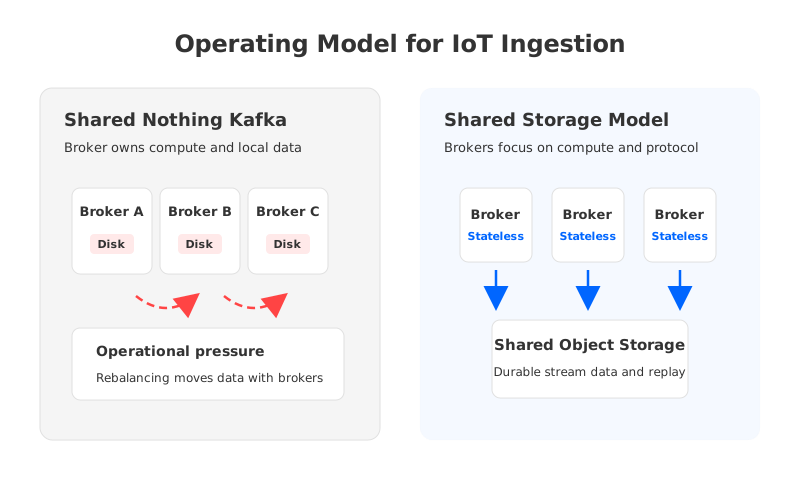
The coupling matters most when the IoT workload is uneven. Kafka's partition and consumer group model gives platform teams a strong foundation for parallelism, but a broker that owns both compute and local persistent data is harder to scale elastically. Adding capacity also changes where data lives and what has to move during rebalancing or recovery.
3Failure Handling, Schema, and Replay Trade-Offs
MQTT-to-Kafka ingestion has three failure planes. The device-to-bridge plane deals with unreliable networks and MQTT session behavior. The bridge-to-Kafka plane deals with producer retries, batching, and acknowledgments. The Kafka-to-consumer plane deals with lag, offset commits, downstream failures, and replay. A production design has to make each plane observable.
The most important rule is to avoid hiding loss behind convenience. If the bridge acknowledges MQTT messages before Kafka accepts the corresponding records, the system may look healthy while silently losing data during a bridge failure. If the bridge waits for Kafka acknowledgment but has no bounded retry and backpressure strategy, it may protect durability while turning a Kafka-side issue into an edge-side outage.
Schema design follows the same pattern. Some teams publish raw device payloads into Kafka and let downstream processors normalize them. Others normalize at the bridge so Kafka topics already carry canonical records. Raw-first designs preserve forensic detail but push validation downstream. Normalize-first designs make analytics easier, but they need a quarantine path for unexpected device messages.
| Decision | Raw-first ingestion | Normalize-first ingestion |
|---|---|---|
| Failure visibility | Malformed messages remain available for inspection. | Invalid messages need a dead-letter or quarantine path. |
| Downstream usability | Consumers need more parsing and validation logic. | Consumers get more consistent records. |
| Replay behavior | Reprocessing can use the original payload. | Reprocessing depends on transformation version control. |
| Governance effort | Topic contracts may be looser at first. | Topic contracts are clearer but require earlier ownership. |
Replay is the part that exposes weak designs. When a stream processor bug corrupts derived state, the team needs to reset offsets and reprocess a known range of Kafka records. If Kafka is the durable handoff point, replay becomes a data platform operation rather than an edge coordination exercise.
That does not mean every MQTT message needs long retention. It means retention should match business recovery expectations. Safety telemetry, payment terminals, logistics events, and industrial control signals have different replay needs.
4Evaluation Checklist for Platform Teams
Before selecting a bridge or Kafka-compatible platform, separate protocol mechanics from platform mechanics. Protocol mechanics answer whether the bridge can subscribe to MQTT topics, map payloads, and produce Kafka records. Platform mechanics answer whether the resulting Kafka estate can survive growth, bursts, and operational turnover.
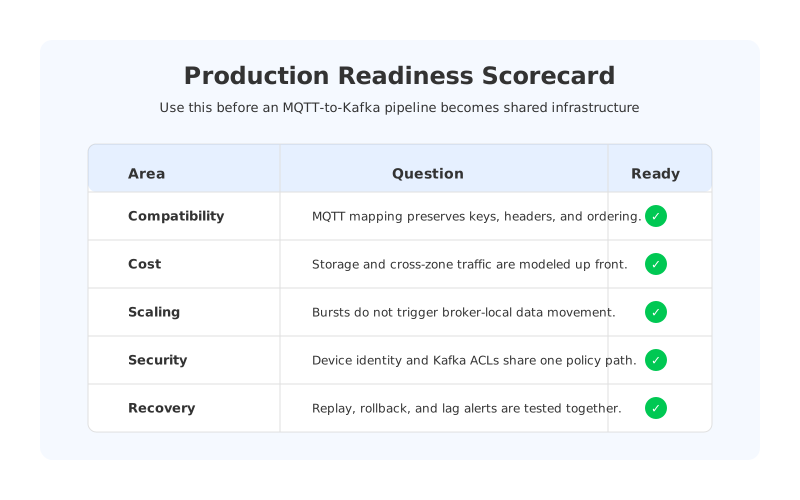
A practical readiness review should cover these areas:
- Topic and key mapping. Decide whether Kafka topics represent device types, tenants, regions, or business event categories. Keys should preserve the ordering boundary that downstream consumers actually need, not the device hierarchy that happened to exist in MQTT.
- Acknowledgment semantics. Define when the bridge considers a message accepted. The answer should name the Kafka producer acknowledgment policy, retry behavior, and what happens when Kafka is unavailable.
- Backpressure and buffering. Identify where messages wait during downstream pressure: in the MQTT broker, the bridge, Kafka producer buffers, or Kafka itself. Hidden buffers are operational debt.
- Security boundaries. Map device identity, gateway identity, Kafka principals, ACLs, network isolation, and secret rotation into one auditable path.
- Retention and replay. Set retention by topic family and write down the replay runbook before the first production incident.
- Observability. Track MQTT subscription health, bridge throughput, Kafka produce latency, consumer lag, error topics, and transformation failures together.
The review should also include a cost model. IoT workloads often look small when measured by average throughput and large when measured by peak fan-in, retention, and replication. A platform sized only for average write volume may fail during reconnect storms. A platform sized only for peak storms may carry idle capacity for most of the month.
5How AutoMQ Changes the Operating Model
Once the evaluation framework is clear, the architectural requirement becomes straightforward: keep Kafka protocol behavior familiar, but reduce broker-local state that makes ingestion capacity hard to change. AutoMQ is a Kafka-compatible cloud-native streaming system designed around that idea. Its architecture separates broker compute from durable stream storage, using shared object storage as the persistence layer.
For MQTT-to-Kafka ingestion, that distinction matters because edge traffic is bursty and retention can grow independently from steady-state compute. In a shared-storage model, adding or removing broker capacity does not imply the same degree of local data movement as a shared-nothing broker fleet. The ingestion bridge can continue to write to Kafka-compatible topics while the platform team gets a different scaling and recovery model underneath.
AutoMQ's architecture is not a substitute for good ingestion design. You still need topic naming, key selection, schema policy, dead-letter handling, and observability. The change is in the operating surface behind those decisions. Stateless brokers, object-storage-backed durability, and independent compute/storage scaling can reduce the planning tied to broker disk ownership.
The natural fit is strongest when the ingestion platform has these traits:
- Bursty write traffic. Reconnect storms and regional gateway failovers require temporary write headroom.
- Longer replay windows. Analytics, compliance, or ML pipelines need durable event history beyond the minimum operational buffer.
- Kafka ecosystem dependency. Downstream teams already depend on Kafka clients, consumer groups, stream processors, or Kafka Connect-style integration.
- Cloud cost scrutiny. Platform owners need to separate compute capacity, storage retention, and network traffic instead of treating the cluster as one opaque cost center.
This is also where managed connector strategy matters. Some teams want the MQTT bridge, transformation logic, and sink/source connectors to be owned by a central platform team. Others want domain teams to operate connectors inside guardrails. Either model needs stable Kafka-compatible infrastructure beneath it.
6Migration Path Without Losing the Edge Context
Existing MQTT ingestion systems should not be replaced in one step. Create a parallel Kafka-compatible topic path, mirror a subset of device traffic, and compare record counts, ordering behavior, schema outcomes, and downstream lag. This test should use real device cohorts because edge behavior is the workload.
A phased migration usually works better than a big switch:
- Inventory MQTT topic patterns and device cohorts. Identify which topics carry command signals, telemetry, diagnostics, or state updates.
- Define Kafka topic families and keys. Preserve ordering where it matters and avoid creating one Kafka topic per device unless there is a strong governance reason.
- Run a shadow ingestion path. Produce records to Kafka-compatible topics while existing consumers continue using the current path.
- Validate replay and recovery. Reset a test consumer group, replay a bounded range, and confirm that derived outputs match expectations.
- Move consumers by domain. Shift analytics, monitoring, and operational consumers in stages so failures have a small blast radius.
The shadow phase often reveals inconsistent payload versions, gateway timestamps, missing device identity, or consumers relying on arrival time rather than event time. Those discoveries are much less expensive during migration than during an incident.
7A Practical Architecture Pattern
A solid MQTT-to-Kafka ingestion architecture has a small number of clear responsibilities. MQTT brokers or gateways handle device sessions near the edge. The ingestion bridge maps MQTT messages into Kafka records, applies authentication and transformation policy, and writes to topic families with explicit keys. Kafka-compatible streaming infrastructure becomes the durable handoff point for downstream consumers, stream processors, lakehouse writers, and dashboards.
The pattern works because it assigns each layer a job it can perform. MQTT handles device communication. The bridge handles protocol translation and immediate policy. Kafka handles durable log semantics, consumer coordination, and replay. Shared-storage Kafka-compatible infrastructure addresses the cloud operating model behind the log.
There is no universal topic layout for IoT. A fleet-monitoring workload may key by device ID to preserve per-device order. A payments workload may key by terminal or merchant account. The right key is the smallest boundary where order matters. Everything wider reduces parallelism; everything narrower can break consumer assumptions.
The same principle applies to retention. Raw telemetry may need short retention if it is quickly transformed into governed events. Safety, billing, or audit topics may need longer retention because replay has business value.
8Conclusion
MQTT-to-Kafka ingestion is a bridge between unreliable edge connectivity and central streaming. The bridge has to translate protocols, but the platform carries the long-term consequences of bursts, replay, governance, and cloud cost. If Kafka remains tightly coupled to broker-local storage, every retention and scaling decision can become an operations decision.
The evaluation path is therefore simple: design the protocol bridge carefully, then stress-test the Kafka operating model behind it. If your team is building an IoT ingestion platform that needs Kafka compatibility with a cloud-native storage model, review the AutoMQ documentation and compare the shared-storage architecture against your current scaling, replay, and cost assumptions.
9References
- OASIS MQTT Version 5.0 specification
- Apache Kafka documentation
- Apache Kafka Connect documentation
- AutoMQ architecture overview
- AutoMQ WAL storage documentation
- AutoMQ zero cross-AZ traffic overview
10FAQ
10.1Is MQTT-to-Kafka ingestion mainly a connector problem?
The connector is necessary, but it is not the whole design. Production ingestion also needs topic mapping, key strategy, schema policy, backpressure handling, durable retention, replay runbooks, security boundaries, and cost modeling. Teams that focus only on the bridge often discover the missing pieces when the pipeline becomes shared infrastructure.
10.2Should Kafka store raw MQTT payloads or normalized events?
Both patterns are valid. Raw-first ingestion preserves original device data and helps with forensic replay, but downstream consumers need more parsing logic. Normalize-first ingestion gives consumers cleaner records, but it requires stronger transformation ownership and a dead-letter path for unexpected payloads. Many teams keep raw topics for a short window and publish governed event topics for broader consumption.
10.3How should MQTT topics map to Kafka topics?
Map Kafka topics to durable business or platform boundaries, not automatically to every MQTT topic string. MQTT topic hierarchies often reflect device routing, while Kafka topics should support ownership, retention, access control, and consumer behavior. Use Kafka keys to preserve the ordering boundary that matters for consumers.
10.4Where does AutoMQ fit in this architecture?
AutoMQ fits on the Kafka-compatible streaming side of the architecture. The MQTT bridge still performs protocol translation, authentication, and transformation. AutoMQ provides Kafka-compatible infrastructure with a shared-storage operating model, which can help platform teams separate compute scaling from durable storage growth for bursty IoT and edge workloads.
10.5What should be tested before production?
Test reconnect storms, bridge failure, Kafka unavailability, malformed payloads, consumer lag, offset reset, replay from retention, ACL changes, and regional network degradation. The goal is to prove that the ingestion path fails visibly and recovers through documented operations rather than hidden buffers or manual edge coordination.


