
Table of Contents
Table of Contents
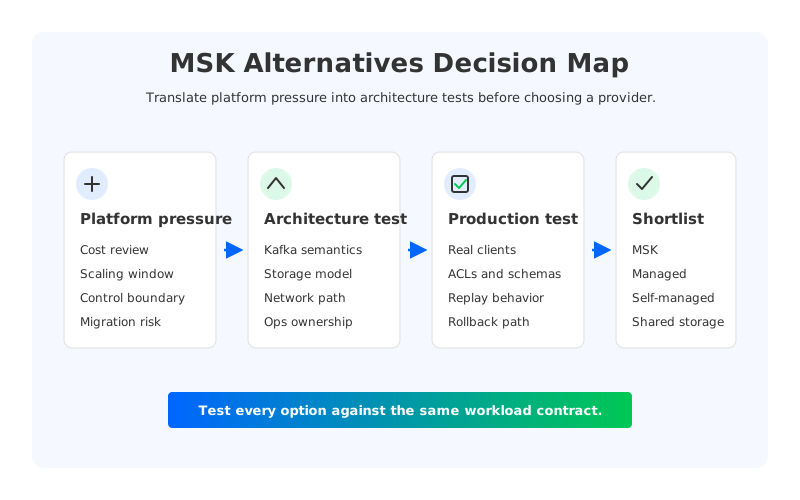
Teams rarely search for msk alternatives because Amazon MSK failed at the basic job of running Apache Kafka. The search usually starts after MSK has already proven useful: the organization standardized on AWS, moved away from hand-built broker fleets, and gave platform teams a managed service boundary. The pressure appears later, when the estate grows from a few clusters into a shared streaming platform with many tenants, long retention, replay-heavy consumers, private connectivity, governance requirements, and cost reviews from FinOps.
At that point, the alternative question is not "Which product has the longest feature list?" It is "Which operating model should own our Kafka estate for the next several years?" Amazon MSK, Confluent Cloud, Aiven, Redpanda, self-managed Apache Kafka, and Kafka-compatible shared-storage systems all answer that question differently. A useful evaluation maps the workload to the architecture before it maps the vendor to a procurement row.
1Why teams search for msk alternatives
MSK is often the conservative AWS-native answer. AWS describes Amazon MSK as a managed service for Apache Kafka and Kafka-compatible workloads, with AWS handling much of the infrastructure management around clusters. That can be exactly right for teams that want Apache Kafka semantics with AWS identity, networking, monitoring, and procurement patterns. The problem is that a managed boundary does not erase every Kafka-shaped responsibility.
The search for alternatives tends to come from one of four pressures:
- Cost has moved from broker sizing to byte movement. The bill may include broker capacity, storage, networking, connectivity, monitoring, and operational labor. AWS publishes MSK pricing separately from broader data transfer pricing surfaces, so a serious model has to trace where bytes move instead of stopping at broker count.
- Scaling still feels stateful. Kafka partitions, leaders, replicas, retention, and broker-local state shape how capacity changes happen. Even when a provider manages the service, the platform team still has to understand workload placement and change windows.
- Migration risk is larger than the feature delta. Existing producers, consumers, ACLs, schemas, connectors, observability, and incident runbooks may matter more than any single platform feature. A replacement that requires broad application rewrites can lose before the proof of concept starts.
- Control boundaries matter. Some teams want a fully managed service. Others need data-plane resources in their own cloud account, private network, or regulated environment. The right alternative depends on where the customer wants the control plane, data plane, and operational responsibility to sit.
Those pressures explain why flat comparison tables disappoint serious buyers. They can name options, but they rarely show whether a platform changes the underlying mechanics that created the pressure.
2Start with the architecture, not the shortlist
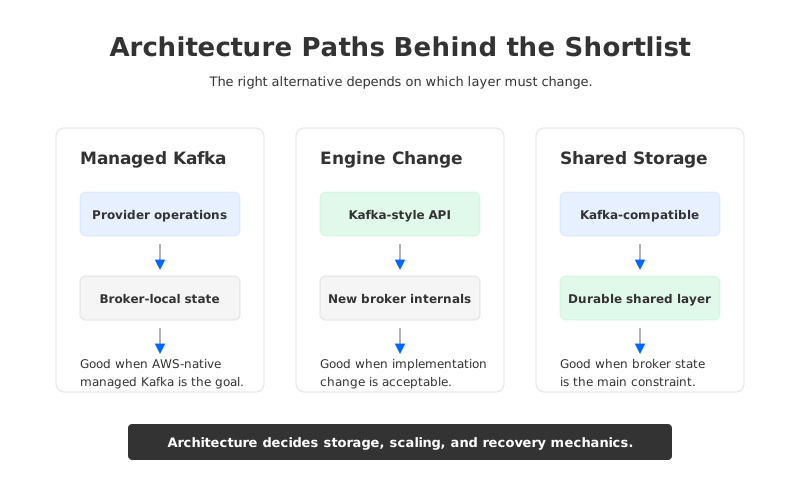
An MSK alternative can mean several different things. One team may mean "a more complete managed Kafka service." Another may mean "a Kafka-compatible engine with lower operational overhead." A third may mean "a cloud-native architecture that changes storage, scaling, and network economics." Treating those as one category creates bad evaluations because the products are not optimizing for the same trade-off.
The first decision is whether the team wants to preserve Apache Kafka itself or preserve Kafka compatibility. Apache Kafka gives the strongest continuity for clients, ecosystem tooling, operational knowledge, and semantics. Kafka-compatible platforms can reduce migration effort while changing the storage engine, deployment boundary, or operations model. Compatibility still has to be proven, especially for admin APIs, transactions, security, connectors, and failure behavior.
The second decision is where durable state lives. Traditional Kafka keeps active log data attached to brokers and uses replication across brokers for durability and availability. Tiered storage can offload older data to remote storage, and Apache Kafka's tiered storage work formalized that direction, but active broker-local storage still matters for the hot path. Shared-storage Kafka-compatible systems take a stronger step: they separate compute from durable storage so brokers become less stateful and storage can be backed by object storage or another shared layer.
The third decision is who operates the platform boundary. A fully managed service can reduce infrastructure work and align with cloud procurement. A BYOC or software deployment can keep data-plane resources in the customer's account or private environment while still reducing broker operations through automation. Self-managed Kafka can remain valid when the organization has deep Kafka expertise and wants direct control over every layer.
| Evaluation axis | What to test | Why it changes the shortlist |
|---|---|---|
| Kafka semantics | Producer, consumer, admin, transactions, ACLs, quotas, Connect, Streams, monitoring | Compatibility gaps usually appear in edge behavior, not in a happy-path produce and consume test |
| Storage model | Broker-local log, tiered storage, shared storage, retention behavior, recovery path | Storage determines scaling friction, recovery mechanics, and long-retention economics |
| Network path | AZ placement, client access, PrivateLink, replication, cross-region flows, connector egress | Streaming bills often follow byte paths rather than service names |
| Operating model | Fully managed, BYOC, self-managed, software in private infrastructure | Security and platform teams care where control, data, and credentials live |
| Migration blast radius | Client changes, topic migration, schema handling, ACL mapping, rollback, dual-write period | The safest platform on paper can be too expensive to adopt if migration touches every application |
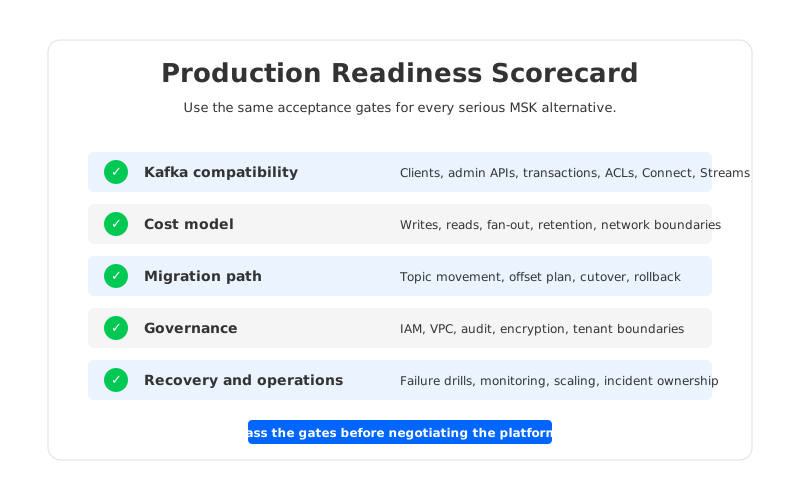
This table is deliberately not a vendor ranking. It is a workload contract. If a platform cannot pass the contract for the workloads that matter, it should not be on the production shortlist, even if it looks attractive in a generic comparison.
3Cost modeling: count the events, not the products
Kafka cost analysis gets muddy when teams start with product names. A better model starts with billable events: a record is produced, replicated or persisted, retained, fetched by one or more consumers, replayed, mirrored, exported, monitored, and sometimes moved across availability zones, VPCs, accounts, or regions. Each event can create compute, storage, request, or network cost depending on the platform architecture and cloud pricing rules.
For MSK specifically, the official pricing page is the source to check for current service dimensions. The broader AWS pricing pages are still relevant because data transfer, private connectivity, storage, and adjacent services may be billed outside the headline Kafka service. The responsible approach is to build a workload-specific model instead of quoting a universal savings number.
A practical cost worksheet should include:
- Write throughput and replication behavior. How many MiB/s enter the platform, how many copies are created for durability, and which of those copies cross failure domains?
- Read fan-out and replay. A stream with 5 independent consumer groups can generate a very different cost profile from a stream with 1 consumer group, even when write throughput is identical.
- Retention and cold reads. Long retention is not only a storage question. It changes restore, replay, and object-read behavior when historical consumers appear.
- Connectivity boundaries. Private endpoints, multi-VPC access, cross-AZ clients, cross-region replication, and connector egress should be modeled explicitly.
- Human operations. Broker resizing, partition balancing, incident response, upgrade planning, quota tuning, and cost attribution all consume engineering time.
The important distinction is whether an alternative changes the mechanics or only changes the packaging. A managed Kafka service may make operations cleaner without changing the broker-local storage model. A different Kafka-compatible engine may change performance and operations while keeping durable state tied to nodes. A shared-storage design may change how scaling and retention behave by moving durable data away from broker-local disks.
4Migration questions platform teams should ask
Migration is where architecture promises meet production reality. The first proof of concept should not be a benchmark that writes synthetic records into an empty cluster. It should be a compatibility and operations rehearsal using one representative workload, its real client libraries, its authentication pattern, its schema behavior, its consumer lag profile, and its rollback requirement.
The migration plan should answer five questions before a production date appears on a calendar. First, can existing clients connect without code changes, or is the project actually a client migration? Second, can the team reproduce topic configuration, ACLs, quotas, and observability signals with enough fidelity for incident response? Third, how will historical data move, and what happens to consumers that need offset continuity? Fourth, where is the cutover boundary: producer first, consumer first, topic by topic, or application group by application group? Fifth, what is the rollback path if the target platform passes benchmarks but fails a governance, security, or operational test?
The answers often split the shortlist. Fully managed services can reduce platform labor but may impose service-specific limits or migration patterns. Self-managed Kafka can minimize semantic surprise but preserve much of the operational burden. Kafka-compatible platforms can be compelling when they preserve application behavior while changing storage and scaling mechanics, but they require disciplined compatibility testing rather than assumptions.
5How AutoMQ fits the evaluation
The neutral framework above points to a specific architectural question: what if the main problem is not Kafka's API, but the fact that durable streaming state is tied to brokers? When that is the pressure, an MSK alternative should keep Kafka compatibility while changing the storage and scaling model underneath.
AutoMQ fits that category as a Kafka-compatible cloud-native streaming platform built around Shared Storage architecture. It keeps the Kafka protocol and ecosystem surface while moving durable storage responsibilities into an object-storage-backed design through S3Stream, WAL storage, caching, and stateless brokers. In practical terms, the platform target is not "leave AWS" or "rewrite Kafka applications." The target is to reduce the amount of persistent state attached to each broker so compute and storage can scale more independently.
That distinction matters for AWS-native estates. If the team likes MSK because it is integrated with AWS but dislikes the cost and operational shape of stateful broker storage, the evaluation should include a shared-storage Kafka-compatible path. AutoMQ BYOC can run in the customer's cloud environment, which keeps the data-plane discussion close to the organization's existing security and network review process. AutoMQ Software can serve teams that need private infrastructure rather than a cloud service boundary.
AutoMQ should not be the automatic answer to every MSK alternatives search. If a team wants the simplest AWS-managed Apache Kafka service and its workload fits the service economics, MSK can remain the right choice. If a team wants a broad managed event-streaming suite, another managed provider may fit. If the core pain is broker-local state, cross-zone traffic pressure, slow scaling, and long-retention economics, AutoMQ deserves a proof of concept because it changes the architecture that produces those symptoms.
6A decision map for the shortlist
The final shortlist should be small enough to test deeply. A good decision memo can reduce the field by assigning each option to the problem it actually solves.
| Option type | Strong fit | Watch carefully |
|---|---|---|
| Amazon MSK | AWS-native managed Apache Kafka with familiar AWS security, billing, and operations patterns | Service limits, storage and broker scaling model, workload-specific network paths |
| Fully managed Kafka platforms | Teams that want more provider-managed ecosystem services, multi-cloud options, or commercial Kafka platform features | Data-plane boundary, pricing model, private connectivity, migration and lock-in surfaces |
| Kafka-compatible engines | Teams open to changing the broker implementation while retaining Kafka-style clients | Compatibility coverage, operational tooling, failure behavior, ecosystem edge cases |
| Self-managed Apache Kafka | Teams with deep Kafka operations capability and strict implementation control | Ongoing labor, upgrades, capacity planning, balancing, incident ownership |
| Shared-storage Kafka-compatible platforms | Teams that want Kafka compatibility while changing storage, scaling, retention, and broker-state economics | Compatibility validation, deployment boundary, object-storage design, workload-specific latency targets |
This framing keeps the evaluation respectful. MSK is not "bad Kafka"; it is a managed AWS service with a particular operating model. Other platforms are not generic replacements; they are different answers to cost, control, compatibility, and operational risk. The right decision is the one whose architecture matches the pressure that triggered the search.
If your team is evaluating MSK alternatives because stateful broker storage, scaling windows, and network economics are now platform-level concerns, use the decision map as a proof-of-concept checklist. To see how a Kafka-compatible shared-storage architecture works in practice, review the AutoMQ architecture docs or contact the AutoMQ team through go.automq.com with your workload shape, retention target, and AWS deployment boundary.
7References
- AWS documentation: What is Amazon MSK?
- AWS pricing: Amazon MSK pricing
- Apache Kafka documentation: Apache Kafka documentation
- Apache Kafka KIP: KIP-405: Kafka Tiered Storage
- AutoMQ documentation: Architecture overview
- AutoMQ documentation: S3Stream Shared Streaming Storage
8FAQ
8.1Which MSK alternative should a team choose?
There is no universal best alternative. Amazon MSK, fully managed Kafka platforms, self-managed Apache Kafka, Kafka-compatible engines, and shared-storage Kafka-compatible systems solve different problems. Start with workload requirements: Kafka semantics, storage model, network path, control boundary, migration risk, and operating model.
8.2Is Amazon MSK the same as self-managed Kafka?
No. Amazon MSK is an AWS managed service for Apache Kafka and Kafka-compatible workloads. It reduces infrastructure management work, but platform teams still need to design topics, clients, security, networking, quotas, observability, and workload-specific operations.
8.3When should a team evaluate AutoMQ as an MSK alternative?
Evaluate AutoMQ when the pressure is architectural rather than cosmetic: broker-local state, scaling friction, cross-zone traffic pressure, long retention, and the need to keep Kafka compatibility while changing the storage model. It is especially relevant when the team wants data-plane resources in its own cloud or private environment.
8.4Can Kafka applications migrate without rewrites?
They can if the target platform preserves the Kafka protocol and the application's specific API usage, but that should be verified. Test producer and consumer behavior, admin operations, transactions if used, ACLs, schemas, connectors, metrics, failure recovery, and rollback before assuming a drop-in migration.
8.5Should cost comparisons use published list prices?
Published pricing pages are necessary, but they are not enough. Model the workload events that create cost: writes, reads, fan-out, retention, replay, network boundaries, private connectivity, monitoring, and human operations. Then apply current prices for the selected region and deployment shape.


