
Table of Contents
Table of Contents
Searches for "MSK cost" usually start with a pricing page and end in a spreadsheet. The hard part is the distance between those two points. Amazon MSK has several deployment and feature surfaces, and each one exposes a different billing shape: broker hours, storage, bytes written, capacity units, connector workers, replication throughput, PrivateLink, and standard AWS data transfer. A Kafka platform team cannot answer the budget question by looking at a broker hourly rate in isolation.
The real question is architectural: which parts of the workload must be paid for as reserved capacity, which parts scale with traffic, and which parts appear only after production requirements such as multi-AZ, migration, private connectivity, or cross-region recovery are added? That is why MSK cost work belongs in the design review, not at the end of procurement.
1The four surfaces behind an MSK bill
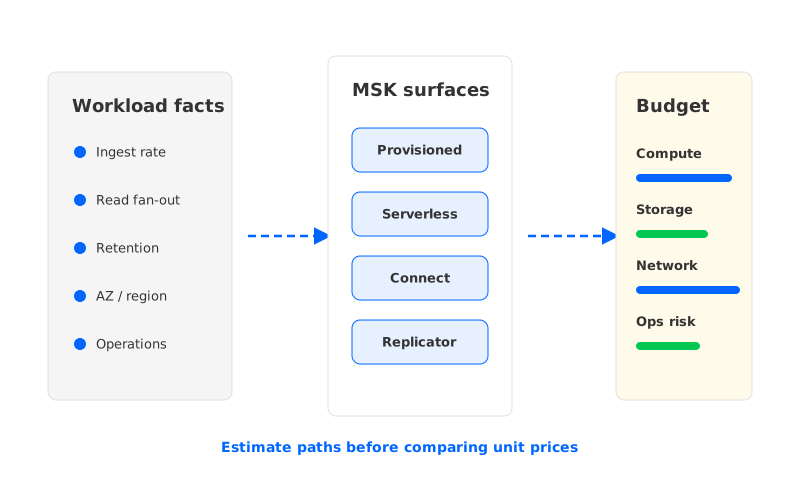
Amazon MSK is not one cost model. MSK Provisioned, MSK Serverless, MSK Connect, and MSK Replicator solve related but different problems, so they should not be forced into a single row called "Kafka." A team running a persistent event backbone cares about broker shape and storage. A team moving CDC streams into a lake cares about connector worker sizing and task behavior. A team planning migration or disaster recovery cares about replicated bytes, offset sync, and cross-region traffic.
That distinction matters because a low estimate in one surface can be invalidated by another. A small cluster may look acceptable until Connect workers are added for database capture, Replicator is added for migration, and PrivateLink is enabled for clients in separate VPCs. None of those are exotic enterprise features. They are normal production requirements.
Start with five workload facts:
- Ingest rate and record size. This determines write pressure, broker sizing, connector throughput, and replication throughput. It also changes request and storage behavior for object-storage-based designs.
- Read fan-out. A topic read by one internal service and a topic read by ten analytics, search, fraud, and AI pipelines can have the same write rate but very different network and compute pressure.
- Retention and replay pattern. Thirty days of retention with rare replay is a different budget problem from seven days of retention where consumers routinely scan old data.
- Availability boundary. Single-region multi-AZ, cross-region warm standby, active-active, and migration-only replication all move different volumes of data across different network boundaries.
- Operational ownership. A managed service can reduce operational work, but the bill still reflects how much capacity, storage, and traffic the architecture asks the cloud to provide.
Once those inputs are explicit, pricing pages become useful. Without them, they are a menu of unit prices with no denominator.
2Provisioned MSK: capacity is still the anchor
MSK Provisioned is the most familiar model for Kafka teams because it preserves the idea of a cluster with brokers. The main cost inputs are broker instance usage, storage, optional provisioned storage throughput for Standard brokers, and data transfer in or out of the cluster. AWS also documents separate behavior for Express brokers, where teams pay for broker instance usage, storage used, and data written to Express brokers. AWS states on its pricing page that broker replication traffic and metadata-node-to-broker traffic are not charged as MSK data transfer, while standard AWS data transfer charges still apply for data moved in and out of MSK clusters.
The financial implication is straightforward: Provisioned MSK rewards teams that can predict capacity accurately. If the workload is steady, the model is easy to reason about. If traffic is bursty, the spreadsheet has to include unused headroom because Kafka brokers are sized for peak write rate, peak read fan-out, partition count, disk, network, and recovery behavior at the same time.
There is also a storage distinction that often gets blurred. Standard brokers charge for provisioned primary storage, so the estimate is based on allocated capacity. Express brokers charge for storage used, which can fit workloads where retention changes more dynamically. Tiered storage can reduce the pressure on primary storage for older data, but it does not remove the need to reason about hot data, retrieval, and broker behavior during reassignment or failure recovery.
| Cost input | Why it matters | Design question |
|---|---|---|
| Broker instance hours | Baseline cluster capacity | Are brokers sized for average load or peak load? |
| Primary storage | Hot data and operational headroom | How much data must remain local or primary? |
| Storage throughput | Write-heavy Standard broker workloads | Does disk throughput need to be provisioned separately? |
| Data written or transferred | Traffic-sensitive billing dimensions | Which clients, VPCs, or regions send and receive bytes? |
| Private connectivity | Cross-VPC access patterns | Is PrivateLink required for client network boundaries? |
The table also explains why a narrow "broker cost" comparison is misleading. Kafka production cost is a capacity-and-data-motion problem.
3Serverless: fewer knobs, different diligence
MSK Serverless changes the buyer's job. Instead of choosing broker instance types and storage allocations, the team evaluates the workload against the serverless service model and its scaling boundaries. That can be attractive for teams that want less capacity planning and less broker administration.
The tradeoff is not "serverless means no cost model." The model moves from broker sizing to workload fit. Teams still need to understand ingress, egress, partitions, client behavior, quotas, and retention. They also need to check whether the feature surface matches their governance, networking, observability, and migration requirements.
Serverless should be evaluated with a short but strict test: can the workload stay inside the service's documented limits while meeting latency, throughput, isolation, and compliance requirements? If yes, it may reduce the human and capacity-planning cost of Kafka. If no, a provisioned or alternative Kafka-compatible architecture may be more predictable.
4Connect and Replicator are not side notes
MSK Connect and MSK Replicator are easy to treat as add-ons because they sit around the cluster, but financially they often carry the workload's business purpose. Connect moves data between Kafka and external systems. Replicator copies data between clusters for migration, resilience, lower-latency regional access, or partner distribution. If either service is central to the platform, it deserves first-class budget modeling.
For Connect, the key input is more specific than "number of connectors." A connector with one task moving a small S3 sink has a very different cost and failure profile from a high-volume CDC connector with many tasks, transformations, and strict restart requirements. Worker capacity, autoscaling settings, source and sink limits, and retry behavior can all alter the bill. A noisy connector can also increase broker write rate, partition pressure, or consumer lag.
For Replicator, the key input is replicated data volume and the topology that volume crosses. Same-region replication, cross-region replication, migration from self-managed Kafka to MSK, and multi-active patterns have different reasons to exist. They also have different implications for network transfer, duplicate storage, consumer offset handling, and recovery objectives. Replication is valuable precisely because it copies important data; the budget has to acknowledge that copied data is no longer free.
5The missing worksheet: traffic paths
Most Kafka cost models are too infrastructure-centric. They start with brokers and storage, then append a network line at the end. In cloud deployments that order is backwards. The traffic paths decide how many times a byte is written, copied, read, replicated, or moved across a network boundary.
Draw the paths before estimating the service units:
- Producers to brokers, including whether clients are in the same VPC, another VPC, another account, or another region.
- Broker-to-broker or service-managed replication paths, including what the managed service includes and what AWS still bills as standard transfer.
- Brokers to consumers, especially when consumers run in different Availability Zones or fan out across analytics, search, monitoring, and machine learning systems.
- Connect source and sink paths, including database CDC, object storage, OpenSearch, warehouses, and SaaS integrations.
- Replicator paths between clusters, including offset sync, topic metadata, access controls, and failover workflow.
This is where FinOps and platform engineering need the same diagram. FinOps sees billable meters; engineers see failure domains and latency. The architecture is healthier when both groups are looking at the same arrows.
6How architecture changes the cost curve
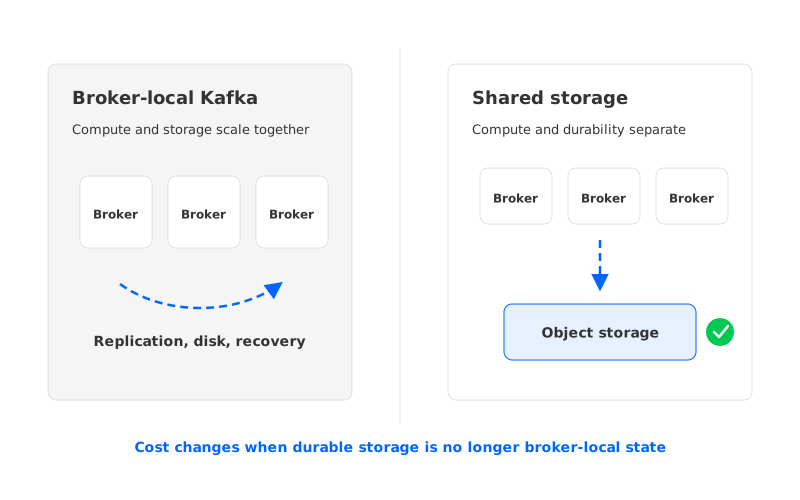
Traditional Kafka couples compute and storage at the broker. That design is proven and well understood, but it makes cost scale along several axes at once. More throughput can require more brokers, more retention can require more disk, and more consumers can require more network and broker read capacity. Even with a managed service, the architecture still asks the cloud to run a stateful distributed log with local or primary broker storage.
Object-storage-backed Kafka-compatible designs change that curve by moving durable log storage away from broker-local disks. The important distinction is between tiered storage and shared storage. Tiered storage keeps broker primary storage in the write path and offloads older data later. Shared storage uses object storage as the main durable data layer and makes brokers closer to stateless compute. That does not make cost disappear; it changes the unit economics and operational constraints.
AutoMQ fits this second category. It is a Kafka-compatible streaming system that reworks the Kafka storage layer around shared object storage, a WAL layer, and stateless brokers while keeping Kafka protocol compatibility as a design requirement. In an MSK cost evaluation, AutoMQ is relevant when the team wants to preserve Kafka APIs but reduce the coupling between broker count, retained data, and cross-AZ replication traffic. AutoMQ documentation also describes an inter-zone routing design that can reduce Kafka inter-zone data transfer by keeping producer and consumer traffic local to an Availability Zone while using shared storage for durability.
That product mention belongs after the cost worksheet, not before it. If the worksheet shows that the expensive part of the platform is predictable broker capacity, local primary storage, cross-AZ traffic, slow reassignment, or over-provisioning for peaks, then a shared-storage Kafka-compatible architecture deserves evaluation. If the workload is small, steady, and already operationally acceptable on MSK, the business case may be weaker. Architecture should earn its place in the spreadsheet.
7A production readiness scorecard
The final decision should not be a unit-price bakeoff. Kafka platforms carry application compatibility, operational recovery, data governance, and migration risk. A lower estimate is not useful if it pushes complexity into client rewrites, fragile failover, or untested connector behavior.
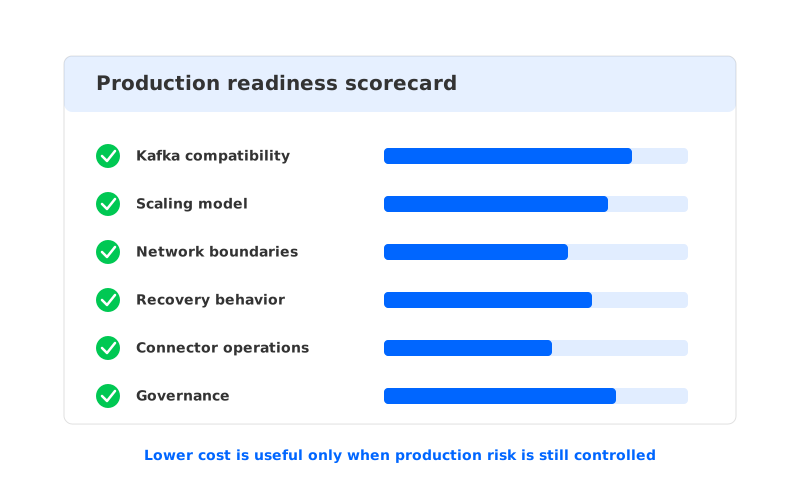
Use a scorecard that forces each option to answer the same production questions:
| Dimension | What to verify | Why it affects cost |
|---|---|---|
| Kafka compatibility | Client APIs, connectors, ACLs, transactions, ecosystem tools | Rewrites and exceptions become migration cost |
| Scaling model | Broker scaling, storage scaling, partition movement, quotas | Slow scaling creates over-provisioning pressure |
| Network boundaries | AZ, VPC, account, region, PrivateLink, internet egress | Traffic paths can dominate the bill |
| Recovery behavior | Broker failure, AZ event, region event, offset recovery | Recovery design determines duplicate capacity |
| Connector operations | Task sizing, retries, autoscaling, source and sink limits | Integration cost is often outside broker estimates |
| Governance | Encryption, IAM, audit, tenancy, data residency | Compliance gaps become platform exceptions |
This scorecard is intentionally boring. That is the point. A Kafka bill becomes hard to control when excitement over a deployment model hides ordinary production requirements.
8Practical estimation flow
Start with one representative workload rather than the entire platform. Choose a topic family with known write rate, retention, read fan-out, and availability requirements. Then model three architectures: current or planned MSK Provisioned, MSK Serverless if it fits the service limits, and one Kafka-compatible shared-storage option such as AutoMQ if broker-local storage or cross-AZ traffic is a major cost driver.
For each architecture, estimate the same five lines: compute, storage, write or ingest units, network, and operations. "Operations" should not be a vague discount. It should include the concrete work the team performs: version upgrades, broker scaling, partition rebalancing, connector incident response, capacity reviews, failover drills, and cost anomaly investigation. Managed services reduce some of this work, but production Kafka still requires ownership of workload behavior.
Then run the sensitivity analysis that pricing calculators rarely show. Double the read fan-out. Extend retention from 7 days to 30 days. Add one cross-region recovery copy. Move clients into another VPC. Add a CDC connector that writes continuously.
The outcome should be a decision memo, not a single number. A good memo says: at this ingest rate, retention, fan-out, and recovery target, this option is lowest risk; these meters dominate the bill; these assumptions would change the answer; this migration path is acceptable; and these URLs are the source of truth for current pricing and compatibility.
9Closing the spreadsheet gap
The phrase "MSK cost" sounds like a request for prices, but it is usually a request for confidence. The buyer wants to know whether the Kafka platform will stay understandable after production traffic, private networking, connectors, replication, and retention are added. The only reliable answer is a workload-driven model that treats cost as a property of architecture.
If your worksheet shows that broker-local state, cross-AZ data movement, or retention growth is driving the curve, compare MSK with a Kafka-compatible shared-storage design. AutoMQ's documentation is a useful next step for that evaluation, especially the architecture and Kafka compatibility pages. You can start here: Explore AutoMQ for Kafka-compatible streaming cost evaluation.
10References
- Amazon MSK pricing
- Amazon MSK Connect documentation
- Amazon MSK Replicator documentation
- Amazon VPC pricing
- Apache Kafka documentation: replication
- Apache Kafka KIP-405: Kafka Tiered Storage
- AutoMQ architecture overview
- AutoMQ compatibility with Apache Kafka
- AutoMQ inter-zone traffic overview
11FAQ
11.1What is the biggest mistake in estimating MSK cost?
The biggest mistake is estimating only broker instance hours. Production Kafka cost also depends on storage, read fan-out, private connectivity, data transfer, connector workers, replication, and operational headroom.
11.2Is MSK Serverless always lower cost than MSK Provisioned?
No. MSK Serverless can reduce capacity planning and operational work for suitable workloads, but the better choice depends on throughput, retention, partitions, quotas, networking, governance, and traffic variability.
11.3Should MSK Connect be included in the Kafka platform budget?
Yes. Connectors often represent the actual data integration workload. Worker sizing, autoscaling, retries, source and sink limits, and task count can all affect both connector cost and broker load.
11.4How should teams model MSK Replicator cost?
Start with replicated data volume, source and target regions, migration or recovery objective, duplicate retention, and consumer offset requirements. Replication should be modeled as a production data path, not as a minor add-on.
11.5When should AutoMQ be evaluated as an MSK alternative?
Evaluate AutoMQ when the cost model is dominated by broker-local storage, over-provisioned compute, cross-AZ traffic, slow scaling, or retention growth, and when Kafka protocol compatibility remains important.


