
Table of Contents
Table of Contents
The confusing part of an Amazon MSK bill is rarely the broker line item. Most teams already expect to pay for broker instances, storage, and request-driven infrastructure. The surprise usually appears somewhere else: AWS data transfer. That line is hard to reason about because Kafka does not move each record once. A single produced record can be written, replicated, fetched by consumers, mirrored by a connector, and carried through more than one Availability Zone before the application is done with it.
That is why "MSK cross-AZ cost" is a useful search term, not a narrow billing complaint. It points at an architectural mismatch between Kafka's replication model and cloud network accounting. Kafka was designed around broker-local disks and a replicated log. AWS prices network movement by path, scope, and service boundary. When those two models meet inside a multi-AZ MSK cluster, the bill follows the data path rather than the mental model on the whiteboard.
1Why Cross-AZ Traffic Matters for Kafka on AWS
Amazon MSK pricing is split across MSK-specific charges and standard AWS charges. The MSK pricing page lists broker instance, storage, and related service dimensions, and it also notes that standard AWS data transfer charges apply to data transferred in and out of MSK clusters. The EC2 pricing page is the canonical place to verify data transfer rules for traffic that crosses Availability Zones within a region. The exact amount depends on region, direction, and the services involved, so the responsible way to estimate cost is to calculate traffic volume first and apply current AWS pricing afterward.
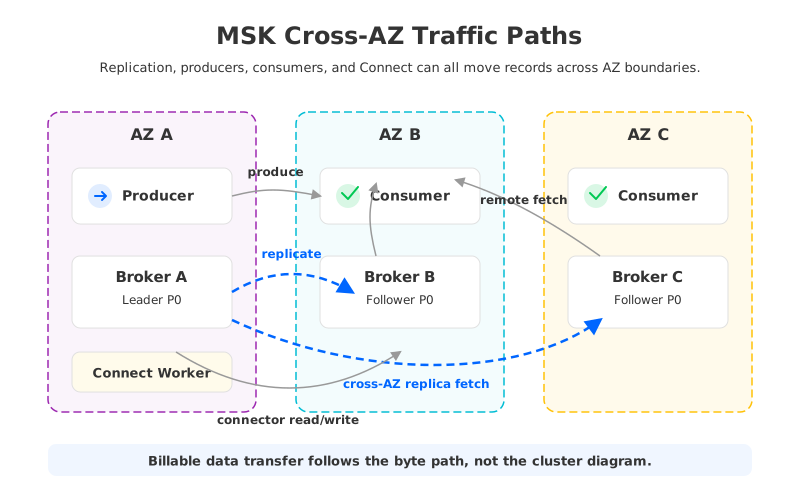
Kafka makes that traffic volume larger than many first-pass estimates. A producer write is not the end of the story. If the topic has a replication factor greater than 1, the leader broker appends the record and follower brokers fetch it to keep their replicas in sync. If the replicas sit in other Availability Zones, replication can become cross-AZ traffic. Consumers can add another layer when applications in one AZ fetch from leaders in another AZ. Connect workers, stream processors, and disaster recovery pipelines can do the same.
This is not an MSK defect. It is the direct consequence of running a replicated, broker-local log in a cloud environment where network locality has a price. The same mechanism that gives Kafka durability and high availability also creates a data movement pattern that FinOps teams need to model explicitly.
2Where MSK Inter-AZ Traffic Comes From
The first source is replica replication. Apache Kafka's replication design assigns each partition a leader and one or more followers. Producers send records to the leader. Followers replicate by fetching from the leader. Consumers typically fetch from the leader as well, although Kafka supports follower fetching for rack-aware deployments when configured appropriately. In a multi-AZ cluster, those leader and follower roles are spread for availability, which means the replication path can cross AZ boundaries.
The second source is client placement. MSK gives applications broker endpoints, but producers in private subnets, EKS nodes, ECS tasks, EC2 instances, Lambda functions, or analytics jobs can still sit in different Availability Zones from the current partition leaders. A producer follows Kafka metadata and partitioning, not a cost model. Consumers do the same. When client fleets scale unevenly across AZs, the traffic pattern can drift away from the deployment diagram.
The third source is the surrounding platform. Kafka Connect workers, Flink jobs, MirrorMaker-style replication, schema registry clients, monitoring agents, and backup or DR pipelines are often deployed after the core cluster is already running. Each one reads from or writes to Kafka, and each one has its own network placement. A cluster that looked balanced from a broker perspective can still generate avoidable inter-AZ traffic because the data plane around it is not AZ-local.
| Traffic path | Why it happens | Cost implication to verify |
|---|---|---|
| Leader to follower replication | Kafka keeps multiple replicas of each partition | Can cross AZs when replicas are distributed |
| Producer to leader | Producer follows partition metadata and leader location | Can cross AZs when clients and leaders differ |
| Consumer fetch | Consumers fetch records from broker endpoints | Can cross AZs when consumers run outside the leader AZ |
| Connect and stream processing | Workers read and write Kafka topics | Adds another client-side traffic layer |
| DR or replication pipelines | Data is copied to another cluster or region | May include inter-AZ and inter-region transfer |
The table is intentionally framed as "verify," not "assume." AWS pricing changes by region and service path, and Kafka traffic changes by partition leadership, consumer group behavior, and client deployment. The useful estimate is not a universal price per topic. It is a traffic inventory tied to your actual topology.
3The Replication Multiplier in Plain Terms
A Kafka topic with replication factor 3 stores three copies of each partition. One broker hosts the leader replica, and two brokers host follower replicas. When a producer writes a record, the leader receives it once; then followers fetch the same record to maintain their local logs. With acks=all, the producer waits for in-sync replicas according to the topic and broker settings, but the network movement still follows the leader-to-follower replication path.
This is why compression helps but does not change the structure. Better compression can reduce the bytes that move. It does not remove the need for followers to receive replicated data when durability is based on broker-local replicas. Smaller messages, batching, and topic hygiene all matter, but they tune the multiplier rather than eliminate it.
Consumer behavior has a similar shape. A consumer group reads partitions from brokers according to metadata, assignment, and client configuration. If applications are deployed without AZ awareness, a consumer can fetch from a broker in another AZ even when a local broker exists. Kafka's rack-aware features and client placement can reduce that waste, but they require careful operational discipline across producers, consumers, and the platform that schedules them.
4How to Measure MSK Cross-AZ Cost
Start with AWS billing, but do not stop there. Cost Explorer can show data transfer categories and trends, while the AWS Cost and Usage Report gives the detail needed for allocation. MSK metrics and broker-level telemetry then help explain why the bill moved. Put those together and you can separate "Kafka is busy" from "Kafka is busy in the wrong network path."
A practical investigation usually follows four steps:
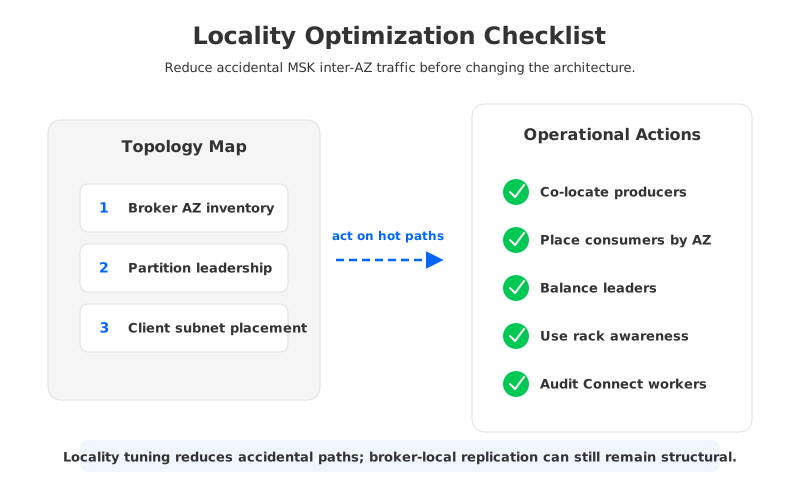
- Map the cluster topology. Record broker subnets, broker AZs, topic replication factors, and partition leader distribution. The question is not whether the cluster is multi-AZ; it is which AZ owns each hot leader.
- Map client runtime placement. Producers, consumers, Connect workers, stream processors, and batch jobs should be grouped by subnet and AZ. Kubernetes node groups deserve special attention because pod placement can change during scaling and upgrades.
- Compare byte rates with billing windows. Align CloudWatch, client metrics, and CUR time windows. Spikes in
BytesOutPerSec, client fetch rates, or connector throughput should have a corresponding explanation in the bill. - Separate steady-state replication from avoidable locality misses. Replication traffic is structural in traditional Kafka. Cross-AZ client fetches caused by placement drift are often operationally fixable.
That last distinction prevents a common mistake. Teams sometimes treat all inter-AZ traffic as waste. In Kafka, some of it is the cost of availability under the chosen architecture. The goal is to remove accidental cross-AZ paths first, then decide whether the remaining structural replication cost is acceptable.
5Tactics to Reduce MSK Cross-AZ Traffic Without Migration
The fastest improvements usually come from locality. Place producers and consumers in the same AZ set as the brokers, and keep Connect workers and stream processing jobs close to the partitions they read and write. Review Kubernetes topology spread constraints, node group design, and autoscaling behavior so a workload does not silently concentrate in one AZ while leaders sit elsewhere. For high-throughput systems, this is not a cosmetic cleanup; it changes the byte path.
Kafka-level tuning also helps. Use rack awareness so replicas are distributed intentionally across failure domains. Evaluate follower fetching where the Kafka version, client support, and operational model make it appropriate. Keep partition leadership balanced so one AZ does not become the hot egress point. Review topic replication factors, retention, compression, batching, and producer settings with a cost lens, while preserving durability and recovery objectives.
There are limits. If the topic needs multi-AZ durability through broker-local replicas, cross-AZ replication remains part of the design. You can make it smaller, more balanced, and easier to attribute, but the cluster still relies on brokers copying log data to other brokers. That is the point where the conversation moves from tuning to architecture.
6How Shared Storage Changes the Data Path
Traditional Kafka ties compute and durable storage to the broker. A broker is both a request processor and the owner of local log segments. That model is operationally familiar and deeply proven, but it means durability is achieved by copying data among brokers. In a cloud region, those brokers often live in different AZs, so the replication design becomes a network cost design.
Shared storage architectures change the premise. If durable data is written to a storage service designed for regional durability, brokers no longer need to act as the durable storage chain in the same way. The broker can become more stateless, focused on protocol handling, caching, coordination, and serving reads, while the storage layer holds the durable log. The important shift is not "storage somewhere else" as a slogan. It is that the system stops treating broker-to-broker local-disk replication as the primary durability path.
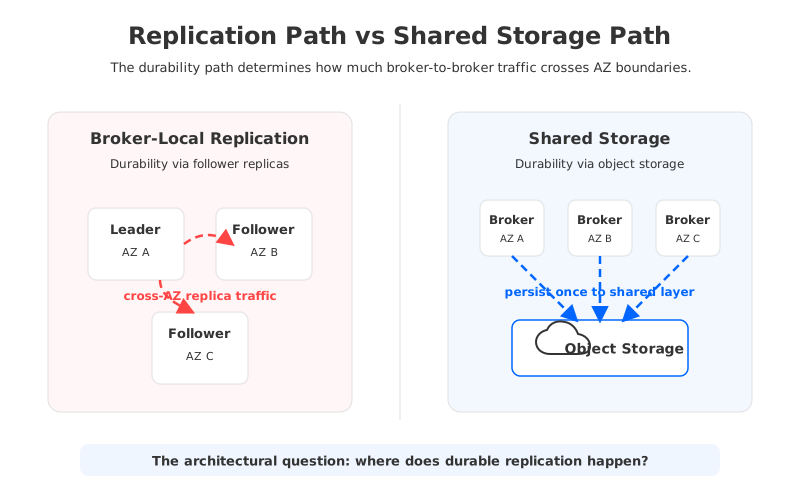
AutoMQ is one Kafka-compatible implementation of that cloud-native pattern. Its documentation describes a shared-storage design that uses object storage as the persistent layer and stateless brokers to reduce the pressure created by traditional cross-AZ replica traffic. AutoMQ's AWS documentation also discusses eliminating inter-zone traffic by changing the data path, which is directly relevant to teams trying to separate unavoidable availability cost from architecture-driven data movement.
This does not make network cost disappear. Producers still send data, consumers still fetch data, and applications still need good locality. Object storage and control-plane operations have their own pricing and performance considerations. The difference is where the high-volume durability traffic goes: the system can persist data through a shared storage layer instead of requiring follower brokers in other AZs to pull the same hot log data through the broker network path.
For architects, the decision is less about product labels and more about workload shape. A moderate Kafka cluster with stable throughput may be fine with MSK tuning. A high-throughput platform with replication factor 3, many fan-out consumers, cross-AZ client drift, and strict cost allocation pressure should model the broker-local replication multiplier directly.
7A Cost Model That Engineers and FinOps Can Share
A useful MSK cost model has two layers. The first layer is the billable infrastructure: brokers, storage, MSK feature charges, data transfer, private connectivity, monitoring, and backup or replication services. The second layer is the Kafka data path: produce, replicate, consume, process, mirror, and retain. Most cost disagreements happen because one team is looking at the invoice while another is reasoning from the byte path.
Use a table like this during design reviews:
| Question | Owner | Evidence |
|---|---|---|
| Which topics dominate write throughput? | Platform engineering | Broker and topic metrics |
| Which partitions have leaders outside the main client AZ? | Kafka SRE | Partition leadership inventory |
| Which consumers fetch across AZ boundaries? | Application teams | Client placement and consumer metrics |
| Which connectors duplicate high-volume streams? | Data engineering | Connect worker placement and task configs |
| Which charges are standard AWS data transfer, not MSK broker charges? | FinOps | CUR and AWS pricing pages |
This keeps it grounded: engineers see traffic choices, and FinOps sees path-level attribution.
8References
- Amazon MSK Pricing: https://aws.amazon.com/msk/pricing/
- AWS EC2 On-Demand Pricing, Data Transfer section: https://aws.amazon.com/ec2/pricing/on-demand/
- Amazon MSK Developer Guide, client access: https://docs.aws.amazon.com/msk/latest/developerguide/client-access.html
- Amazon MSK Developer Guide, monitoring metrics: https://docs.aws.amazon.com/msk/latest/developerguide/metrics-details.html
- Apache Kafka documentation, replication design: https://kafka.apache.org/documentation/#design_replicatedlog
- Apache Kafka documentation, producer acknowledgments: https://kafka.apache.org/documentation/#producerconfigs_acks
- Apache Kafka documentation, consumer rack awareness: https://kafka.apache.org/documentation/#consumerconfigs_client.rack
- AutoMQ documentation, eliminating inter-zone traffic: https://docs.automq.com/automq-cloud/eliminate-inter-zone-traffics/overview?utm_source=blog&utm_medium=references&utm_campaign=kw10-c02-0005
- AutoMQ product overview: https://www.automq.com/?utm_source=blog&utm_medium=references&utm_campaign=kw10-c02-0005
9FAQ
9.1Does Amazon MSK always charge for cross-AZ traffic?
MSK usage can involve standard AWS data transfer charges, and cross-AZ traffic should be checked against current AWS pricing for the region and path. The important operational point is that Kafka workloads often create cross-AZ traffic through replication and client placement, even when the cluster itself looks balanced.
9.2Is Kafka replication the same as AWS storage replication?
No. Kafka replication is an application-level log replication mechanism among brokers. AWS storage services have their own durability and replication models. In traditional Kafka, follower brokers fetch data from leaders so each broker maintains its local replica of the partition.
9.3Can compression remove MSK inter-AZ cost?
Compression can reduce the number of bytes transferred, so it can reduce cost pressure. It does not remove the structural need for replication traffic when durability depends on broker-local replicas across AZs.
9.4Should every MSK workload migrate to shared storage?
No. Many MSK workloads are well served by locality tuning, partition balancing, compression, and careful client placement. Shared storage becomes more relevant when high-volume durability replication is a major and persistent part of the AWS data transfer bill.
9.5How does AutoMQ reduce cross-AZ replica traffic pressure?
AutoMQ uses a Kafka-compatible design with stateless brokers and shared object storage for the persistent data layer. That changes the durability path so brokers do not need to rely on the same broker-local replica chain for high-volume cross-AZ persistence traffic.
9.6What is the first thing to check in an MSK cross-AZ cost investigation?
Start by separating structural replication from avoidable client locality misses. Map broker AZs, partition leaders, producer and consumer placement, and connector placement, then compare those paths with AWS billing and MSK metrics.
If your MSK cost review keeps coming back to the same data transfer line, the next useful step is to model the data path rather than the invoice label. AutoMQ's inter-zone traffic documentation is a practical reference for that architecture-level comparison: review the AutoMQ data path.


