
Table of Contents
Table of Contents
Teams do not search for msk exit planning kafka because MSK failed at the first job. Amazon MSK removes a large amount of Kafka administration: broker provisioning, patching workflows, cluster creation, and the basic managed-service boundary. The exit question tends to arrive later, after the platform team has lived with production traffic, budget reviews, security constraints, and application owners who expect Kafka behavior to stay stable while the operating model changes underneath them.
That is a harder problem than a product comparison. An MSK exit plan has to protect compatibility, consumer progress, networking boundaries, governance evidence, and cost predictability at the same time. The durable question is whether the next Kafka-compatible platform changes the constraints that made the current environment expensive or difficult to operate.
1Why Teams Search For msk exit planning kafka
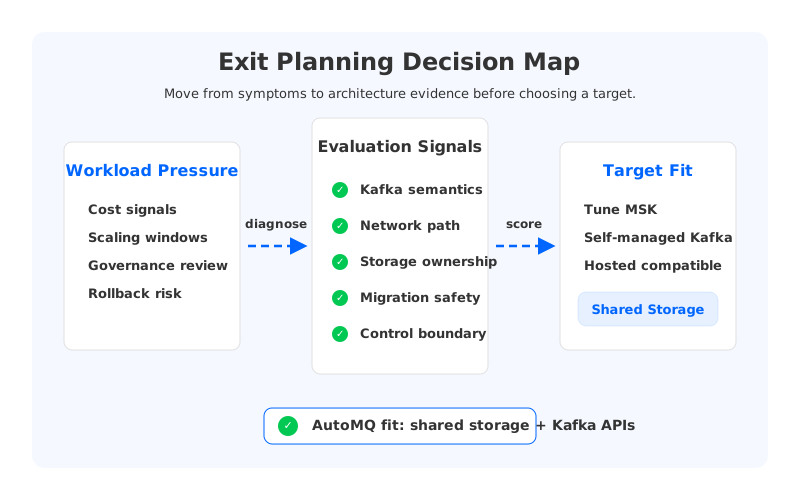
The search usually starts with one of three signals. The first is cost: storage grows faster than expected, cross-Availability Zone traffic appears in finance reviews, and capacity headroom becomes a standing tax. The second is operations: partition reassignment, broker replacement, scaling, and upgrade windows still require coordination even though the service is managed. The third is governance: the organization wants clearer control over where data lives, how private connectivity is routed, who owns cloud resources, and how rollback works during migration.
Those signals are often mixed together, which is why exit planning needs a framework before it needs a vendor shortlist. A team that mainly needs a procurement boundary may make a different choice from a team that is dominated by data movement during scaling. A team with strict Kafka Streams and transaction usage will weight compatibility differently from a team using Kafka mostly as a log ingestion layer. The phrase "Kafka-compatible" is necessary, but it is not precise enough for production planning.
Separate symptoms from design constraints:
- Compatibility pressure: Existing producers, consumers, Kafka Connect jobs, ACLs, schemas, transactions, compaction, and consumer group behavior must be tested against real workloads rather than assumed from a protocol label.
- Network pressure: Multi-AZ replication, client locality, private connectivity, load balancers, VPC routing, and cross-region replication each create different costs and failure modes.
- Storage pressure: Retention, replay, broker replacement, and partition movement expose whether durable data is tied to broker-local disks or held in a shared layer.
- Governance pressure: Audit teams need to know who controls the data plane, which cloud account owns resources, how encryption and IAM are enforced, and what support access can reach.
- Migration pressure: Cutover has to coordinate topic data, producer writes, consumer offsets, rollback paths, and observability during the same window.
This is why the most useful MSK exit discussion rarely begins with a monthly bill. The bill is evidence, not the root cause. The root cause is the architecture and operating boundary that generated that bill.
2The Production Constraint Behind The Problem
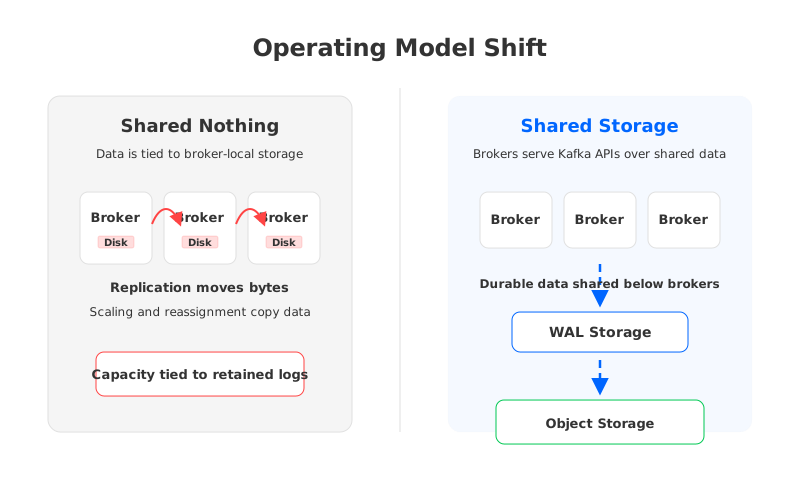
Traditional Kafka uses a Shared Nothing architecture: brokers own partitions, partitions are stored on broker-local or broker-attached storage, and replication moves data between brokers for durability and availability. That design is coherent. It lets Kafka keep ordered logs, serve consumers, handle leader election, and recover from broker loss using replicas. It also means that capacity changes are rarely metadata-only events because bytes live on specific machines.
In the cloud, that storage ownership model shows up in several places. Retained data consumes block storage or local disk attached to brokers. Replication creates additional write traffic between brokers, often across Availability Zones in a resilient deployment. Reassigning partitions requires data movement. Adding brokers improves compute headroom, but it does not instantly rebalance durable data.
The operational effect is not limited to infrastructure teams. Application owners experience it as planned maintenance, uneven performance during rebalance, longer incident recovery, or conservative capacity limits. Finance sees it as broker instances, attached storage, inter-zone transfer, private connectivity, and spare capacity. Security sees subnets, IAM, encryption, endpoint policies, and observability streams that may cross account or network boundaries.
The important distinction is between managed operations and changed architecture. MSK can reduce the amount of Kafka machinery a team directly operates. It does not, by itself, remove the broker-local storage model that defines scaling, replication, and recovery work. Exit planning should ask whether the next platform changes that model or only changes who operates it.
3Architecture Options And Trade-Offs
Most teams evaluate four paths, even when the internal language differs. They can stay on MSK and tune the current estate. They can move to self-managed Apache Kafka for deeper control. They can select another hosted Kafka-compatible service. Or they can evaluate a cloud-native Kafka-compatible architecture that changes storage ownership while keeping Kafka APIs.
Each path can be rational. Staying on MSK may be right when the workload is stable, the bill is acceptable, and the main risk is migration disruption. Self-managed Kafka can make sense when the platform team has strong Kafka operations expertise and needs full control over versions, networking, and deployment mechanics. Hosted Kafka-compatible services can reduce operational burden, but the data-plane boundary and pricing model need careful review. Shared-storage Kafka-compatible platforms are relevant when broker-local storage, data movement, and cross-AZ traffic are first-order constraints.
The table below keeps the conversation from collapsing into one metric.
| Evaluation area | What to validate | Exit-planning signal |
|---|---|---|
| Kafka semantics | Producer idempotence, transactions, compaction, consumer group behavior, offset handling, Connect, Streams, and admin APIs | Protocol compatibility is not enough; semantic compatibility needs workload tests. |
| Storage model | Where durable log data lives, how WAL behavior works, how replay and retention are served | Broker-local storage keeps capacity changes tied to data movement. |
| Network model | Multi-AZ write path, replica traffic, client locality, private endpoints, and cross-region replication | Network cost and failure domains may dominate the operating model. |
| Migration model | Topic copy, offset preservation, producer cutover, consumer restart, rollback, and observability | Migration risk is usually coordination risk, not only copy throughput. |
| Governance boundary | Cloud account ownership, VPC placement, IAM, encryption, logs, metrics, and support access | Security review needs concrete evidence, not a generic managed-service claim. |
| Operating model | Scaling, balancing, upgrades, broker replacement, alert ownership, and incident drills | The next platform should reduce the recurring work that triggered the exit plan. |
This matrix also prevents a common mistake: treating cost as an isolated finance line. Lower infrastructure spend is useful only when the platform still meets durability, latency, security, and compatibility requirements. A lower bill with weaker rollback semantics is not an exit plan; it is a delayed incident.
4Evaluation Checklist For Platform Teams
An MSK exit plan should start with a workload inventory, not a slide deck. Export topic names, partition counts, retention policies, compaction settings, consumer groups, ACLs, quotas, connectors, schemas, and client versions. Mark which workloads use transactions, Kafka Streams, compacted topics, or strict offset continuity. These details decide the migration path long before a benchmark does.
The second step is to model the current network and storage behavior. Identify which producers and consumers run in each Availability Zone, how clients choose brokers, where private endpoints sit, and how cross-zone or cross-region traffic is billed. Then identify which cost lines grow with throughput, retention, replay, or fan-out.
The third step is to rehearse failure and rollback. A credible exit plan should answer practical questions: What happens if consumers lag during cutover? Can producers be moved in batches? Are offsets preserved, remapped, or reset? Who owns the runbook when replication is caught up but application teams are not ready to switch?
Use this readiness checklist before committing to a migration window:
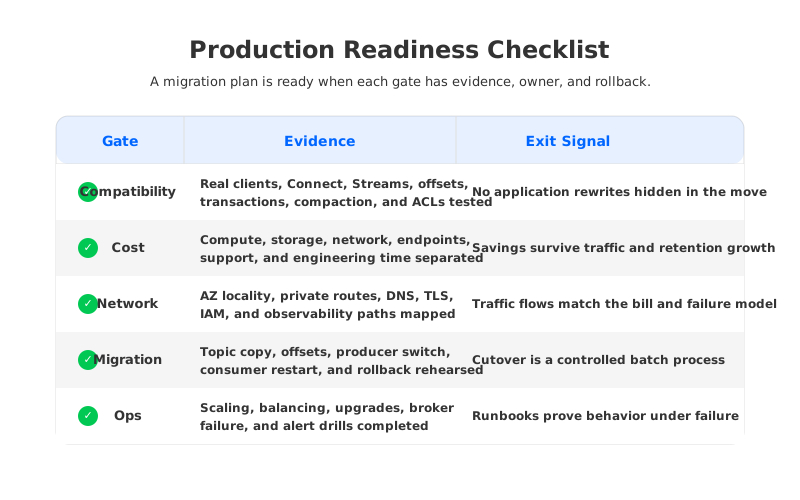
- Compatibility gate: Run real clients and ecosystem tools against the target platform, including the awkward workloads that make the current estate hard to change.
- Cost gate: Separate compute, block storage, object storage, private connectivity, cross-AZ traffic, request charges, support, and engineering time.
- Network gate: Validate client locality, DNS, TLS, IAM, private endpoints, firewall rules, and observability routes.
- Migration gate: Rehearse topic replication, consumer progress handling, producer switch, rollback, and post-cutover validation.
- Operations gate: Drill scaling, broker replacement, partition movement, upgrade behavior, and alert response before the production cutover.
Architecture choices matter because they change runbooks. A platform that looks attractive in a steady-state benchmark may still be the wrong exit target if cutover, rollback, or governance evidence is hard to prove.
5How AutoMQ Changes The Operating Model
Once the framework has exposed broker-local storage as a recurring constraint, a different architecture becomes worth evaluating. AutoMQ is a Kafka-compatible cloud-native streaming platform built around Shared Storage architecture: it keeps the Kafka protocol and ecosystem contract while moving durable log storage away from broker-local disks into shared storage backed by object storage and WAL storage.
This matters because it changes the unit of operational work. In a broker-local design, broker replacement, scaling, and partition movement frequently involve moving retained data or waiting for replicas to catch up. In AutoMQ's Shared Storage architecture, brokers are closer to stateless compute nodes. They handle Kafka protocol work, leadership, caching, and request processing, while S3Stream and WAL storage handle durable data placement.
The networking implications are also central to MSK exit planning. AutoMQ's documentation describes a zero cross-AZ traffic design in supported deployments: writes and reads can be routed through local-zone paths while shared object storage removes broker-to-broker replica traffic from the data path. That does not make networking design disappear. Teams still need to configure clients, brokers, endpoints, IAM, and observability correctly. It does change which traffic patterns should be first-order in the cost model.
Migration is the other place where architecture and tooling meet. AutoMQ Linking for Kafka is designed for migrations from Kafka-compatible sources, including AWS MSK in supported authentication modes. The documented approach covers byte-to-byte replication, offset consistency, consumer progress synchronization, producer proxying, and rolling application cutover. A platform team should still test this against its own clients and failure drills, but the planning surface is more specific than a generic "copy topics and switch bootstrap servers" project.
AutoMQ BYOC is relevant when the exit plan is partly about ownership boundaries. In a BYOC model, the deployment is evaluated inside the customer's cloud account and VPC rather than treated as an opaque external data plane. That boundary can simplify conversations about data residency, IAM ownership, private routing, audit evidence, and cost attribution. AutoMQ Software addresses private environment deployments where similar Kafka-compatible behavior is needed outside a public-cloud managed service model.
None of this means every MSK estate should move. A small, stable cluster with low retention, predictable traffic, and clean cost ownership may not warrant migration risk. AutoMQ becomes interesting when the exit signals are architectural: broker-local storage creates slow scaling, cross-AZ traffic is material, partition movement is operationally painful, or the organization wants Kafka compatibility with a customer-controlled deployment boundary.
6A Practical Exit Scorecard
The final decision should be boring in the right way. A platform team should be able to show why the current state is constrained, which target architecture reduces that constraint, what compatibility tests passed, what costs were modeled, what migration rehearsals proved, and what rollback remains possible.
Score each candidate on evidence:
| Scorecard item | Pass condition | Warning sign |
|---|---|---|
| Workload compatibility | Critical applications run with existing clients and expected Kafka semantics | The test covers only basic produce and consume paths. |
| Cost model | Bill drivers are mapped to throughput, retention, fan-out, and network paths | Savings rely on one steady-state benchmark. |
| Migration safety | Cutover and rollback are rehearsed by topic group with observed lag and offsets | The plan assumes a single maintenance window. |
| Network control | Private routing, AZ locality, DNS, TLS, and observability paths are documented | The design hides where traffic flows. |
| Operations readiness | Scaling, balancing, upgrade, and broker-failure drills are complete | The target platform has not been tested under failure. |
Return to the original search phrase: msk exit planning kafka. The keyword is clumsy because the problem is clumsy. It combines procurement, architecture, migration, and production risk in one decision. The right answer is not "leave MSK" or "stay on MSK"; it is to make the implicit constraints visible enough that the next platform choice can be defended under load, during an incident, and in a finance review.
If broker-local storage, cross-AZ traffic, and migration coordination are the constraints you keep finding, evaluate a Kafka-compatible shared-storage architecture with the same rigor you would apply to any core platform change. Start with AutoMQ's architecture and migration materials, then test them against your own clients, retention targets, and rollback drills: explore AutoMQ.
7References
- Apache Kafka documentation
- Apache Kafka KRaft documentation
- Apache Kafka Connect documentation
- Amazon MSK developer guide
- AWS EC2 data transfer pricing
- AWS PrivateLink documentation
- AutoMQ Kafka compatibility
- AutoMQ architecture overview
- AutoMQ migration guide
- AutoMQ Kafka Linking overview
- AutoMQ zero cross-AZ traffic overview
8FAQ
8.1What does MSK exit planning mean?
MSK exit planning is the process of evaluating whether and how to move Kafka workloads from Amazon MSK to another Kafka-compatible platform. A serious plan covers compatibility, migration sequencing, consumer progress, producer cutover, network routing, cost modeling, governance, and rollback.
8.2Is Kafka compatibility enough for an MSK migration?
No. Kafka compatibility should be tested at the semantic and ecosystem level. Producers, consumers, transactions, compacted topics, consumer groups, Kafka Connect, Kafka Streams, ACLs, and operational tooling all need validation against the target platform.
8.3Why does networking matter so much in Kafka cost planning?
Kafka traffic is continuous, so network decisions compound. Multi-AZ replication, client locality, private endpoints, cross-region replication, and observability export can each create recurring costs or failure paths. The exit plan should map traffic flows before comparing platform prices.
8.4When should a team evaluate AutoMQ during MSK exit planning?
Evaluate AutoMQ when the main constraints are tied to broker-local storage, slow partition movement, cross-AZ traffic, scaling headroom, or customer-controlled deployment boundaries. It should be tested with real workloads and migration rehearsals rather than treated as a drop-in assumption.


