
Table of Contents
Table of Contents
MSK Express attracts a specific kind of search. The reader is usually not asking what Kafka is. They already run Kafka, operate Amazon MSK, or are comparing AWS Kafka options for a workload that has become too large, too spiky, or too expensive to treat casually. The questions are sharper: will Express brokers make MSK faster, will the pricing model actually improve the bill, and can a production cluster move there without creating another migration project?
As of May 26, 2026, AWS positions Express brokers as a broker type inside MSK Provisioned, not as a replacement for every MSK mode. That distinction matters. Express changes the broker implementation, storage management model, and scaling behavior, while the buyer still needs to evaluate quotas, feature coverage, migration mechanics, and the pricing surface.
1What is Amazon MSK Express?
Amazon MSK Express brokers are a broker type for Amazon MSK Provisioned clusters. AWS documents MSK Provisioned as having two broker types: Standard and Express. Standard brokers provide more configuration flexibility. Express brokers are designed for higher elasticity, throughput, resilience, and ease of use for high-performance streaming applications.
The short version is this: Express tries to remove the most painful parts of operating high-throughput Kafka on broker-local storage. AWS says Express brokers include fully managed, pay-as-you-go storage that scales automatically, require no storage sizing or provisioning, and come pre-configured with MSK best-practice defaults. AWS also states that, depending on instance size, each Express broker can provide up to 3x more throughput per broker, scale up to 20x faster, and recover 90% faster than Standard Apache Kafka brokers.
Those are material claims, but they are not a license to skip workload validation. Express brokers are available only in a 3-AZ configuration, are available on selected M7g instance sizes, and are supported on Apache Kafka versions 3.6, 3.8, and 3.9 according to the current AWS docs. AWS also notes that Express brokers work with Apache Kafka APIs but do not yet fully support Kafka Streams APIs. If Kafka Streams stateful applications sit close to your cluster adoption plan, that line deserves attention before any architecture decision.
2What problems MSK Express is meant to solve
Traditional Kafka scaling is not only a compute problem. Apache Kafka topics are split into partitions, brokers store partition logs, and replication keeps copies available across brokers. When you add capacity, recover from failure, or rebalance load, the system has to reason about where partition data lives. That is why large Kafka clusters often have a second operational plane around Cruise Control, partition reassignment, broker sizing, storage utilization, and client throttling.
MSK Standard brokers reduce the operational burden compared with self-managed Kafka, but they still expose storage decisions to the operator. AWS documents Standard brokers as using customer-managed storage features such as EBS storage, tiered storage, provisioned storage throughput, storage auto-scaling, and storage alerts. That flexibility is useful when the team wants tuning control. It also means the platform team remains accountable for more capacity decisions.
Express brokers shift more of that responsibility into MSK:
- Storage management: Express uses fully MSK-managed storage. Teams no longer size EBS volumes or plan broker storage throughput for the Express storage layer.
- Throughput planning: AWS publishes sustained and maximum throughput limits by Express broker size, including recommended ingress and egress ranges that scale by instance size.
- Resilience defaults: AWS describes Express brokers as using guardrails, throughput quotas, and background-operation capacity reservations to reduce contention between client traffic and cluster maintenance.
- Scaling time: AWS published examples where Express broker scaling and partition movement complete much faster than Standard broker reassignment under the tested conditions.
For platform teams, the real value is not the label "Express." The value is reducing the number of operational decisions that sit between a traffic spike and usable Kafka capacity. A service that scales faster is useful only when the limits, quotas, and migration path fit the workload.
3Pricing questions to answer before adoption
MSK Express pricing should be modeled, not guessed. AWS pricing pages are region-specific and change over time, so this article intentionally avoids hard-coding a publish-time price as if it were universal. The durable lesson from the AWS pricing page is the cost structure.
For Express brokers, AWS lists three primary MSK charge categories: hourly Express broker instance usage, storage consumed in GB-months, and a per-GB rate for data written to an Express broker. AWS also states that replication traffic between brokers or between metadata nodes and brokers is not charged as MSK data transfer, while standard AWS data transfer charges still apply for data transferred in and out of MSK clusters. Private connectivity through AWS PrivateLink can add hourly and per-GB processing charges.
That means the most useful pricing questions are operational:
| Pricing question | Why it matters for MSK Express |
|---|---|
| What is sustained ingress and egress by cluster, broker, and partition? | Express sizing starts with throughput, but quotas still apply at broker and partition levels. |
| How much retained data is hot, replayed, or rarely read? | Express storage is managed and pay-as-you-go, but retention still determines stored GB-months. |
| How much producer and consumer traffic crosses VPC, account, AZ, or Region boundaries? | MSK pricing and standard AWS networking charges can sit outside the broker-hour line item. |
| Will a smaller Express cluster replace a larger Standard cluster? | Higher per-broker throughput may reduce broker count, but the cost model also adds data-in and storage dimensions. |
| Do you need PrivateLink, MSK Replicator, MSK Connect, or multi-cluster DR? | Adjacent MSK services and connectivity choices can dominate the final architecture cost. |
The interesting FinOps question is not "Is MSK Express lower cost?" It is "Which cost driver was causing the old bill?" If the old problem was over-provisioning Standard brokers for peak ingress, Express can be attractive. If the old problem was read fan-out through cross-VPC or cross-region paths, Express may improve broker operations while leaving the largest network line item untouched. If the old problem was long retention, Standard brokers with tiered storage, Express managed storage, or a shared-storage Kafka architecture may all deserve a model.
4MSK Express vs Provisioned vs Serverless
The naming can be confusing because Express is part of MSK Provisioned. A cleaner comparison is MSK Standard brokers, MSK Express brokers, and MSK Serverless.
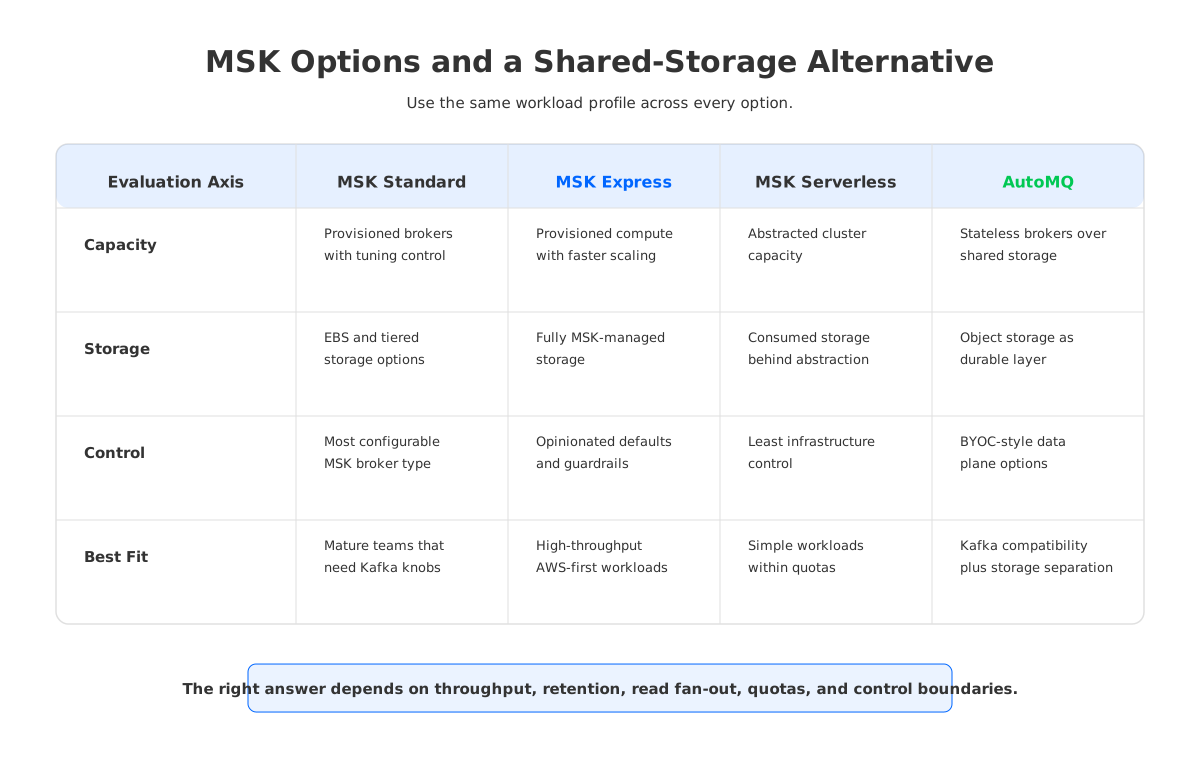
| Dimension | MSK Standard brokers | MSK Express brokers | MSK Serverless |
|---|---|---|---|
| Capacity model | Provision broker instances and manage more storage choices. | Provision broker compute while MSK manages storage. | AWS abstracts broker capacity management. |
| Storage model | Customer-managed storage options, including EBS and tiered storage. | Fully MSK-managed storage with automatic scaling. | Consumed storage model behind the serverless abstraction. |
| Configuration control | Highest flexibility among the three. | More opinionated defaults and guardrails. | Least infrastructure control. |
| Scaling work | Vertical or horizontal scaling, with more operator responsibility for partition movement. | Vertical or horizontal scaling, with faster partition movement than Standard in AWS examples. | Serverless capacity management, subject to documented quotas. |
| Good fit | Teams that need Kafka tuning control and mature operations. | High-throughput teams that want fewer storage decisions but still provisioned clusters. | Teams that want the most abstracted MSK experience and fit serverless quotas. |
4.1Performance
AWS documents Express throughput limits by broker size. The current quota page lists sustained ingress from 15.6 MBps to 500 MBps per broker and sustained egress from 31.2 MBps to 1000 MBps per broker, depending on instance size. It also lists maximum throttling thresholds above those sustained limits and a maximum throughput per partition of 15 MB/s.
That last number is easy to miss. Kafka performance is rarely a single broker number. It is a broker, partition, client, replication, request-size, compression, and fan-out problem. A workload with many evenly distributed partitions may use Express capacity well. A workload with hot partitions may hit per-partition limits before the cluster-wide broker math looks full.
4.2Cost model
Standard brokers charge for broker instance usage and provisioned storage, with optional provisioned storage throughput. Express brokers charge for broker instance usage, storage consumed, and data written to brokers. Serverless charges for cluster hours, partition hours, data in, data out, and storage consumed. These are different models, not a simple ladder from high to low cost.
For a FinOps review, model all three with the same workload: write throughput, read fan-out, retention, partition count, client placement, connector traffic, DR replication, and expected peak-to-average ratio. The winner can change when retention or read fan-out changes.
4.3Operations and limits
Express removes some operational work but introduces a different kind of checklist. The current AWS documentation says Express brokers require 3 AZs, selected Express instance sizes, supported Kafka versions, and quota-aware planning for throughput, connections, and partitions. AWS also states that you cannot change an existing MSK Provisioned cluster from Standard to Express by switching the broker type through the MSK API. You need to create a cluster with the desired broker type.
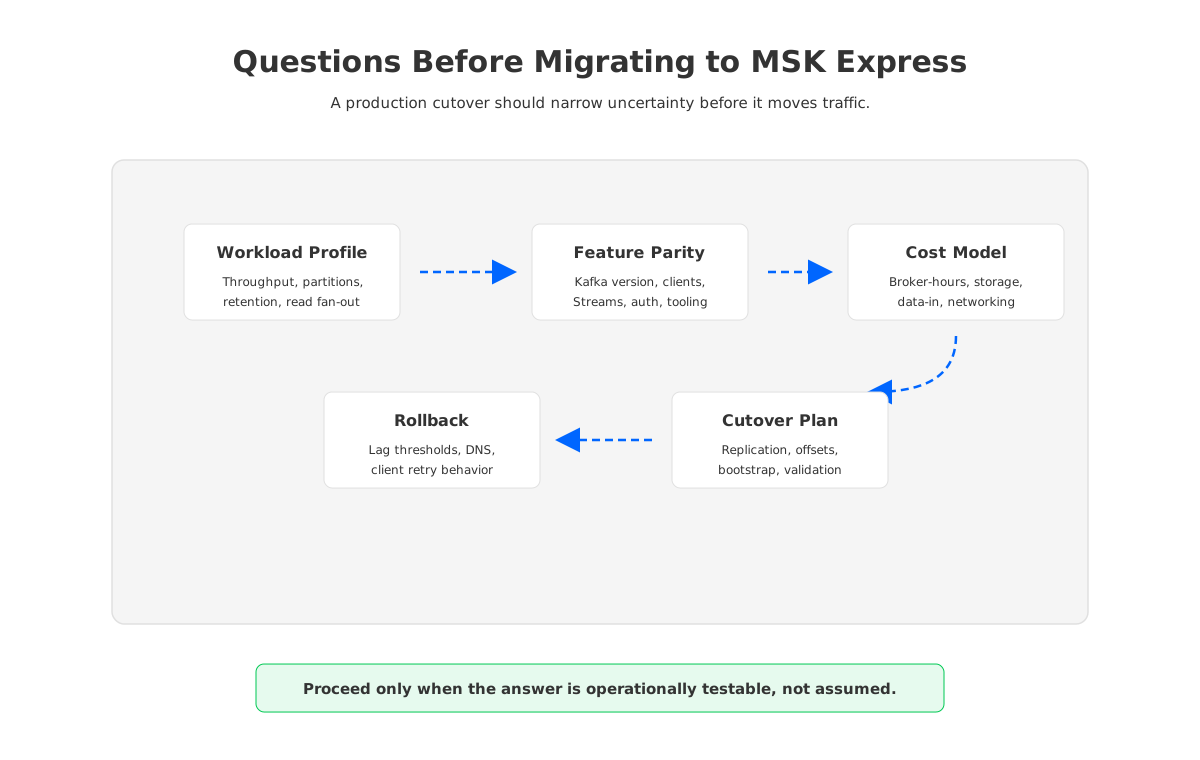
That migration shape matters. For existing MSK users, the decision is not an in-place toggle. It is a controlled migration, often involving MSK Replicator or another replication path, offset planning, client bootstrap changes, observability comparison, rollback criteria, and a cutover window.
5Pricing and migration checks before choosing Express
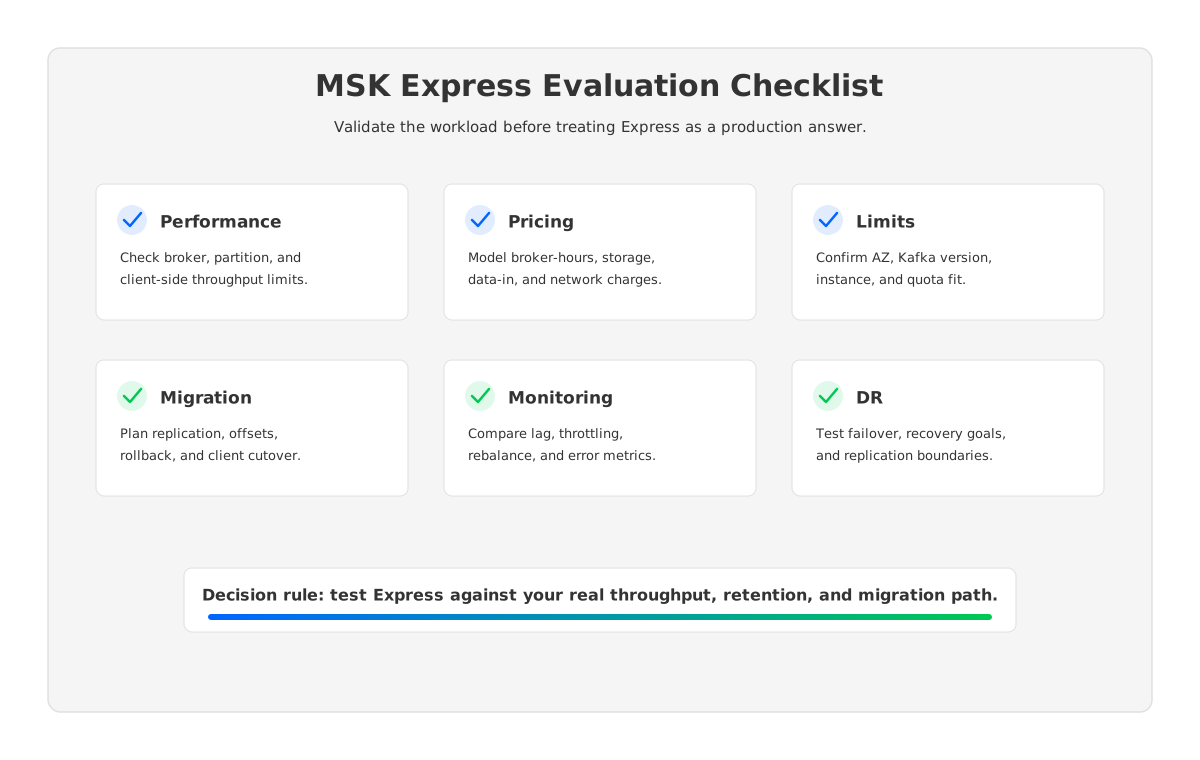
The most reliable Express evaluation starts with workload evidence, not a product comparison table. Gather CloudWatch metrics, broker-level throughput, partition counts including replicas, client connection rates, storage retention, and consumer read patterns. Then test Express against the two moments that usually hurt Kafka clusters: peak traffic and failure recovery.
Use this checklist before a production migration:
- Feature parity: Confirm Kafka version, client libraries, Kafka Streams usage, authentication, ACLs, open monitoring, connector behavior, and operational tooling.
- Quota fit: Check broker count, partition count, per-broker ingress and egress, per-partition throughput, connection limits, connection-attempt rates, and service quota increase lead time.
- Cost model: Include broker hours, data-in, consumed storage, standard AWS data transfer, PrivateLink, MSK Connect, MSK Replicator, and any parallel-run migration period.
- Migration path: Decide whether you can tolerate dual-running clusters, replication lag, topic metadata replication behavior, offset translation, and rollback.
- DR design: Compare same-region replication, cross-region replication, client failover behavior, DNS/bootstrap strategy, and recovery objectives.
This is the point where Express becomes easier to evaluate. If the blocker is Standard broker storage management and slow scaling, Express is directly relevant. If the blocker is broader control over data placement, multi-cloud portability, or a different storage architecture, Express may be one option rather than the endpoint.
6When to evaluate AutoMQ instead
Express is an AWS-native answer to a real Kafka operations problem. It improves the managed MSK experience while keeping the buyer inside the MSK service family. But it still leaves a broader architecture question on the table: should durable Kafka data remain tied to broker-local ownership, or should brokers become a stateless compute layer over shared storage?
Apache Kafka tiered storage shows one partial answer. The Apache Kafka 3.9 documentation describes tiered storage as using two tiers: local broker storage for the current Kafka log path and remote storage such as S3 for completed log segments. That helps long retention and cloud storage economics, but it does not fully erase the local tier.
AutoMQ represents the more aggressive shared-storage design. AutoMQ is a Kafka-compatible cloud-native streaming platform that replaces Kafka's native log storage with S3Stream, offloads data to cloud storage, and makes brokers stateless. Its documentation describes object storage as the primary data repository, with a WAL layer used to handle the latency and I/O characteristics of object storage. AutoMQ also documents compatibility with Apache Kafka protocols and ecosystem tools.
That difference leads to a different evaluation frame:
| Requirement | Express-style MSK evaluation | AutoMQ-style shared storage evaluation |
|---|---|---|
| AWS-native service ownership | Strong fit when MSK service integration is the priority. | Fit depends on BYOC or deployment preference. |
| Kafka compatibility | Uses Apache Kafka APIs with documented Express limitations. | Designed for Kafka protocol and ecosystem compatibility. |
| Broker state | Managed storage reduces operator work, but Express remains an MSK broker model. | Brokers are designed to be stateless over shared storage. |
| Data control | AWS-managed service boundary. | BYOC options can keep data and infrastructure in the customer's cloud account or VPC. |
| Elasticity goal | Faster MSK scaling and recovery within Express quotas. | Storage-compute separation and stateless brokers as the main scaling premise. |
AutoMQ should not be treated as a drop-in answer to every MSK Express question. If procurement, governance, and operations strongly prefer AWS service ownership, Express deserves a serious test. If the core requirement is Kafka compatibility plus customer-account data control, object-storage-backed durability, and stateless broker elasticity, AutoMQ belongs in the alternative set.
The practical next step is a workload bake-off. Run the same throughput, partition, retention, read fan-out, and failure-recovery profile through MSK Standard, MSK Express, MSK Serverless if quotas allow, and a shared-storage Kafka option such as AutoMQ. The goal is not to crown a generic winner. It is to find the architecture whose cost and operational behavior remain explainable after the workload grows.
7FAQ
7.1Is MSK Express the same as MSK Serverless?
No. MSK Express is a broker type for MSK Provisioned clusters. MSK Serverless is a separate MSK mode where AWS abstracts more capacity management and uses a different pricing model. Express still involves selecting broker compute capacity.
7.2Can I convert an existing MSK Standard cluster to Express in place?
AWS currently states that you cannot change an MSK Provisioned cluster from Standard to Express by switching the broker type through the MSK API. You need to create a cluster with the desired broker type, then plan migration.
7.3Is MSK Express pricing lower than MSK Standard?
Not automatically. Express may reduce broker count or operational overhead for high-throughput workloads, but its pricing includes broker instance usage, consumed storage, and data written to Express brokers. Standard, Express, and Serverless should be modeled with the same workload and region-specific AWS pricing inputs.
7.4What are the main MSK Express limits to check?
Check Kafka version support, 3-AZ requirement, selected instance sizes, broker and partition quotas, per-broker ingress and egress quotas, per-partition throughput, connection limits, Kafka Streams support, and any service quota increase lead time.
7.5When should AutoMQ be evaluated as an MSK Express alternative?
Evaluate AutoMQ when the requirement is not only faster MSK scaling but a different Kafka-compatible architecture: shared storage, stateless brokers, object-storage-backed durability, and BYOC-style data control. It is most relevant when the team wants Kafka APIs but wants to change the storage and elasticity model underneath those APIs.
8References
- AWS, Amazon MSK broker types
- AWS, Amazon MSK Express brokers
- AWS, Amazon MSK Standard brokers
- AWS, Amazon MSK pricing
- AWS, Amazon MSK quota
- AWS News Blog, Introducing Express brokers for Amazon MSK
- AWS Big Data Blog, Express brokers for Amazon MSK: Turbo-charged Kafka scaling
- Apache Kafka, Tiered Storage
- AutoMQ Docs, Architecture overview
- AutoMQ Docs, Compatibility with Apache Kafka
- AutoMQ Docs, Deployment overview
- AutoMQ, BYOC Kafka


