
Table of Contents
Table of Contents
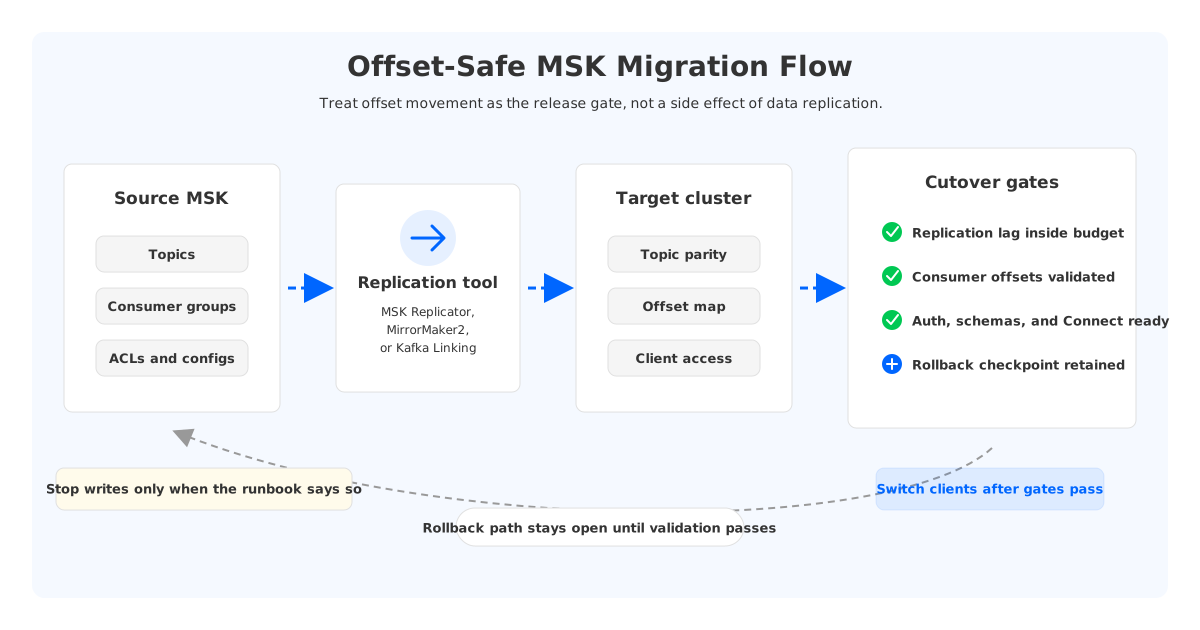
Most MSK migration plans look clean until consumer traffic moves. Topics replicate, target brokers are healthy, producers can write, dashboards are green, and then one consumer group replays six hours of data while another skips records it was supposed to process. That failure mode is why an MSK migration guide should start with offsets, not with cluster creation.
In Apache Kafka, the committed offset is the durable record of where a consumer group should resume for each topic partition. Kafka stores committed offsets in an internal topic, and consumers rely on those positions during rebalances, restarts, and deployments. Moving from Amazon Managed Streaming for Apache Kafka (Amazon MSK) to another Kafka cluster is therefore a data migration, a metadata migration, and a consumption-progress migration that must line up at cutover time.
The practical goal is not to promise zero downtime for every workload. Downtime, RPO, and RTO depend on write rate, replication lag, client behavior, network path, authentication changes, schema dependencies, and the migration tool. The safer goal is to make the cutover observable: every critical consumer group has a known source offset, a known target offset, an accepted lag window, and a rollback path that still works if validation fails.
1Why Offsets Are the Hardest Part of MSK Migration
Replicating topic data is mostly mechanical. You decide which topics move, preserve partition counts where required, copy records, and keep the target caught up until a maintenance window or a rolling client switch. Offset migration is less forgiving because offsets encode application progress against a specific partition log.
That detail matters when the target log is not byte-for-byte identical to the source. If a replication tool rewrites records, changes partition layout, or assigns different target offsets, the source offset orders-3@10500000 cannot be blindly committed as the same target offset. It has to be translated or validated. Apache MirrorMaker2 supports cross-cluster mirroring and offset translation through checkpointing, but operators still need to plan group mapping and application behavior around translated positions.
AWS makes a similar distinction in its MSK migration documentation. Amazon MSK Replicator is a managed option for replication and migration to MSK, and AWS states that it replicates data, topic configurations, ACLs, and consumer group offsets. AWS also describes the replication as asynchronous, so cutover quality depends on lag and checkpoint freshness.
The first design decision is tool fit:
- MSK Replicator is useful when the migration path is supported by AWS and you want a managed replication service. AWS documents consumer group offset synchronization in supported migration scenarios.
- MirrorMaker2 is useful when you need open-source control across Kafka distributions, accounts, or environments. You own Connect capacity, offset-sync topics, checkpoint topics, monitoring, and failover runbooks.
- Kafka Linking in AutoMQ BYOC is relevant when AutoMQ is the target and you want byte-to-byte replication plus synchronized consumption progress in the documented migration flow. AutoMQ documents Kafka Linking support for Apache Kafka and AWS MSK sources, with an important caveat: MSK IAM role authentication is not supported by Kafka Linking, so native ACL authentication is required for that path.
No tool removes the need for validation. The difference is where validation happens and what offset semantics the tool preserves.
2Build the Inventory Around Consumer Groups
A migration inventory that lists only topics is a false sense of progress. Topics tell you what data exists. Consumer groups tell you which applications can tolerate replay, which cannot miss a record, and which have external side effects.
Use the inventory to decide the cutover model before replication starts:
| Inventory area | What to capture | Why it matters for offsets |
|---|---|---|
| Topics and partitions | Topic name, partition count, retention, cleanup policy, message format | Offset translation assumes stable topic and partition relationships. Partition changes make resume behavior harder to prove. |
| Consumer groups | Group ID, subscribed topics, committed offsets, lag, reset policy, owner team | Each group needs a target resume plan. Low-priority groups can often replay; payment, billing, or CDC groups usually need stricter gates. |
| Producers | Bootstrap configuration, idempotence, transactions, retry behavior | Producer switching can create ordering or duplication risk if writes reach both clusters without a controlled proxy or freeze. |
| Schemas | Registry endpoint, subject naming strategy, compatibility mode, schema IDs | Consumers may fail even when offsets are correct if schemas or IDs do not resolve the same way. |
| Kafka Connect | Connector configs, task offsets, source/sink idempotency, external system state | Connector offsets are not identical to application consumer offsets and often need a separate migration or restart plan. |
| Security and networking | ACLs, TLS, SASL, DNS, VPC routing, firewall rules | A consumer that cannot authenticate on the target will trigger fallback behavior, timeouts, or offset reset surprises. |
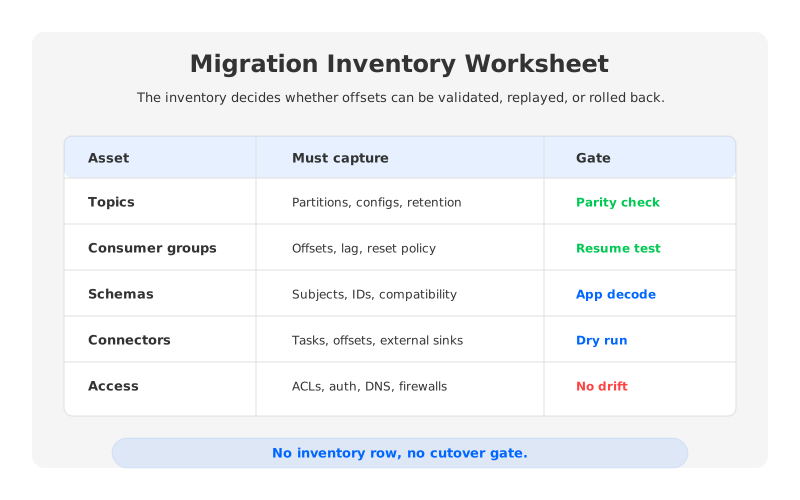
The highest-risk groups deserve a rehearsal. Pick a representative topic and a non-production group ID, replicate data, commit a controlled source offset, move the consumer to the target, and verify where it resumes. This exposes errors that diagrams hide: a group ID prefix, a schema mismatch, a missing ACL, or auto.offset.reset=latest silently skipping history when no committed offset exists.
3Replicate Topics Before You Move Offsets
A clean migration runbook separates data catch-up from offset acceptance. During data catch-up, the target cluster receives topic data while producers continue writing to MSK. During offset acceptance, you decide whether the target has enough data and metadata for a consumer group to resume safely.
For each migration batch, define the acceptance gates in observable terms:
- Source and target topics exist with expected partition counts and key topic-level configs.
- Replication lag is inside the pre-agreed budget for the specific batch.
- The relevant consumer group has a committed position on the source.
- The target has a translated or preserved position for the same logical group.
- A test consumer can start from that position without triggering offset reset behavior.
- The source cluster retains enough data to support rollback if the target is rejected.
The lag budget must be explicit because the right value is workload-dependent. Instead of publishing a generic RPO target, set a per-group condition: "cutover can proceed when replicated records are caught up to the source high watermark at the freeze point" or "the remaining lag is small enough for the application to replay within its maintenance window."
MirrorMaker2 migrations need special attention here. Apache Kafka's geo-replication documentation describes MirrorMaker2 as the cross-cluster mirroring framework, and the Apache design notes explain checkpointing and offset translation. A topic that is caught up does not automatically prove the consumer group offset is ready.
4Cutover Is a Gate, Not a Timestamp
The easiest migration plan to write is "switch clients at 22:00." The plan you want is "switch clients after gates A through E pass, before rollback condition F expires." That shift changes the meeting from a calendar ritual into an engineering decision.
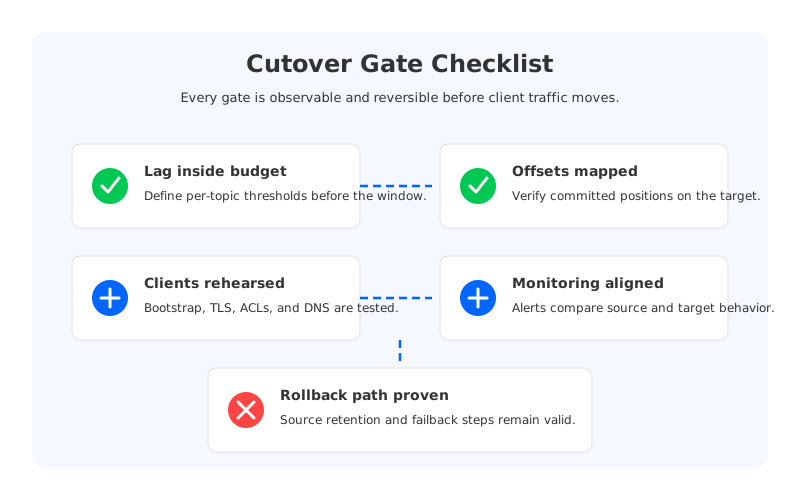
A conservative cutover sequence looks like this:
- Freeze or proxy writes according to the tool and application model.
- Let replication drain to the accepted condition. Watch source high watermarks, target end offsets, and the replication tool's own health metrics.
- Capture final source offsets for the selected consumer groups. Keep the snapshot with the incident record or release ticket.
- Validate target offsets and lag on the target.
- Start target-side consumers in a controlled order.
- Keep the source readable until post-cutover validation passes.
The gate model also helps teams avoid a common rollback trap. If producers start writing to the target and consumers process target records for a while, rolling back to MSK is no longer a DNS change. You need to know whether target-window records were replicated back, whether external side effects happened, and whether source retention still covers the original committed offsets.
5Schemas, Connectors, and Stateful Applications Can Break a Clean Offset Plan
Offsets tell a consumer where to resume, but they do not prove the consumer can deserialize, authorize, process, or commit. That is why schema and connector migration belongs in the same runbook.
Schema Registry is the first place to look. If producers write Avro, Protobuf, or JSON Schema payloads, consumers may depend on subject naming, compatibility rules, and schema IDs. A target cluster that contains the right bytes can still fail if the registry endpoint changes or if schemas are re-created with different IDs. Inventory subjects and run decode tests before moving production groups.
Kafka Connect needs a separate decision tree. Sink connectors often consume Kafka records and write to external systems, so replay may produce duplicate writes unless the sink is idempotent. Source connectors often store offsets for external systems, which means Kafka offset migration does not cover the connector's upstream position.
Stateful stream processing systems add another layer. Flink, Kafka Streams, Spark Structured Streaming, and custom processors may track positions in checkpoints or local state stores. Byte-to-byte offset preservation can reduce restore risk when the target and tool support it, but it still needs a job-level restore test.
6Where AutoMQ Fits as a Kafka-Compatible Target
Once the migration plan is framed around offset safety, the target cluster question becomes more concrete. You are asking whether existing Kafka clients, schemas, Connect workers, stream processors, and operational tools can keep their mental model while the storage and operations model changes underneath.
AutoMQ is a Kafka-compatible, cloud-native streaming platform that uses a Shared Storage architecture rather than the traditional broker-local storage model. For this topic, the relevant point is compatibility and migration mechanics. AutoMQ documentation describes Kafka ecosystem compatibility, and AutoMQ BYOC documentation describes Kafka Linking as the migration path for moving data from sources such as Apache Kafka and AWS MSK to AutoMQ.
Kafka Linking is worth evaluating when offset preservation is a primary requirement. AutoMQ documents byte-to-byte data synchronization with aligned offsets, synchronized consumption progress for consumer groups, and a producer proxy path for switching writes. Those capabilities can reduce the offset translation logic your team owns, but they do not eliminate migration planning.
Evaluate AutoMQ through the same gates as any other target:
- Can the target preserve or correctly translate offsets for the groups that matter?
- Can your client authentication model move without application rewrites?
- Can Kafka Connect, Schema Registry, stream processing, and observability tools run against the target path?
- Can the team rehearse rollback before the production cutover window?
- Can the target's operational model justify the migration beyond the cutover itself?
That last question matters to CTO and FinOps readers. AutoMQ's Shared Storage architecture, stateless brokers, and BYOC model may be attractive if the migration is also part of a broader effort to reduce broker-local storage operations or keep data in your own cloud account. Those benefits should be evaluated after the offset-safe migration path is proven.
7Rollback Planning: Keep the Source Useful
Rollback planning starts before the first topic is replicated. The source MSK cluster must retain enough data for the rollback window, and the team must decide what happens to writes that reach the target after cutover. Pre-write rollback is comparatively simple because source offsets are still valid and target writes have not become authoritative. Post-write failback is harder because bidirectional replication, replay rules, external side effects, and source catch-up all need to be tested. A failed gate should stop the cutover before partial target writes begin.
8Keep the Runbook Short Enough to Use
For an MSK migration that must protect offsets, the runbook should fit on a few pages: scope, tooling, preflight checks, offset evidence, cutover gates, rollback triggers, and post-cutover monitoring. Topic replication completion is not the finish line. The finish line is a set of consumers that resume from the intended logical positions and remain reversible until the team has enough evidence to close the migration window.
If you are evaluating MSK migration and want to test whether AutoMQ BYOC fits your offset, authentication, and rollback constraints, start with the official path and talk through the runbook with a migration engineer: evaluate AutoMQ for your Kafka migration.
9FAQ
9.1Can I migrate from MSK without downtime?
Sometimes, but not as an unconditional promise. Downtime depends on the migration tool, authentication model, producer switching strategy, replication lag, client retry behavior, and whether writes need to be frozen.
9.2Does MSK Replicator migrate consumer group offsets?
AWS documentation states that MSK Replicator replicates consumer group offsets and other Kafka metadata in supported scenarios. It also describes the replication as asynchronous, so cutover planning still needs lag and offset validation gates.
9.3Is MirrorMaker2 enough for offset-safe migration?
MirrorMaker2 can be enough when it is configured, monitored, and tested correctly. It supports cross-cluster mirroring concepts, including checkpointing and offset translation, but the operator owns deployment, availability, checkpoint cadence, group mapping, and failover behavior.
9.4What should I validate before moving consumers?
Validate topic partition parity, replicated lag, committed source offsets, target-side translated or preserved offsets, schema resolution, ACLs, bootstrap connectivity, and application restart behavior.
9.5Can AutoMQ be a target for MSK migration?
Yes, subject to the documented migration path and prerequisites. AutoMQ documentation lists AWS MSK as a supported source for Kafka Linking and describes Kafka compatibility across clients and ecosystem components. Verify authentication first because Kafka Linking documentation states that MSK IAM role authentication is not supported for that path.
9.6When can I delete the old MSK cluster?
Delete or downscale the source only after the post-cutover confidence window closes, target consumers are stable, external side effects are reconciled, and rollback is no longer needed.
10References
- AWS Documentation: Migrate Kafka workloads to an Amazon MSK cluster
- AWS Documentation: Amazon MSK Replicator
- Apache Kafka Documentation: Geo-Replication (Cross-Cluster Data Mirroring)
- Apache Kafka Documentation: Consumer configs and offset behavior
- Apache Kafka Wiki: KIP-382: MirrorMaker 2.0
- AutoMQ Documentation: Migrate to AutoMQ BYOC overview
- AutoMQ Documentation: Migrate to AutoMQ BYOC prerequisites
- AutoMQ Documentation: Executing migration
- AutoMQ Documentation: Compatibility with Apache Kafka


