
Table of Contents
Table of Contents
MSK Serverless is attractive for the same reason every good serverless product is attractive: it removes a planning problem. You do not pick broker sizes, estimate disk growth, or schedule a partition reassignment before an unexpected traffic spike. For an AWS team that wants Apache Kafka without capacity management, that is a real improvement over running a hand-sized cluster and hoping yesterday's estimate survives next month's launch.
The tradeoff starts when "no capacity planning" becomes "less control over the shape of capacity." Kafka workloads are rarely defined by one number. A cluster may have modest average ingress, heavy consumer fan-out, thousands of partitions, long retention, strict private networking, compacted topics, or client behavior that creates connection pressure. MSK Serverless can be a good fit for some of those patterns, but it is not a universal answer to Kafka elasticity.
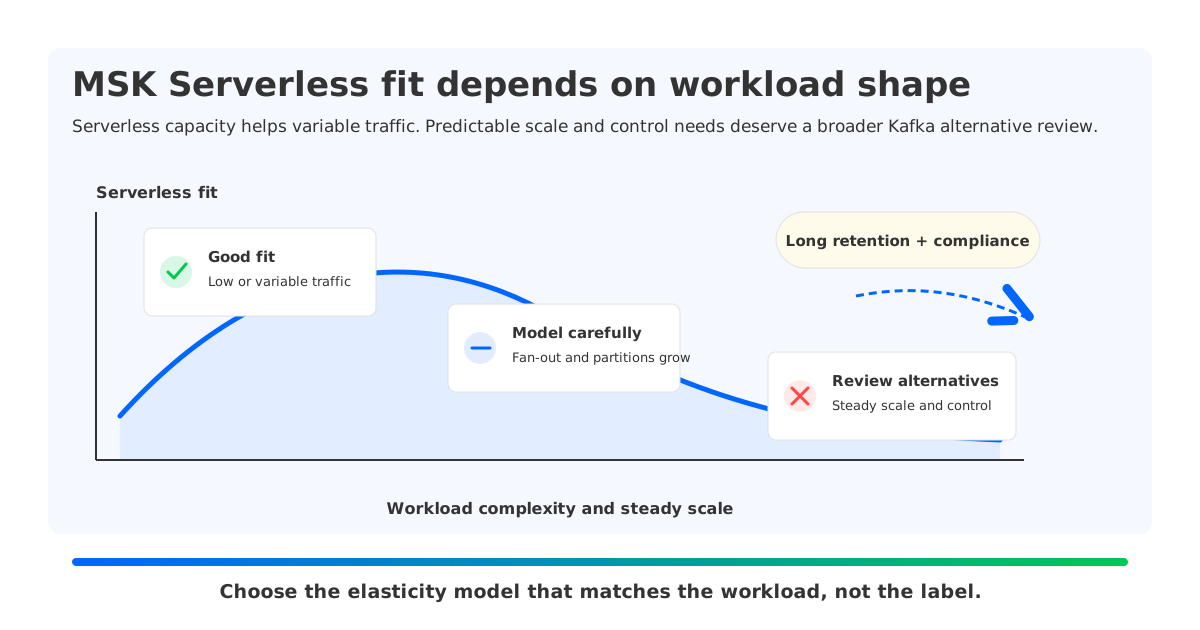
The practical question is not whether MSK Serverless is good or bad. It is whether your workload benefits more from AWS-managed serverless capacity or from another elasticity model: provisioned MSK, another managed Kafka service, self-managed Kafka, or a Kafka-compatible architecture such as AutoMQ that separates storage from compute while keeping the data plane in customer-controlled infrastructure.
1What MSK Serverless Is Good At
AWS describes MSK Serverless as a cluster type that runs Apache Kafka without requiring customers to manage and scale cluster capacity. It automatically provisions and scales capacity, manages partitions in topics, and uses a throughput-based pricing model. It also integrates with AWS services that many platform teams already use, including AWS PrivateLink, IAM access control, AWS Glue Schema Registry, Managed Service for Apache Flink, and AWS Lambda.
That combination is useful when the workload is uncertain. A team launching a new event stream may not know whether traffic will settle at a few GB per day or grow by an order of magnitude. A data science team may need Kafka for a project but not want a long-lived broker fleet. A platform team may want to provide a Kafka-compatible entry point to internal applications before committing to a larger streaming architecture.
MSK Serverless also reduces a class of operational tasks that make traditional Kafka tedious:
- Broker sizing moves out of the application team's workflow. You still need to understand workload limits, but you do not choose EC2 instance families for the cluster.
- Storage provisioning becomes consumption-oriented. The pricing page describes storage charges based on what is consumed rather than pre-provisioned disk.
- Partition management becomes less manual for common workloads. AWS handles the cluster capacity behind the service rather than asking users to plan every broker change.
- AWS-native security and connectivity are built into the product boundary. For AWS-first teams, IAM and PrivateLink support can simplify the approval path.
Those are not small advantages. They are exactly why teams search for "serverless Kafka AWS" in the first place. The mistake is assuming that serverless removes the need to model Kafka behavior. It changes what you model.
2Where Serverless Kafka Can Surprise Production Teams
MSK Serverless pricing is usage-based, but it is not only a "pay for bytes written" model. The AWS pricing page says MSK Serverless charges for cluster hours, partition hours, producer data written, consumer data read, and consumed storage. AWS also notes that standard data transfer charges apply for data transferred to or from another Region and for data transferred out to the public internet.
That matters because Kafka cost often hides in the shape of the workload, not only in raw ingest. A topic with many consumer groups can have moderate write volume and high read volume. A platform with many small teams can accumulate partitions faster than it accumulates traffic. A compliance workload can retain data long enough that storage becomes a steady-state cost rather than an incidental one.
AWS gives a public MSK Serverless example for US East (Ohio): 5 topics with 20 partitions each, 100 GB written daily, 200 GB read daily, and 24-hour retention over a 31-day month. In that example, the total is $1,299.60, made up of cluster hours, partition hours, data-in, data-out, and storage. The exact rates are region- and date-sensitive, so the useful lesson is the cost structure: reads, partitions, and baseline cluster presence all matter.
Quotas are the other part of the fit conversation. As of the AWS MSK quota documentation checked on 2026-05-20, MSK Serverless lists per-cluster quotas such as 200 MBps maximum ingress, 400 MBps maximum egress, 3,000 client connections, 500 consumer groups, 2,400 leader partitions for non-compacted topics, 120 leader partitions for compacted topics, 5 MBps ingress per partition, and 10 MBps egress per partition. AWS says teams should create a support case if they experience issues with service quota limits.
None of those numbers make MSK Serverless unsuitable by default. They make it a product with a defined operating envelope. Production teams should look closely when they see these patterns:
- Steady high throughput. If traffic is predictable and high, the benefit of serverless elasticity may be smaller than the premium paid for per-GB and per-partition usage.
- Heavy read fan-out. Kafka read volume can exceed write volume when multiple consumers replay or process the same topics independently.
- Large partition estates. Partition-hour charges and partition quotas matter when teams use partitions as a scaling or tenancy unit.
- Compacted topics. The documented compacted-topic partition quota is much lower than the non-compacted-topic leader partition quota, so changelog-heavy workloads deserve early testing.
- Strong control requirements. If the team needs Kafka ACL semantics, deep broker-level tuning, specific placement behavior, or a data plane fully governed in its own account, serverless convenience may not be the highest-priority requirement.
This is the point where the word "alternative" becomes useful. The alternative is not always "leave AWS" or "run everything yourself." It may be choosing a different control boundary for the same Kafka application contract.
3Evaluation Criteria for MSK Serverless Alternatives
A serious MSK Serverless alternative should be evaluated against the workload dimensions that serverless abstracts away. Start with traffic, but do not stop there. Kafka is a distributed log with client behavior, partitions, retention, replay, and operational ownership all tangled together.
| Criterion | What to check | Why it changes the decision |
|---|---|---|
| Throughput shape | Average, peak, burst duration, ingress-to-egress ratio | Serverless helps bursty workloads; steady high traffic needs cost modeling |
| Partition model | Total leaders, compacted topics, tenant-per-topic patterns | Partitions can become both a quota and billing driver |
| Retention | Hours, days, replay frequency, compliance hold | Long retention changes storage economics and recovery planning |
| Networking | VPC count, cross-Region paths, public internet egress, PrivateLink | Network charges and topology often decide the real bill |
| Kafka semantics | ACLs, transactions, compaction, client versions, connectors | Compatibility is more than accepting produce and fetch requests |
| Control boundary | SaaS, AWS-managed, BYOC, self-managed | Data ownership, IAM, audit, and incident response depend on where the platform runs |
This scorecard keeps the comparison honest. A serverless service may win on operational simplicity while losing on partition-heavy cost predictability. A self-managed cluster may win on control while losing on staffing and upgrade risk. A BYOC platform may preserve customer infrastructure ownership while still outsourcing parts of lifecycle management.
For AWS teams, the common alternatives are usually four paths. MSK Serverless is the first path: AWS-managed Kafka capacity with usage-based billing and service-defined limits. MSK Provisioned is the second: still AWS-managed, but with explicit broker sizing and more configuration responsibility. A SaaS Kafka provider is the third: often strong on managed experience and ecosystem integrations, but with a different data-plane and commercial boundary. The fourth path is BYOC or customer-controlled Kafka-compatible infrastructure, where the data plane runs in the customer's cloud account and the architecture can be optimized differently from traditional broker-local Kafka.
4BYOC and Diskless Kafka as Another Elasticity Model
Serverless is one way to make Kafka feel elastic. Diskless Kafka is another. The difference is subtle but important: serverless hides capacity management behind a service boundary, while diskless architecture changes why capacity management is difficult in the first place.
Traditional Kafka binds durable log data to broker-local storage. When brokers are added, removed, replaced, or rebalanced, the system often has to move partition data across machines. Tiered storage can reduce the amount of older data sitting on broker disks, but the hot path and broker-local state still matter. That is why Kafka elasticity is so often measured in operational work: reassign partitions, watch network traffic, protect hot brokers, and avoid doing too much during business hours.
AutoMQ takes a different approach by redesigning Kafka storage around shared object storage. Its documentation describes a shared-storage architecture in which persistent data is offloaded through S3Stream and broker nodes become stateless. The stateless broker documentation connects that design to automatic scaling, simplified operations, and broker replacement without moving persistent local log data.
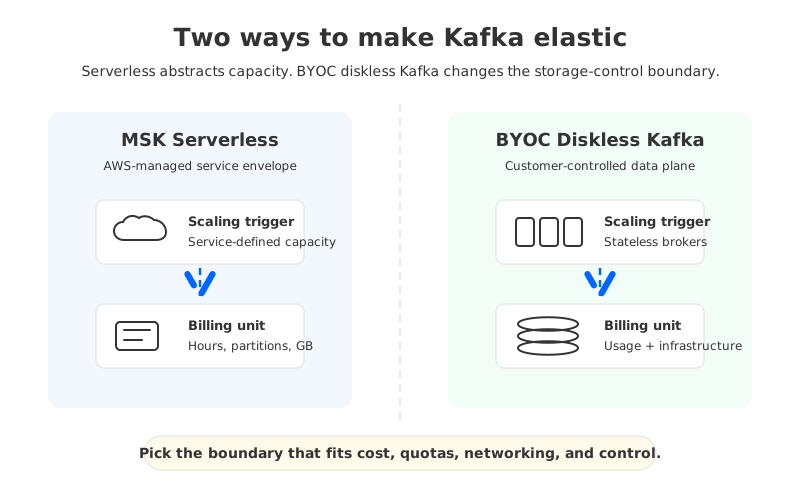
That makes AutoMQ relevant when the requirement is not "give me Kafka without thinking" but "give me Kafka compatibility with a data plane and cost model I can reason about." AutoMQ documentation describes Kafka compatibility across clients, connectors, proxies, and ecosystem components. AutoMQ Cloud BYOC billing documentation also describes usage-based billing items such as data ingress, data egress, data retention, and cluster uptime, and says AutoMQ does not charge for the number of partitions in that billing model.
This does not make BYOC automatically better than MSK Serverless. It changes the tradeoff. With BYOC, the team still needs to approve cloud account design, VPC layout, object storage, IAM, observability, and operational access. The payoff is that infrastructure ownership, network topology, and architectural elasticity can be tuned for the organization's production requirements rather than fully inherited from a serverless service boundary.
5Decision Table: Which Alternative Fits Which Workload?
The easiest way to misuse serverless Kafka is to treat the word "serverless" as a maturity shortcut. It is better to map the workload to an operating model.
| Workload pattern | Likely fit | Why |
|---|---|---|
| New AWS-native application with uncertain traffic | MSK Serverless | Low planning burden and AWS-native integrations are often more valuable than deep tuning |
| Stable high-throughput platform with predictable peaks | MSK Provisioned or diskless BYOC | Explicit capacity or architecture-level elasticity can be easier to model |
| Long retention with heavy replay | Diskless/shared-storage Kafka or carefully modeled MSK | Storage and read economics dominate the decision |
| Many teams, many topics, many partitions | Diskless BYOC or provisioned model with clear governance | Partition billing, quotas, and tenancy controls need early attention |
| Strict customer-account data-plane control | BYOC Kafka-compatible platform | The deployment boundary matters as much as Kafka protocol compatibility |
| Small project that wants the fewest knobs | MSK Serverless | Operational simplicity may beat configurability |
The decision is rarely permanent. A team can start with MSK Serverless to validate a product idea, then move a mature workload to a different Kafka-compatible platform when traffic stabilizes or control requirements harden. The important part is designing the application contract so that the future migration is possible: standard Kafka clients, clear topic ownership, portable schemas, observable consumer lag, and a documented offset strategy.
6MSK Serverless Decision Checklist
Before committing production traffic to MSK Serverless or any alternative, answer the questions that will hurt later if they are skipped now.
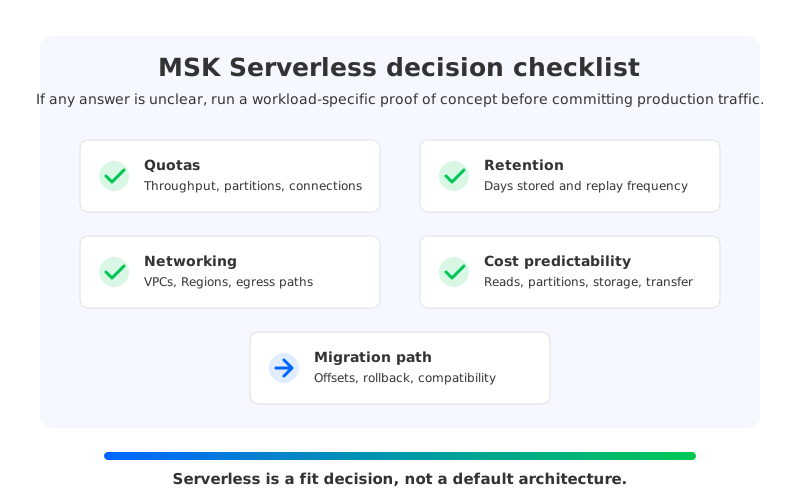
- What is the expected ratio of write volume to read volume across all consumer groups?
- How many leader partitions do you need now, and how many will exist if every internal team onboards?
- Which topics are compacted, and do they fit the documented compacted-topic quota?
- How long is data retained, and how often is old data replayed?
- Which applications require Kafka ACLs, transactions, custom client behavior, or connector placement?
- Which VPCs, accounts, Regions, and external consumers need private connectivity?
- What happens if the workload outgrows a serverless quota, and who owns the support case or migration plan?
- What cost model is acceptable to Finance: usage-only, committed capacity, marketplace billing, direct cloud infrastructure, or a mix?
If the answers are fuzzy, MSK Serverless may still be the right starting point. It is a strong product for teams that want AWS-managed Kafka capacity and can stay within the service envelope. If the answers point toward steady scale, long retention, partition-heavy tenancy, or customer-controlled infrastructure, the alternative should not be framed as "less serverless." It should be framed as a better elasticity model for that workload.
7Sources Checked
- What is MSK Serverless?
- Amazon MSK pricing
- Amazon MSK quotas
- MSK Serverless features page
- AutoMQ overview
- AutoMQ architecture overview
- AutoMQ stateless broker
- AutoMQ compatibility with Apache Kafka
- AutoMQ BYOC usage-based billing
- AutoMQ migration overview
8FAQ
8.1Is MSK Serverless a good Kafka option for production?
Yes, if the workload fits the documented quotas, pricing model, networking model, and security requirements. It is especially useful for AWS-native workloads with variable demand and teams that want to avoid broker capacity planning. Production teams should still test throughput, partitions, consumer groups, compaction, connectivity, and cost under realistic traffic.
8.2What are the main MSK Serverless limitations to check first?
Start with throughput, partitions, connections, consumer groups, message size, compacted-topic usage, VPC connectivity, and IAM-only access control. These are not theoretical concerns; they are listed in AWS documentation as service quotas or product characteristics, and they directly affect production fit.
8.3Is MSK Serverless always lower cost than provisioned Kafka?
No. MSK Serverless can be cost-effective when usage is variable or difficult to forecast, but steady high-throughput workloads may need a detailed comparison against provisioned MSK, SaaS Kafka, or BYOC architectures. The AWS pricing model includes cluster hours, partition hours, data written, data read, storage, and applicable data transfer charges.
8.4What is the difference between MSK Serverless and a BYOC Kafka alternative?
MSK Serverless is an AWS-managed serverless cluster type. A BYOC Kafka alternative runs the data plane in the customer's cloud account or infrastructure boundary, depending on the vendor and deployment model. BYOC can provide more control over networking, IAM, cost visibility, and data placement, but it also requires more infrastructure approval and operating design.
8.5Where does AutoMQ fit as an MSK Serverless alternative?
AutoMQ fits when a team wants Kafka compatibility, customer-controlled infrastructure, and elasticity from a diskless shared-storage architecture rather than a purely serverless service boundary. It is not a drop-in answer for every workload, but it is worth evaluating when partitions, retention, network topology, or steady high throughput make MSK Serverless harder to model.


