
Table of Contents
Table of Contents
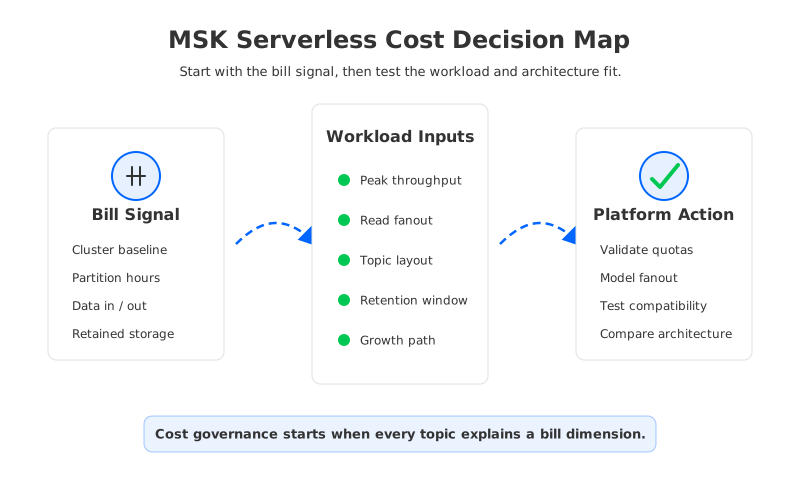
Teams usually search for "MSK Cost" after the first AWS bill has stopped matching the mental model they had during architecture review. Serverless sounded like capacity planning would disappear. In practice, MSK Serverless removes broker sizing work, but it does not remove the need to understand Kafka workload shape. A cluster can be easier to operate and still be expensive for the wrong traffic pattern.
That distinction matters because Kafka cost is rarely a single line item. It is the consequence of write volume, read fanout, retained data, partition count, traffic locality, security paths, and operational constraints. MSK Serverless changes the unit of purchase from broker capacity to usage-based dimensions, so the right question is not "Is serverless lower cost?" The better question is "Which workload variables still scale the bill, and which architecture constraints remain outside the service abstraction?"
1Why MSK Serverless Cost Can Surprise Kafka Teams
MSK Serverless is useful because it removes a familiar source of Kafka toil: choosing broker instances, provisioning storage, and manually scaling cluster capacity. AWS describes it as a cluster type that automatically provisions and scales capacity while managing partitions in topics. For teams that have suffered through broker right-sizing, that is a meaningful operational improvement.
The surprise comes from translating "no broker sizing" into "no capacity economics." MSK Serverless still charges around workload behavior. AWS pricing identifies dimensions such as cluster hours, partition hours, data written, data read, and storage. Those dimensions are reasonable for a managed service, but they can feel unintuitive to teams that expected a scale-to-zero style service or assumed that low average traffic would dominate cost.
The first fit question is therefore about the baseline. A Kafka environment often exists to provide always-on connectivity for applications, CDC pipelines, observability streams, fraud systems, or feature platforms. Even when traffic is bursty, the cluster, topics, partitions, and retained data can remain present for long periods. A workload with many idle partitions is still different from a workload with no partitions.
The second fit question is about fanout. Producer ingress is only half the story. The same event may be consumed by stream processors, warehouses, search pipelines, model features, audit jobs, and internal platform tools. A design that looks modest by write throughput can become expensive when downstream consumption multiplies egress and retention requirements.
2The Cost Surface Is Bigger Than Throughput
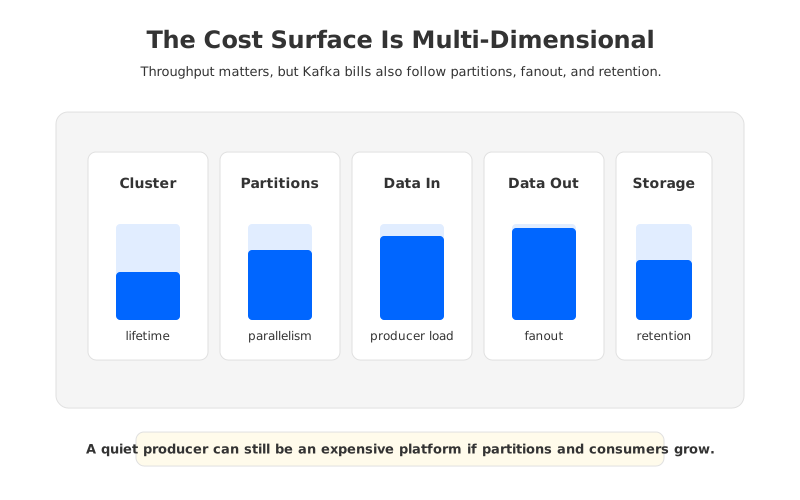
Most Kafka cost reviews start with megabytes per second because throughput is easy to discuss in architecture meetings. Throughput matters, but it is not enough to predict MSK Serverless cost. The service meter follows several axes, and each axis maps to a different engineering decision.
| Workload input | Why it matters for MSK Serverless | Engineering question |
|---|---|---|
| Cluster lifetime | Cluster hours create a baseline even when traffic is quiet. | Is this a persistent platform or a temporary pipeline? |
| Partition count | Partition hours make topic design visible in cost. | Are partitions sized for parallelism, tenant isolation, or future growth? |
| Data written | Producer traffic maps directly to usage. | Is ingress steady, bursty, compressed, or duplicated across pipelines? |
| Data read | Consumer fanout can exceed producer ingress. | How many independent teams and jobs read the same stream? |
| Storage retained | Retention converts time into cost. | Is Kafka being used as a replay log, a buffer, or a long-lived archive? |
The table is not a warning against MSK Serverless. It is a reminder that Kafka economics are workload economics. A small number of high-value streams with moderate partitions and predictable retention may fit well. A platform cluster with hundreds of topics, many tenants, long retention, and broad consumer fanout needs a different review because usage dimensions stack.
This is where FinOps teams and Kafka platform teams often talk past each other. FinOps sees a bill grouped by service and usage category. Platform engineers see a topic layout, a replication strategy, and a set of application SLAs. The useful review connects both views: every topic and consumer group should explain at least one cost dimension.
3Quotas Are Part of Cost Planning
Cost planning cannot be separated from quota planning. AWS documents MSK Serverless quotas, including limits for throughput and partitions. These limits are not defects; every managed service has boundaries. The point is that a workload can be economically attractive at small scale and then hit a service boundary before it hits an organizational boundary.
For Kafka platform owners, this creates three design checks. First, compare peak ingress and egress, not only monthly averages. Serverless capacity has to satisfy the busy minute, not the quiet month. Second, review partition growth. Teams often add partitions to increase consumer parallelism, isolate tenants, or reduce hot partitions; those choices affect both quotas and partition-hour cost. Third, examine the shape of long retention. Storage may be a minor line for short buffers but a structural cost for replay-heavy architectures.
The operational question is not "Will AWS raise the quota?" Sometimes quotas can be increased, and sometimes the workload is better served by another deployment option. The real question is whether the architecture has a clean path when the workload grows beyond the original envelope. A late migration under pressure can turn the lower early operating burden into a delayed platform project.
4Provisioned MSK, Serverless MSK, and Shared Storage Ask Different Questions
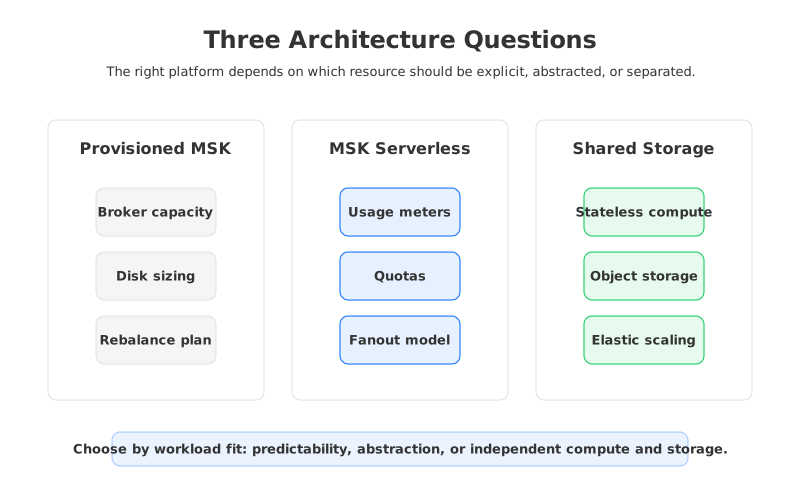
Provisioned MSK and MSK Serverless solve different problems. Provisioned clusters expose more capacity planning knobs: broker family, broker count, storage, throughput, and networking choices. Serverless reduces that planning surface and charges by workload dimensions. Both can be good choices, but they create different failure modes in budgeting.
With provisioned MSK, teams often overpay by reserving capacity for peaks, retention, and growth. Idle brokers are visible, and storage decisions are explicit. With MSK Serverless, teams may under-model the cost of partitions, read fanout, and retained data because there are fewer infrastructure objects to size. The bill can look cleaner while the workload logic still drives the outcome.
Kafka-compatible systems with a Shared Storage architecture ask a third question: does the platform still need broker-local storage to be the center of durability? Traditional Kafka was designed around brokers that own local logs and replicate them for fault tolerance. In cloud environments, object storage changes that premise. If persistent data can live in durable shared storage while brokers focus on compute, then scaling, recovery, and cost allocation begin to look different.
That architectural shift is not a free pass. Teams still need to evaluate Kafka protocol behavior, latency, durability path, client compatibility, security model, operational tooling, and migration risk. But it changes which resources dominate the review. Instead of asking only how many brokers and disks to reserve, the team can ask how much compute is needed now, how storage grows over time, and how much data movement is created by the architecture itself.
5A Practical Workload Fit Worksheet
A useful MSK Serverless review should be deliberately plain. It should turn broad claims into inputs that engineers can test and procurement can defend. Start with a representative month, but do not stop there. Model the peak hour, the noisiest tenant, the busiest consumer group, and the longest replay window.
Use these questions before committing a production workload:
- What is the expected average and peak ingress, and how much does compression change the billable shape?
- What is the expected egress after all consumers, stream processors, connectors, and analytics jobs are counted?
- How many partitions exist on day one, and what policy controls partition growth?
- Which topics need long retention for replay, audit, or backfill, and which topics only need short buffering?
- Which workloads require strict latency, dedicated isolation, or predictable throttling behavior?
- What is the exit path if quotas, cost, or operational requirements outgrow the serverless envelope?
The worksheet should be owned jointly. Platform teams provide topic and traffic facts. Application teams explain fanout and retention. Security and cloud architects validate network paths, IAM, encryption, and private connectivity. FinOps turns those facts into a bill model and asks whether the model still holds after growth.
6How AutoMQ Fits the Evaluation
Once the workload inputs are visible, AutoMQ belongs in the evaluation as a Kafka-compatible platform with a Shared Storage architecture, not as a generic "lower cost" slogan. AutoMQ keeps Kafka protocol compatibility while replacing broker-local log storage with an S3-based Shared Storage architecture. Brokers become stateless compute nodes, and durable stream data is written through a WAL (Write-Ahead Log) and object storage path.
The relevance to MSK cost evaluation is architectural. If a large part of the bill is tied to retained data, cross-AZ data movement, or over-provisioned broker capacity, then a storage model that separates compute from storage deserves a serious test. AutoMQ documentation also describes approaches for reducing inter-zone traffic by using S3-based shared storage, which is especially relevant when Kafka replication and client traffic cross Availability Zone boundaries.
That does not mean every MSK Serverless workload should move. A small team with moderate throughput, short retention, and a strong preference for AWS-native service management may decide that MSK Serverless is the right trade-off. A platform team with sustained traffic, heavy fanout, long replay windows, or strict cost attribution may find that shared storage gives them better control over the variables that keep showing up in the bill.
The migration review should be concrete. Validate client versions, topic configurations, ACLs, authentication, consumer group behavior, transactions if used, observability, backup and restore expectations, and failure drills. AutoMQ's Kafka compatibility documentation gives teams a starting point, but the production answer must come from a compatibility test that resembles the real workload, not a toy producer and consumer.
7Cost Governance After the First Deployment
The best time to control Kafka cost is before every team has learned to treat the cluster as an infinite utility. MSK Serverless makes the first deployment faster, which is useful, but faster provisioning can also spread topic sprawl faster. Governance has to be lightweight enough that engineers use it and strict enough that the bill remains explainable.
Good governance starts with ownership. Every topic should have an owner, retention policy, partition rationale, expected producer volume, expected consumer groups, and deletion path. Consumer teams should understand that read amplification is a platform cost, not an invisible side effect. Platform teams should publish a small set of approved topic patterns rather than reviewing every topic from scratch.
Cost alerts should map back to workload facts. Alerting on total service spend is useful for finance, but it is too late for engineering. Alert on unusual ingress, egress, partition growth, storage growth, and consumer fanout. Those signals tell the platform team what changed before the invoice arrives.
8Decision Summary
MSK Serverless is a strong option when a team values managed operations, has a workload inside documented service boundaries, and can predict the usage dimensions that drive the bill. It is less comfortable when the workload has sustained high traffic, broad fanout, long retention, aggressive partition growth, or a growth path that may exceed quotas. The word "serverless" removes broker management from the foreground; it does not remove Kafka's workload physics.
Return to the first bill that triggered the search. The number is not the final answer. It is a signal that the architecture review needs to move from service names to workload inputs: cluster lifetime, partitions, data in, data out, storage retained, network path, and migration control. If those inputs show that broker-local storage or cross-zone data movement is shaping the cost curve, evaluate a Kafka-compatible shared-storage option alongside MSK.
For teams that want to test that path, start with an AutoMQ BYOC evaluation and run a compatibility and cost model against one real workload, including its consumers and retention policy: try AutoMQ in your own cloud account.
9References
- Amazon MSK pricing
- What is MSK Serverless?
- Amazon MSK quotas
- AWS EC2 data transfer pricing
- Apache Kafka replication documentation
- AutoMQ architecture overview
- AutoMQ inter-zone traffic documentation
- AutoMQ migration prerequisites and compatibility notes
10FAQ
10.1Is MSK Serverless always lower cost than provisioned MSK?
No. MSK Serverless can reduce capacity planning and may fit variable workloads well, but its cost depends on cluster hours, partition hours, data written, data read, and retained storage. Provisioned MSK can be more predictable for some sustained workloads, while serverless can be more convenient for others.
10.2What is the most common MSK Serverless cost surprise?
The common surprise is that Kafka workload design still matters. Partition count, long retention, and consumer fanout can keep growing even when broker sizing is hidden. Teams that model only producer ingress usually undercount the real cost surface.
10.3When should a team evaluate an MSK alternative?
Evaluate alternatives when the workload has sustained throughput, heavy read fanout, long retention, cross-AZ traffic concerns, quota pressure, or strict requirements for cost attribution and operational control. The evaluation should include compatibility, migration, security, observability, and failure recovery, not only monthly price.
10.4How is AutoMQ different from MSK Serverless?
AutoMQ is a Kafka-compatible streaming platform built around shared storage. Instead of making broker-local disks the center of durability, AutoMQ uses stateless brokers with WAL and object storage. That architecture is relevant when teams want independent compute and storage scaling, lower data movement, and more control over cloud storage economics.


