
Table of Contents
Table of Contents
MSK Serverless is attractive because the team can stop sizing brokers before it knows the workload. For application teams that need Kafka-compatible streaming on AWS, that removes a real operational burden: no broker fleet to pre-provision, no storage volume sizing exercise, and no capacity spreadsheet that becomes wrong when traffic changes.
That does not make MSK Serverless pricing invisible. It changes what you have to measure. Instead of asking how many brokers and how much disk you reserved, you need to understand producer writes, consumer reads, open partitions, retention, and network paths. For many workloads, that is a fair trade. For others, the bill becomes harder to reason about because the knobs moved from infrastructure to workload behavior.
1What MSK Serverless is designed to solve
Amazon describes MSK Serverless as an Amazon MSK cluster type that runs Apache Kafka without customers managing and scaling cluster capacity. AWS automatically provisions and scales capacity and manages topic partitions, while the service uses a throughput-based pricing model. That positioning matters: MSK Serverless is not primarily a way to get the lowest possible Kafka unit cost. It is a way to buy elasticity and reduce operational work when demand is uneven or difficult to forecast.
The operational win is clearest when a team would otherwise over-provision a provisioned MSK cluster for traffic spikes. A steady cluster forces broker count, broker size, storage, partition distribution, and scaling procedures to be chosen ahead of time. MSK Serverless moves much of that work into the managed service and integrates with AWS services such as IAM, PrivateLink, AWS Glue Schema Registry, Amazon Managed Service for Apache Flink, and AWS Lambda.
The trade-off is control. AWS documentation states that MSK Serverless requires IAM access control and does not support Apache Kafka ACLs. Broker configuration properties are set by Amazon MSK, and only a defined subset of topic-level properties can be changed. That is reasonable for serverless operations, but not neutral for teams with strict Kafka configuration requirements.
2How MSK Serverless pricing works
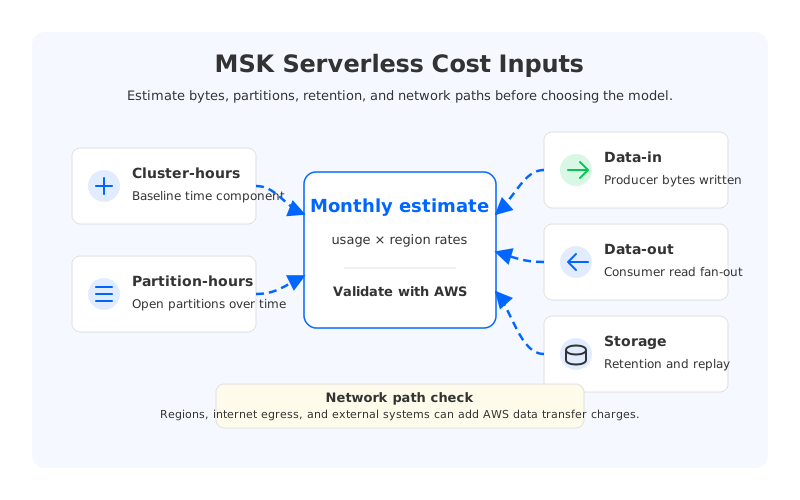
The AWS pricing page for Amazon MSK lists the main MSK Serverless charge categories as cluster-hours, partition-hours, data-in, data-out, and storage. AWS also notes that standard AWS data transfer charges apply for data transferred to or from another Region and for data transferred out to the public internet. Prices vary by Region, so production estimates should use the AWS pricing page or AWS Pricing Calculator at evaluation time.
| Cost driver | What to measure | Why it matters |
|---|---|---|
| Cluster-hours | How long each MSK Serverless cluster exists | The cluster has an hourly component even when traffic is low. |
| Partition-hours | Number of partitions multiplied by time | Over-partitioned topics can create a baseline cost independent of bytes. |
| Data-in | Producer bytes written to topics | Producer traffic is a direct usage dimension in the AWS pricing model. |
| Data-out | Consumer bytes read from topics | Fan-out can make read traffic exceed write traffic. |
| Storage | Data retained over time | Retention windows and replay requirements determine consumed storage. |
| AWS data transfer | Region, internet, and network path | Some movement outside the service pricing dimensions is billed by AWS networking rules. |
This model is easy to underestimate when Kafka is used as a fan-out layer. A topic may receive each event once but serve it to stream processors, observability pipelines, search indexes, feature stores, and archival connectors. Independent consumer groups are a Kafka strength, but every additional read path belongs in the cost model.
2.1Throughput
Throughput in MSK Serverless pricing has two sides: producer writes and consumer reads. AWS's pricing example separates data-in from data-out, and MSK Serverless CloudWatch metrics expose BytesInPerSec and BytesOutPerSec at the topic level. That gives teams a practical estimate path: measure average and peak writes, then aggregate reads across consumer groups.
Quota checks belong in the same exercise. The AWS MSK quota page lists cluster throughput, per-partition throughput, request-rate, connection, fetch, and message-size limits for MSK Serverless. Treat those as design constraints, not footnotes.
The cost question is therefore not only "How many GB do we write?" It is "How many GB do we read, how many consumer groups multiply those reads, and do our peaks fit the service quotas without throttling?" A workload can look modest at average traffic and still be a poor fit if peaks press against per-partition or cluster-level limits.
2.2Storage and retention
Kafka retention is usually a product decision disguised as an infrastructure setting. Teams keep data for replay, late consumers, recovery, backfills, audits, or convenience. In MSK Serverless, storage is a direct pricing dimension, and AWS documentation lists editable topic-level retention settings such as retention.ms and retention.bytes.
That makes retention a cost control, but not a free one. Short retention lowers storage exposure but reduces replay windows; long retention helps recovery and reprocessing but increases storage consumption. Compacted topics need additional scrutiny because the MSK Serverless quota page lists separate limits for compacted-topic partition counts and partition size.
2.3Partitions and topic design
Partitions are not only a scaling primitive. In MSK Serverless, they are also a pricing primitive. The AWS pricing page charges an hourly rate for each partition created, and the quota page lists partition limits, partition creation and deletion rate limits, and different maximum leader partition counts for non-compacted and compacted topics.
That changes the incentive around "partition generously." In provisioned Kafka, excessive partitions show up as broker overhead, recovery time, controller load, and operational complexity. In MSK Serverless, partition-hours also create a visible baseline charge, so low-traffic partitions can become economically noisy.
2.4Networking and reads
MSK Serverless pricing includes data-in and data-out at the service level, but AWS networking still matters. The MSK pricing page states that standard AWS data transfer charges apply for traffic to or from another Region and for data transferred out to the public internet. For workloads that bridge Regions, expose streams externally, or move data outside the same network boundary, that can become material.
This is where FinOps reviews often find the gap between Kafka diagrams and bills. A clean architecture diagram may show "producer to Kafka to consumer," while the bill sees Region boundaries, internet egress, PrivateLink paths, cross-service movement, and repeated reads. The right estimate traces bytes by path, not only by topic.
3Workloads that fit MSK Serverless
MSK Serverless is strongest when elasticity and reduced operations outweigh the premium of usage-based abstraction. That often describes product teams launching event-driven services, platforms with uncertain adoption curves, bursty workloads, and teams that do not want broker capacity planning as a standing process.
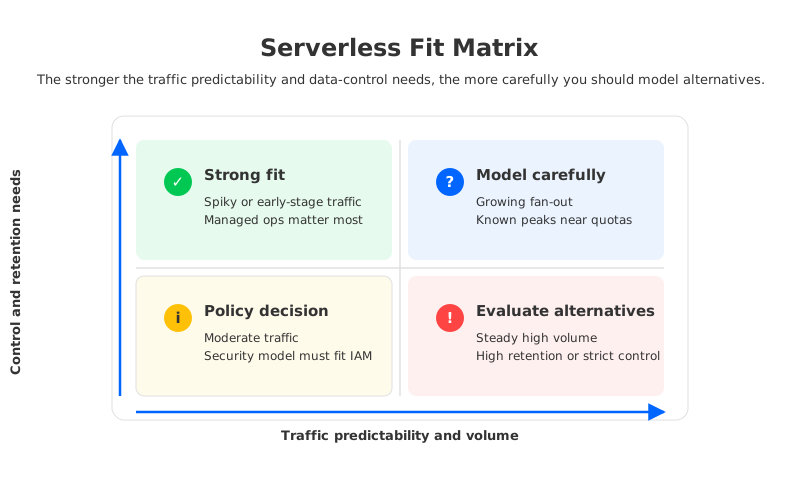
The fit is usually good when several of these are true:
- Traffic is spiky or early-stage, and provisioned capacity would sit underused for long periods.
- The team prefers managed Kafka-compatible APIs over low-level broker control.
- IAM-based access control fits the security model.
- Partition counts are moderate and tied to actual throughput needs.
- Retention windows are intentional rather than "keep everything because storage was already there."
- Consumer fan-out is known and can be measured through topic-level read metrics.
The fit becomes less clear when the workload is steady, large, read-heavy, long-retention, heavily regulated, or configuration-sensitive. Those traits do not disqualify MSK Serverless, but they do require cost and limit modeling before serverless becomes the default.
4When MSK Serverless cost becomes hard to predict
The difficult cases have one common feature: the bill follows application behavior more closely than infrastructure reservations. That is good when behavior is elastic and well understood. It is uncomfortable when small product or architecture changes multiply usage dimensions.
Consider a stream that starts with one producer and one consumer group. The team later adds alerting, Flink enrichment, search indexing, lakehouse ingestion, and an SRE debugging consumer. Producer volume may remain stable, but aggregate read volume changes. If the topic also increases retention and partitions, the model now includes higher data-out, higher storage, and more partition-hours.
The same pattern appears in multi-team platforms. One team owns the cluster bill; other teams make producer and consumer choices. Without per-topic and per-consumer-group observability, this becomes a showback problem before it becomes a technical problem.
| Signal to review | What it can indicate | Action |
|---|---|---|
BytesOutPerSec grows faster than BytesInPerSec | Read fan-out is becoming the dominant cost driver | Attribute reads by topic and consumer group. |
| Partition count grows faster than throughput | Topic design may be over-partitioned | Review partition sizing and inactive topics. |
| Retention settings drift upward | Kafka is becoming a replay or audit store | Separate replay requirements from convenience retention. |
| Throttling or lag appears during peaks | Quotas or per-partition limits may be binding | Check MSK Serverless quotas and partition distribution. |
| Network charges rise outside MSK line items | Traffic crosses Regions, internet, or other billed paths | Trace byte paths through AWS networking. |
This is why "is MSK Serverless expensive?" is the wrong first question. A better question is "Which usage dimension will dominate for this workload, and who controls that dimension?" If the answer is clear, MSK Serverless can be a clean operating model. If the answer is unclear, pricing can become a governance problem.
5Alternatives to MSK Serverless on AWS
The obvious alternative to MSK Serverless is MSK Provisioned. That can fit teams with steady traffic, mature capacity models, and more control needs. The less obvious alternative is not necessarily self-managed Kafka on EC2. For many teams, the more interesting question is whether Kafka can keep its protocol and ecosystem while changing the storage architecture underneath.
Traditional Kafka couples brokers tightly to local or attached storage. That model works, but scaling, recovery, and cost depend heavily on broker fleets and replicated disk. A shared-storage Kafka architecture separates compute from durable storage: brokers become more stateless, while durability moves to cloud object storage or another shared layer. The goal is to keep Kafka-compatible semantics while improving elasticity, recovery, and cost predictability.
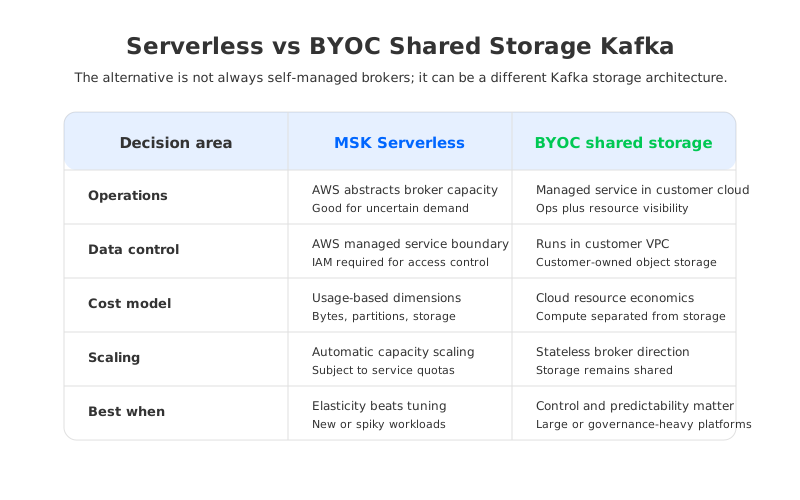
AutoMQ belongs in this category. It is a Kafka-compatible, cloud-native streaming platform that uses object storage as the storage foundation and offers a BYOC deployment model where the service runs in the customer's cloud account and VPC. AutoMQ's public BYOC page emphasizes that streaming data remains in customer-owned storage and that the deployment is designed for VPC-level data control. For teams evaluating MSK Serverless alternatives, the option is not only "managed serverless or self-managed brokers"; it can also be "managed operations with customer-side cloud resources and shared storage."
This kind of architecture is worth considering when the workload has one or more of these traits:
- The team needs Kafka compatibility but wants more predictable economics for large, steady workloads.
- Read fan-out and retention make usage-based serverless pricing harder to govern.
- Data control, VPC isolation, or customer-owned storage are important buying criteria.
- Elasticity matters, but the platform team still wants visibility into the underlying resource model.
- The organization is comparing Kafka options as part of a broader FinOps review rather than a one-off service launch.
Use MSK Serverless as the baseline for operational simplicity. Use MSK Provisioned as the baseline for AWS-native broker control. Use BYOC shared-storage Kafka, such as AutoMQ, as the baseline for separating Kafka-compatible compute from durable storage while keeping data in the customer's cloud environment. The right answer depends on which cost driver dominates: operations, reserved capacity, reads and partitions, storage retention, or network movement.
6A practical MSK Serverless pricing checklist
Before choosing MSK Serverless, build the estimate from workload facts rather than cluster intuition:
- Measure producer and consumer bytes per topic, including peak periods.
- Count partitions and identify topics with low traffic but high partition counts.
- Document retention requirements by topic and separate replay needs from convenience.
- Check MSK Serverless quotas for throughput, partitions, requests, connections, message size, and consumer groups.
- Trace network paths across Regions, public internet, and external systems.
- Decide who owns each cost driver: platform, application team, data team, or FinOps.
That last step is easy to skip. MSK Serverless can remove broker management, but it cannot remove the economics of bytes, partitions, retention, and reads.
If your team is comparing MSK Serverless with a Kafka-compatible BYOC/shared-storage architecture, review AutoMQ's BYOC model here: AutoMQ BYOC. Treat it as one comparison point in a disciplined cost model, especially if data control and predictable cloud storage economics are part of the decision.
7FAQ
7.1Is MSK Serverless expensive?
MSK Serverless is not inherently expensive or inexpensive. It charges by cluster-hours, partition-hours, data-in, data-out, and storage. It often fits spiky or uncertain workloads, but needs closer modeling for steady, high-volume, read-heavy, or long-retention workloads.
7.2What are the main MSK Serverless pricing dimensions?
The AWS pricing page lists hourly cluster charges, hourly partition charges, producer data-in, consumer data-out, and consumed storage. Also account for AWS data transfer when traffic moves to or from another Region or out to the public internet.
7.3Does MSK Serverless charge for partitions?
Yes. AWS describes an hourly rate for each partition created in an MSK Serverless cluster. That means partition count is both a Kafka design decision and a pricing input.
7.4How do consumer groups affect MSK Serverless cost?
Consumer groups can increase aggregate data-out. Kafka allows independent consumers to read the same topic for different purposes, but each read path should be included in the pricing model.
7.5What MSK Serverless limits should architects check?
Check the official MSK Serverless quota page for throughput, request rate, message size, fetch bytes, connections, consumer groups, partition counts, and serverless clusters per account. These quotas can affect both performance and design.
7.6When should I consider an alternative to MSK Serverless?
Consider alternatives when traffic is large and steady, read fan-out is high, retention is long, Kafka configuration control is important, data must stay in customer-owned storage, or FinOps needs more predictable resource mapping.
8References
- AWS, Amazon MSK pricing.
- AWS, What is MSK Serverless?.
- AWS, Amazon MSK quota.
- AWS, Configuration properties for MSK Serverless clusters.
- AWS, Monitor MSK Serverless clusters.
- AWS, Amazon EC2 On-Demand Pricing: Data Transfer.
- Apache Kafka, Official documentation.
- AutoMQ, BYOC Kafka: Fully Managed, Air-Gapped in Your VPC.


