
Table of Contents
Table of Contents
Teams searching for MSK Serverless vs Confluent Cloud are usually not asking whether Apache Kafka is useful. They already have producers, consumers, schemas, topics, and SRE scars. The real question is more specific: if Kafka operations are consuming too much platform time, which managed or serverless Kafka model reduces that work without creating a worse boundary around cost, networking, security, or data control?
That boundary matters because both products remove a large part of broker operations, but they do it from different positions. Amazon MSK Serverless is an AWS-native cluster type for Amazon Managed Streaming for Apache Kafka. Confluent Cloud is a fully managed data streaming platform with elastic Kafka cluster types, dedicated capacity options, and a broader ecosystem around connectors, governance, and stream processing. Both can be good answers. Neither is automatically right because it uses a serverless or fully managed operating model.
1Quick Answer by Priority
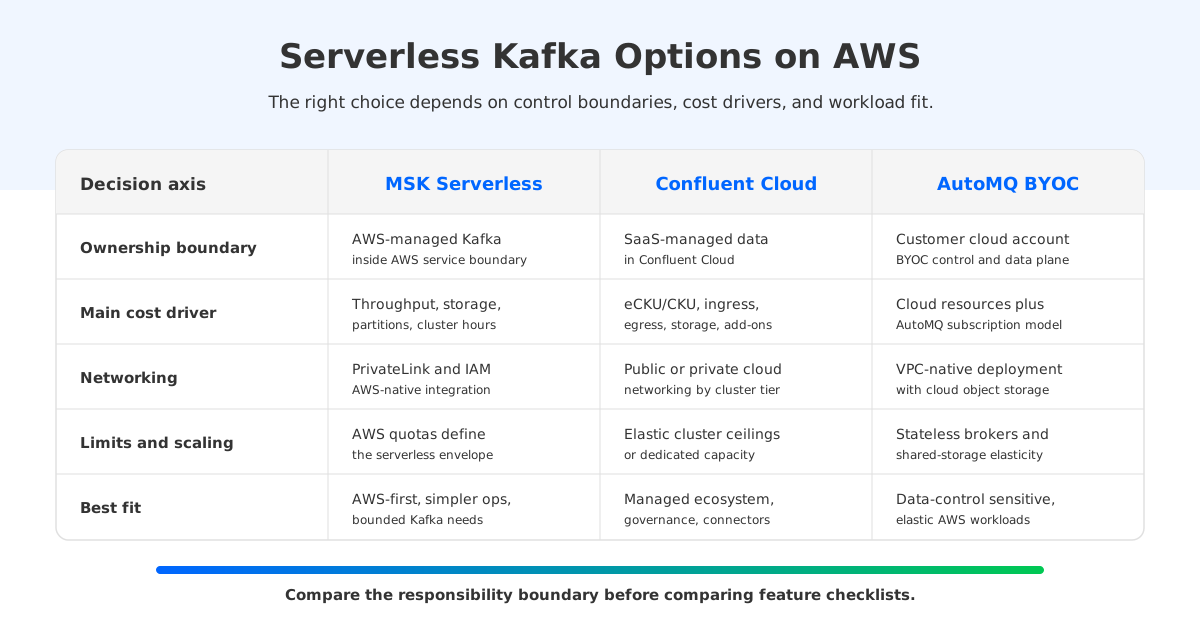
Choose MSK Serverless when the workload is AWS-first, Kafka requirements fit within MSK Serverless quotas, IAM-based access control is acceptable, and the platform team wants AWS-native private connectivity and billing. AWS describes MSK Serverless as automatically provisioning and scaling capacity, managing topic partitions, and using throughput-based pricing. AWS also documents specific service quotas and a required IAM access-control model.
Choose Confluent Cloud when the decision is less about AWS-native simplicity and more about the managed streaming platform around Kafka. Confluent Cloud offers Basic, Standard, Enterprise, Dedicated, and Freight Kafka cluster types. Elastic cluster types use Elastic Confluent Units for Kafka, while Dedicated clusters use Confluent Units for Kafka, so cost and networking must be reviewed by cluster type.
Consider a BYOC shared-storage Kafka architecture, such as AutoMQ, when the team wants to keep infrastructure and data in its own cloud account while reducing the operational weight of local-disk Kafka. This is not the same category as SaaS Kafka or AWS-owned serverless Kafka. The tradeoff is more cloud-account responsibility than in a pure SaaS service, with a clearer data boundary and a different cost structure.
| Priority | Stronger default fit | Why it matters |
|---|---|---|
| AWS-native operations | MSK Serverless | Runs as an AWS service with IAM, PrivateLink, AWS integrations, and AWS billing. |
| Managed Kafka ecosystem | Confluent Cloud | Adds managed connectors, governance, Flink, Cluster Linking, and multiple cluster types. |
| Data plane in your account | AutoMQ BYOC | Keeps Kafka-compatible infrastructure and storage in the customer's cloud environment. |
| Hard quota simplicity | It depends | MSK Serverless has explicit per-cluster quotas; Confluent has cluster-type ceilings and billing units. |
| Procurement simplicity | It depends | AWS-native billing may favor MSK; marketplace commitments or existing Confluent agreements may favor Confluent. |
These priorities often conflict. A security team may prefer data to remain in the company AWS account. A data platform team may prefer managed connectors and governance. A FinOps team may care more about the bill under spiky traffic, high fan-out reads, many partitions, or long retention. The right comparison starts with those constraints.
2Pricing and Cost Predictability
MSK Serverless pricing is easiest to reason about when your workload is bounded and AWS-native. AWS states that MSK Serverless uses a throughput-based pricing model. The public pricing page breaks serverless cost into dimensions such as cluster-hours, partition-hours, storage, and data in/out, which maps well to teams already measuring Kafka throughput, retention, and partition count.
The simplicity has a catch: serverless does not mean unlimited. AWS publishes per-cluster MSK Serverless quotas, including 200 MBps maximum ingress, 400 MBps maximum egress, 3,000 client connections, 15,000 requests per second, 500 consumer groups, 2,400 leader partitions for non-compacted topics, and 120 leader partitions for compacted topics. These numbers turn architecture discussion into a workload fit exercise. If you are near the ceiling, you need a plan before production traffic discovers the limit for you.
Confluent Cloud pricing is broader because Confluent Cloud is broader. Confluent's billing documentation describes a consumption-based model that includes data transferred, storage, compute units such as CKUs and eCKUs, and add-on services including connectors, ksqlDB, and Flink SQL. Basic, Standard, Enterprise, and Freight clusters use eCKUs that scale elastically up to a configured ceiling; Dedicated clusters use hourly CKU capacity.
The practical FinOps question is which dimensions are likely to surprise you:
- Ingress-heavy workloads make write volume the central driver. Check MSK Serverless data-in pricing and Confluent Kafka ingress billing.
- High fan-out workloads can be dominated by reads. Check egress, consumer read patterns, and whether downstream systems multiply KafkaNetworkRead.
- Long retention workloads shift attention to storage. Kafka retention is not expensive only because bytes sit somewhere; it is expensive because the platform has to preserve availability, reads, and operational recovery around those bytes.
- Connector-heavy workloads may favor Confluent Cloud if managed connectors reduce enough platform labor to offset their separate billing dimensions.
- Partition-heavy workloads need special care. Kafka partitions are the unit of parallelism, ordering, and leadership; managed services still need limits around them.
Apache Kafka's own documentation explains why partitions and replication sit at the heart of Kafka design: topics are split into partitions, consumers track offsets, and replicas provide fault tolerance. Managed services hide many broker tasks, but they do not erase Kafka's resource model.
3Data Control and Networking Boundary
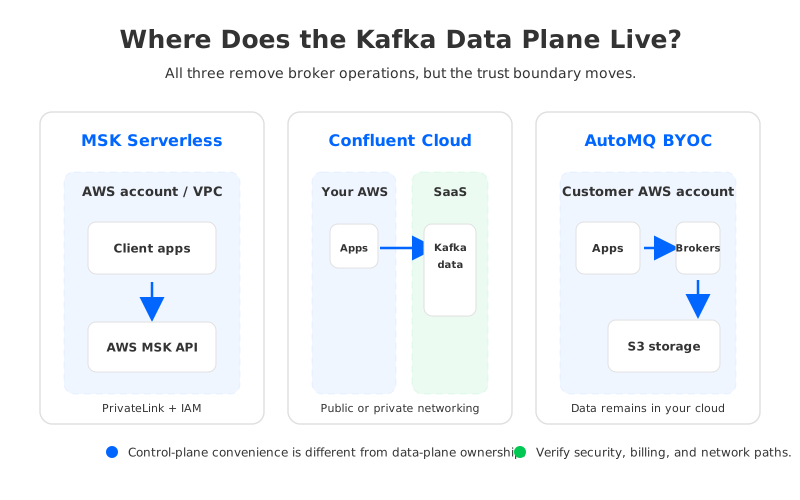
The cleanest way to compare MSK Serverless and Confluent Cloud is to draw the data plane boundary. MSK Serverless keeps the Kafka service inside the AWS service model. AWS documents integrations with AWS PrivateLink, IAM, AWS Glue Schema Registry, Amazon Managed Service for Apache Flink, and AWS Lambda. AWS also notes that MSK Serverless requires IAM access control and does not support Apache Kafka ACLs.
That IAM requirement is not a minor detail. For AWS-native applications, IAM may be exactly what the platform team wants: one identity model and a familiar security review path. For teams that rely heavily on Kafka ACL semantics or established non-AWS identity patterns, it may add migration work. Access control is part of the product boundary.
Confluent Cloud moves the managed data streaming platform into Confluent's cloud service boundary. It supports public and private networking options, but those options depend on cluster type and cloud provider design. Enterprise and Dedicated clusters are usually where private networking requirements become more relevant, while Basic and Standard are often evaluated for faster starts and lower operational friction.
For regulated workloads, the question becomes concrete:
| Boundary question | Why it changes the decision |
|---|---|
| Where is durable Kafka data stored? | Determines data residency, audit scope, and incident-response ownership. |
| Which identity system authorizes clients? | Affects client migration, least privilege, and security operations. |
| Does traffic leave the customer VPC? | Changes network cost, private connectivity design, and threat modeling. |
| Who can inspect operational metadata? | Matters for support, troubleshooting, and compliance review. |
| Which team owns quota and capacity requests? | Determines how fast the platform can respond to growth or incidents. |
If the security team treats "AWS service in our account boundary" differently from "SaaS provider operating the Kafka data plane," MSK Serverless may be easier to approve. If the organization standardizes on Confluent Cloud for governed data products, Confluent may be easier to operate across teams. If infrastructure and object storage must remain in the customer's account, BYOC becomes relevant.
4Features, Limits, and Ecosystem Services
MSK Serverless is intentionally focused. It aims to reduce the work of provisioning and scaling Kafka capacity on AWS without requiring a broader streaming platform adoption. AWS-native integrations cover many common needs: schema management with AWS Glue Schema Registry, stream processing with Amazon Managed Service for Apache Flink, and event processing with Lambda.
The tradeoff is that MSK Serverless should be evaluated against its quotas and feature boundaries. The documented per-cluster limits around throughput, connections, request rate, partitions, compacted topics, client VPCs, and serverless clusters per account are design inputs. A team with many small topics, heavy compaction, or thousands of ephemeral clients should test early.
Confluent Cloud's feature surface is wider. Cluster Linking, managed connectors, Schema Registry, Stream Governance, Flink, ksqlDB, audit logs, and multiple cluster classes can reduce the number of surrounding systems a platform team has to assemble. In many evaluations, the buyer is not buying "Kafka hosting" alone.
That broader ecosystem also means more dimensions to govern. Billing can include Kafka capacity, ingress, egress, storage, connectors, stream processing, governance, networking, support, and marketplace arrangements. Networking features may differ by cluster type. Serious evaluations should model the exact Confluent cluster type, not a generic Confluent logo.
5Migration and Operational Ownership
Migration is where "Kafka-compatible" needs careful interpretation. Kafka clients may use standard producer and consumer APIs, but a production migration also touches authentication, topic configuration, retention policy, schema registry, monitoring, quotas, network paths, and consumer offset behavior. Preserving data alone is not enough.
For MSK Serverless, migration work often centers on AWS identity, VPC connectivity, topic and quota fit, and client compatibility. IAM access control can simplify AWS-native authorization, but it can also require client configuration changes. The platform team still owns topic design, client behavior, and workload validation.
For Confluent Cloud, migration can be easier when the team wants the surrounding Confluent ecosystem. Cluster Linking and migration tooling can support phased moves, hybrid patterns, or cross-cluster data movement. The customer still owns application compatibility, governance policy, network configuration, and cost controls.
The most useful migration test is a rehearsal with representative traffic. Test peak ingress, peak egress, consumer lag recovery, topic creation rate, schema evolution, compaction if used, client reconnect storms, disaster recovery, and observability handoff. Managed Kafka can remove broker toil, but it cannot absorb an application design that was never measured under production-like load.
6AutoMQ as a BYOC Alternative
The MSK Serverless vs Confluent Cloud decision often gets framed as AWS service versus SaaS. That misses a third architecture: Kafka-compatible systems that separate compute from storage and run in the customer's cloud environment. AutoMQ fits this category. Its documentation describes AutoMQ as a Kafka-compatible streaming platform built on S3, with shared-storage architecture, stateless brokers, and BYOC deployment options on AWS.
This matters because traditional Kafka couples broker compute with local disk. Scaling brokers, reassigning partitions, and recovering replicas can become data-movement projects. A shared-storage design changes the mechanics: durable log data is backed by cloud object storage, while broker compute can become more elastic. AutoMQ's docs describe S3Stream shared storage, stateless broker behavior, second-level scaling, and compatibility with Apache Kafka APIs.
AutoMQ is not a universal replacement for either service. MSK Serverless may be simpler when your team wants AWS-native managed Kafka and fits within the documented limits. Confluent Cloud may be better when your team wants connectors, governance, and stream processing under one provider. AutoMQ becomes interesting when the requirements are: keep data in our cloud account, retain Kafka compatibility, reduce broker-storage coupling, and avoid turning Kafka operations into a permanent capacity-planning project.
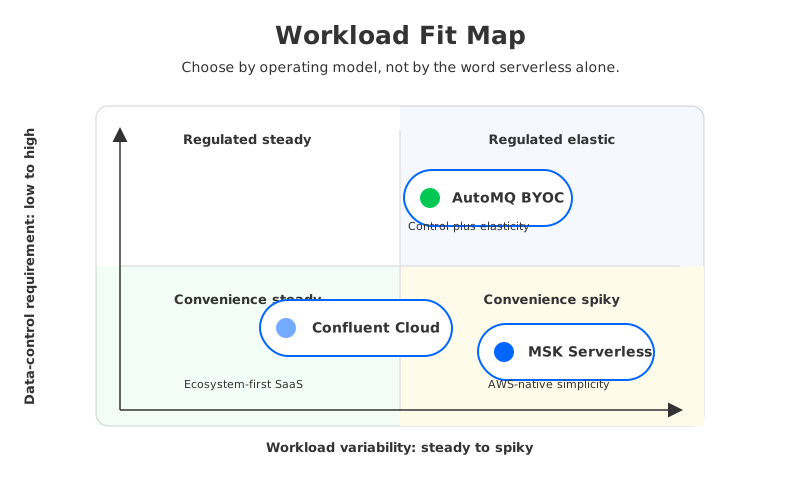
Evaluate AutoMQ the same way you should evaluate MSK Serverless and Confluent Cloud: test it against your traffic shape, operational constraints, and failure modes. The architecture is most relevant when object storage economics, data-plane ownership, and elastic compute matter more than adopting a fully external SaaS data plane.
7Workload-Based Recommendation
For small to medium AWS-native workloads with variable traffic, limited custom Kafka requirements, and comfort with IAM-based authorization, start with MSK Serverless. It gives you a low-operations AWS path, clear quotas, and direct integration with AWS services. The main due diligence is quota fit and cost modeling under read fan-out.
For platform teams building a company-wide streaming layer with many connectors, governance requirements, managed stream processing, and multi-environment standardization, evaluate Confluent Cloud carefully. The strongest case is not "serverless Kafka"; it is reducing the number of platform components your team has to operate. Model the exact cluster type, networking option, eCKU or CKU spend, and add-on services.
For teams that want a Kafka-compatible model while keeping the data plane in their own AWS environment, evaluate AutoMQ BYOC alongside the two managed options. This is especially relevant when local-disk Kafka scaling and cross-AZ data movement are pain points, but the organization is not comfortable moving the Kafka data plane fully into an external SaaS boundary.
The decision is not serverless versus not serverless. It is a choice among responsibility boundaries. Before committing, write down five answers: where data lives, who owns capacity, how cost scales, what limits apply, and how migration can be rolled back. That document will do more for production than any one-line vendor comparison.
If your AWS Kafka evaluation is already running into the data-control and cost-boundary problem, review AutoMQ's BYOC and shared-storage architecture in the AutoMQ documentation or explore the AutoMQ GitHub project. Treat it as a third design pattern to benchmark, not as a slogan to accept.
8FAQ
8.1Is MSK Serverless the same as Confluent Cloud serverless Kafka?
No. MSK Serverless is an Amazon MSK cluster type that automatically provisions and scales Kafka capacity within the AWS service model. Confluent Cloud is a fully managed data streaming platform with multiple Kafka cluster types, including elastic cluster types that use eCKUs and Dedicated clusters that use CKUs. They both reduce broker operations, but their ownership, billing, networking, and ecosystem boundaries differ.
8.2Does MSK Serverless support Kafka ACLs?
AWS documents that MSK Serverless requires IAM access control for all clusters and does not support Apache Kafka ACLs. That can be an advantage for AWS-native security models, but it should be checked early if your current Kafka environment relies heavily on Kafka ACLs.
8.3Which is more cost-effective: MSK Serverless or Confluent Cloud?
There is no universal answer. MSK Serverless pricing centers on serverless Kafka dimensions such as throughput, storage, partitions, and cluster hours. Confluent Cloud billing can include eCKUs or CKUs, ingress, egress, storage, connectors, governance, stream processing, and support-related dimensions. The more your workload depends on managed ecosystem services, the less useful a raw Kafka-only price comparison becomes.
8.4When should AutoMQ be considered instead of MSK Serverless or Confluent Cloud?
Consider AutoMQ when you want Kafka compatibility and cloud-native elasticity, but your security, compliance, or network design favors keeping the data plane in your own cloud account. AutoMQ's shared-storage architecture is a different tradeoff: more BYOC responsibility than SaaS, but more data-plane control than a provider-operated Kafka service.
8.5Can I migrate existing Kafka applications to these services without code changes?
Sometimes, but production migration is rarely only a client API question. Kafka-compatible clients help, yet you still need to validate authentication, networking, topic settings, schemas, offsets, quotas, monitoring, and failure behavior. Run a representative migration rehearsal before declaring any option drop-in compatible.
9References
- AWS: What is MSK Serverless?
- AWS: Amazon MSK quotas, including MSK Serverless quotas
- AWS: Amazon MSK pricing
- Confluent: Kafka cluster types in Confluent Cloud
- Confluent: Manage billing in Confluent Cloud
- Confluent: Confluent Cloud pricing
- Apache Kafka documentation
- AutoMQ Cloud overview
- AutoMQ architecture overview
- AutoMQ S3Stream shared storage overview
- AutoMQ migration overview


