
Table of Contents
Table of Contents
Kafka teams rarely ask for “serverless” because they dislike brokers as an abstract concept. They ask because capacity planning has become a tax on every new event stream: instance sizing, disk growth, partition movement, rolling changes, storage alarms, consumer spikes, and the uncomfortable moment when a low-traffic cluster still has to be provisioned like production infrastructure. MSK Serverless changes that conversation, but it does not turn Kafka into a magic queue with no design constraints.
The useful way to compare MSK Serverless vs Kafka is not “managed vs self-managed.” Amazon MSK provisioned clusters are already managed in meaningful ways. The sharper question is: which Kafka responsibilities move from your team to AWS, which responsibilities remain yours, and which constraints become less visible until cost, quotas, or client behavior expose them?
1Is MSK Serverless Still Kafka?
Yes, with an important boundary. AWS describes MSK Serverless as a cluster type for Amazon MSK that lets you run Apache Kafka without managing and scaling cluster capacity. The same AWS documentation says it is compatible with Apache Kafka clients, so producer and consumer applications can use Kafka APIs rather than a service-specific event interface. That matters for teams with Kafka Connect, Flink, Spark, Debezium, Kafka Streams, custom producers, and operational tooling already built around Kafka semantics.
Kafka compatibility does not mean every operational assumption remains the same. Apache Kafka’s own model is built around topics split into partitions, ordered records within a partition, consumers that track offsets, and replication for fault tolerance. Those concepts still shape application behavior in MSK Serverless. Ordering remains partition-scoped, consumer parallelism still follows partitioning strategy, hot keys can still create hot partitions, and retention still determines how long data is available for replay.
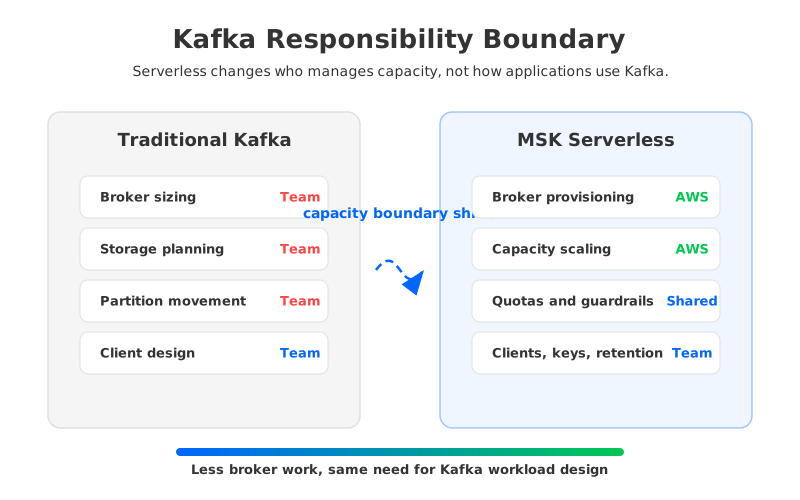
The difference is where the control plane boundary sits. In traditional Kafka, your platform team sizes brokers, assigns storage, chooses instance families, monitors disk utilization, and plans partition reassignment when cluster topology changes. In MSK Serverless, AWS hides broker provisioning and capacity scaling behind a service abstraction. You still design topics, partitions, producers, consumers, IAM access, VPC connectivity, observability, and cost controls.
That distinction is easy to miss because “serverless Kafka” sounds like Kafka with the infrastructure removed. A more precise description is Kafka APIs with a serverless capacity model and AWS-defined guardrails.
2What Serverless Changes For Operations
The biggest operational change is the disappearance of broker sizing as a first-order user workflow. In a provisioned Kafka cluster, capacity decisions are concrete: how many brokers, which instance type, how much attached storage, how much headroom, and how quickly the team can add capacity when traffic changes. Those choices are visible but heavy. They create predictable infrastructure boundaries, and they also create over-provisioning when traffic is spiky or uncertain.
MSK Serverless moves much of that work into AWS. AWS automatically provisions and scales capacity, manages partitions in the topic, and exposes a throughput-based pricing model. For teams whose biggest pain is right-sizing clusters for irregular workloads, that is a real simplification. A development platform, event-driven application backend, or early-stage data product can avoid a long broker-sizing exercise before the workload has stable traffic.
The operational model also changes the kind of incidents you prepare for. Traditional Kafka teams watch broker disk, under-replicated partitions, leader balance, controller health, network saturation, and storage throughput. MSK Serverless teams still need Kafka application telemetry, but the most important questions shift:
- Are producers receiving throttling responses because cluster-level or partition-level throughput quotas are being hit?
- Are topics and partitions designed for the service quotas documented by AWS?
- Are IAM authentication, PrivateLink, security groups, and client VPC limits aligned with the application topology?
- Are cost alerts tracking cluster-hours, partition-hours, data in, data out, and storage consumption?
This is not a smaller version of the same runbook. It is a different runbook. You spend less time maintaining brokers and more time managing the contract between Kafka clients and a service with fixed published quotas.
3What Does Not Disappear
Serverless removes a set of infrastructure decisions, but it does not remove Kafka architecture. The most expensive mistakes in Kafka usually start above the broker layer: too many partitions created for future parallelism, keys that concentrate traffic, consumers that cannot keep up, retention policies that turn streams into accidental archives, and teams that treat Kafka as an infinite replay buffer without modeling storage and reads.
In MSK Serverless, those mistakes are still possible. They show up through quota pressure, throttling, partition-hour charges, data transfer charges, or client-side latency. The service is easier to start, but it still rewards teams that understand Kafka’s core mechanics.
3.1Cost Modeling
The MSK Serverless cost model is not the same as buying a fixed broker fleet. AWS states that MSK Serverless pricing includes an hourly rate for the serverless cluster, an hourly rate for each partition, charges for producer writes and consumer reads in GB, and consumed storage. AWS also notes that standard AWS data transfer charges apply for data transferred to or from another region and out to the public internet.
That means “pay only for what you use” needs a workload-specific interpretation. Low-throughput workloads with many partitions may be dominated by cluster-hours and partition-hours. High fan-out workloads may be shaped by read volume. Long retention increases storage. Multi-region or public internet paths can introduce additional data transfer considerations outside the Kafka API itself.
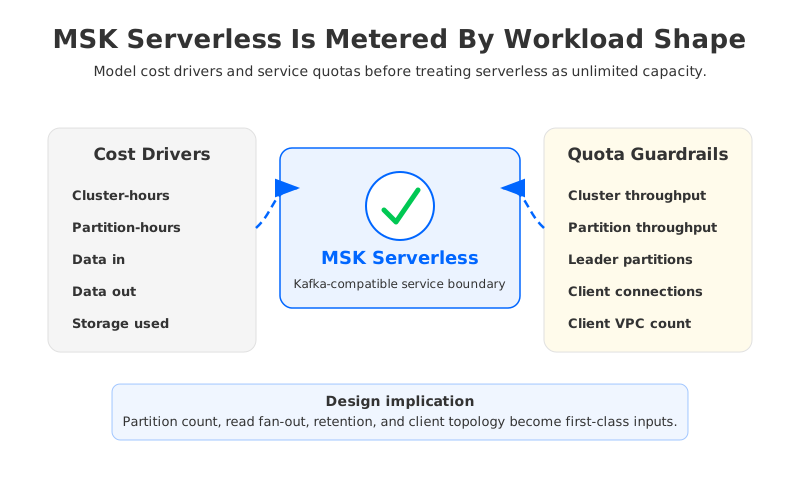
For FinOps teams, the practical model is:
| Cost driver | Why it matters | Design question |
|---|---|---|
| Cluster-hours | A serverless cluster still has an hourly cluster charge. | How many environments and always-on clusters are necessary? |
| Partition-hours | Partitions are a direct pricing dimension. | Are partition counts based on measured parallelism or habit? |
| Data in and data out | Writes and reads are metered separately. | What is the read fan-out per produced GB? |
| Storage consumed | Retention turns into a storage bill. | Is Kafka the right retention layer for this data? |
| Data transfer | Some network paths follow standard AWS data transfer rules. | Are clients, processors, and sinks placed to avoid avoidable transfer? |
The table is not an argument against MSK Serverless. It is the discipline needed to use it well. Serverless pricing is often attractive when demand is variable and the alternative is idle broker capacity. It becomes less predictable when partition counts, fan-out, or retention grow without ownership.
3.2Limits And Quotas
AWS publishes MSK Serverless quotas, and they should be treated as architecture inputs, not footnotes. As checked on May 27, 2026, the AWS quota page lists per-cluster limits including maximum ingress throughput, maximum egress throughput, maximum client connections, maximum request rate, maximum message size, maximum consumer groups, maximum leader partitions, partition creation and deletion rate, per-partition ingress and egress throughput, compacted-topic partition size, client VPCs per serverless cluster, and serverless clusters per account.
Some of those limits may be adjustable through AWS support, and some are hard service behavior. Either way, they change capacity planning. In provisioned Kafka, a team can often add brokers, change broker types, alter storage throughput, or redesign the cluster topology. In MSK Serverless, the service boundary is more abstract, so the planning unit becomes quota headroom rather than broker headroom.
This is where partition design becomes more important, not less. A single hot partition can hit per-partition throughput limits even when the cluster is not near its aggregate limit. A large number of small topics can create partition-hour cost and topic-management pressure. A compacted topic has its own constraints. A high-churn platform that creates and deletes topics dynamically needs to check the API and partition operation rates before assuming serverless will absorb the pattern.
3.3Client And Networking Design
MSK Serverless integrates with AWS PrivateLink, IAM access control, AWS Glue Schema Registry, Amazon Managed Service for Apache Flink, and AWS Lambda. Those integrations are useful, but they also make the architecture more AWS-native. AWS documentation states that MSK Serverless requires IAM access control for all clusters and does not support Apache Kafka ACLs. For teams standardized on Kafka ACLs, SCRAM, mTLS, or multi-cloud identity patterns, this is not a small implementation detail.
Networking deserves the same attention. Kafka clients are long-lived, connection-heavy, and sensitive to bootstrap configuration, DNS, security groups, and retry behavior. Serverless does not erase those facts. If clients live in several VPCs, accounts, or regions, the PrivateLink and client VPC model must be reviewed early. If consumers run in Lambda or Flink, the service integration may simplify wiring, but the application still needs clear backpressure, retry, and replay behavior.
The cleanest MSK Serverless deployments are usually not the ones with the fewest Kafka concepts. They are the ones where application teams understand which Kafka concepts are now hidden by AWS and which are still part of their application contract.
4MSK Serverless vs AutoMQ
Once a team separates “Kafka API compatibility” from “who owns capacity and storage,” another option enters the evaluation: Kafka-compatible systems that change Kafka’s storage architecture rather than only hiding broker capacity. AutoMQ belongs in that category. It is a Kafka-compatible streaming platform that uses shared storage backed by object storage and makes brokers more stateless by moving durable log storage away from broker-local disks.
This is not the same tradeoff as MSK Serverless. MSK Serverless is an AWS-managed Kafka service where AWS owns the capacity abstraction and defines the service quotas. AutoMQ is a Kafka-compatible architecture aimed at cloud-native elasticity, shared storage, and BYOC-style data control. In AutoMQ BYOC deployments, the infrastructure and data can run in the customer’s cloud environment while AutoMQ provides the Kafka-compatible control and operational model.
The practical difference is responsibility shape. MSK Serverless is attractive when a team wants AWS to remove broker operations from the critical path and is comfortable with AWS-native authentication, regional availability, and published service quotas. AutoMQ is more relevant when the team wants Kafka compatibility but also wants the storage model, data placement, cloud account ownership, or cost structure to remain under its own architectural control.
| Requirement | MSK Serverless | Traditional Kafka | AutoMQ |
|---|---|---|---|
| Kafka client compatibility | Kafka-compatible clients | Native Apache Kafka | Kafka-compatible clients |
| Broker capacity management | Abstracted by AWS | Owned by the platform team | Reduced through shared-storage architecture |
| Data/control ownership | AWS-managed service boundary | Customer-owned infrastructure | BYOC and customer cloud options |
| Scaling model | Service-managed within quotas | Broker and partition operations | Stateless broker and shared-storage oriented |
| Best fit | AWS-native teams reducing broker ops | Teams needing full Kafka control | Teams evaluating Kafka-compatible elasticity with data control |
AutoMQ should not be framed as “MSK Serverless but elsewhere.” The stronger comparison is architectural: MSK Serverless changes the operating model around Kafka; AutoMQ changes the storage and elasticity model while keeping Kafka compatibility as the developer-facing contract.
5Which Option Fits Your Workload?
The right choice depends less on whether “serverless” sounds appealing and more on what your workload is trying to optimize. A small team running an AWS-native application with uncertain throughput may get real leverage from MSK Serverless because it avoids early broker sizing and reduces operational surface area. A heavily regulated platform with custom security controls, high partition counts, strict data residency, or multi-cloud requirements may find the service boundary too constraining.
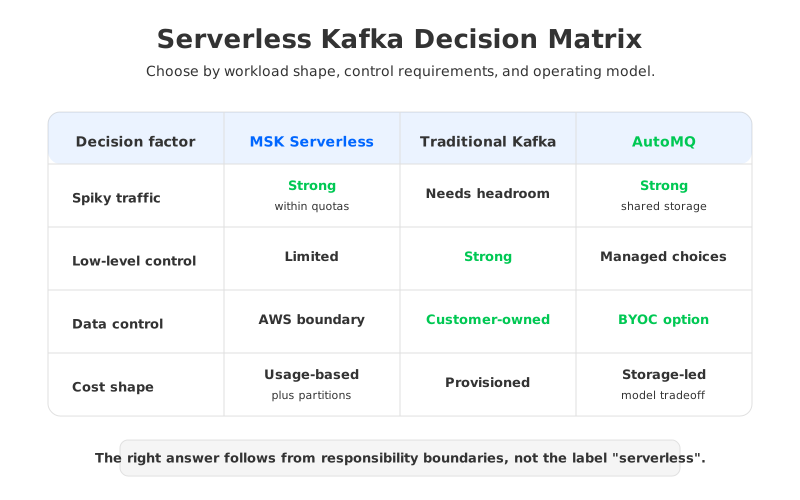
Use MSK Serverless when most of these are true: the workload runs primarily in AWS, traffic is variable, the team prefers IAM-based access control, partition counts fit published quotas, and the value of reduced broker operations outweighs the need for low-level Kafka control.
Use traditional Kafka or MSK provisioned when predictable high utilization, specialized broker tuning, strict compatibility with Kafka-native security features, or explicit control over instance and storage choices matters more than operational abstraction.
Evaluate AutoMQ when Kafka compatibility is required but the business problem is broader than broker management: elastic scaling, shared storage, BYOC deployment, data control, and cost structure are part of the architectural decision. That tends to matter for platform teams supporting many internal tenants, FinOps teams trying to reduce over-provisioning, and CTO-level evaluations where Kafka is a long-term infrastructure layer rather than a single managed service choice.
The important move is to model Kafka as a set of responsibility boundaries. Serverless moves some boundaries to AWS. Shared-storage Kafka moves different boundaries into the storage architecture. Self-managed Kafka keeps most boundaries under your team. None of these is universally better; each makes a different class of tradeoff explicit.
If your evaluation has moved from “Can we avoid broker operations?” to “What Kafka architecture gives us the right balance of elasticity, data control, and cost governance?”, review the AutoMQ architecture docs or talk with the team through AutoMQ Cloud.
6References
- AWS: What is MSK Serverless?
- AWS: Amazon MSK quota, including MSK Serverless quota
- AWS: Amazon MSK pricing
- Apache Kafka documentation
- AutoMQ documentation: Architecture overview
- AutoMQ documentation: Compatibility with Apache Kafka
- AutoMQ website
7FAQ
7.1Is MSK Serverless real Kafka?
MSK Serverless exposes Kafka-compatible client behavior and is documented by AWS as fully compatible with Apache Kafka clients. It is still a managed AWS service, so authentication, quotas, operations, and supported configurations follow the MSK Serverless service model rather than a self-managed Kafka cluster model.
7.2Is MSK Serverless lower cost than Kafka?
It depends on workload shape. MSK Serverless can reduce idle over-provisioning for variable workloads, but its bill includes cluster-hours, partition-hours, data in, data out, and storage. Traditional Kafka cost is driven by brokers, storage, operations, and data transfer. Model both with your partition count, retention, write volume, read fan-out, and environment count.
7.3What Kafka responsibilities remain with my team?
Your team still owns topic and partition design, producer and consumer behavior, key distribution, retention policies, security integration, networking, monitoring, and cost governance. AWS takes on broker provisioning and capacity scaling within the MSK Serverless service boundary.
7.4When should I not use MSK Serverless?
Be cautious when you need Kafka-native ACLs, deep broker tuning, very high or unusual partition patterns, multi-cloud portability, custom network topology, or requirements that exceed published MSK Serverless quotas. Those needs may point toward MSK provisioned, self-managed Kafka, or a Kafka-compatible alternative.
7.5How is AutoMQ different from MSK Serverless?
MSK Serverless is an AWS-managed serverless cluster type for Kafka workloads. AutoMQ is a Kafka-compatible platform with a shared-storage architecture backed by object storage and BYOC deployment options. The comparison is not one-for-one; it is a tradeoff between AWS-managed abstraction and a Kafka-compatible architecture designed around storage-compute separation and customer-controlled environments.


