
Table of Contents
Table of Contents
When teams search for MSK Cost, they are usually past the question of whether Kafka is useful. The harder question is whether the architecture they are about to fund will keep making sense after traffic, retention, availability requirements, and audit pressure grow. A small cluster can look predictable on a pricing page. A production streaming platform is different: storage grows every hour, throughput arrives in uneven bursts, replicas move data across failure domains, and consumer fan-out can turn a write workload into a network workload.
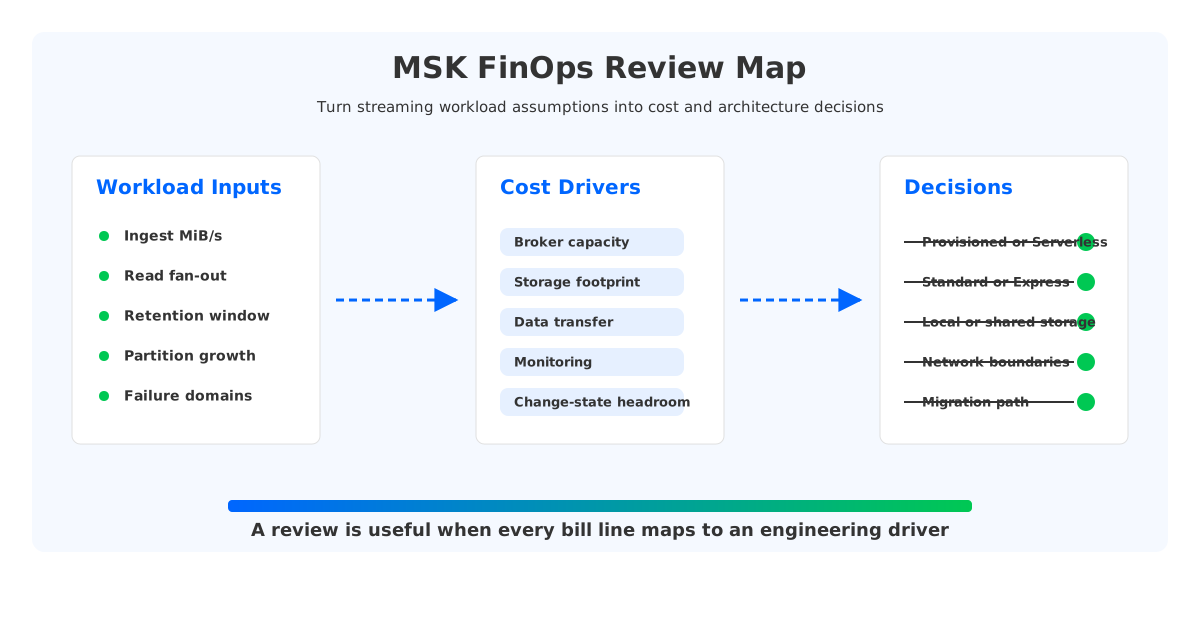
That is why a FinOps review for Amazon Managed Streaming for Apache Kafka should not start with a single broker-hour estimate. Amazon MSK is a managed service that runs open-source Apache Kafka and handles many control-plane operations, but the bill still reflects architectural choices: broker type, number of brokers, storage, partition count, data transfer, monitoring, and the way applications read and write. A useful review turns those choices into a workload model that platform, finance, and application teams can all inspect.
1Why MSK Cost Is Really a Planning Question
The phrase looks financial, but the intent is architectural. A buyer looking at MSK cost is trying to decide how much Kafka capacity to reserve, which deployment option fits the workload, and whether the operating model will remain manageable under production growth. AWS documents MSK Provisioned as a deployment option where teams choose instance types, storage volumes for Standard brokers, and the number of broker nodes. That control is useful, but it also means cost planning depends on workload assumptions rather than a single service toggle.
The first assumption is write throughput. Kafka durability is more than bytes in; it is bytes written to leaders, replicated to followers, retained on disk or remote storage, indexed, fetched, and sometimes rebalanced. The second assumption is read fan-out. A topic with one consumer group behaves differently from a topic with analytics, fraud detection, search indexing, CDC, and monitoring consumers all reading the same data. The third assumption is retention. A team keeping 24 hours of data is buying a different storage system from a team keeping 14 days for replay and audit.
FinOps reviews become noisy when those inputs are mixed together. A broker-size debate hides retention. A retention debate hides cross-AZ data transfer. A data-transfer debate hides producer compression and consumer locality. The practical move is to separate the inputs before pricing any option:
- Ingest rate and peak ratio. Model sustained MiB/s and peak MiB/s separately. Kafka clusters are usually sized for peaks, while storage grows with sustained volume.
- Replication and availability model. Replication factor, minimum in-sync replicas, and Availability Zone placement define both resilience and duplicated traffic.
- Retention and replay behavior. Retention is not only capacity. Long replay windows can create catch-up traffic, page cache pressure, and storage throughput needs.
- Consumer fan-out. A cost model that prices only producer writes will understate workloads where reads are the dominant source of throughput.
- Operational change rate. Topic growth, partition growth, rebalances, broker replacement, and version upgrades all affect the capacity buffer a team needs.
This framing also keeps the review fair. MSK is not “expensive” or “cost-effective” in isolation. It is one way to run Kafka on AWS, with managed operations and several deployment choices. The cost question is whether those choices match the workload’s storage and throughput shape.
2The Workload Inputs Most Cost Pages Miss
Pricing pages are necessary, but they compress reality. They show the chargeable dimensions, not the reason your workload consumes them. A production Kafka platform owner needs a worksheet that finance can understand and engineers can defend.
| Input | What to collect | Why it changes cost |
|---|---|---|
| Ingest throughput | Average, p95, and peak MiB/s by topic group | Drives broker sizing, storage write load, and replication traffic |
| Read throughput | Number of consumer groups and replay patterns | Can exceed ingest when many downstream systems consume the same data |
| Retention | Hours or days per topic class | Determines storage footprint and recovery/replay expectations |
| Partition count | Current and 12-month projection | Affects broker metadata, file handles, balancing, and operational headroom |
| Failure-domain policy | AZ count, replication factor, min ISR | Defines the amount of duplicated data and recovery behavior |
| Network path | Same VPC, cross-AZ, cross-VPC, PrivateLink, cross-region | Moves cost from compute/storage into data transfer and endpoint processing |
The worksheet should separate steady-state and change-state cost. Steady state covers normal writes, reads, retention, monitoring, and broker hours. Change state covers broker replacement, storage expansion, partition reassignment, backfills, and disaster recovery tests. Many budget surprises show up during change-state operations because a cluster sized for daily traffic may still need extra headroom when it is copying partitions or serving a large replay.
The most common mistake is treating retention as a pure storage line item. Longer retention gives teams more replay safety, but it also changes how much data may be scanned during backfills and how large the recovery surface becomes after a broker or disk event. Apache Kafka's tiered storage work exists because local broker disks alone are a limiting abstraction for long retention and elastic storage growth; teams still need to understand how local and remote tiers interact with their workload.
3Architecture Choices That Move the Cost Curve
Once the workload model exists, the next review is architectural. The same business requirement can map to different Kafka operating models, and each model exposes a different cost curve.
MSK Provisioned gives teams control over broker count, broker type, storage, and cluster configuration. That control is attractive for known workloads and strict configuration requirements. It also means the team owns the sizing model. Under-size and the platform becomes unstable; over-size and the bill carries idle headroom.
MSK Serverless shifts more capacity management to AWS. That can be useful for variable workloads, but the review still needs throughput, partition, and quota checks. Serverless removes some provisioning decisions; it does not remove the need to model data volume, read patterns, security boundaries, and integration cost.
MSK Express, where appropriate, is another path inside MSK Provisioned. It changes the broker choice and performance profile, so the review should test it against workload requirements rather than treating it as a generic replacement for every Standard-broker cluster. The right comparison is a workload replay: the same ingest, reads, partitions, retention, security model, and failure testing across the options being considered.
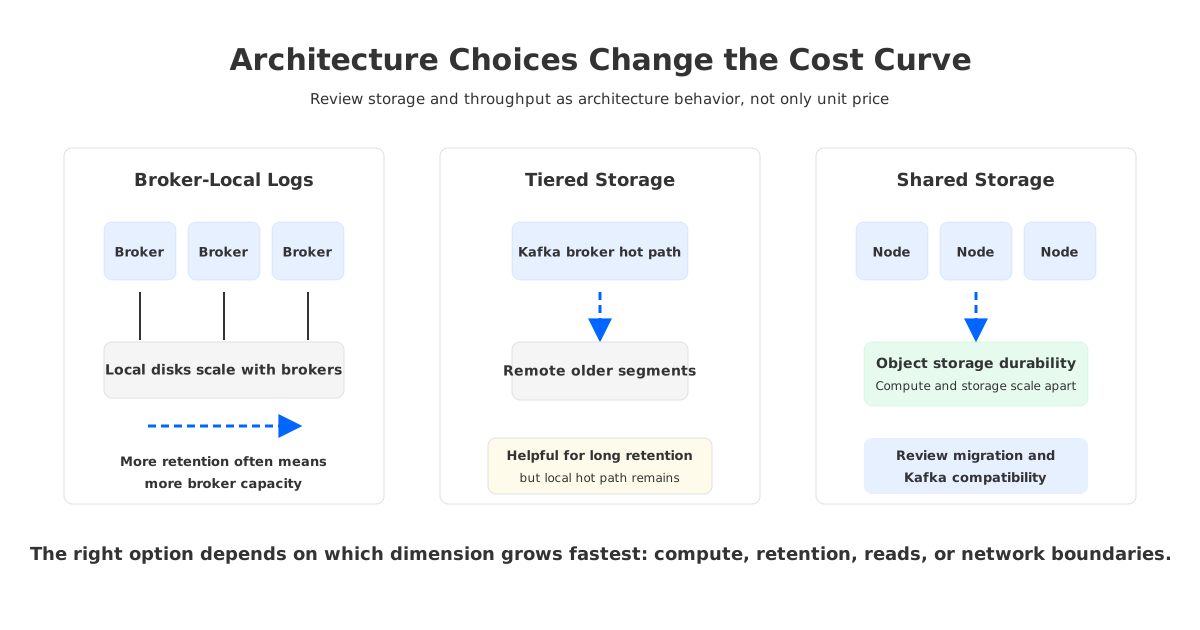
The deeper architectural divide is whether the Kafka broker remains tightly coupled to local persistent storage. Traditional Kafka's broker-local log design is mature and well understood, but it makes storage and compute scale together. If retention grows, brokers carry more storage. If throughput grows, brokers carry more compute and network. If one dimension grows faster than the other, the platform may buy capacity it does not fully use.
Tiered storage and shared-storage architectures both respond to that pressure, but they are not the same thing. Tiered storage keeps Kafka's local log model while offloading older segments to remote storage. A shared-storage Kafka-compatible architecture goes further by making object storage the durable storage layer and keeping brokers more focused on compute, cache, and protocol serving. The FinOps question is not which phrase sounds better; it is which failure mode and scaling model the team wants to operate.
4Network Cost Belongs in the Same Review
Network is where Kafka cost reviews often become uncomfortable. Replication, consumer reads, PrivateLink, cross-VPC access, and cross-region replication can all be legitimate design choices. They also sit outside a broker-hour estimate. AWS publishes separate pricing pages for EC2 data transfer, S3, and PrivateLink because these are distinct metered services, and Kafka deployments can touch several of them at once.
For MSK reviews, classify network traffic by cause rather than by bill label:
- Durability traffic is data copied for replication and recovery. It is tied to replication factor, broker placement, and failure-domain design.
- Application traffic is producer and consumer movement. It depends on where applications run relative to brokers and how many systems read each topic.
- Operational traffic appears during rebalancing, broker replacement, migration, backfill, and disaster recovery testing.
- Access-boundary traffic comes from cross-VPC, PrivateLink, or cross-region designs that are chosen for organizational or security reasons.
This classification prevents two bad outcomes. The first is false optimization, where a team cuts cost by weakening availability or making application placement brittle. The second is blind spending, where every data-transfer charge is accepted as inevitable because no one can connect it to a design decision. A good review keeps availability goals intact while asking whether the architecture sends data across paid boundaries more often than the workload requires.
5A FinOps Review Should Score Operations, Not Only Unit Price
The lowest unit price is not always the lowest platform cost. Kafka clusters need upgrades, monitoring, quota management, access control, incident response, partition planning, client compatibility checks, and migration procedures. A FinOps review that excludes these areas will approve an architecture that looks clean in a spreadsheet and then becomes costly in engineering time.
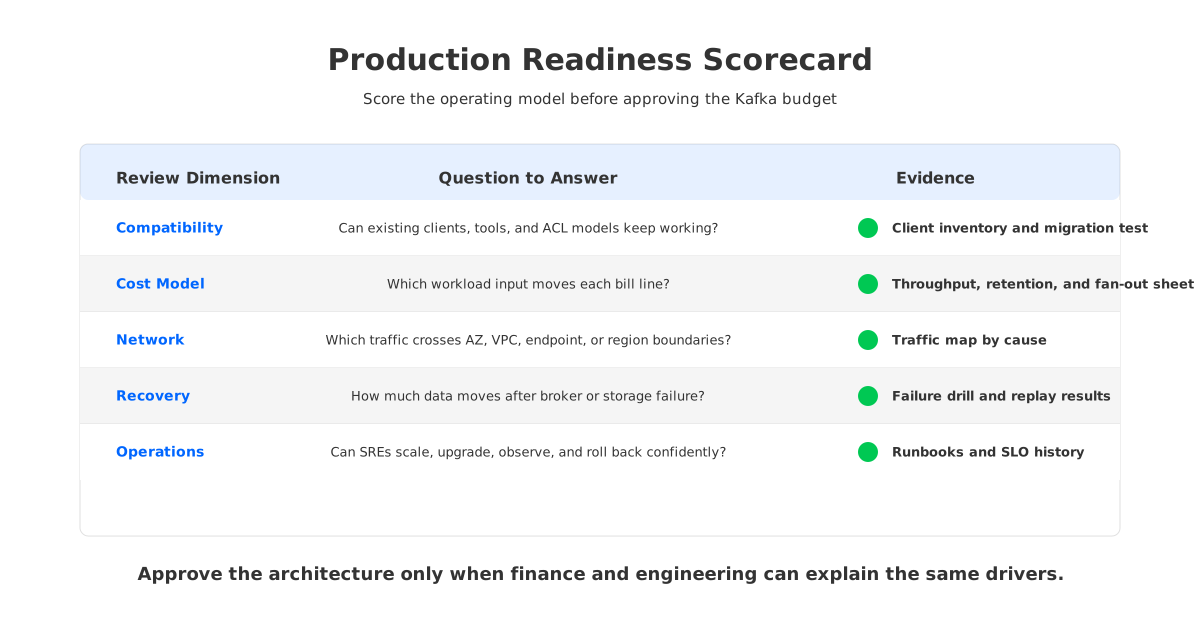
Use a scorecard that combines financial and operational questions. Can the team scale storage without scaling compute at the same rate? Can it absorb a broker replacement without a long partition-copy storm? Are client applications using standard Kafka APIs that keep migration paths open? Can finance map each bill line to an engineering driver?
The answer does not have to be perfect. It has to be explicit. A team may choose MSK Provisioned because managed Kafka operations and AWS-native integration matter more than storage/compute decoupling. Another team may choose a Kafka-compatible shared-storage architecture because retention grows faster than throughput and cross-AZ replication traffic is a recurring cost concern. A third team may run more than one model for different workload classes. The scorecard makes those choices visible.
6Where AutoMQ Fits the Evaluation
After the review has separated workload inputs, network paths, and operational risk, AutoMQ becomes relevant as an architectural option rather than a slogan. AutoMQ is a Kafka-compatible streaming system that uses a shared-storage design with object storage as the durable layer. Its architecture is aimed at teams that want Kafka protocol compatibility while reducing the coupling between broker compute and persistent storage.
That matters for FinOps because the major cost levers in Kafka are rarely isolated. Storage retention affects broker sizing. Broker sizing affects operational headroom. Replication affects network traffic. Recovery affects the amount of data that must move after failure. A shared-storage model changes those relationships: brokers can be treated more like stateless compute nodes, object storage handles durable data, and the platform can scale compute and storage more independently.
AutoMQ should be evaluated with the same worksheet used for MSK:
- Does the workload rely on Kafka clients, Kafka Connect, Flink, or tooling that requires protocol compatibility?
- Is the cost pressure driven by retention, cross-AZ traffic, read fan-out, or underused broker capacity?
- Does the organization want BYOC-style control, self-managed software, or a managed service boundary?
- How will the team test migration, rollback, configuration compatibility, ACLs, observability, and recovery?
The respectful comparison is mechanism to mechanism. MSK reduces the operational burden of running Apache Kafka on AWS. AutoMQ changes the storage architecture while preserving Kafka-compatible access patterns. Both can be reasonable choices; the right one depends on whether the review is optimizing for managed Kafka continuity, storage/compute separation, network-cost control, or migration flexibility.
7A Practical Review Sequence
Run the review in this order, because each step narrows the next one. First, group topics by workload class rather than by application owner. High-ingest short-retention topics, audit topics, replay-heavy topics, and low-volume control topics should not share the same assumptions. Second, model writes, reads, retention, and partitions for each class. Third, map network boundaries and identify which traffic exists for availability, application consumption, or organizational topology.
Only then compare deployment options. For each option, document the broker or compute model, storage model, scaling unit, network implications, migration work, and operating responsibilities. Finance gets a cost model; engineering gets a design review; procurement gets an explanation of why the selected architecture fits the workload.
The final artifact should be short enough to survive an executive review and detailed enough to survive an incident review. If the cluster grows 3x, which line moves first? If retention doubles, what gets re-sized? If a broker fails, how much data moves? These questions turn MSK Cost from a search query into a platform decision.
If your team is reviewing MSK cost and wants to test a Kafka-compatible shared-storage option against the same workload model, the next useful step is a concrete architecture and cost walkthrough. You can contact AutoMQ with your workload assumptions at automq.com/contact and compare the trade-offs before committing the operating model.
8References
- Amazon MSK pricing
- Amazon MSK Developer Guide: What is Amazon MSK?
- Amazon MSK Developer Guide: What is MSK Provisioned?
- Amazon EC2 data transfer and network bandwidth documentation
- Amazon S3 pricing
- Apache Kafka documentation: Tiered Storage
- AutoMQ documentation: What is AutoMQ?
- AutoMQ documentation: Architecture overview
9FAQ
9.1Is MSK cost mostly broker cost?
No. Broker cost is visible, but production cost also includes storage, monitoring, data transfer, access patterns, operational headroom, and change-state events such as rebalancing or migration. A useful model separates those drivers before comparing options.
9.2Should every MSK workload use Serverless?
Not necessarily. Serverless can reduce capacity-planning work for some variable workloads, while Provisioned gives teams more direct infrastructure control. The right choice depends on throughput, partition count, quotas, retention, security boundaries, and the level of operational control required.
9.3Why include network cost in a storage and throughput review?
Kafka moves data for replication, producer writes, consumer reads, recovery, and migration. Those flows often cross Availability Zone, VPC, endpoint, or regional boundaries. Network cost is therefore a design outcome, not a separate accounting detail.
9.4How is shared-storage Kafka different from Kafka tiered storage?
Tiered storage generally keeps the local broker log as the primary hot path and offloads older segments to remote storage. A shared-storage Kafka-compatible architecture makes object storage the durable storage layer and uses brokers more as compute, cache, and protocol-serving nodes. The operational and scaling implications are different, so they should be reviewed separately.
9.5When should AutoMQ enter the evaluation?
AutoMQ is most relevant after the team has modeled workload inputs and identified whether storage growth, cross-AZ traffic, recovery behavior, or coupled compute/storage scaling is a major concern. At that point, it can be evaluated as a Kafka-compatible shared-storage alternative using the same scorecard as MSK.


