
Table of Contents
Table of Contents
Title: MSK vs Confluent Cloud: Which Managed Kafka Option Makes Sense on AWS?
Description: Compare Amazon MSK and Confluent Cloud for AWS teams across pricing, data control, networking, operations, ecosystem features, scaling architecture, and alternatives such as AutoMQ.
Keywords: msk vs confluent, amazon msk vs confluent, aws msk vs confluent, confluent cloud vs msk, msk confluent
User Search Queries:
- msk vs confluent
- amazon msk vs confluent
- aws msk vs confluent
- confluent cloud vs msk
- MSK or Confluent on AWS
- Confluent Cloud vs Amazon MSK pricing
Choosing between Amazon MSK and Confluent Cloud is rarely a pure Kafka feature checklist. Both run Kafka-compatible infrastructure on AWS and reduce broker operations. The question is where your team wants the boundary to sit. Amazon MSK keeps the cluster closer to your AWS account and operating model. Confluent Cloud gives you a broader managed streaming platform with Confluent-operated clusters, connectors, governance services, and cloud-native commercial packaging.
That distinction matters because Kafka is not a single thing in production. It is compute, storage, networking, security, client compatibility, observability, quotas, procurement, and incident response wrapped around a distributed log. An architect may care about VPC topology; an SRE may care who wakes up when broker storage fills; a FinOps team may care whether the bill grows with brokers, storage, cross-AZ traffic, SaaS units, or all of them at once.
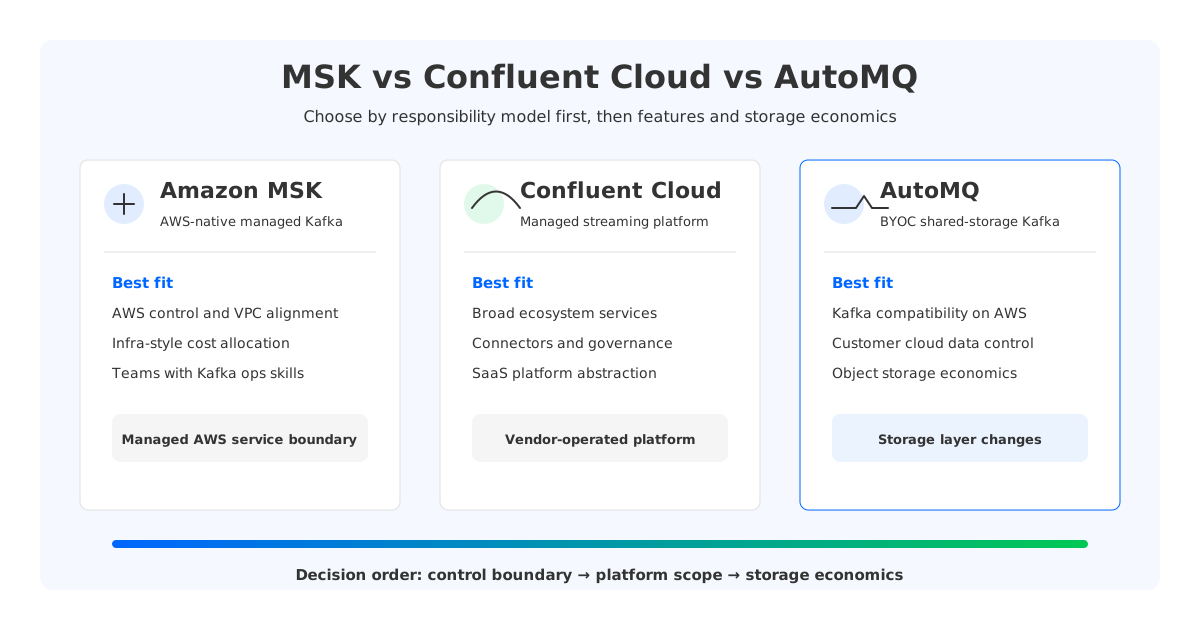
1Quick Answer by Team Priority
If your team is standardized on AWS operations and wants the Kafka data plane in your AWS environment, Amazon MSK is usually the natural starting point. AWS documents MSK as a managed service for Apache Kafka that provisions and manages broker infrastructure while integrating with AWS networking, security, and monitoring services.
Confluent Cloud is more compelling when the streaming platform itself is the product your team wants to consume. Confluent positions its cloud service around Apache Kafka plus managed stream processing, connectors, governance, and networking choices. The trade-off is a SaaS responsibility boundary, with pricing and abstractions that differ from AWS infrastructure line items.
A useful first-pass decision looks like this:
| Priority | Amazon MSK tends to fit when... | Confluent Cloud tends to fit when... |
|---|---|---|
| AWS control | You want Kafka inside AWS operations, IAM, VPC patterns, and procurement. | You accept a Confluent-operated SaaS boundary for a richer platform experience. |
| Feature breadth | You need managed Kafka brokers, Kafka APIs, and AWS-adjacent tooling. | You want Confluent services such as managed connectors, governance, and stream processing. |
| Cost visibility | You prefer AWS-style infrastructure pricing by broker, storage, throughput, and data transfer. | You prefer platform pricing around clusters, networking, storage, and service units. |
| Operations | Your SRE team can own Kafka capacity, quotas, client behavior, and AWS networking. | You want more platform work abstracted into the vendor service. |
| Architecture | You can operate within Kafka's broker-local storage model or MSK's variants. | You value Confluent's platform abstractions more than direct control over data-plane architecture. |
The table is not a winner-takes-all scorecard. For a regulated AWS environment, data-plane placement may dominate. For a small data platform team, managed connectors and governance can dominate broker-level control.
2Pricing and Cost Model
Amazon MSK pricing is closer to infrastructure accounting. The AWS pricing page breaks charges into broker instance usage, storage, provisioned throughput or serverless dimensions, and data transfer where applicable. In provisioned MSK, teams think about broker size, broker count, storage volume, storage throughput, and AWS data transfer rules. MSK Serverless changes the packaging, but the buyer is still thinking inside AWS service meters.
Confluent Cloud pricing is a platform consumption model. Confluent's public pricing and billing documentation describes costs across cluster types, data transfer, storage, networking, connectors, governance, support, and usage units such as Confluent Unit for Kafka or Elastic Confluent Unit. That can be easier for a team that wants a managed streaming platform, but a comparison against MSK broker hours is incomplete.
| Cost dimension | Amazon MSK | Confluent Cloud |
|---|---|---|
| Compute | Broker instance or service capacity meters, depending on cluster type. | Cluster and Kafka capacity units vary by cluster type and usage model. |
| Storage | Kafka log storage is priced through MSK storage dimensions; tiered storage has local and remote considerations. | Retained data and storage are Confluent Cloud billing dimensions. |
| Networking | AWS data transfer and PrivateLink-style topology choices can matter across AZs or VPC boundaries. | Networking charges depend on Confluent networking options, ingress/egress, and private connectivity. |
| Ecosystem | MSK Connect, Replicator, Lambda integrations, Glue Schema Registry, and AWS services are separate choices. | Connectors, stream processing, governance, and related capabilities are first-class Confluent services. |
The cost mistake is to compare only the smallest visible meter. A broker-hour comparison can miss retained storage, cross-AZ replication, consumer egress, private networking, connectors, governance, and support. The right model starts with workload shape: write throughput, read fanout, retention, partition count, replication factor, cross-AZ topology, connector count, and operational staffing.
This is also where Kafka's architecture shows up in the bill. Apache Kafka stores records in partition logs, and production deployments usually replicate partitions for availability. Replication is excellent for durability and failover, but in cloud environments every extra copy, broker, disk, and network path can become a priced resource.
3Data Control and Networking
Data control is the sharpest difference for many AWS teams. With Amazon MSK, clusters are created in your AWS account context and integrate with AWS VPC networking, security groups, IAM-related access patterns, CloudWatch, KMS, and other AWS services. MSK is not self-managed Kafka, but the center of gravity stays AWS-native. For regulated teams, that can simplify reviews because the service aligns with existing AWS account, network, and compliance patterns.
Confluent Cloud offers several networking models, including public networking, private networking, and AWS PrivateLink options depending on cluster type and region support. The platform can connect securely to workloads in AWS, but the control boundary is different: Confluent operates the cloud service, and your AWS workloads connect through the selected networking model. That should be a conscious architectural decision rather than a detail discovered during security review.
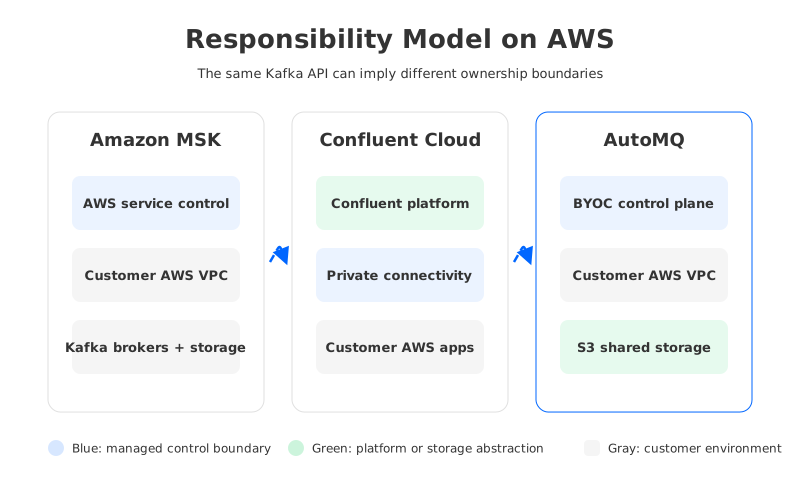
The practical questions are concrete:
- Where do broker resources run, and who controls the account that contains them?
- Where does retained event data live during operation and recovery?
- Which private connectivity option is available in your regions?
- Which identity, encryption, audit, and network inspection controls are mandatory?
- Who owns response for throttling, quota exhaustion, partition skew, and connector failures?
These questions cut through vendor terminology. "Managed Kafka" can mean AWS-managed infrastructure inside an AWS-native model, or it can mean a vendor-operated streaming platform consumed from AWS workloads. Both can be valid, but they are not the same responsibility model.
4Operations and Ecosystem Features
MSK reduces the amount of Kafka infrastructure your team has to build, but it does not erase Kafka operations. You still design topics and partitions, choose client settings, manage quotas, watch consumer lag, plan retention, and handle application-level failure modes. AWS adds managed service integrations around monitoring, security, MSK Connect, and replication patterns, but the day-to-day shape still feels familiar to teams that have operated Kafka on AWS.
Confluent Cloud leans further into the platform layer. Its value is not only "Kafka brokers as a service"; it is the surrounding ecosystem around connectors, schemas, governance, stream processing, cluster linking, and developer workflows. For data engineering teams that would otherwise assemble those pieces from multiple services, this can be the main reason to choose Confluent Cloud even when MSK looks more AWS-native.
Teams often ask, "Which Kafka is less work?" The better question is, "Which work do we still want to own?" If you already have AWS platform standards, Terraform modules, dashboards, IAM workflows, and Kafka expertise, MSK's narrower managed boundary may feel efficient. If your bottleneck is building a complete streaming platform experience, Confluent Cloud's broader managed surface may remove more backlog.
5Scaling and Storage Architecture
Kafka's original architecture ties partitions, replicas, broker compute, and broker-attached storage together. This keeps the log abstraction predictable, but scaling is not only adding CPU. When partition replicas live on broker-local disks, rebalancing, broker replacement, storage expansion, and failure recovery can involve data movement across the network. Apache Kafka's documentation describes topics as partitioned logs with replicas, and that design choice is still the foundation behind most operational trade-offs.
Amazon MSK has added managed capabilities around this model, including different cluster modes and storage options such as tiered storage for supported configurations. Confluent Cloud abstracts much of the operational detail behind its service interface and has its own cluster types and capacity models. These are meaningful improvements over self-managing every broker process, but buyers still need to know whether their biggest pain is service management, platform features, or replicated log economics.
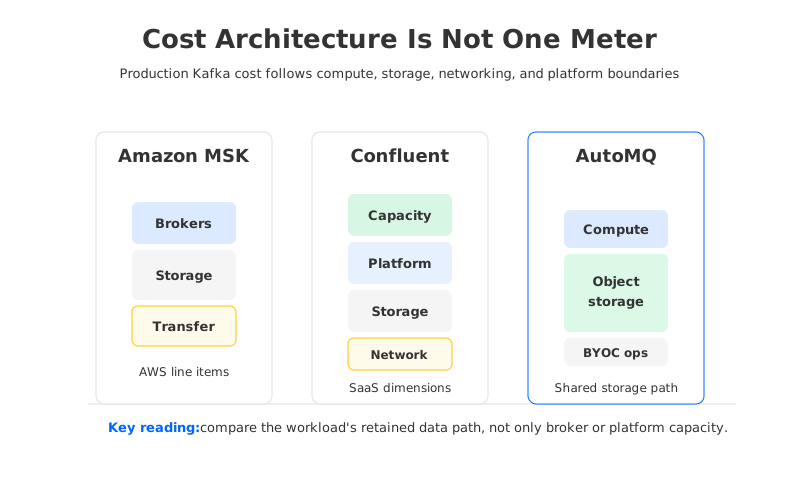
For workloads with long retention, high fanout, uneven partition growth, or frequent scaling events, the storage architecture becomes more than an implementation detail. A team may tolerate broker-based storage for short-retention streams but struggle with the same model for analytical event backbones that retain large volumes of data. Another team may accept SaaS pricing for high-value data products but prefer tighter control for internal pipelines with predictable heavy throughput.
This is why MSK vs Confluent Cloud should not be framed only as "AWS service vs Kafka vendor." It is also about whether your main constraint is operational ownership, ecosystem breadth, or Kafka storage elasticity.
6Where AutoMQ Fits as a Third Path
Once the decision reaches storage architecture and data-plane control, a third category becomes relevant: Kafka-compatible systems that keep the Kafka protocol and client ecosystem while changing how durable storage is implemented on cloud infrastructure. AutoMQ fits this category. It uses object storage such as Amazon S3 as the durable storage layer and supports BYOC deployment patterns for teams that want data and infrastructure to remain in their own cloud environment.
The point is not that AutoMQ replaces every MSK or Confluent Cloud use case. A team that wants Confluent's full managed platform ecosystem may still choose Confluent Cloud. A team that wants AWS-native managed Kafka may still choose MSK. AutoMQ becomes interesting when the team wants Kafka compatibility on AWS while changing the broker-local storage behavior that often drives Kafka cost and operational drag.
The architectural distinction is straightforward:
| Architecture question | MSK | Confluent Cloud | AutoMQ |
|---|---|---|---|
| Kafka API | Apache Kafka-compatible managed service. | Kafka-compatible Confluent platform service. | Kafka-compatible cloud-native streaming system. |
| Data control | AWS-native service model. | Confluent-operated cloud service model. | BYOC deployment where customer cloud resources can remain under customer control. |
| Storage pattern | Kafka broker storage model with managed AWS service options. | Abstracted through Confluent Cloud cluster architecture. | Shared object storage architecture using cloud storage such as S3. |
| Buying reason | Managed Kafka inside AWS operations. | Managed streaming platform breadth. | Kafka compatibility with storage separation and AWS data control. |
That makes AutoMQ a practical evaluation item for teams whose MSK vs Confluent Cloud debate keeps circling the same triangle: more elasticity than broker-local Kafka usually provides, more data-plane control than pure SaaS may provide, and less operational burden than self-managed Kafka. The decision still needs proof against your workload: throughput, latency, retention, failure recovery, client compatibility, and migration plan.
7Decision Framework
Start with the constraint that would be most painful to reverse after six months. If the answer is security architecture and data residency, prioritize the responsibility model before feature checklists. If the answer is data platform productivity, compare the managed ecosystem around Kafka, not broker uptime alone. If the answer is runaway storage and replication cost, model the retained data path before committing to a conventional replicated-log cost structure.
For AWS teams, the decision usually lands in one of these patterns:
- Choose Amazon MSK when AWS-native control, VPC integration, AWS procurement, and existing platform operations matter more than a broad SaaS streaming platform.
- Choose Confluent Cloud when the value of Confluent's managed ecosystem, connectors, governance, and platform abstraction outweighs the desire to keep the data plane close to AWS-native operations.
- Evaluate AutoMQ when Kafka compatibility, BYOC-style AWS control, and shared object storage architecture are central to the business case.
- Revisit self-managed Kafka only when your organization has unusual customization needs and is willing to own the full operational burden.
The search query "MSK vs Confluent" sounds binary, but the production decision is not. It is a responsibility model decision first, a platform feature decision second, and a storage economics decision third. Getting that order right avoids choosing a service that looks simple in a demo, then discovering that the real constraint was network topology, retention cost, or ownership.
For teams comparing Kafka options on AWS, the next step is to model one real workload rather than a generic cluster. Use your write throughput, retention, read fanout, partition count, region layout, and security constraints. If shared-storage Kafka is part of that evaluation, AutoMQ's AWS documentation shows how to test the BYOC, S3-backed path without giving up Kafka protocol compatibility.
8FAQ
8.1Can Amazon MSK be lower cost than Confluent Cloud?
Not universally. MSK uses AWS-style dimensions such as broker capacity, storage, throughput mode, and data transfer, while Confluent Cloud uses platform billing dimensions that can include cluster capacity, storage, networking, connectors, governance, and support. The lower-cost option depends on retention, throughput, fanout, private networking, and ecosystem features.
8.2Is Confluent Cloud more managed than Amazon MSK?
Usually yes at the streaming platform layer. MSK manages Kafka infrastructure inside the AWS service model, while Confluent Cloud manages a broader platform around Kafka. That abstraction can reduce platform engineering work, but it changes the responsibility boundary and pricing model.
8.3Can MSK and Confluent Cloud both run with AWS workloads?
Yes. MSK is an AWS service, and Confluent Cloud supports AWS regions and connectivity options. The key difference is where the data plane runs, how private connectivity is designed, who operates the platform, and how costs are metered.
8.4When should an AWS team evaluate AutoMQ?
Evaluate AutoMQ when the team wants Kafka compatibility and AWS data control while changing the scaling and cost profile of broker-local Kafka storage. It is most relevant when retention, storage growth, cross-AZ replication, or scaling operations are central to the debate.
8.5Does AutoMQ mean Confluent Cloud or MSK are bad choices?
No. Confluent Cloud can fit a team that wants a full managed streaming platform. MSK can fit a team that wants AWS-native managed Kafka. AutoMQ is a different architectural option for Kafka-compatible streaming with BYOC-style control and object-storage-backed shared storage.


