
Table of Contents
Table of Contents
Amazon MSK is often evaluated as if it were an alternative to Kafka. That framing is slightly off. Amazon Managed Streaming for Apache Kafka is AWS's managed service for running applications that use Apache Kafka, and the AWS documentation states that it runs open-source versions of Apache Kafka while preserving Kafka data-plane operations such as producing and consuming records. In plain language: MSK is managed Kafka on AWS, not a separate messaging system with Kafka-like branding.
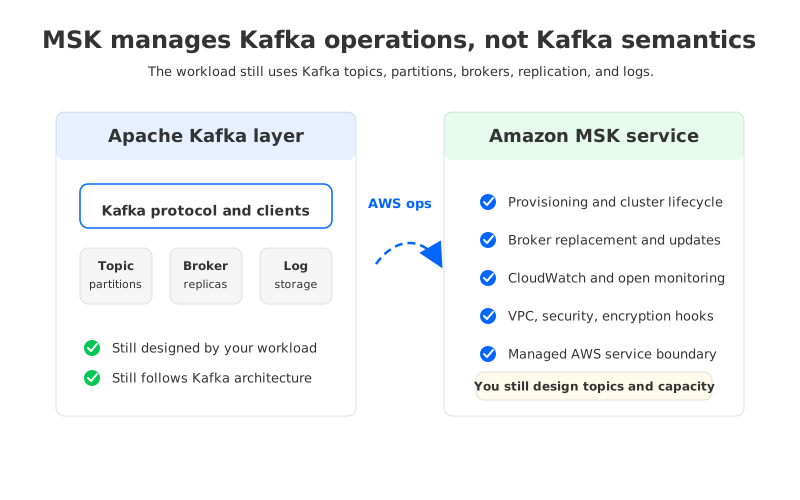
That distinction prevents two common mistakes. One is assuming MSK is "not really Kafka" and therefore incompatible with the Kafka ecosystem. The opposite mistake is assuming a managed service removes every hard part of Kafka. MSK reduces cluster lifecycle work, but it does not erase Kafka's architecture: topics are still partitioned, brokers still host replicas, replication still consumes capacity, and storage decisions still shape cost and recovery.
1Is Amazon MSK the same as Kafka?
For most application teams, yes in the practical sense: MSK exposes Apache Kafka semantics and lets existing Kafka applications, tooling, and community plugins run without application code changes, according to AWS's MSK developer guide. Producers write to topics, consumers read from partitions, consumer groups coordinate offsets, and administrators still reason about broker capacity, retention, replication, and client behavior.
But "same as Kafka" needs a boundary. Apache Kafka is an open-source distributed event streaming system. Amazon MSK is a managed AWS service that provisions and operates Kafka clusters for you. The difference is not the wire protocol; it is the responsibility model. AWS owns more of the infrastructure control plane, while your team still owns the workload design and the consequences of the Kafka architecture you choose.
That makes the MSK vs Kafka question two questions:
- Are you comparing MSK with self-managed Apache Kafka on EC2 or Kubernetes? If so, MSK can remove much of the undifferentiated operational work around cluster creation, patching, integration with AWS networking, and managed service recovery.
- Are you asking whether MSK changes Kafka's storage, partitioning, and replication model? If so, the answer is more limited. MSK manages Kafka; it does not turn Kafka into a different architecture.
2What MSK manages for you
AWS describes MSK as a fully managed service that provides control-plane operations such as creating, updating, and deleting clusters, while letting users keep Kafka data-plane operations. In production, that control-plane shift is valuable. Running Kafka yourself means the platform team has to package broker deployments, manage broker replacement, plan upgrades, configure monitoring, rehearse failure recovery, and align security controls with the rest of the cloud environment. MSK moves many of those tasks into an AWS service interface.
The biggest operational change is that Kafka becomes an AWS resource instead of a fleet you assemble yourself. MSK integrates with VPC networking, IAM-related access patterns, encryption options, CloudWatch metrics, open monitoring with Prometheus, MSK Connect, MSK Replicator, and AWS service operations.
For architecture and platform teams, the managed surface usually falls into five buckets:
| Operational area | What changes with Amazon MSK |
|---|---|
| Cluster lifecycle | Cluster creation, updates, deletion, broker replacement, and managed service workflows are exposed through AWS rather than custom automation. |
| AWS integration | VPC, subnets, security, encryption, CloudWatch, PrivateLink options, and related AWS controls are part of the service model. |
| Monitoring hooks | AWS provides CloudWatch metrics and supports open monitoring integrations, but teams still have to interpret health, lag, saturation, and client behavior. |
| Kafka ecosystem | MSK runs open-source Kafka versions supported by AWS, so existing Kafka applications and tools remain the baseline expectation. |
| Pricing visibility | AWS publishes pricing dimensions for broker instance usage, storage, data transfer, serverless usage, and related features, giving FinOps teams a modelable bill. |
This is a meaningful reduction in operational burden, especially when the organization already runs most production systems on AWS. The tradeoff is that the managed service boundary can make Kafka feel simpler than it is. When a workload grows, the old Kafka questions come back quickly.
3What MSK does not remove from Kafka operations
Apache Kafka's design centers on topics, partitions, brokers, logs, and replicated records. The official Kafka documentation describes topics as partitioned logs, with each partition ordered and append-only. Replication maintains replicas across brokers, with leaders serving reads and writes and followers keeping up. That model also creates the planning surface that managed services cannot fully hide.
MSK changes who operates the cluster machinery. It does not change what a partition is.
3.1Partition planning
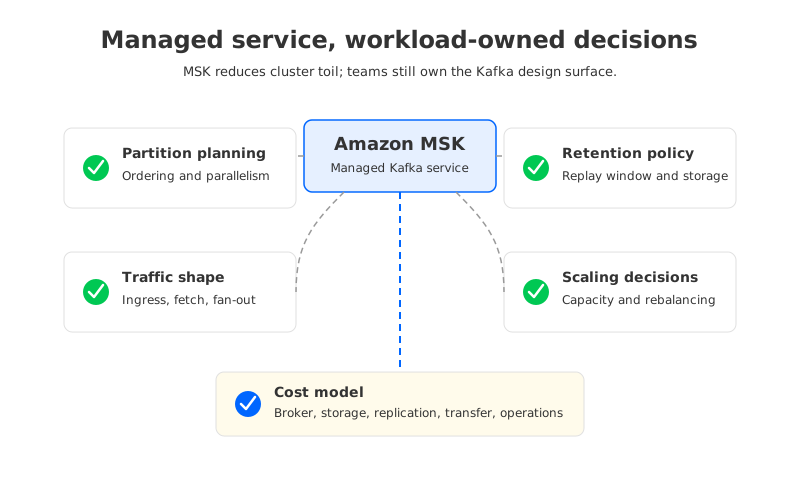
Partitions remain the unit of parallelism, ordering, placement, and much of the operational blast radius. Too few partitions can cap throughput and consumer parallelism. Too many partitions can increase metadata, file, recovery, and rebalance overhead. MSK provides the managed environment, but it cannot infer ordering requirements, consumer topology, peak throughput, retention, or expansion plans.
This is where teams sometimes overestimate managed Kafka. A service can provision brokers, but it cannot decide whether a topic should have 12 partitions or 240 partitions without understanding the workload. Repartitioning a high-volume production topic is still a migration problem involving producers, consumers, ordering assumptions, and often release coordination.
3.2Storage and replication
Kafka stores records in log segments, and retention determines how long those records remain available for replay. In a traditional Kafka architecture, brokers are stateful because they host partition replicas on local or attached storage. Replication improves availability, but it also multiplies write traffic and storage footprint. On AWS, those choices become infrastructure costs.
MSK Standard brokers keep the familiar broker-storage model. AWS also provides storage management features such as updating broker storage and tiered storage for supported Standard configurations. Tiered storage can reduce pressure from long retention by moving older data away from primary broker storage, but it does not make the active Kafka layer stateless. Current writes, active segments, leaders, followers, and replica placement still matter.
Managed does not mean architecture-free. If a topic has high ingress, long retention, multiple consumer groups, and multi-AZ durability requirements, MSK reduces operational work, but the deployment still behaves like Kafka.
3.3Scaling decisions
Scaling is also not a single button in the architectural sense. MSK can support changes to cluster configuration and broker capacity, and AWS offers broker options such as Express brokers, which AWS positions as less complex to manage and faster to scale than Standard brokers. Platform teams still need to know what they are scaling for: produce throughput, fetch throughput, partition count, storage growth, catch-up reads, consumer fan-out, or failure recovery.
These dimensions do not grow evenly. A fraud detection topic, a clickstream pipeline, and a CDC stream can stress latency, retention, replay, ordering, and connectors in different ways. The same MSK cluster can host them, but the capacity plan has to respect the interactions among them.
4Pricing: what changes and what stays visible
Amazon MSK pricing is more transparent than a custom Kafka fleet because AWS publishes service dimensions. For MSK Provisioned, the pricing page lists broker instance usage, broker storage, optional provisioned storage throughput for Standard brokers, data written to Express brokers, private connectivity, and standard AWS data transfer charges where applicable. For MSK Serverless, the dimensions shift toward serverless usage metrics, but the bill still follows throughput, storage, and data movement.
This clarity helps FinOps teams, but it does not make Kafka cost disappear. Kafka cost is a function of workload shape: provisioned broker headroom, storage retained for replay, replication traffic, consumer fan-out, cross-network paths, monitoring data, and operational support. MSK can reduce labor and service management overhead, while the infrastructure bill still reflects the platform you designed.
The most useful MSK cost model separates four questions:
| Cost question | Why it matters |
|---|---|
| How much capacity is provisioned? | Broker instances, storage, and throughput settings define the base footprint for provisioned clusters. |
| How much data is retained? | Retention converts a streaming workload into a storage workload, especially when topics keep data for days or weeks. |
| How often is data replicated or reread? | Replication, reprocessing, consumer fan-out, and cross-network paths can change the bill more than the broker count alone suggests. |
| How much engineering work is avoided? | Managed service value includes reduced operational labor, not only lower infrastructure line items. |
This is why "MSK vs Kafka cost" has no universal answer. MSK can be more cost-effective than self-managed Kafka when it removes fragile operations. Self-managed Kafka may look lower on raw instance pricing if a team ignores labor, recovery, and upgrade work. Use the same availability, retention, throughput, and support assumptions before comparing options.
5When managed Kafka is still not enough
The teams that keep searching after choosing MSK usually are not rejecting AWS management. They are running into Kafka's deeper coupling between compute and storage. A broker is not only a compute process that handles requests; it is also a storage owner for partition replicas.
The pain appears in familiar production moments:
- A retention increase forces the team to revisit broker storage and topic-level capacity instead of treating object storage as the primary durable layer.
- A traffic spike requires more broker capacity, but rebalancing partition load and storage is not the same as adding stateless application pods.
- A cost review finds that replication, storage, and read fan-out are growing faster than the team expected when Kafka was first adopted.
None of these points make MSK a bad choice. They clarify the layer at which MSK helps. MSK is the conservative path when a team wants Apache Kafka on AWS with less direct cluster administration. It is not a storage architecture redesign.
6How AutoMQ changes the Kafka architecture
The architectural fork is clearer once MSK is described accurately. MSK manages Kafka. AutoMQ keeps Kafka compatibility while replacing the broker-local storage layer with a shared-storage architecture built around object storage and a write-ahead log layer. AutoMQ's documentation describes this as an architecture that offloads Kafka log storage through S3Stream, making broker nodes stateless, while its compatibility documentation positions the system as Kafka-compatible for clients and ecosystem integration.
That is a different bet from managed Kafka. Instead of asking AWS to operate a stateful Kafka cluster more smoothly, the shared-storage approach asks whether Kafka's cloud-era bottleneck is the fact that brokers own durable log storage at all. When persistent data moves into shared cloud storage, broker nodes can behave more like compute workers. Scaling becomes less tied to moving partition data between broker disks.
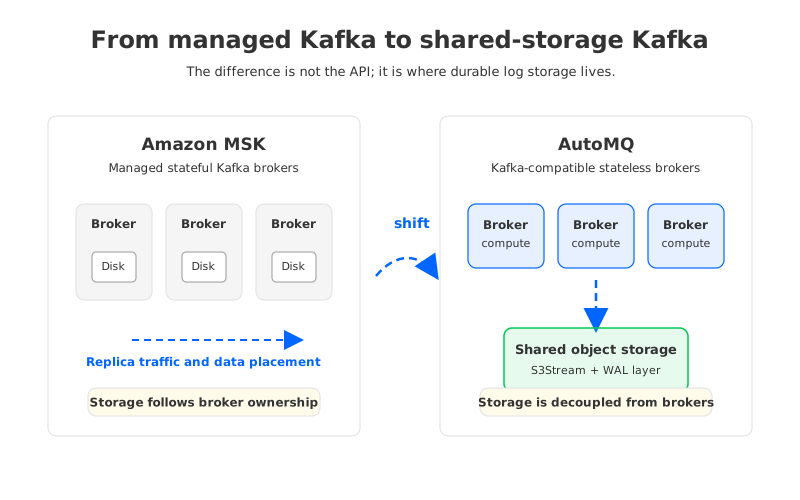
The difference is especially important when comparing shared storage with tiered storage. Kafka tiered storage can offload older data, but Kafka still has a primary local or attached storage layer for active data. AutoMQ's documentation makes the distinction explicit: object storage is the primary data repository, while the WAL layer is used for efficient persistence and recovery.
For a professional evaluation, AutoMQ belongs in the conversation when the team wants Kafka-compatible clients, the workload is retention-heavy or bursty, the platform team prefers BYOC-style control, and FinOps pressure is tied to storage, replication, elasticity, or cross-AZ data paths rather than only managed service fees.
The restrained conclusion is not "always replace MSK." MSK is often the right first managed Kafka answer for AWS teams. The more precise conclusion is that MSK and shared-storage Kafka-compatible systems solve different layers of the problem: one manages Kafka's operational control plane, while the other changes the storage architecture that makes Kafka stateful.
7Decision framework: MSK vs Kafka vs shared-storage alternatives
The best decision starts with the question behind the search term. "Is MSK the same as Kafka?" needs a compatibility and responsibility answer. "Why is MSK still expensive?" needs a workload and cost model. "What is an MSK alternative?" needs to separate managed-service alternatives from architecture alternatives.
MSK vs Kafka is not a rivalry between two messaging systems. It is a choice about how much Kafka operation you want AWS to absorb. Use MSK where managed Apache Kafka is enough, self-manage Kafka where control matters more, and evaluate shared-storage systems where the storage layer is the constraint.
If your current MSK review is really a storage and elasticity review, the next useful step is to compare the workload against a shared-storage Kafka architecture. AutoMQ's architecture documentation and Kafka compatibility guide are good places to test that question against concrete implementation details rather than vendor labels.
8References
- AWS, What is Amazon MSK?
- AWS, Amazon MSK pricing
- AWS, Monitor an Amazon MSK cluster
- AWS, Update broker storage
- AWS, Amazon MSK tiered storage
- Apache Kafka, Apache Kafka 4.0 documentation
- AutoMQ, Architecture overview
- AutoMQ, Stateless broker
- AutoMQ, Compatibility with Apache Kafka
- AutoMQ, Difference with tiered storage
9FAQ
9.1Is Amazon MSK the same as Kafka?
Amazon MSK is AWS's managed service for Apache Kafka. It runs open-source Kafka versions supported by AWS and supports Kafka data-plane operations. AWS manages more of the cluster lifecycle, while your team still designs topics, partitions, clients, retention, and capacity.
9.2Is MSK better than self-managed Kafka?
MSK is usually better when your team wants Kafka on AWS without owning broker deployment, patching, integration, and recovery. Self-managed Kafka can still make sense when a platform team needs maximum control over versions, infrastructure, customization, or non-AWS deployment patterns.
9.3Does MSK remove Kafka partition planning?
No. MSK manages the service environment, but partitions remain the unit of ordering, parallelism, placement, and capacity planning. Application teams still design partition counts, keys, retention, compaction, and consumer behavior.
9.4Does MSK use Kafka brokers and storage?
Yes. MSK clusters use broker nodes, and MSK Standard brokers use broker storage as part of the provisioned cluster model. Storage updates and tiered storage do not make the traditional Kafka active storage layer disappear.
9.5When should teams evaluate AutoMQ instead of only MSK?
Evaluate AutoMQ when the issue is not only Kafka operations, but the coupling of broker compute and durable storage. It is relevant for teams that want Kafka compatibility with shared storage and stateless brokers.
9.6Is AutoMQ a drop-in replacement for every MSK workload?
No platform should be treated as a blind drop-in replacement for every production Kafka workload. AutoMQ is Kafka-compatible, but teams should still validate clients, security, connectors, tooling, latency targets, retention, and failure behavior before migrating.


