
Table of Contents
Table of Contents
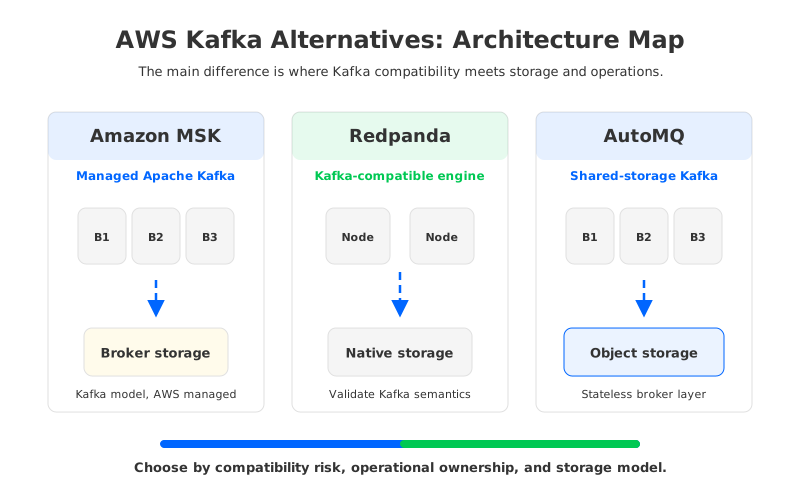
For AWS teams, the MSK vs Redpanda discussion usually starts with a familiar frustration: Kafka is strategic, but operating it well is expensive in engineering time, infrastructure capacity, and failure rehearsal. Amazon MSK keeps you close to Apache Kafka while moving much of the control plane into AWS. Redpanda takes a different route: it presents a Kafka-compatible API while replacing parts of the Kafka implementation with its own streaming engine. Those are not minor packaging differences. They change how you reason about compatibility, operations, storage, scaling, and cost.
That is why a useful comparison cannot stop at benchmark claims or a feature checklist. A production Kafka platform is a web of client libraries, topic semantics, connectors, stream processors, observability, disaster recovery plans, and on-call muscle memory. The right question is not "which one is faster?" It is "which architecture preserves the guarantees my workloads depend on while reducing the operational burden I am trying to escape?"
1What MSK and Redpanda are each trying to solve
Amazon MSK is AWS's managed Apache Kafka service. The AWS documentation describes MSK as a fully managed service for building and running applications that use Apache Kafka, while still supporting Kafka data-plane operations such as producing and consuming records. In practical terms, MSK lets teams keep Kafka itself: the broker model, Kafka protocol, ecosystem assumptions, and AWS-native cluster lifecycle management.
Redpanda is positioned as a Kafka-compatible streaming platform rather than managed Apache Kafka. Redpanda documentation says Kafka clients version 0.11 or later are compatible, with documented validations and exceptions. For teams that want Kafka API compatibility but are willing to evaluate a reimplementation of the broker internals, that is the point. Redpanda is not trying to be "MSK with a different console"; it is trying to remove parts of the traditional Kafka operating model.
The distinction matters because both options can be reasonable for production, but they reduce different kinds of risk.
| Decision axis | Amazon MSK | Redpanda |
|---|---|---|
| Core identity | Managed Apache Kafka on AWS | Kafka-compatible streaming platform |
| Primary bet | Stay close to upstream Kafka while delegating infrastructure operations to AWS | Use Kafka-compatible APIs with a different broker implementation and operating model |
| Deployment relationship to AWS | AWS service in your AWS environment | Redpanda Cloud options, including BYOC, and self-managed deployment patterns |
| Evaluation focus | Kafka version, broker type, storage, AWS networking, MSK pricing | Compatibility coverage, Redpanda operational model, deployment ownership, pricing plan |
If your organization has deep Kafka knowledge and wants AWS to manage the undifferentiated cluster work, MSK is easy to explain internally. If your organization is questioning Kafka's operational complexity and wants a Kafka API without the same internals, Redpanda deserves a serious evaluation.
2Kafka compatibility and ecosystem fit
Compatibility is the first place where teams should slow down. Apache Kafka is more than a wire protocol. The official Kafka documentation spans producers, consumers, admin APIs, Kafka Connect, Kafka Streams, transactions, security, monitoring, replication, and operations. Many production systems depend on edge behavior: rebalances, idempotent producers, transactional writes, ACL behavior, metrics names, connector assumptions, and operational scripts.
MSK's compatibility story is direct: it runs open-source Apache Kafka versions supported by AWS. Existing Kafka clients and plugins are generally the baseline assumption because the service is Kafka. The tradeoff is that you inherit Kafka's architectural model. MSK can reduce operational work, but it does not turn Kafka into a different storage architecture.
Redpanda's compatibility story is more nuanced. Its official docs validate Kafka client compatibility and document exceptions. That is a good sign because it gives platform teams something concrete to test. It also means a serious Redpanda evaluation should include more than a producer/consumer smoke test. The migration plan should exercise the specific Kafka surface area your applications rely on:
- Client libraries and protocol versions used by critical services, including Java, Go, Python, and framework-managed clients.
- Producer semantics such as idempotence, retries, batching, compression, and transactions where applicable.
- Consumer group behavior under rolling deploys, lag spikes, partition expansion, and coordinator failover.
- Kafka Connect, Kafka Streams, Schema Registry, MirrorMaker-style replication, and observability integrations.
- Security controls, ACL patterns, private networking, audit requirements, and incident response workflows.
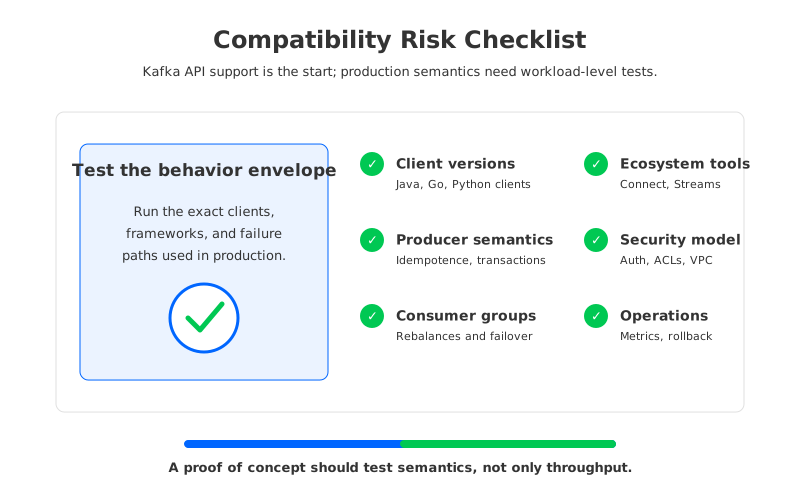
Test compatibility as a behavior envelope, not a marketing label. For architects, the question is whether any compatibility gaps are acceptable in exchange for Redpanda's operating model. For FinOps, the same issue appears as risk-adjusted cost: a lower infrastructure bill does not help if application teams spend months validating semantic differences.
3Storage and scaling architecture
Kafka's traditional architecture couples broker compute with local persistent storage. A broker owns partitions, writes logs to attached disks, replicates data to other brokers, and participates in leadership changes. This model is robust and well understood, but it creates cloud-specific friction: scaling can move partition data, multi-AZ durability can create cross-AZ replication traffic, and long retention can grow storage faster than compute.
MSK keeps this model, with AWS-managed operations around it. MSK Standard brokers use storage that is part of the broker configuration, and AWS also offers tiered storage for Standard brokers so older data can move to a lower-cost storage tier. Tiered storage helps with retention economics, but it does not erase the difference between hot broker storage, replica placement, and partition leadership.
Redpanda changes the broker implementation. Its documentation emphasizes a different architecture, Kafka API compatibility, and cloud storage/tiered storage capabilities. The architectural question is how its storage, recovery, compaction, leadership, and tiered storage behavior map to the failure modes your team already plans for.
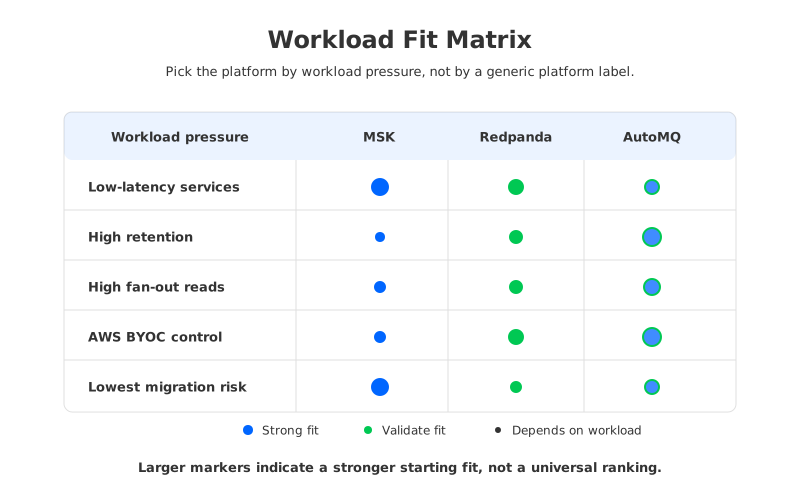
This is where many MSK vs Redpanda comparisons get too shallow. Low-latency workloads, high-retention workloads, high fan-out analytics workloads, and high-ingress event pipelines stress different parts of the system. A design that reduces broker operations may still require careful planning for cloud networking, backup, replication, and tenant isolation.
4Cost model on AWS
AWS pricing makes the MSK cost model explicit. On the Amazon MSK pricing page, provisioned clusters are priced around broker instance-hours, storage, data transfer, and feature-specific dimensions such as tiered storage or serverless usage. That clarity gives FinOps teams a billable surface they can model. It also exposes why Kafka costs can become uncomfortable on AWS: the bill follows provisioned brokers, attached storage, replication traffic, retention, and consumer read patterns.
Redpanda's pricing depends on deployment choice. Redpanda publishes commercial pricing pages and cloud deployment options, including BYOC. The practical cost question is whether your target Redpanda deployment shifts cost from AWS-managed Kafka capacity to Redpanda subscription, cloud infrastructure, and retained operational ownership. For self-managed or BYOC-style deployments, cloud resources still appear somewhere.
A useful model separates cost into four buckets:
| Cost bucket | Why it matters in MSK vs Redpanda |
|---|---|
| Compute capacity | MSK ties capacity to broker instances or serverless dimensions. Redpanda cost depends on its chosen deployment model and required resources. |
| Storage and retention | MSK Standard uses broker storage and can use tiered storage. Redpanda has its own storage and tiering behavior that must be validated for retention and replay. |
| Network traffic | Multi-AZ replication, consumers, mirroring, and cross-region designs can dominate cost for high-volume workloads. |
| Operational labor | Managed services reduce some work, while alternative architectures may move effort into validation, deployment, or platform ownership. |
This cost framing is less exciting than a headline savings number, but it prevents a common mistake: comparing one vendor's best-case benchmark against another vendor's default production configuration. For production workloads, the fair comparison uses your required durability, retention, availability zones, security model, peak throughput, replay behavior, and support expectations.
5Operational ownership and migration
MSK and Redpanda also differ in who owns which operational surfaces. With MSK, AWS owns much of the service control plane and common recovery automation. AWS documentation notes that MSK detects and recovers from common broker failure scenarios and handles cluster-level control-plane operations. Your team still owns topic design, partition strategy, client behavior, authentication choices, monitoring interpretation, scaling decisions, and incident runbooks.
With Redpanda, the answer depends on Redpanda Cloud, BYOC, or self-managed deployment. A managed Redpanda option shifts more responsibility to Redpanda. A BYOC or self-managed deployment keeps more infrastructure and integration work near your team. That may be a positive tradeoff for platform teams that want more control, especially where data residency, VPC ownership, or custom automation matters. It can also be a burden if the team expected a service-level experience identical to AWS-native MSK.
Migration should be treated as a production program, not a weekend switch. A responsible plan usually includes dual writes or replication, offset validation, topic-by-topic rollout, consumer lag observation, failure drills, rollback criteria, and signoff from application owners. Redpanda compatibility testing should include the exact clients and frameworks used in production. MSK migration planning should include Kafka version support, topic configuration parity, and security controls.
The migration risk is not symmetrical. Moving to MSK from self-managed Kafka is often a move toward the same Kafka engine with an AWS-managed service boundary. Moving to Redpanda is often a move to a Kafka-compatible engine with different internals. The test plan must match the architectural distance you are crossing.
6Where AutoMQ differs
After comparing MSK and Redpanda, a third category becomes visible. Some teams do not primarily want a Kafka reimplementation, and they also do not want to keep Kafka's broker-local storage economics. They want Kafka protocol and ecosystem compatibility while changing the storage architecture behind cloud cost and scaling friction.
AutoMQ fits that category: a Kafka-compatible, BYOC-oriented streaming platform built around shared object storage and stateless brokers. The important distinction is architectural, not promotional. AutoMQ keeps the Kafka-facing compute and protocol layer recognizable to Kafka users, while moving persistent log storage away from broker-local disks and into shared cloud storage.
This makes AutoMQ most relevant when the evaluation criteria include all of the following:
- You want Kafka-compatible clients and ecosystem behavior rather than a broad application rewrite.
- You run on AWS and care about cloud infrastructure cost, especially storage, cross-AZ replication, and retention-heavy workloads.
- You prefer BYOC-style control over where data runs, but do not want to operate Kafka as a collection of stateful disk-heavy brokers.
- You need elastic scaling and faster recovery characteristics without turning every scaling event into a partition data movement project.
AutoMQ is not a universal replacement for every MSK or Redpanda workload. MSK may be the conservative choice when AWS-native Kafka operations and cost are acceptable. Redpanda may be the better fit when its implementation model has been validated. AutoMQ belongs in the shortlist when the architectural pain is specifically the coupling of Kafka brokers and persistent local storage.
7Decision framework: workload fit beats vendor labels
The most useful MSK vs Redpanda decision is a workload-fit decision. Start with the workloads that matter most, not the platform name. A payments event stream with strict latency and transactional requirements deserves a different evaluation than a clickstream pipeline with high ingress, long retention, and occasional large replays.
Use the following decision posture:
| If your priority is... | Start by evaluating... |
|---|---|
| Maximum upstream Kafka familiarity on AWS | Amazon MSK |
| Kafka-compatible APIs with a different streaming engine | Redpanda |
| Kafka-compatible ecosystem with shared-storage cloud architecture | AutoMQ |
| Lowest migration uncertainty | The option closest to your current semantics and tooling |
| Lower cloud cost for high retention or elastic workloads | Storage architecture, data transfer paths, and scaling behavior across all options |
This is also the right way to read benchmarks. Benchmarks can be useful, but they are never a substitute for workload replay. Test with your message sizes, partition counts, retention, compression, producer settings, consumer fan-out, failure patterns, and observability stack.
If your current AWS Kafka decision is stuck between MSK's familiar managed Kafka model and Redpanda's Kafka-compatible reimplementation, add one more architectural question before closing the design: is the real constraint Kafka operations, or is it Kafka's storage model in the cloud? When storage coupling is the root problem, a shared-storage Kafka-compatible option such as AutoMQ deserves a focused proof of concept. AutoMQ's free trial is a direct way to run that validation in your own AWS context.
8References
- Amazon Web Services, Amazon MSK pricing
- Amazon Web Services, What is Amazon MSK?
- Amazon Web Services, Tiered storage for Standard brokers
- Apache Kafka, Official documentation
- Redpanda, Architecture documentation
- Redpanda, Kafka compatibility
- Redpanda, Redpanda Cloud BYOC architecture
- Redpanda, Pricing page
- AutoMQ, AutoMQ overview
- AutoMQ, AutoMQ BYOC
9FAQ
9.1Is Redpanda a drop-in replacement for Amazon MSK?
Not automatically. Redpanda provides Kafka-compatible APIs and documents supported client compatibility, but production teams should validate the exact client versions, transactions, connectors, security controls, monitoring, and failure behavior they use. MSK runs Apache Kafka, so the migration distance is different.
9.2Is Amazon MSK the same as self-managed Kafka?
No. MSK is a managed AWS service that runs Apache Kafka and handles many cluster control-plane and recovery tasks. Your team still owns workload-level choices such as topic design, partitioning, client configuration, access control, monitoring, and scaling decisions.
9.3Which is more cost-effective on AWS: MSK or Redpanda?
It depends on deployment model and workload shape. MSK pricing is based on AWS service dimensions such as broker capacity, storage, data transfer, and related features. Redpanda cost depends on Redpanda Cloud, BYOC, or self-managed choices plus underlying cloud resources. Model compute, storage, network traffic, support, and operational labor together.
9.4When should AutoMQ be considered alongside MSK and Redpanda?
Consider AutoMQ when you want Kafka-compatible behavior but the main pain is cloud storage architecture: retention cost, broker-local disks, partition data movement, or cross-AZ replication economics. It is especially relevant for AWS teams that prefer BYOC deployment and shared object storage.
9.5What should a proof of concept include?
Use a representative workload rather than a generic benchmark. Include production message sizes, partition counts, producer settings, consumer fan-out, retention, replay traffic, authentication, monitoring, broker failure, and rollback criteria. The POC should answer operational questions as well as throughput questions.


