
Table of Contents
Table of Contents
"MSK vs WarpStream" looks like a vendor comparison, but the real decision is architectural. Amazon MSK runs Apache Kafka as a managed AWS service, so the data plane still follows Kafka's broker-local log model. WarpStream takes a different path: stateless Agents write directly to object storage and use a cloud metadata/control plane. Both can serve Kafka workloads on AWS, but they put durability, cost, scaling, and compatibility pressure in different places.
That distinction matters because shared storage is not a small feature toggle. It changes what a broker is responsible for. In traditional Kafka, a broker owns local log segments for specific partitions, leaders accept writes, followers replicate those writes, and recovery often involves moving or rebuilding partition state. In a shared-storage design, durable data is held outside the broker fleet, usually in object storage or a storage layer built around it. Brokers or agents can become more stateless, and scaling becomes less entangled with data movement.
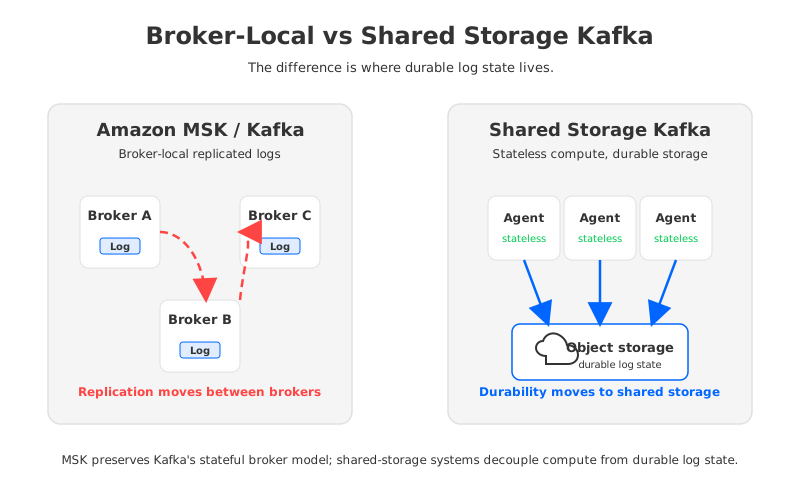
The right answer is not "MSK is old" or "shared storage is always better." A low-latency trading pipeline, a cost-sensitive observability lake, and a corporate event backbone with hundreds of existing Kafka tools may make different tradeoffs. The useful comparison is the data path: where the record goes after Produce, where it is acknowledged, how reads find it, and what must move when load or failure changes.
1Why this comparison matters
Amazon MSK's strongest argument is familiarity. The AWS documentation says MSK runs open-source Apache Kafka versions and supports existing Kafka applications, tooling, and plugins without application code changes. MSK reduces the control-plane burden of creating, updating, monitoring, and recovering clusters while preserving the Kafka data-plane model that applications expect.
WarpStream's strongest argument is that Kafka's original storage design carries cloud-era costs. Its architecture documentation says WarpStream replaces a physical Kafka cluster with stateless Agents that communicate with object storage such as Amazon S3 and a cloud metadata store. Its write-path documentation also says any Agent can write data for any topic-partition and that data is stored durably in object storage before a produce request is acknowledged. That is not "MSK with a different pricing page." It is a different storage architecture exposed through a Kafka-compatible interface.
The comparison becomes sharper on AWS because Availability Zones make locality visible. Kafka's replicated log is durable, but when replicas are spread across AZs, leader-follower replication and client placement become part of the cost model. AWS's MSK pricing page says Standard brokers charge for broker instance usage and provisioned storage, and that standard AWS data transfer charges apply to data transferred in and out of MSK clusters.
This is where shared storage enters the conversation. If object storage provides the durable data layer, broker-to-broker replica traffic no longer has to be the primary persistence mechanism. That can simplify scaling and reduce some cross-AZ pressure, but it also introduces new questions about object-store latency, metadata consistency, cache behavior, feature coverage, and the operational boundary between customer infrastructure and vendor control plane.
2MSK's broker-local storage model
MSK is managed Kafka, not a new Kafka-compatible storage engine. The Amazon MSK developer guide describes brokers as nodes created across Availability Zones, with clients using Kafka data-plane operations to produce and consume data. In the Standard broker storage documentation, AWS states that MSK brokers persist data on storage volumes and that storage I/O is consumed when producers write, when data is replicated between brokers, and when consumers read data that is not in memory.
That maps directly to Apache Kafka's design. Kafka partitions have leaders and followers. Producers send data to the partition leader, followers replicate from the leader, and consumers fetch from the log using offsets. Kafka's design documentation describes a partition as a replicated log and says the replication unit is the topic partition.
The operational cost is that the broker is stateful. Capacity planning must consider broker CPU, network, disk throughput, storage volume size, partition count, leader distribution, replication factor, retention, and consumer fan-out. Increasing broker capacity can be straightforward in the AWS console, but changing the shape of a Kafka cluster still requires attention to partition placement and data movement.
MSK tiered storage changes part of that story, but not all of it. AWS documents tiered storage for Standard brokers as a low-cost tier that scales to virtually unlimited storage. MSK keeps streaming data in a performance-tuned primary tier until topic retention limits move older data into the low-cost tier. This helps longer retention and reprocessing, but it remains tiered storage: the active Kafka broker model is still present, and the primary tier still matters for hot data.
For many teams, that is exactly the tradeoff they want. MSK is close to Kafka, familiar to auditors and platform teams, integrated with AWS networking and IAM patterns, and available in provisioned and serverless forms. The penalty is that the architecture inherits Kafka's stateful broker responsibilities.
3WarpStream and object-storage-backed Kafka
WarpStream starts from the opposite assumption: keep the Kafka protocol surface where it matters, but remove broker-local disks from the persistence path. Its architecture page says the Agent is a single stateless binary, any Agent can act for any topic, and no Agent is special. Its write-path page says Agents align producer clients with Agents in the same Availability Zone, do not use topic-partition leaders, buffer produce requests from multiple producers and partitions, and write batched files to object storage before committing metadata and acknowledging clients.
That design attacks three cloud Kafka problems at once. Compute can scale without moving partition data between brokers. Durability is delegated to object storage rather than triply replicated broker disks. Producer writes do not have to find a remote partition leader because any Agent can accept writes.
The model also has a clear control-plane boundary. WarpStream's architecture documentation says the Agent pool runs in the customer's VPC, while cloud services manage metadata and coordination. Customer data is described as remaining in the customer VPC/object storage path, with metadata exchanged with WarpStream Cloud. That is often attractive to teams that want BYOC-style data residency without operating a full Kafka control plane themselves.
The pricing model reinforces the architecture. WarpStream's billing documentation says BYOC clusters are metered on cluster-minutes, uncompressed GiB written, and uncompressed GiB stored. Its public pricing page shows tiered rates for uncompressed write throughput and storage, and says BYOC clusters are charged for uncompressed writes, cluster-minutes, and storage, with no per-Agent, per-node, or per-vCPU charge. Those dimensions are intentionally different from broker-hour plus provisioned disk capacity.
There are tradeoffs. WarpStream's protocol support page lists the Kafka APIs currently implemented and says more features and message types are being added. It also notes that some broker-management messages have no meaning in WarpStream because the architecture has no partition leaders and no broker-local replication. For workloads that use mainstream produce, consume, consumer groups, ACLs, transactions, and topic operations, that may be enough. For a platform that depends on obscure broker operations, exact Kafka internals, or tools that inspect local log placement, the compatibility review needs to be explicit.
Latency deserves the same care. Object storage is not a magic low-latency log by itself. WarpStream's architecture page acknowledges the cost and latency challenge of naive object-store designs and explains that Agents write a few files per second, mix records from multiple topics and partitions into files, and compact files in the background. Its write-path documentation describes a default buffering threshold of 250 ms or 8 MiB, whichever comes first. Those choices may be acceptable for analytics, observability, CDC fan-out, and buffered streaming pipelines; they need deeper testing for sub-10 ms workloads.
4AutoMQ's shared storage Kafka architecture
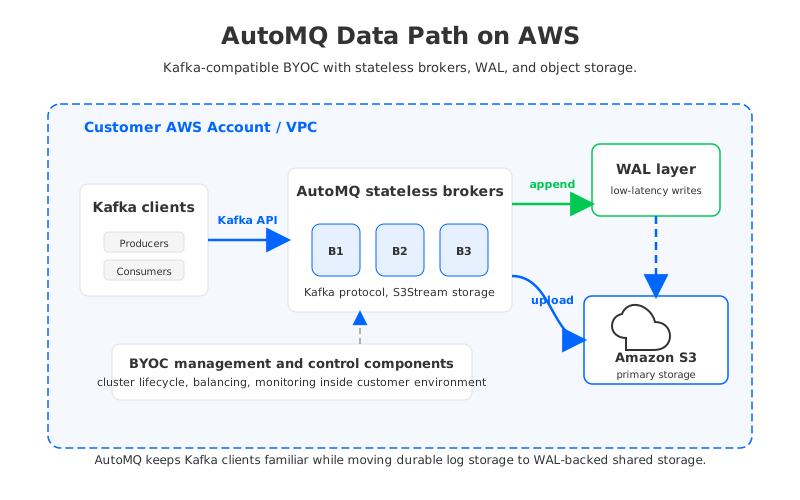
Once the comparison is framed as broker-local Kafka versus shared-storage Kafka, AutoMQ belongs in the evaluation set. AutoMQ is Kafka-compatible and BYOC-oriented, but its architecture is not identical to WarpStream's. The AutoMQ documentation describes a shared storage architecture where Kafka's log storage layer is replaced by S3Stream, with stateless brokers and object storage as the primary data repository. AutoMQ also introduces a WAL layer to address object storage's latency and IOPS characteristics.
That WAL layer is the important distinction. WarpStream's write-path documentation emphasizes direct object-storage persistence with no intermediary disks or WAL. AutoMQ's S3Stream documentation says data is first durably written to WAL storage and then uploaded to S3 storage near real time, with caching for tail reads and catch-up reads. In other words, both systems separate compute from durable object storage, but they make different choices about the low-latency write path.
This difference is not a ranking. It is a design fork:
- WarpStream is designed around a diskless Agent model where object storage and metadata commit are the core persistence path.
- AutoMQ is designed around Kafka compatibility while replacing Kafka's storage layer with S3Stream, combining WAL storage, S3 storage, and cache.
- MSK is designed around managed Apache Kafka, where broker-local logs and Kafka's native replication model remain central.
AutoMQ's compatibility page says it uses Apache Kafka's compute-layer code and makes minimal modifications in the storage layer, with applications able to transition without application changes. Its stateless broker documentation says offloading Kafka's storage layer through S3Stream makes brokers stateless, which simplifies operations, scaling, and rolling updates. Its inter-zone traffic documentation also describes how S3-based shared storage can reduce inter-broker replica replication and client inter-zone data movement.
That makes AutoMQ relevant for teams that like the shared-storage direction but do not want to evaluate only a diskless Agent architecture. If you need Kafka protocol continuity, BYOC deployment, object storage as the durable layer, and a write path designed around WAL plus S3Stream, AutoMQ is a credible third option to put next to MSK and WarpStream.
5Cost, latency, and operational tradeoffs
The cost comparison is easiest to get wrong when it is reduced to one headline. MSK Standard charges for broker instance usage and provisioned storage, with optional provisioned storage throughput. MSK Express has its own broker, storage, and per-GB write dimensions. WarpStream BYOC meters cluster-minutes, uncompressed writes, and uncompressed stored data, while the customer still pays the underlying cloud infrastructure such as compute and object storage. AutoMQ BYOC similarly needs a workload model that includes AutoMQ subscription or license dimensions plus the cloud resources used in the customer account.
That is why a serious evaluation starts with workload shape rather than vendor SKUs. Write throughput, read fan-out, retention, hot versus cold reads, partition count, compression ratio, AZ layout, and recovery objectives all affect the answer. A high-throughput observability workload with long retention may value object-storage-backed persistence more than a latency-sensitive command pipeline with small messages and strict p99 budgets.
| Dimension | Amazon MSK | WarpStream | AutoMQ |
|---|---|---|---|
| Core model | Managed Apache Kafka with broker-local logs | Kafka-compatible stateless Agents with object storage | Kafka-compatible shared storage with S3Stream |
| Primary persistence path | Broker storage volumes plus Kafka replication | Object storage plus metadata commit | WAL storage plus object storage |
| Scaling unit | Brokers and broker storage capacity | Stateless Agent pool | Stateless brokers |
| Pricing lens | Broker instances, storage, throughput options, AWS transfer paths | Cluster-minutes, uncompressed writes, uncompressed stored data, customer cloud infra | BYOC service plus customer cloud infra |
| Compatibility posture | Native Apache Kafka versions | Kafka protocol subset with explicit feature support | Kafka-compatible distribution using Kafka compute layer |
| Best-fit evaluation question | Do we want managed Kafka with AWS-native operations? | Do we want diskless Kafka-compatible streaming around object storage? | Do we want Kafka compatibility with stateless brokers and WAL-backed shared storage? |
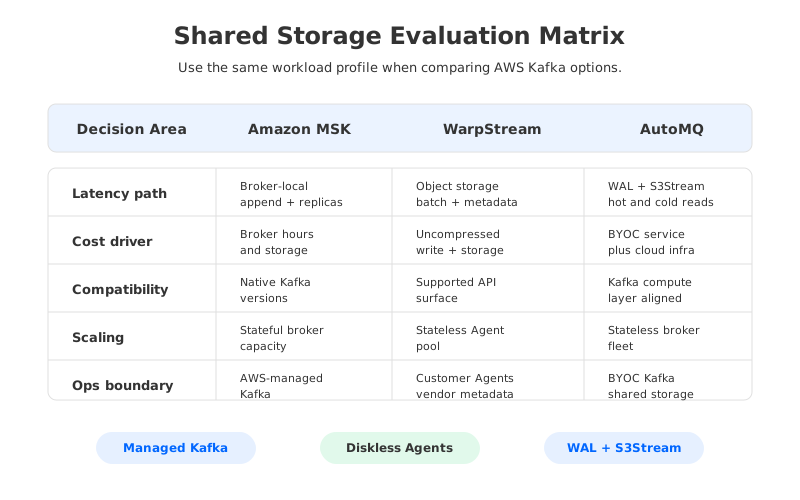
Latency is the second axis. MSK's hot path is Kafka's familiar broker-local append and replication path. WarpStream's hot path batches data into object storage and commits metadata, with documented buffering behavior. AutoMQ's hot path uses WAL storage to absorb writes and S3 as primary durable storage near real time. None of these should be evaluated from architecture diagrams alone. Run the same producer settings, message sizes, partition counts, consumer patterns, and failure tests against each candidate.
Operations is the third axis. MSK fits teams that want AWS to manage Kafka infrastructure while their platform team still thinks in Kafka terms. WarpStream fits teams that want to operate something closer to a stateless proxy fleet while the vendor handles metadata/control-plane complexity. AutoMQ fits teams that want Kafka-compatible shared storage in a BYOC model while preserving a stronger connection to Kafka's compute-layer behavior.
6A practical evaluation checklist
Start by deciding which risks you are trying to reduce. If the pain is mostly cluster patching, broker replacement, and AWS integration, MSK may already solve enough. If the pain is broker-local replication cost, slow data rebalancing, and overprovisioned stateful capacity, shared storage deserves a real test. If the pain is vendor control or data residency, the details of BYOC, metadata access, support boundaries, and customer-cloud permissions become as important as throughput.
Use the following checklist before choosing:
- Data path: where is a produce request acknowledged, and what durable systems have the record at that moment?
- Compatibility: which Kafka APIs, clients, connectors, admin tools, ACLs, transactions, and monitoring workflows do you actually use?
- Latency: what are your p50, p95, and p99 targets for tail reads and produce acknowledgments under normal and failure conditions?
- Cost model: which dimensions are metered by the vendor, which are paid directly to AWS, and which are sensitive to compression or retention?
- Failure mode: what happens when a broker, Agent, AZ, metadata service, object storage path, or customer VPC component fails?
- Operations: who owns upgrades, autoscaling policy, cache sizing, network placement, incident response, and support escalation?
That checklist turns "MSK vs WarpStream" into an architecture review instead of a slogan contest. MSK is the conservative default for managed Kafka on AWS. WarpStream is a stronger departure from Kafka's broker-local storage model. AutoMQ sits in the same shared-storage conversation, but with S3Stream, WAL, stateless brokers, and Kafka-compatible BYOC as its center of gravity.
If your AWS Kafka roadmap keeps circling the same issues of broker storage, cross-AZ movement, and stateful scaling, model the data path before you renew the platform choice. Start with the official docs, test with your own workloads, and include a Kafka-compatible shared-storage option such as AutoMQ in the proof of concept: review AutoMQ for your AWS Kafka architecture.
7References
- Amazon MSK Developer Guide, What is Amazon MSK: https://docs.aws.amazon.com/msk/latest/developerguide/what-is-msk.html
- Amazon MSK Developer Guide, create an MSK Provisioned cluster: https://docs.aws.amazon.com/msk/latest/developerguide/msk-create-cluster.html
- Amazon MSK Developer Guide, provision storage throughput: https://docs.aws.amazon.com/msk/latest/developerguide/msk-provision-throughput.html
- Amazon MSK Developer Guide, tiered storage for Standard brokers: https://docs.aws.amazon.com/msk/latest/developerguide/msk-tiered-storage.html
- Amazon MSK Pricing: https://aws.amazon.com/msk/pricing/
- Apache Kafka documentation, design and replication: https://kafka.apache.org/43/design/design/
- WarpStream documentation, architecture: https://docs.warpstream.com/warpstream/overview/architecture.md
- WarpStream documentation, write path: https://docs.warpstream.com/warpstream/overview/architecture/write-path.md
- WarpStream documentation, billing: https://docs.warpstream.com/warpstream/reference/billing.md
- WarpStream documentation, protocol and feature support: https://docs.warpstream.com/warpstream/kafka/reference/protocol-and-feature-support.md
- WarpStream pricing: https://www.warpstream.com/pricing
- AutoMQ documentation, architecture overview: https://docs.automq.com/automq/architecture/overview?utm_source=blog&utm_medium=references&utm_campaign=kw10-c02-0011
- AutoMQ documentation, S3Stream shared streaming storage: https://docs.automq.com/automq/architecture/s3stream-shared-streaming-storage/overview?utm_source=blog&utm_medium=references&utm_campaign=kw10-c02-0011
- AutoMQ documentation, stateless broker: https://docs.automq.com/automq/architecture/technical-advantage/stateless-broker?utm_source=blog&utm_medium=references&utm_campaign=kw10-c02-0011
- AutoMQ documentation, compatibility with Apache Kafka: https://docs.automq.com/automq/what-is-automq/compatibility-with-apache-kafka?utm_source=blog&utm_medium=references&utm_campaign=kw10-c02-0011
8FAQ
8.1Is WarpStream the same thing as Amazon MSK tiered storage?
No. MSK tiered storage keeps Kafka's broker model and moves older data to a low-cost tier after primary retention conditions are met. WarpStream's documentation describes a diskless architecture where Agents write directly to object storage and do not use broker-local disks for the persistence path.
8.2Does MSK use shared storage?
MSK Standard brokers persist data on broker storage volumes, and Kafka replication happens between brokers. MSK tiered storage adds a low-cost remote tier for older data, but that is different from making object storage the primary persistence layer for all broker state.
8.3Is WarpStream fully compatible with Apache Kafka?
WarpStream is Kafka-compatible for supported protocol operations, and its documentation lists the specific Kafka messages and features currently supported. Teams should compare that list against the clients, admin operations, connectors, security features, transactions, and observability tools they use in production.
8.4Where does AutoMQ fit in an MSK vs WarpStream evaluation?
AutoMQ is a Kafka-compatible BYOC shared-storage option. Like WarpStream, it moves away from broker-local durability as the center of the architecture. Unlike WarpStream's no-WAL design, AutoMQ documents S3Stream with WAL storage, object storage, caching, and stateless brokers.
8.5Which option has the lowest latency?
There is no universal answer. MSK uses the familiar Kafka broker-local hot path. WarpStream uses object-storage-backed batching and metadata commit. AutoMQ uses WAL storage plus object storage. The right test is a workload-specific benchmark using your message size, partition count, producer acks, consumer fan-out, and failure scenarios.
8.6Which option is most cost-effective on AWS?
The cost-effective choice depends on throughput, retention, fan-out, compression, AZ layout, cloud resource prices, and vendor metering dimensions. MSK pricing is broker- and storage-oriented, WarpStream BYOC pricing is based on cluster-minutes, uncompressed writes, and stored data, and AutoMQ BYOC should be modeled with both service and customer-cloud costs.
8.7Should I migrate from MSK to shared storage Kafka?
Not automatically. MSK is a strong fit when managed Apache Kafka behavior and AWS integration are the priority. Shared storage becomes more compelling when stateful broker scaling, high-volume replication, retention cost, and cross-AZ data paths dominate your architecture review.


