
Table of Contents
Table of Contents
A search for multi az kafka economics usually begins after the first clean architecture diagram has met the cloud bill. The Kafka cluster is healthy, replication is configured, and clients are spread across Availability Zones. Then FinOps asks why network transfer grew faster than producer traffic, or why a scale-out event needed more spare capacity than the workload forecast suggested.
That is the uncomfortable part of multi-AZ Kafka: availability is not one cost line. It is a chain of broker placement, replication, storage ownership, client routing, recovery windows, and human procedures. If those pieces are modeled separately, the numbers are manageable. If they are blended into a monthly platform average, the team sees the real economics only after traffic doubles or a broker fails at the wrong time.
The practical thesis is that multi-AZ Kafka cost is shaped less by the number of zones than by the architecture used to make data durable across them. A Shared Nothing architecture pays through broker-local copies and operational movement. A Shared Storage architecture pays through the write-ahead path, object storage, metadata coordination, and the controls that prove the handoff is safe.
1Why Teams Search for multi az kafka economics
The phrase sounds like a finance question, but the searcher is often an engineer defending a production design. Multi-AZ Kafka is rarely optional for a business-critical event stream. Teams need zone failure tolerance, client locality, rolling maintenance, and room to rebalance traffic. The economic question appears when those choices turn into recurring network transfer, broker over-provisioning, and slow capacity changes.
The first mistake is to model only producer ingress. If applications write 1 unit of data, the platform still has to account for the way Kafka stores, replicates, reads, and moves that data. A replicated partition may create internal broker-to-broker traffic. Consumers in another zone may create read traffic across zone boundaries. Reassignment and recovery can add background movement that does not show up in the application throughput forecast.
That is why a usable model separates cost surfaces before comparing vendors or architectures:
- Write path: producer traffic, leader placement, follower replication, acknowledgment settings, and broker routing.
- Read path: consumer group locality, fan-out, catch-up reads, replay jobs, and analytics consumers.
- Storage path: broker-local disks, remote storage, object storage requests, retention, backup, and the write-ahead layer.
- Operations path: reassignment, broker replacement, scale-out, scale-in, recovery testing, and observability.
- Governance path: VPC boundaries, private connectivity, IAM, encryption keys, audit logs, and compliance review.
The point is to keep a team from comparing a managed-service quote, a self-managed Kafka cluster, and a Kafka-compatible shared-storage platform using only broker count and retained terabytes.
2The Production Constraint Behind the Problem
Apache Kafka gives platform teams a mature contract: producers write records to topics, partitions preserve ordered offsets, consumer groups coordinate parallel reads, Kafka Connect integrates external systems, transactions support atomic writes, and KRaft manages cluster metadata without ZooKeeper. Those semantics are the starting point for any serious evaluation. A lower cost model is not useful if it breaks clients, offsets, transactions, or operational tooling.
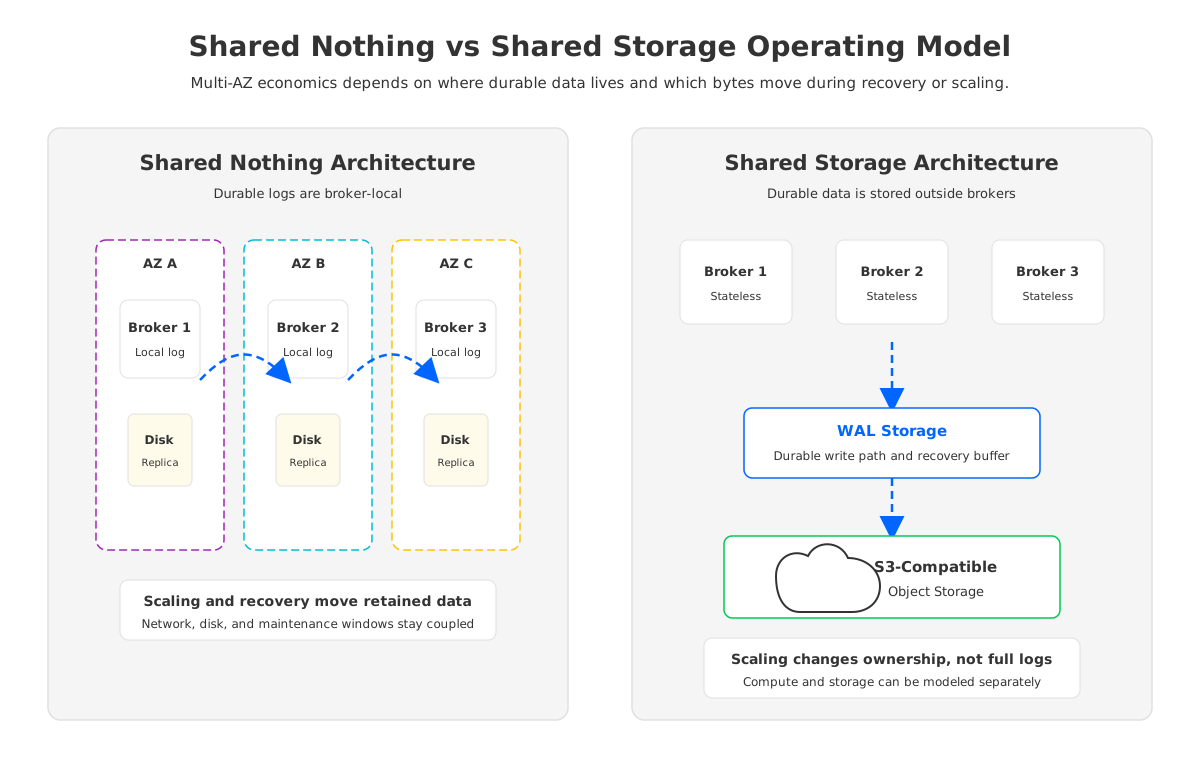
Once compatibility is protected, the constraint moves down to placement. Traditional Kafka uses a Shared Nothing architecture: each broker manages local storage, and replicas protect availability by keeping copies on different brokers. That model is clean inside a data center where machine-to-machine replication is part of the hardware plan. In cloud multi-AZ deployments, the same application-level replication has to cross explicit network and failure-domain boundaries.
This is where the bill begins to diverge from the diagram. Cloud providers publish separate pricing and guidance for data transfer paths, and cross-zone traffic is often treated differently from same-zone traffic. The exact number depends on provider, Region, resource type, and private connectivity design, so teams should validate the relevant path on the official pricing page. Architecturally, if the broker stores durable data locally, availability, recovery, and rebalance work tend to move data between compute nodes.
Retention amplifies the problem. Event history is useful for replay, audit, backfill, machine learning features, and incident response. But when retained data lives on broker-local storage, longer retention increases the weight of broker replacement and partition movement. A cluster can be scaled for CPU and network while still being dragged by storage logistics.
3Architecture Options and Trade-Offs
There are four common paths for teams that need multi-AZ reliability without letting Kafka spend drift out of control. The right choice depends on workload volatility, governance constraints, team skill, and whether the dominant pain is storage growth, network transfer, recovery time, or staffing.
| Option | What it improves | Cost surfaces to inspect | Watch the boundary |
|---|---|---|---|
| Tune broker-local Kafka | Better placement, throttling, rack awareness, and operational discipline | Broker disks, inter-zone replication, reassignment windows, spare capacity | Durable bytes still belong to brokers |
| Use Apache Kafka Tiered Storage | Lower pressure from older completed log segments | Local active data, remote storage requests, fetch behavior, operational maturity | Tiering does not make brokers stateless |
| Adopt managed Kafka | Less direct infrastructure operation | Service pricing, network paths, quotas, retention, private connectivity | Control and billing move into provider terms |
| Evaluate shared storage | Separation of compute and storage, faster broker replacement, smaller data-movement windows | WAL storage, object storage, cache, metadata, governance | The write path must prove durability and fencing |
Tiered Storage deserves a fair reading. It moves older completed log segments away from broker disks, which can help retention-heavy workloads. It does not fully remove broker statefulness because the active log path, local disk behavior, placement, and recovery mechanics still matter.
Managed Kafka also has a clear place. If the team wants fewer operational tasks and accepts the provider's scaling, quota, networking, and migration model, managed service economics may be easier to justify. The review should still include data transfer, private connectivity, support tiers, and exit paths.
Shared storage changes the core question. Instead of asking how many broker-local copies must exist and move across zones, it asks which parts of Kafka need to stay close to compute and which parts should live in shared durable storage. That shift raises a higher bar for write durability, stale-writer fencing, metadata correctness, cache behavior, and object-storage failure handling.
4Evaluation Checklist for Platform Teams
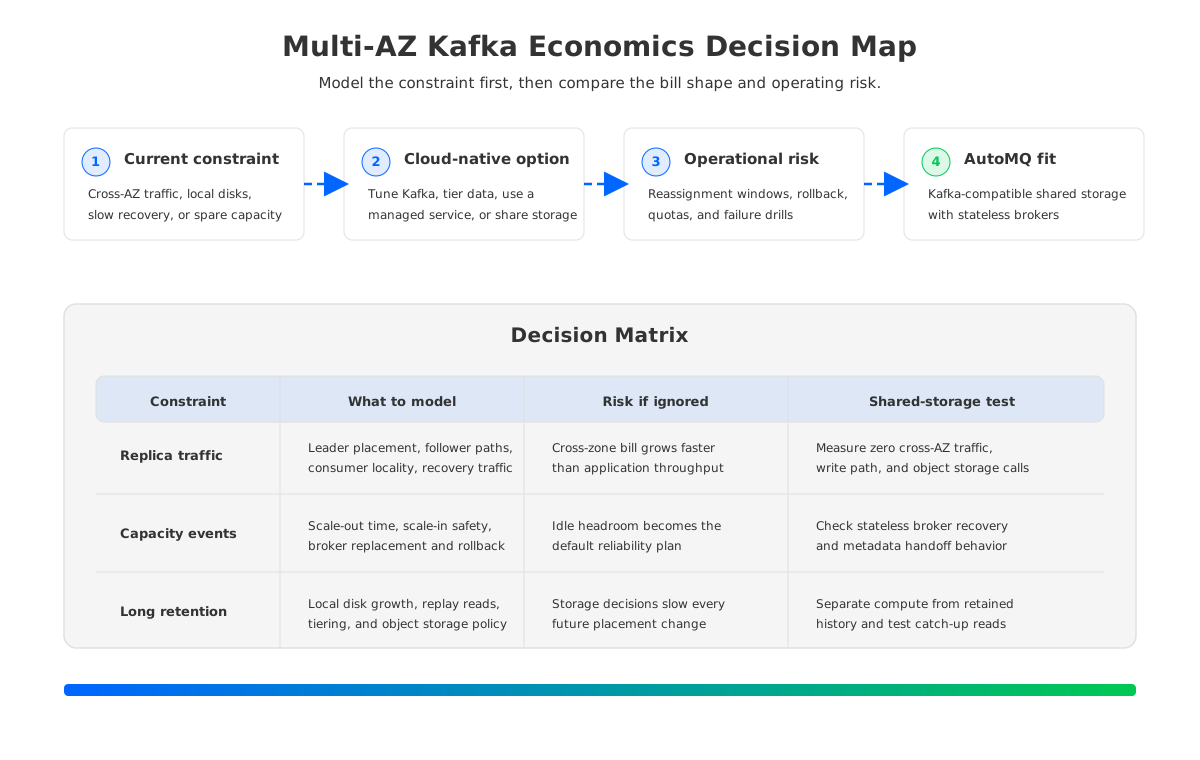
A good evaluation starts with a workload profile, not a vendor page. Pick topic classes that represent real pressure: high write throughput, long retention with replay, and high fan-out consumer traffic. Then model each topic across steady state, scale-out, scale-in, and failure recovery.
Use the checklist as a scoring exercise before the team commits to an architecture:
- Compatibility: Confirm producer, consumer, admin, transaction, Kafka Connect, security, and monitoring behavior with your real client versions.
- Network economics: Map the write path, replica path, read path, recovery path, observability path, and private connectivity path across Availability Zones.
- Storage economics: Separate active storage, retained history, object storage, request cost, WAL storage, backup, and cache capacity.
- Elasticity: Test scale-out and scale-in separately. Scale-out asks when added capacity helps clients. Scale-in asks what happens to ownership, data, and rollback.
- Failure recovery: Drill broker loss, zone impairment, slow object storage operations, stale leaders, and consumer catch-up under load.
- Governance: Check where business data, metadata, logs, metrics, keys, operators, and control-plane actions reside.
- Migration: Prove topic sync, offset continuity, ACL mapping, DNS or bootstrap changes, rollback, and parallel validation.
The scoring should be blunt. If a platform cannot explain which bytes cross zones during writes, fan-out, reassignment, and recovery, the cost model is not ready. If it cannot show where data and metadata live, the governance model is not ready. If rollback is a sentence instead of a rehearsed operation, the migration model is not ready.
5How AutoMQ Changes the Operating Model
After that neutral evaluation, AutoMQ belongs in the shared-storage category. AutoMQ is a Kafka-compatible streaming platform that keeps the Kafka protocol surface while replacing broker-local persistent log storage with S3Stream, WAL (Write-Ahead Log) storage, data caching, and S3-compatible object storage. Durable stream data is no longer permanently tied to one broker's local disk.
That changes multi-AZ economics. AutoMQ Brokers process Kafka requests, own leadership at runtime, cache hot data, and coordinate with the Controller, while the durable data layer lives in shared storage. When capacity changes, the platform is not forced to copy the full retained log between broker disks before the target placement becomes useful. It coordinates metadata, write safety, cache behavior, and traffic ownership instead.
The WAL layer protects the acknowledgment path and recovery boundary. AutoMQ Open Source supports S3 WAL, where S3-compatible object storage acts as both WAL and main storage. AutoMQ commercial editions can use other WAL storage types, such as Regional EBS WAL or NFS WAL, depending on deployment requirements. The right WAL choice affects latency, failure domain, and operational dependencies, so it belongs in the proof of concept.
AutoMQ's zero cross-AZ traffic model is also relevant to finance. In a traditional broker-replication model, replicas and some client paths can generate inter-zone data movement. In AutoMQ's shared-storage model, data is persisted through S3-based storage paths and AutoMQ can route traffic to reduce cross-AZ movement in supported deployments. The business case should still validate the cloud bill, but the mechanism is architectural.
The governance boundary is different from a fully hosted external service. In AutoMQ BYOC, the control plane and data plane run in the customer's cloud account or VPC, and customer business data remains there. AutoMQ Software follows the same customer-controlled principle for private data center deployments.
The strongest test is to reuse the checklist above. Take the same topic profile, client set, retention policy, and failure drill used for broker-local Kafka. Run it against AutoMQ and record compatibility, cross-zone bill signals, scale-out behavior, broker replacement, object storage behavior, observability, and rollback.
6A Practical Scoring Model
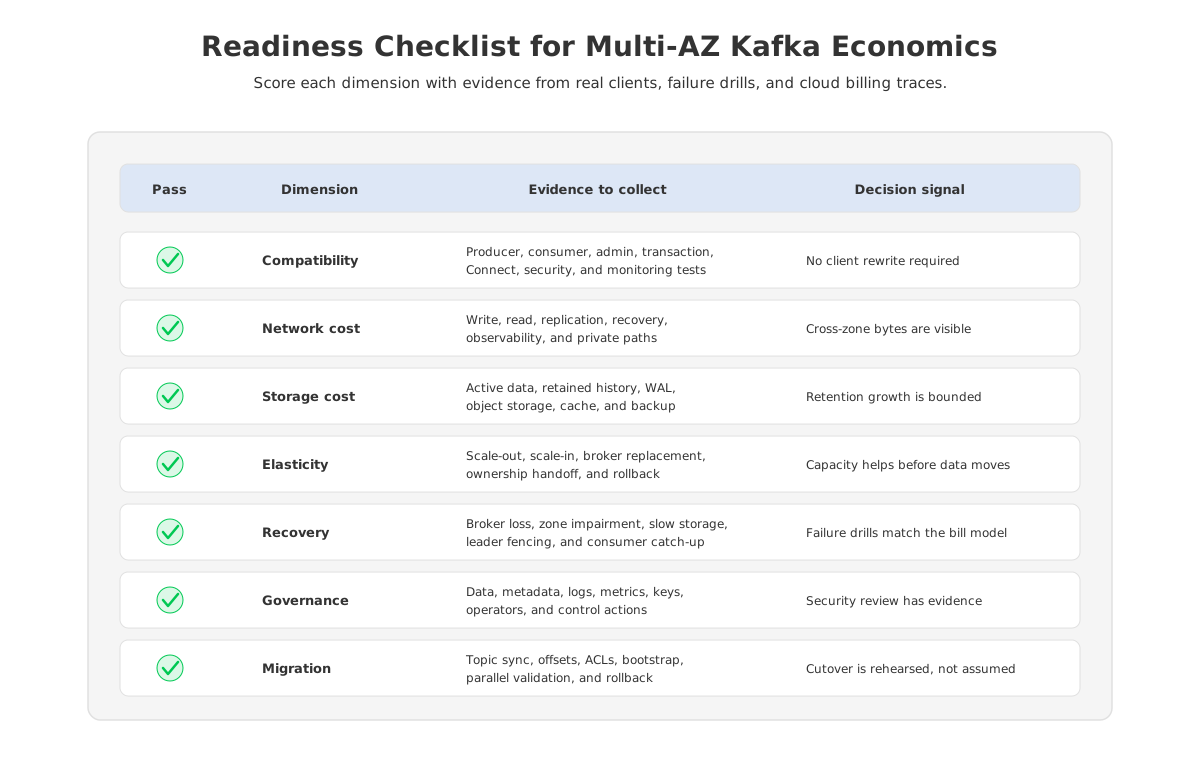
Teams do not need a perfect TCO workbook to make progress. A simple scorecard can reveal whether multi-AZ Kafka is mainly a cost issue, an elasticity issue, or a governance issue. Score each dimension from 1 to 5, where 1 means the risk is mostly unknown and 5 means the team has tested evidence.
| Dimension | Question | Evidence to collect |
|---|---|---|
| Compatibility | Can the platform preserve Kafka behavior for real clients? | Client test matrix, transactions, offsets, Connect jobs, ACLs |
| Network cost | Do you know which paths cross zones? | Flow map, cloud bill tags, replay and recovery traces |
| Storage cost | Can retention grow without broker-local over-provisioning? | Retention profile, local disk plan, object storage plan |
| Elasticity | Does added compute help before large data movement finishes? | Scale-out drill, scale-in drill, broker replacement timing |
| Recovery | Can the team recover without a long manual window? | Failure drills, rollback runbook, observability dashboard |
| Governance | Are data and control boundaries acceptable? | VPC design, IAM review, key ownership, audit evidence |
Low scores are not failures; they are buying signals for engineering work. A low network score calls for traffic tracing before negotiation. A low governance score means the architecture is not ready for security review. A low elasticity score may explain why the team is paying for idle headroom.
7FAQ
7.1What is the biggest cost driver in multi-AZ Kafka?
The biggest driver is usually not one line item. It is the combination of inter-zone traffic, replicated storage, broker headroom, retention growth, and operational windows. The dominant driver depends on whether the workload is write-heavy, read-heavy, retention-heavy, or bursty.
7.2Does Apache Kafka Tiered Storage solve multi-AZ Kafka economics?
It can help with long retention by moving older completed segments to remote storage. It does not fully remove broker-local state, active-log ownership, or all reassignment and recovery costs. Treat it as one option in the model, not as a complete change in operating model.
7.3Should every Kafka team move to shared storage?
No. Shared storage is most compelling when broker-local ownership is the source of cost or operational friction: slow scaling, expensive inter-zone replication, long recovery windows, or heavy retained history. Stable clusters with predictable growth may get enough value from careful broker-local operations.
7.4How should FinOps teams evaluate Kafka-compatible platforms?
Ask for the bill shape, not only the list price. The useful questions are which bytes cross zones, which storage layer holds durable data, how scale-out behaves under load, how rollback works, and where data and metadata reside.
7.5Where does AutoMQ fit in a multi-AZ Kafka plan?
AutoMQ fits when a team wants Kafka compatibility, Shared Storage architecture, stateless brokers, independent compute and storage scaling, zero cross-AZ traffic in supported deployment patterns, and customer-controlled deployment boundaries through AutoMQ BYOC or AutoMQ Software.
The search that started with multi az kafka economics is really asking whether the platform's reliability model still matches the cloud's pricing model. Start with the bytes that move during normal writes, replay, scaling, and recovery. Then test whether changing the storage architecture changes the answer. To evaluate that path with a Kafka-compatible shared-storage design, talk to the AutoMQ team.
8References
- Apache Kafka documentation: Consumer groups and design
- Apache Kafka documentation: Transactions and delivery semantics
- Apache Kafka documentation: KRaft
- Apache Kafka documentation: Tiered Storage
- Apache Kafka documentation: Kafka Connect
- AWS documentation: Amazon EC2 On-Demand Pricing, Data Transfer
- AutoMQ documentation: Shared Storage architecture
- AutoMQ documentation: WAL storage
- AutoMQ documentation: Eliminate inter-zone traffic


