
Table of Contents
Table of Contents
Multi-cloud data integration is rarely a clean-room architecture exercise. It usually begins with pressure from several directions at once: one analytics team needs fresher product events in another cloud, an application team wants partner data without copying whole databases, a security team needs tighter control over movement, and finance wants to understand why network and storage bills rise every time the streaming estate expands.
For teams already invested in Kafka, the search for multi cloud kafka integration is usually not about replacing every producer or consumer. The harder question is whether a Kafka-compatible API can remain the common application contract while the infrastructure underneath changes across clouds, regions, storage systems, network boundaries, and operational teams. That distinction matters. APIs give applications continuity; architecture decides whether the platform stays operable when traffic, retention, and governance requirements diverge across environments.
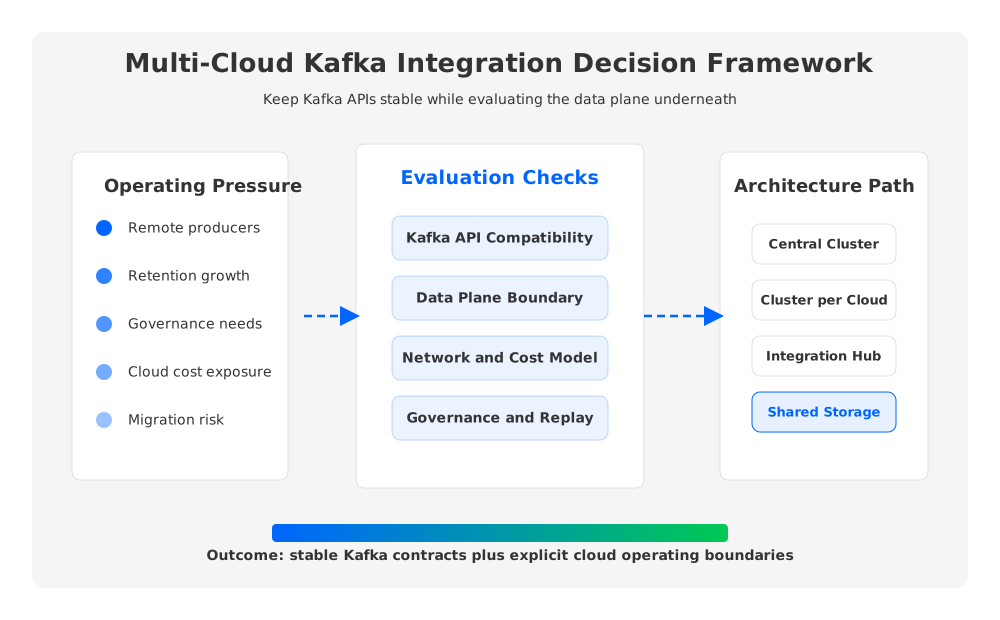
The right design is not a single pattern. The useful starting point is a decision framework that separates application compatibility from deployment topology, storage architecture, governance, and migration risk.
1Why Multi-Cloud Kafka Integration Matters Now
Kafka became the default event backbone in many organizations because it gives teams a durable log, partitioned parallelism, consumer groups, offset tracking, replay, and a mature client ecosystem. Those properties remain valuable when the enterprise estate becomes multi-cloud. Producers and consumers can continue to speak Kafka APIs even when the data plane spans cloud accounts, regions, Kubernetes clusters, private data centers, or managed network paths.
The tension is that multi-cloud work exposes assumptions that were tolerable inside one cluster. A topic that worked inside a single VPC may need stricter data classification when it crosses a jurisdictional boundary. A consumer group that was easy to observe inside one operations stack may become difficult to troubleshoot when applications run in another cloud. A retention policy that fit broker disks in one region may become a replication problem when downstream teams want replay elsewhere.
That is why platform teams should avoid treating multi-cloud data integration as a connector catalog exercise. Connectors, CDC tools, sink tasks, and custom producers are important, but they do not decide the operating model. The architecture has to answer broader questions:
- Which Kafka APIs must remain compatible for producers, consumers, connectors, stream processors, and admin automation?
- Where is durable event data stored, and who controls that storage boundary?
- Which traffic paths cross regions, availability zones, cloud accounts, or provider networks?
- How are schemas, ACLs, encryption, audit trails, and replay requests governed?
- What happens when one cloud environment needs to scale faster than another?
Those questions turn integration from a project into a platform decision. They separate a diagram that looks flexible from a platform SREs can operate during failures, migrations, and traffic spikes.
2The Production Constraints Behind the Search
The first production constraint is compatibility. Kafka compatibility should be evaluated as an application contract, not a brand label. Producers need predictable acknowledgments, batching behavior, security configuration, and error handling. Consumers need stable group coordination, offset management, lag visibility, and replay behavior. Kafka Connect deployments need connector lifecycle control and predictable interaction with topics, partitions, and credentials.
The second constraint is data movement. Multi-cloud integration can use remote producer writes, cluster replication, CDC into topics, connector-based sink delivery, or application-level fan-out. Each choice changes latency, egress, failure isolation, and ownership. The wrong choice can create an architecture where every cloud appears connected, but every incident requires multiple teams to find where a record was last durable.
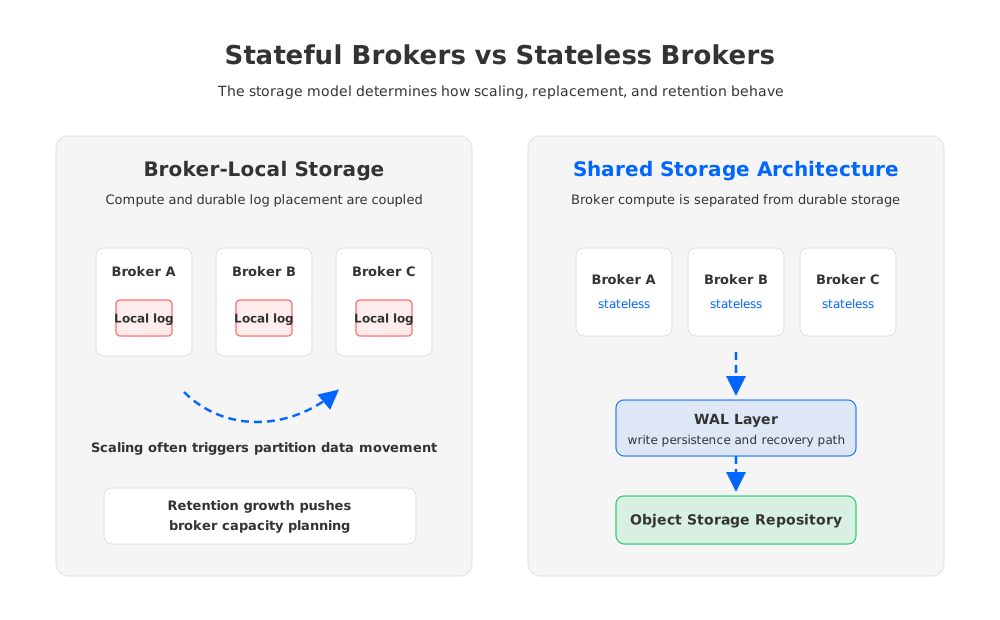
The third constraint is storage growth. Kafka's traditional Shared Nothing architecture keeps partition data on broker-local or attached disks and uses replication across brokers for durability. That model is proven, but it couples compute capacity, storage capacity, and partition placement. If one environment needs longer retention, platform teams may add brokers and rebalance partitions even when the actual pressure is durable bytes rather than compute.
The fourth constraint is governance. Multi-cloud streaming multiplies the number of boundaries where policy matters. A topic may be acceptable for one internal analytics consumer and inappropriate for a third-party sink. A schema change may be harmless in one application and damaging in another region where a downstream model expects stable fields. A replay request may be operationally valid but require approval because it exposes historical records.
These constraints are connected. A compatibility issue can become a migration issue; a storage issue can become a cost issue; a governance issue can become a reliability issue when ownership is unclear.
3Architecture Patterns Teams Usually Compare
Most platform teams compare four patterns. They are not mutually exclusive, and many mature architectures combine them. The decision is where each pattern fits and which one should become the default for a workload class.
| Pattern | Where it fits | Main tradeoff |
|---|---|---|
| Single primary Kafka cluster with remote clients | Applications in multiple clouds produce to or consume from one central event backbone | Simple topic ownership, but network path, latency, and egress become material concerns |
| Cluster-per-cloud with replication | Each cloud has local Kafka infrastructure, with selected topics replicated across environments | Better locality, but more operational state, offset mapping, and replication governance |
| Integration hub with connectors and CDC | A platform team standardizes source and sink movement through managed connector runtimes | Stronger control, but connector semantics may not fit every API or event contract |
| Kafka-compatible shared-storage platform | Kafka APIs stay stable while durable storage and broker compute are separated | Changes infrastructure evaluation; teams must test latency, recovery, and object-storage behavior |
A central cluster can be a good first step when the organization wants one event backbone and the network topology is controlled. It gives teams one place to manage topics, schemas, ACLs, and observability. The risk is that every remote producer and consumer depends on cross-cloud reachability.
Cluster-per-cloud improves locality. Applications write to the nearest cluster, and replication moves selected topics where needed. This reduces dependency on remote network paths, but operators must manage replication lag, topic mapping, ACL propagation, offset translation, failover drills, and duplicated observability.
An integration hub centralizes ingestion and delivery. CDC tools, Kafka Connect, sink connectors, validation services, and schema governance sit under one operating model. This turns repeated custom work into a platform capability. The risk is over-standardization: some workloads need business validation, synchronous behavior, or source-specific rollback logic that does not map cleanly to connector tasks.
The shared-storage option changes a different layer. Instead of deciding only how clusters talk to each other, teams ask whether broker-local storage should remain the foundation. If durable data can live in shared object storage while brokers act closer to stateless compute, scaling and replacement patterns change.
4A Vendor-Neutral Evaluation Checklist
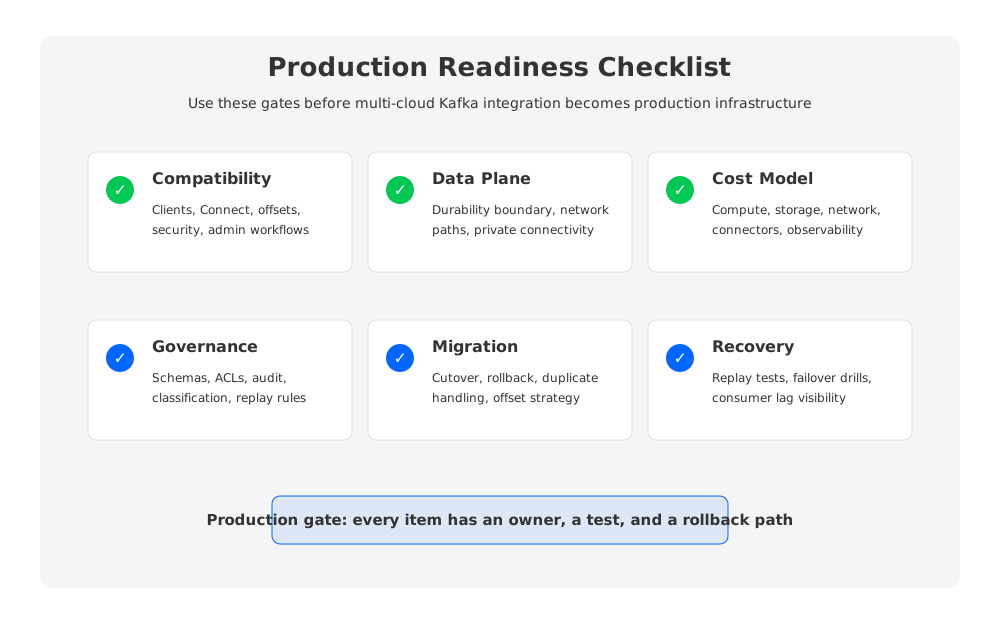
The most useful multi-cloud Kafka architecture review produces a testable checklist, specific enough for SREs, data engineers, and security teams to disagree productively before the platform is in production.
Start with the application contract. Identify which clients, Kafka APIs, connectors, security mechanisms, and admin workflows must work without code rewrites. A compatibility plan should include producer writes, consumer groups, offsets, topic administration, ACLs, TLS, observability, and failure recovery. If a team says "Kafka-compatible," ask which clients and workflows were tested.
Then map the data plane. Draw where each record becomes durable, which network paths it crosses, and which team owns each boundary. Include private connectivity, VPC endpoints, peering, VPN, inter-region links, and service-to-service authentication. The architecture should make it obvious whether a failed cloud link blocks producers, consumers, replication, or only a subset of sinks.
Cost modeling belongs in the same review. Multi-cloud streaming cost can come from brokers, disks, object storage, cross-zone traffic, cross-region transfer, connector runtimes, observability, backup, and operational toil. The right question is not "which service has the lowest unit price?" It is "which cost components scale with write throughput, retained bytes, consumer fan-out, and recovery drills?"
Governance should be concrete. Define topic ownership, schema compatibility rules, data classification, encryption requirements, replay approval, tenant quotas, and audit metadata before teams move records between clouds. A schema registry or catalog is helpful, but someone must own what happens when a field changes, a consumer needs replay, or a topic becomes restricted.
Finally, test migration and rollback. Teams may move producers first, consumers first, or replicate topics while old and target environments run side by side. A plan that cannot explain offset handling, duplicate behavior, cutover criteria, and rollback windows is not ready.
5Where Shared Storage Changes the Operating Model
Storage architecture becomes important when the main source of friction is not the Kafka API surface but the cost of operating broker-local data. In traditional Kafka, retention growth and partition placement are closely tied to broker capacity. If one environment needs more retained bytes or faster node replacement, the team may spend considerable effort moving data and reserving disk headroom.
In a Kafka-compatible shared-storage architecture, the premise changes: keep Kafka protocol and ecosystem compatibility, but separate broker compute from durable log storage. Object storage can become the primary repository for retained data, while a write-ahead log layer supports write efficiency and recovery. Brokers can then be evaluated more like compute nodes than permanent owners of partition data.
This model is not a universal answer. Teams should test end-to-end latency, write durability, consumer replay, object-storage behavior, failure recovery, connector compatibility, security controls, and operational automation. Shared storage moves several hard problems to a different operating model, which may fit workloads where retained data grows faster than broker compute demand.
6Where AutoMQ Fits in the Evaluation
After the neutral framework is clear, AutoMQ becomes relevant as one example of a Kafka-compatible, cloud-native streaming platform built around shared storage. AutoMQ keeps Kafka protocol compatibility while replacing Kafka's broker-local storage layer with a Shared Storage architecture. Its documentation describes stateless brokers, S3-compatible object storage, and a WAL layer for persistence and recovery.
For multi-cloud data integration, the important angle is whether the platform can preserve Kafka-facing application contracts while changing the data-plane economics and operational boundaries. AutoMQ can be evaluated when a team wants Kafka-compatible APIs, object-storage-backed retention, elastic broker operations, and deployment choices that keep the data plane inside the customer's cloud or private environment.
That last boundary matters. A multi-cloud architecture may need to keep regulated data inside a customer-controlled account, use private networking, or align storage with a specific region. AutoMQ BYOC and software deployment options are relevant because the platform can be deployed within customer-controlled infrastructure.
The practical test is straightforward: put AutoMQ into the same decision table as any Kafka-compatible option. Validate clients, connectors, offsets, schemas, security, observability, replay, failover, and cost behavior under the workload that matters. AutoMQ is most relevant when the issue is structural coupling in the Kafka layer, not a short-lived connector job.
7Decision Table for Platform Teams
Use this table when the discussion shifts from "how do we connect clouds?" to "which operating model are we willing to support?"
| If your main pressure is... | Prefer this path | Watch for |
|---|---|---|
| One durable event backbone for many environments | Central Kafka-compatible platform | Remote network dependency, private access, consumer latency |
| Local writes and reads in each cloud | Cluster-per-cloud with controlled replication | Topic sprawl, replication lag, offset and ACL consistency |
| Many standard source and sink flows | Connector or CDC integration hub | Connector fit, task isolation, schema ownership |
| Retention and partition movement dominate operations | Kafka-compatible shared-storage evaluation | Latency profile, object-storage behavior, recovery drills |
| Regulated workloads and account-level control | BYOC or private deployment model | IAM, audit evidence, network segmentation, support ownership |
The decision is not permanent. A platform team may centralize governance, run local clusters for latency-sensitive workloads, use connectors for standardized movement, and evaluate shared storage where retention growth is the constraint. What matters is making those decisions explicit. Multi-cloud streaming fails when every integration path becomes an exception.
8Closing the Architecture Loop
Multi-cloud Kafka integration is successful when applications keep a stable contract and operators gain a clearer model for durability, scale, governance, and recovery. Kafka-compatible APIs protect producers, consumers, connectors, and stream processors from unnecessary rewrites. They are not enough by themselves. The platform still needs a storage model, network design, governance process, and migration plan that match the realities of running across clouds.
If your team is evaluating that shift, start with your existing Kafka contracts, then test the data plane underneath them. A useful next step is to compare your checklist with the AutoMQ architecture overview and decide where shared storage belongs in your own multi-cloud roadmap.
9References
- Apache Kafka Documentation
- Apache Kafka Connect Documentation
- Apache Kafka Message Delivery Semantics
- AWS PrivateLink Documentation
- Amazon S3 General Purpose Buckets Overview
- AutoMQ Documentation: Compatibility with Apache Kafka
- AutoMQ Documentation: Architecture Overview
- AutoMQ Documentation: Deployment Overview
10FAQ
10.1What is multi-cloud Kafka integration?
Multi-cloud Kafka integration connects producers, consumers, connectors, and data platforms across more than one cloud or environment while preserving Kafka-compatible event contracts. It can involve remote clients, replicated clusters, CDC pipelines, connector hubs, shared-storage Kafka-compatible platforms, or a combination of these patterns.
10.2Is Kafka compatibility enough for multi-cloud integration?
No. Kafka compatibility protects application contracts, but multi-cloud integration also needs a data-plane design. Teams must evaluate durable storage, network paths, governance, observability, migration, failover, and cost behavior across environments.
10.3When should a team use cluster-per-cloud architecture?
Cluster-per-cloud architecture is useful when applications need local writes and reads, lower dependency on remote network paths, or separate operational boundaries. It requires strong governance for replication, topic ownership, ACLs, offsets, and observability so the environment does not become fragmented.
10.4Why does broker storage architecture matter?
Broker storage architecture affects scaling, retention, replacement, and cost. In a broker-local model, retained data and partition placement are tied to broker capacity. In a shared-storage model, durable data can be separated from broker compute, which may help when retained bytes grow faster than compute demand.
10.5When should AutoMQ be evaluated?
Evaluate AutoMQ when Kafka-compatible APIs are required but the existing Kafka operating model is constrained by broker-local storage, retention growth, partition movement, cloud cost, or customer-controlled deployment boundaries. It should be tested against the same compatibility, latency, governance, and recovery checklist as any production streaming platform.


