
Table of Contents
Table of Contents
Multi-cloud Kafka programs are rarely about running a broker in three places for its own sake. They start because application teams need the same event-streaming contract near different clouds, business units, regions, or data platforms. The difficult part is preserving what those applications already depend on: Kafka producers and consumers, topics, partitions, offsets, retained logs, consumer groups, connectors, stream processors, and operational runbooks that engineers can trust during incidents.
That distinction matters when Google Cloud is part of the platform. GCP has Pub/Sub for cloud-native messaging and Managed Service for Apache Kafka for managed Kafka clusters. AWS has Amazon MSK. Azure has Event Hubs with Kafka protocol support for compatible client scenarios. These services all belong in the architecture discussion, but a multi-cloud platform cannot be designed by matching product names. The real question is whether workloads can keep Kafka semantics across GCP, AWS, and Azure without turning each cloud into a separate application integration project.
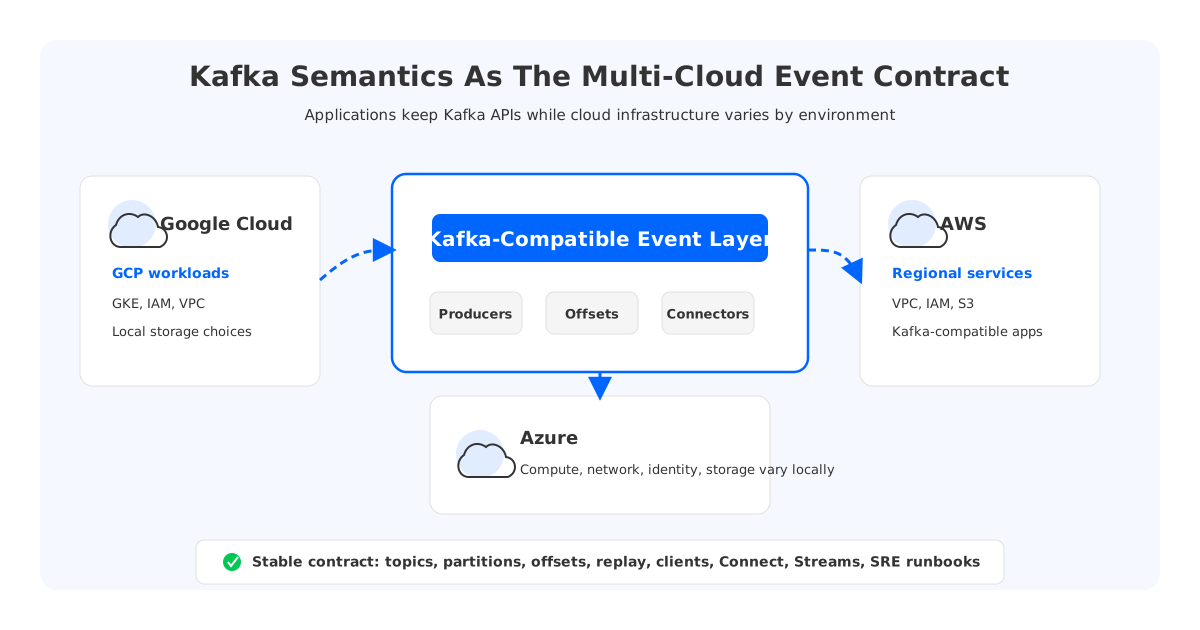
For platform leaders, Kafka often acts as a shared application contract. A fraud pipeline expects partition-aware ordering and replay. A CDC estate expects Kafka Connect behavior. A Flink or Kafka Streams application expects topic input, topic output, committed offsets, and controlled reprocessing. An SRE team expects to debug consumer lag, broker health, rebalances, and throughput with a familiar vocabulary. If a multi-cloud strategy breaks that contract, the cost appears later as rewrites, unclear incidents, and fragmented ownership.
1Why Multi-Cloud Teams Care About Kafka Semantics
Cloud portability is often discussed as a deployment problem, but event-streaming portability is a semantic problem first. Stateless services expose a relatively stable HTTP contract even when the cloud changes. Kafka workloads expose a richer contract: producers append records to topics, partitions define ordering boundaries, consumers commit offsets, retention creates replay windows, and ecosystem tools attach to the same model.
Those semantics let independent teams move at different speeds. A data platform team can add a consumer group without asking the producer to change. A data science team can reprocess a retained stream after a model change. A compliance team can reason about audit events as durable logs rather than transient notifications. A migration team can mirror or dual-write selected topics while downstream applications keep the same mental model.
In one cloud, service-specific differences can sometimes be hidden behind local platform conventions. Across clouds, they accumulate. If GCP workloads use Pub/Sub, AWS workloads use MSK, and Azure workloads use Event Hubs through Kafka-compatible endpoints, the estate may look "event-driven" while running on different semantic foundations. That can work for cloud-local notifications. It is riskier for shared data products where replay, connectors, ordering boundaries, and offset operations are part of the business contract.
The decision is not whether native messaging is good or bad. Pub/Sub is a strong Google Cloud service for many messaging patterns. Amazon MSK is a managed Apache Kafka service. Azure Event Hubs can reduce friction for some Kafka-client ingestion use cases. The decision is which layer owns the cross-cloud application contract. When Kafka owns that contract, the platform has to preserve Kafka behavior wherever the workload runs.
2The Limits of Cloud-Native Messaging Portability
The major clouds do not expose identical messaging abstractions. Google Cloud Pub/Sub is built around topics, subscriptions, acknowledgments, delivery behavior, retention, seek, and integration with Google Cloud services. Amazon MSK runs Apache Kafka as a managed service. Azure Event Hubs is an event ingestion service that offers a Kafka endpoint for compatible Kafka clients. These products overlap, but they differ in replay model, partitioning expectations, identity, observability, client behavior, and operational tuning.
The portability gap usually appears in questions that application teams ask during a real migration:
- Can the same producer and consumer code run in each cloud? Protocol support helps, but client configuration, authentication, error handling, and feature coverage still need validation.
- Can the same replay runbook survive? Kafka offset reset workflows are not the same as Pub/Sub seek operations or service-specific subscription controls.
- Can the ecosystem move with the workload? Kafka Connect, Kafka Streams, Flink Kafka sources, schema tooling, and monitoring dashboards may depend on Kafka-specific behavior.
- Can platform teams use the same operational vocabulary? Capacity, lag, retention, throughput, and failure recovery should not mean different things in each cloud.
- Can security controls vary without changing the application contract? Cloud IAM, private networking, encryption, and audit controls can be cloud-specific while Kafka APIs remain stable.
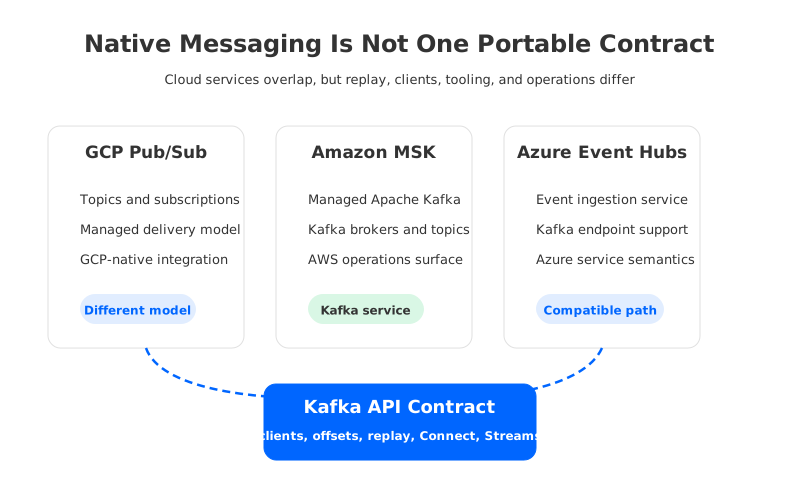
This is where infrastructure convenience can mislead the architecture review. Replacing Kafka with a native service may reduce cluster work, but it can move effort into application teams through connector redesign, replay changes, stream processing rewrites, schema workflow updates, and new incident runbooks. Those costs are not always visible in a managed-service comparison table.
3Kafka as a Cross-Cloud Application Contract
Kafka's multi-cloud value is not that every environment must look identical. It is that the application-facing contract can remain familiar while each cloud uses its own infrastructure primitives underneath. GCP can provide GKE, private networking, Cloud IAM, Cloud Storage, and Cloud Monitoring for Google Cloud workloads. AWS and Azure can provide their own compute, storage, identity, and network foundations. Kafka becomes the event-streaming API that application teams recognize across those environments.
This framing separates decisions that are often mixed together:
| Layer | What should stay consistent | What can vary by cloud |
|---|---|---|
| Application contract | Kafka APIs, topics, offsets, consumer groups, replay expectations | Endpoints, credentials, network path |
| Platform operations | SLOs, monitoring vocabulary, upgrade discipline, incident model | Managed service, Kubernetes distribution, region topology |
| Infrastructure substrate | Durability target, encryption posture, data ownership | GCS, S3, Azure Blob, IAM, private connectivity |
The table is not a claim that standardization is effortless. It clarifies where the work belongs. Instead of asking every application team to learn a different eventing model per cloud, the platform team defines the Kafka contract and maps it to the right deployment pattern. That pattern may be managed Kafka in one environment, self-managed Kafka in another, or a Kafka-compatible architecture that keeps the operating model more consistent across clouds.
For GCP teams, the sharper question is workload class. If the workload is GCP-local and does not require Kafka semantics, Pub/Sub may be the cleaner service boundary. If the workload is part of a cross-cloud data platform, Kafka compatibility is often the safer standard. Platform leaders create leverage by keeping those categories separate instead of treating every event stream as generic messaging.
4Operational Challenges of Traditional Kafka Across Clouds
Keeping Kafka semantics does not make traditional Kafka operations disappear. Multi-cloud Kafka often exposes the hardest parts of broker-local storage. Each cloud has different compute shapes, disk types, network pricing, zone design, maintenance controls, identity models, and observability tooling. A cluster design tuned for one cloud cannot be copied mechanically into another cloud and expected to behave the same way.
Traditional Kafka also couples broker compute with broker storage. When retained data grows, brokers may need larger disks or more nodes. When throughput grows, brokers may need more CPU, memory, network capacity, and partition balancing. When a broker fails, recovery can involve moving large volumes of replicated data. When partitions are reassigned, data placement becomes an operational project rather than a metadata-level change.
The cost model becomes harder to explain as the estate expands. Retention, replication, cross-zone traffic, disk over-provisioning, and recovery traffic all affect cloud bills differently across GCP, AWS, and Azure. A platform team can preserve Kafka APIs and still struggle to preserve operational economics. That is why a mature strategy evaluates two kinds of consistency: semantic consistency for applications and operational consistency for the teams that deploy, scale, recover, and govern the platform.
5Where AutoMQ Fits in a Multi-Cloud Kafka Architecture
Once the goal becomes "keep Kafka semantics while reducing cloud-specific broker-state operations," Kafka-compatible shared-storage architectures deserve attention. AutoMQ fits this category: it is Kafka-compatible, separates broker compute from durable storage, and uses object-storage-backed shared storage as the persistence layer. The architectural lever is straightforward. Each cloud already has durable object storage; using that substrate for Kafka log data can reduce the amount of broker-local data movement tied to scaling, recovery, and lifecycle events.
On Google Cloud, this pattern can align with GKE and Google Cloud storage primitives. In AWS and Azure contexts, the same category maps to each provider's object storage and compute environment. The application-facing Kafka contract remains the standard, while the infrastructure layer adapts to the cloud. For an enterprise platform team, that can be more practical than hand-tuning a separate disk-bound Kafka estate for every provider.
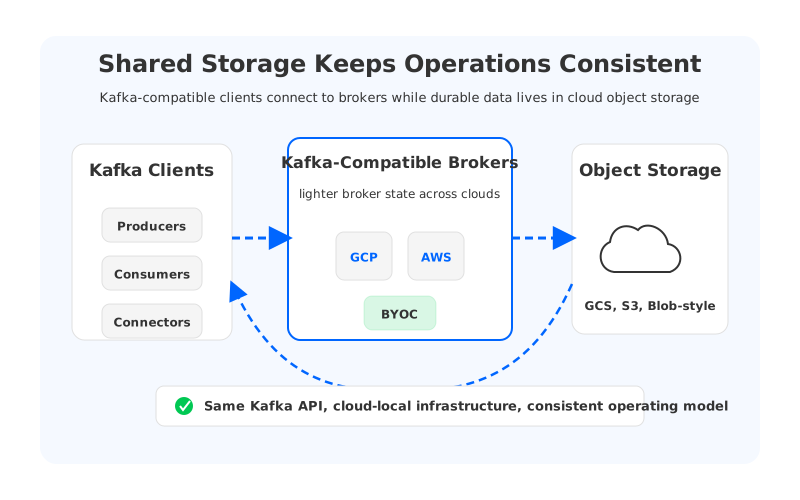
AutoMQ should not be positioned as a universal replacement for every cloud messaging workload. A GCP-native application built around Pub/Sub with no Kafka ecosystem dependency may not need Kafka at all. The fit is stronger when an enterprise already has Kafka clients, connectors, stream processors, topic governance, and replay playbooks, but wants a more consistent cloud deployment pattern. Kafka-compatible APIs, object-storage/shared-storage durability, and BYOC or private-environment deployment control become relevant because they preserve what application teams need while changing the operational substrate.
The credible test is a proof of concept against real workloads. Run existing Kafka clients. Validate consumer group behavior. Test connector compatibility. Measure throughput and latency under representative traffic. Simulate broker or pod failure. Validate retention, replay, encryption, monitoring, and data ownership in the target cloud account. Multi-cloud architecture succeeds only if the Kafka contract survives failure modes, not only a happy-path produce-and-consume test.
6A Multi-Cloud Kafka Evaluation Checklist for GCP Teams
GCP should stay central in the evaluation because many teams first face a local choice: Pub/Sub, Managed Service for Apache Kafka, self-managed Kafka, or a Kafka-compatible architecture such as AutoMQ. AWS and Azure enter the review where cross-cloud consistency changes the answer.
Use this checklist before committing to a platform standard:
- Define the non-negotiable Kafka contract. List required APIs, topic semantics, offset operations, connector dependencies, stream processors, schema workflows, and replay scenarios.
- Classify workloads by semantic need. Separate GCP-local notification patterns from cross-cloud data products that require Kafka behavior.
- Test portability with real clients. Validate producers, consumers, connectors, stream processors, authentication, and observability instead of relying only on protocol claims.
- Model operations across clouds. Compare deployment, scaling, failure recovery, upgrades, monitoring, incident response, and cost allocation.
- Confirm data ownership. Identify where data lives, which account or project owns it, how encryption works, and what BYOC or private-network controls apply.
- Include native services where they fit. Pub/Sub can remain the right service for GCP-local asynchronous messaging even when Kafka is the standard for cross-cloud streaming data products.
This process usually leads to a hybrid answer. Some workloads should be cloud-native. Some should remain Kafka-compatible. Some may need Kafka compatibility plus a different storage and operating model. The architecture win is to make that boundary explicit before teams discover it during migration or incident response.
If your multi-cloud strategy depends on keeping Kafka semantics across GCP, AWS, and Azure, evaluate the Kafka contract first and the deployment substrate second. For teams exploring Kafka-compatible shared storage on Google Cloud, the AutoMQ GKE deployment guide is a useful input for a workload-level proof of concept.
7References
- Apache Kafka Documentation
- Apache Kafka Connect
- Apache Kafka Streams
- Google Cloud Managed Service for Apache Kafka overview
- Google Cloud Pub/Sub overview
- Google Cloud: Choose Pub/Sub or Managed Service for Apache Kafka
- Amazon MSK Developer Guide
- Azure Event Hubs for Apache Kafka
- AutoMQ Architecture Overview
- AutoMQ on Google Cloud GKE
8FAQ
8.1Is Kafka a good standard for multi-cloud event streaming?
Kafka can be a strong standard when teams need the same producer and consumer APIs, retained logs, offsets, consumer groups, connectors, and stream processing behavior across clouds. It is less necessary for simple cloud-local notifications where a native service such as Pub/Sub fits the application contract.
8.2Can Google Cloud Pub/Sub replace Kafka in a multi-cloud architecture?
Pub/Sub can replace Kafka for workloads that can adopt Pub/Sub topics, subscriptions, acknowledgments, delivery behavior, and seek semantics. It is not a drop-in replacement for applications that depend on Kafka clients, Kafka Connect, Kafka Streams, partition-based ordering, or offset-based replay.
8.3How should GCP teams compare Managed Service for Apache Kafka, Pub/Sub, and AutoMQ?
Start with the application contract. Pub/Sub is a GCP-native messaging service. Managed Service for Apache Kafka provides managed Apache Kafka on Google Cloud. AutoMQ is a Kafka-compatible shared-storage architecture to evaluate when teams want Kafka semantics with a different broker-storage operating model.
8.4What makes multi-cloud Kafka difficult operationally?
Traditional Kafka ties broker compute and broker-local storage together. Across clouds, each provider's disks, network, instance types, zone design, and tooling affect scaling, recovery, and cost. Keeping Kafka APIs is only part of the problem; teams also need a consistent operating model.
8.5Where does BYOC matter for multi-cloud Kafka?
BYOC matters when enterprises want data and infrastructure to remain inside their own cloud accounts or controlled environments. For multi-cloud Kafka, that can help teams standardize Kafka behavior while respecting cloud-specific security, network, and governance boundaries.


