
Table of Contents
Table of Contents
Teams do not search for multi cloud kafka governance because they want another abstract architecture diagram. They search for it after Kafka has become a production dependency across regions, business units, and cloud accounts, and the current operating model no longer answers governance questions with confidence. Who can create topics? Which region may store regulated event data? How much cross-zone traffic is tied to replication? Can a cloud exit plan work without breaking offsets, connector state, and audit evidence?
That pressure is sharper in regulated environments because Kafka sits between systems that already have strong controls: payment services, identity systems, risk engines, data warehouses, fraud pipelines, and AI feature platforms. The streaming layer carries enough sensitive metadata to matter, but it is also latency-sensitive enough that governance cannot be bolted on as a monthly review. Governance has to live inside the architecture, the deployment boundary, the migration plan, and the day-2 operating procedures.
The uncomfortable part is that many Kafka estates were built one cluster at a time. A team starts with one cloud region, one compliance boundary, and one workload class. Years later the same organization has multiple providers, separate regulated and non-regulated environments, connector fleets, chargeback expectations, retention differences, and a recovery plan that depends on people remembering which mirror job owns which topic. At that point, multi-cloud governance is no longer a policy document. It is a technical control plane problem.
1Why multi-cloud Kafka governance becomes a production problem
The first governance mistake is treating Kafka as a generic managed service choice. Kafka is not only compute. It is a replicated log, a client protocol, an authorization surface, a data retention system, and a migration boundary. A provider decision therefore changes where data is stored, how replicas move, how offsets are preserved, how consumers recover, and how auditors trace access over time.
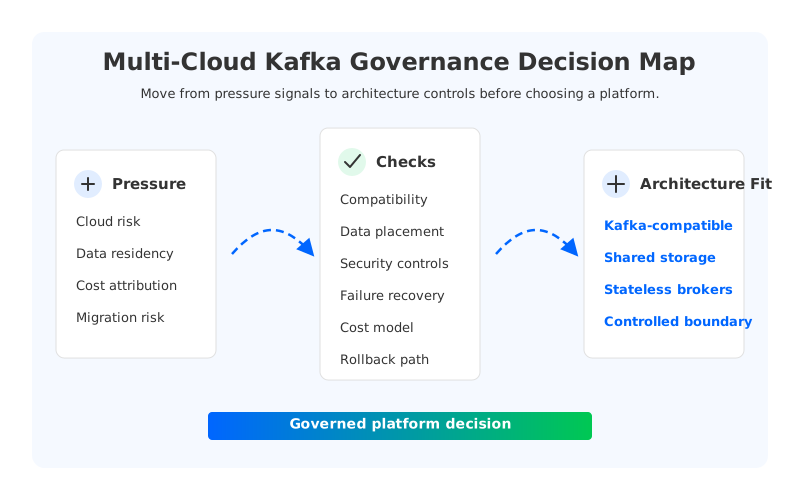
Regulated platform teams usually discover four signals:
- Cloud concentration risk. A business unit wants a second provider for resilience, procurement leverage, or regional availability, but the Kafka estate has grown around provider-specific networking, identity, and storage assumptions.
- Data residency pressure. Topics begin to carry regulated events, and teams need stronger evidence that data stays inside approved regions, accounts, and encryption boundaries.
- Cost attribution gaps. Broker-local storage, replication, catch-up reads, and cross-zone data transfer make streaming cost harder to map to the team or product that caused it.
- Migration hesitation. Even when a better architecture is available, the team fears that moving Kafka will disrupt offsets, connector tasks, producer behavior, or rollback plans.
These signals are operational, not philosophical. A governance program that ignores them becomes a spreadsheet that lags behind production reality. A better starting point is to ask what the Kafka architecture forces teams to do when a workload grows, moves regions, or crosses a compliance boundary.
2The production constraint behind traditional Kafka
Traditional Kafka was designed around a shared-nothing model: each broker owns local log segments for the partitions assigned to it, and replication copies those segments across brokers for durability and availability. That design is coherent. It gives Kafka strong sequential I/O behavior, clear partition ownership, and a recovery model that operators understand. The issue is not that shared-nothing is flawed; the issue is that cloud governance asks it to carry responsibilities it was not designed to simplify.
When broker storage is local, every governance decision has a physical data movement consequence. Scaling out means reassigning partitions. Rebalancing means copying log data. Replacing a broker means restoring its partition replicas elsewhere. Expanding retention means provisioning more disk or accepting tiered behavior with different operational semantics. In a single region, these operations are manageable with experienced operators. Across clouds and regulated boundaries, they become harder to reason about because control, cost, and data placement are tightly coupled.
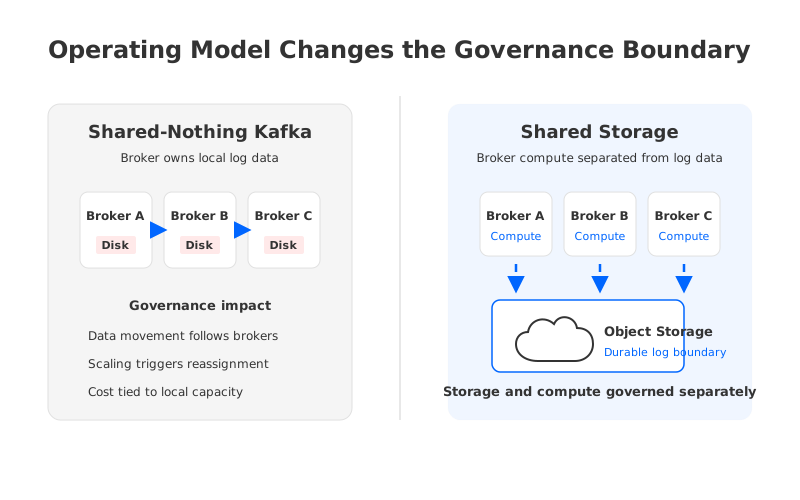
The same coupling shows up in cost governance. Kafka replication is application-level replication; the cluster moves data between brokers to maintain replicas. In cloud environments, that traffic can cross availability zones depending on placement and client behavior. Retention also sits close to compute sizing: teams often reserve broker storage for peak retention and catch-up scenarios even when day-to-day throughput is lower. The result is a governance model where the platform owner has to explain both policy compliance and infrastructure waste from the same set of broker-level choices.
Tiered storage can reduce some pressure by moving older log segments to object storage. It is useful, and for many Kafka estates it is a reasonable step. But tiered storage does not make brokers stateless. The active write path, partition ownership, and much of the operational choreography still revolve around broker-local state. For multi-cloud governance, that distinction matters: archiving old segments is not the same as designing the streaming system so compute and durable storage can be governed independently.
3A practical evaluation framework
A serious multi-cloud Kafka governance plan should evaluate more than feature parity. The hard question is whether the operating model remains understandable under stress: a region restriction, a cloud migration, an audit request, a retention increase, or a failed broker replacement. The evaluation should cover architecture, controls, and migration together.
| Governance dimension | What to verify | Why it matters |
|---|---|---|
| Kafka compatibility | Client protocol, admin APIs, consumer groups, offsets, transactions, ACLs, and operational tooling behavior | Governance fails if every migration requires application rewrites or client exceptions. |
| Data placement | Region, account, VPC, object storage bucket, encryption key, and backup boundary | Regulated teams need evidence about where event data lives and who controls it. |
| Cost model | Compute, storage, replication traffic, catch-up reads, cross-zone transfer, and connector overhead | Multi-cloud plans become fragile when cost is hidden inside broker sizing. |
| Elasticity | Scale-out, scale-in, partition movement, broker replacement, and retention expansion | Governance policies need to survive workload changes without manual data movement projects. |
| Security controls | Authentication, authorization, network isolation, audit logs, and key management | Kafka is a high-value path between sensitive systems, not a passive pipe. |
| Migration and rollback | Topic sync, offset preservation, producer cutover, connector state, and reverse path | A governed migration needs a tested escape route, not a one-way ceremony. |
The table is deliberately not a product checklist. A managed service can look attractive on one dimension and weak on another. A self-managed deployment can give strong boundary control but place too much operational burden on the platform team. A cloud-native Kafka-compatible architecture can improve elasticity while still requiring careful security and observability design. The point is to expose the trade-off before it becomes a production incident.
For regulated teams, one test is useful: pick a critical topic and trace its lifecycle. Where does a produced record enter the network? Which identities can write to it? Where is the durable copy stored? What happens during broker failure? How does a consumer group recover after migration? Which logs prove the answer? If the team cannot answer without switching between five ownership models, governance is already too fragmented.
4Architecture options and trade-offs
Most teams end up comparing three patterns. The first is classic self-managed Kafka on virtual machines or Kubernetes. It gives the most direct control over deployment boundaries, but the team owns version upgrades, broker sizing, partition reassignments, security integration, and disaster recovery workflows. This pattern can work well when the organization has deep Kafka operations experience and stable workload shape. It becomes expensive when every business unit asks for a slightly different cloud, region, or compliance posture.
The second pattern is provider-managed Kafka. It reduces the operational load around broker maintenance and service availability, but the governance boundary often shifts toward the provider's region, account model, networking features, and service limits. That can be a good fit for teams standardizing on one cloud. It is less clean when the same platform must support multiple clouds with consistent policy evidence and migration procedures.
The third pattern is Kafka-compatible shared storage. In this model, the Kafka protocol remains the application boundary, while durable log storage moves to cloud object storage and brokers become closer to stateless compute. The architecture does not remove the need for governance; it changes what governance attaches to. Data placement can be reasoned about through object storage buckets, accounts, regions, encryption keys, and access policies, while compute can scale or recover with less broker-local data choreography.
That architecture is where AutoMQ enters the discussion. AutoMQ is a Kafka-compatible cloud-native streaming system that uses Shared Storage architecture to separate broker compute from durable object-storage-backed data. For platform teams, the relevant operating change is that broker replacement, scaling, and balancing no longer have to imply the same volume of broker-to-broker log movement that a shared-nothing design requires.
This distinction also affects multi-cloud planning. If the durable log is governed through cloud-native storage boundaries, the platform team can align streaming data with the same primitives already used for regulated object data: region selection, account ownership, encryption, private networking, and audit policy. Compute remains important, but it stops being the long-term home of the log. That makes the governance model easier to explain to security and FinOps teams because storage control and compute elasticity are not welded together.
5How AutoMQ changes the operating model
AutoMQ's architecture is useful here because it changes the failure and scaling questions that dominate Kafka operations. In a traditional cluster, a broker problem often turns into a data placement problem: replicas catch up, partitions may need reassignment, and recovery time depends on how much data moves through the broker layer. In a shared-storage design, the broker is not the durable owner of the full log. Object storage holds the durable stream data, and brokers can be treated more like recoverable compute nodes.
That does not make governance automatic. It gives platform teams a cleaner set of controls to govern:
- Compatibility boundary. Applications continue to use Kafka-compatible clients and operational concepts, which keeps governance from turning into a rewrite program.
- Storage boundary. Durable event data can be mapped to cloud object storage locations, encryption policies, and account-level ownership.
- Network boundary. Private deployment patterns and cloud-native networking can keep traffic inside approved paths.
- Elasticity boundary. Compute scaling is less tied to long broker-local data movement, which helps teams handle peaks without carrying permanent overcapacity.
- Cost boundary. Storage, compute, and cross-zone traffic can be reviewed as separate levers rather than one opaque broker bill.
AutoMQ also supports deployment models that matter for governance discussions, including customer-controlled environments and cloud-specific deployment paths. The practical takeaway is that a regulated platform team can evaluate Kafka compatibility and cloud boundary control together instead of choosing between application compatibility and infrastructure ownership.
6A readiness checklist for platform teams
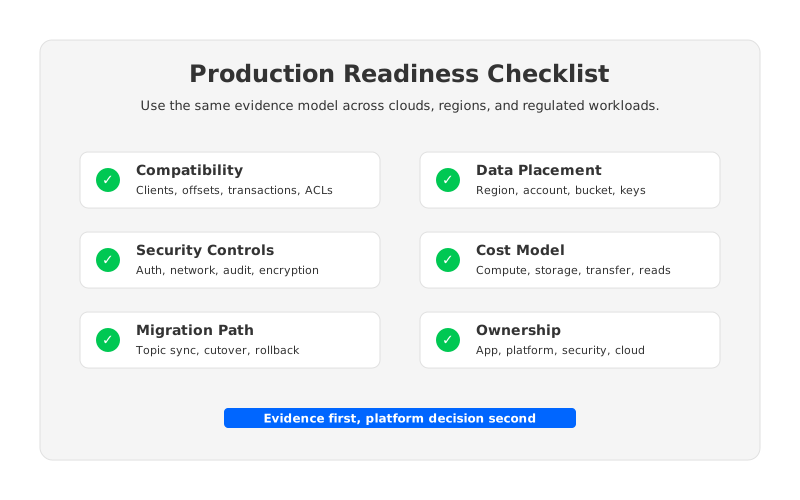
Before approving a multi-cloud Kafka direction, ask the platform team to produce a readiness memo that covers the following items. The memo should be short enough for an architecture review board to read, but concrete enough that an SRE can use it during a migration or incident.
- Define the data classes. Identify which topics carry regulated events, operational telemetry, customer identifiers, model features, or derived analytics. Governance differs by data class, not by cluster name.
- Map durable storage. Document the region, account, bucket or volume boundary, encryption key ownership, retention policy, and deletion path for each critical workload.
- Test client compatibility. Validate producer configs, consumer group behavior, offset commits, transactions where used, ACLs, schema dependencies, and admin tooling before any production cutover.
- Model steady-state and failure cost. Include broker compute, storage growth, replication, catch-up reads, cross-zone transfer, connector workloads, and monitoring systems.
- Design rollback first. A migration plan is incomplete until producers, consumers, offsets, and connector state have a tested reverse path.
- Assign ownership. Separate application topic ownership, platform runtime ownership, security policy ownership, and cloud-account ownership. Governance breaks when one team is assumed to own all four.
The checklist looks mundane, which is why it works. Multi-cloud governance fails less often because a team lacked a target state and more often because nobody could prove the current state. Kafka makes that proof harder when storage, compute, networking, and client behavior are tangled together. A cloud-native Kafka-compatible architecture reduces that tangle, but the team still has to write down the controls it intends to operate.
If your current Kafka estate is starting to feel like a governance exception factory, the next useful step is not another slide deck. Pick one regulated workload, trace the full lifecycle of its events, and compare the operating model against a shared-storage Kafka-compatible design. To discuss how AutoMQ can fit that evaluation, contact the AutoMQ team with the same workload map and governance questions: Talk to AutoMQ.
7References
- Apache Kafka documentation
- Apache Kafka KRaft documentation
- Apache Kafka MirrorMaker 2 documentation
- AWS S3 data durability documentation
- AWS PrivateLink documentation
- AutoMQ architecture overview
- AutoMQ Kafka compatibility
- AutoMQ inter-zone traffic overview
8FAQ
8.1What is multi-cloud Kafka governance?
Multi-cloud Kafka governance is the set of technical controls and operating practices that determine where Kafka data lives, who can access it, how it moves across clouds or regions, how costs are attributed, and how migrations or failures are handled. It is broader than security policy because it includes storage architecture, client compatibility, network boundaries, observability, and rollback procedures.
8.2Is managed Kafka enough for regulated multi-cloud governance?
Managed Kafka can reduce broker operations, but it does not automatically solve multi-cloud governance. Teams still need to verify data placement, cloud-account control, identity integration, audit evidence, migration behavior, and cost attribution. A managed service may be a strong fit when those controls align with the organization's cloud and compliance model.
8.3How does shared storage change Kafka governance?
Shared storage separates durable log storage from broker compute. That separation lets teams govern long-lived data through object storage boundaries while treating brokers as elastic compute. It can reduce the operational impact of scaling, broker replacement, and balancing because less governance-critical state is tied to individual broker disks.
8.4Does Kafka compatibility remove migration risk?
No. Compatibility reduces application rewrite risk, but platform teams still need to test client configurations, consumer offsets, transactions where used, ACLs, connectors, schema dependencies, and rollback procedures. A governed migration treats compatibility as the starting point, not the final proof.
8.5Where should AutoMQ appear in a multi-cloud Kafka evaluation?
AutoMQ belongs in the architecture evaluation stage after the team has defined its governance requirements. It is relevant when the team wants Kafka compatibility, cloud-native storage boundaries, stateless broker operations, independent compute and storage scaling, and customer-controlled deployment options.


