
Table of Contents
Table of Contents
Multi-cloud Kafka usually sounds like an architecture problem, but the harder part often shows up in operations. One cloud has one set of primitives, another cloud has another set of defaults, and the Kafka team is left translating the same intent into different runbooks. Scale a cluster here, migrate partitions there, update brokers somewhere else, and soon the platform has several similar-looking systems that behave differently when traffic or failure pressure arrives.
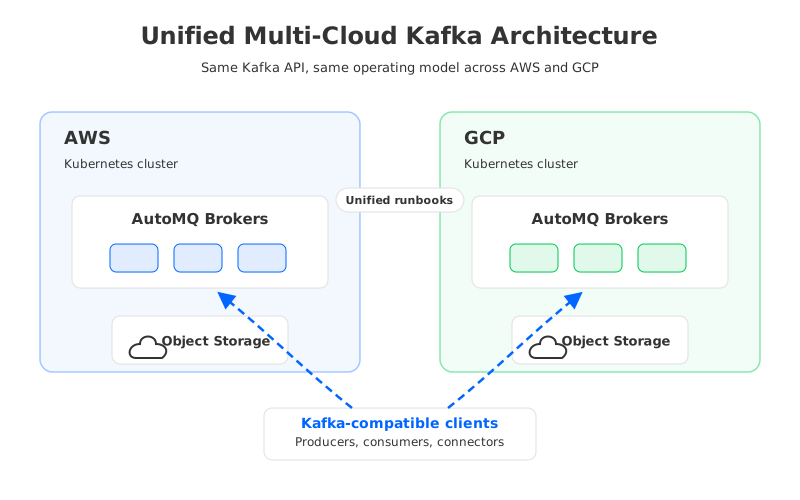
Bambu Lab's public AutoMQ case sits exactly in that gap. The company runs a cloud-based 3D printing platform for makers worldwide, and the case describes a Kubernetes-native environment deployed across AWS and Google Cloud. Streaming consistency mattered because the platform could not treat Kafka as a bespoke stateful system in each cloud.
That is the real story behind Bambu Lab's move to AutoMQ. It was not a search for a shinier Kafka dashboard or a generic managed-service replacement. Traditional Kafka's reliance on local disks and stateful brokers made second-level autoscaling impossible in a containerized, multi-cloud environment. AutoMQ entered because it changed where durable state lives while preserving Kafka API compatibility.
1Why multi-cloud Kafka becomes an operations problem
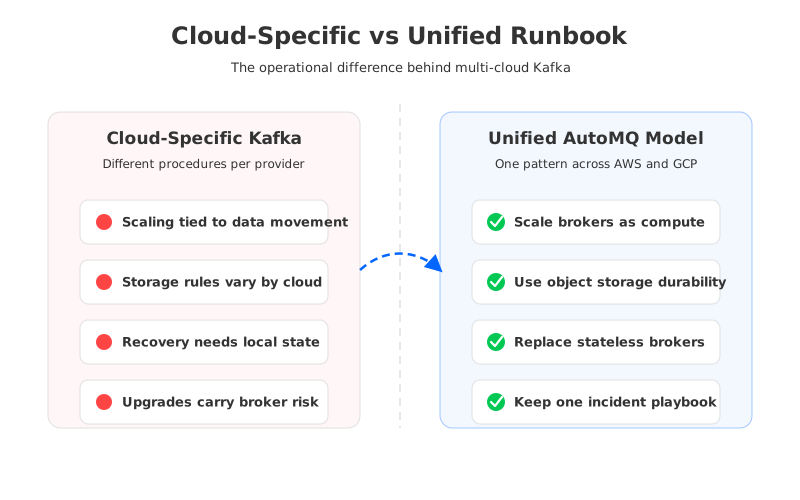
Most teams start multi-cloud planning with reasonable goals: availability, regional coverage, procurement flexibility, or workload placement close to users. Kafka complicates that plan because its traditional storage model makes brokers part of the durable identity of the system. A broker is not only compute capacity; it is also the owner of local partition data. Once that assumption holds, cloud-specific details around disks, networking, zones, node replacement, and scaling become part of the Kafka operating model.
Kubernetes helps, but it does not erase the state. A StatefulSet can give Kafka a cleaner deployment envelope, and operators can automate many day-to-day tasks. The core issue remains that scaling traditional Kafka is often tied to partition reassignment and data movement. When a team wants more broker capacity, it may also have to move historical data across the cluster before the added capacity becomes useful. That is not how platform teams expect Kubernetes workloads to behave.
Across clouds, each environment tends to acquire its own dialect:
- Scaling procedures may differ by node pools, instance types, storage classes, and autoscaling policies.
- Upgrade and restart workflows carry more risk when brokers own local state.
- Monitoring and incident response become harder to standardize when storage and recovery assumptions differ.
- Disaster recovery planning must coordinate Kafka internals with cloud-specific infrastructure behavior.
Traditional Kafka was designed for a world where brokers with local disks owned their partition logs, and that design has served production systems for many years. The mismatch appears when a Kubernetes-native company wants Kafka to behave more like the rest of its cloud platform: replaceable compute, routine scaling, and portable runbooks.
2Bambu Lab's global connected-platform workload
The public Bambu Lab case identifies the company as a consumer electronics and 3D printing business with a global cloud platform built on Kubernetes and deployed across AWS and GCP. Those details explain the pressure: Kafka had to fit a multi-cloud Kubernetes system, not the other way around.
The case lists two requirements. First, Bambu Lab wanted stronger elasticity because traditional Kafka could not provide second-level autoscaling in its environment. Second, the company wanted a unified streaming architecture across AWS and Google Cloud rather than separate Kafka procedures in each environment. The customer page also reports a 50% reduction in Kafka infrastructure costs, seconds-level scaling compared with hours traditionally, and 100% Kafka API compatibility.
| Public case anchor | What Bambu Lab needed | Why it matters for multi-cloud Kafka |
|---|---|---|
| AWS and GCP | One streaming architecture across two clouds | Avoids running separate operational models per provider |
| Kubernetes-native platform | Brokers that fit containerized scaling patterns | Keeps Kafka closer to existing platform workflows |
| Stateless brokers | Zero dependency on local storage | Reduces the operational weight of broker replacement |
| Seconds-level scaling | Faster response to changing load | Makes scaling closer to a routine platform action |
| Kafka API compatibility | Existing Kafka clients and semantics preserved | Lowers migration risk for applications |
The table is intentionally limited to public claims. It does not assume Bambu Lab's topic count, partition count, internal client list, exact region layout, or migration timeline. For another platform team, the lesson is the decision frame: when Kafka becomes the exception inside a Kubernetes platform, the exception starts to dominate the runbooks.
3The limits of cloud-specific managed Kafka
Managed Kafka can reduce provisioning, patching, and some infrastructure work. For many teams, that is enough. The hard part is that managed Kafka services still tend to preserve Kafka's stateful broker model, and the managed boundary is usually cloud-specific. If your platform spans AWS and GCP, the operational experience may improve inside each cloud while still remaining fragmented across clouds.
That fragmentation is subtle. It appears when the same team asks the same operational question in two environments and gets two different answers: how fast can we add capacity, how do we handle broker replacement, what happens during a restart, which metrics drive scaling, and how much depends on provider-specific storage behavior? A multi-cloud strategy that depends on consistent application operations cannot ignore those differences.
This is where Bambu Lab's case reads less like a vendor swap and more like a platform decision. The company was already Kubernetes-native and operating across clouds. The missing piece was a Kafka-compatible streaming layer that could be treated as part of that platform model.
4Stateless brokers and Kubernetes-native operations
AutoMQ's architectural move is straightforward to describe and consequential to operate: separate compute from storage. Its documentation explains that AutoMQ offloads Kafka's storage layer to cloud storage through S3Stream, making broker nodes stateless. The Bambu Lab case puts it in customer terms: brokers handle computation, while data persists in object storage.
Once brokers stop owning durable local data, Kubernetes becomes a better fit. A broker can be scheduled, replaced, restarted, or scaled more like a compute unit because its durable state is no longer tied to a local disk. AutoMQ's docs describe daily operations becoming closer to managing a microservice application, with broker horizontal scaling and HPA configuration as part of the Kubernetes deployment model.
The important part is not that Kubernetes is present. Plenty of Kafka clusters run on Kubernetes. The important part is that the storage model no longer fights the scheduler at every capacity change. AutoMQ's docs describe second-level partition reassignment through shared storage because reassignment no longer requires copying the full partition dataset between broker-local disks. That mechanism is what makes the Bambu Lab result plausible: scaling can move from lengthy data migration to standardized, automated second-level elasticity.
For a multi-cloud platform team, that shift changes the runbook vocabulary:
- Scale brokers as compute capacity, then let partition placement adapt without broker-local data migration.
- Keep object storage as the durable foundation in each cloud, using the same architectural pattern rather than a different Kafka storage strategy per provider.
- Preserve Kafka-facing APIs so application teams do not need to relearn how to produce, consume, or integrate.
- Standardize monitoring, scaling, and incident response around broker health and traffic behavior instead of local disk ownership.
Teams still need to validate object storage, network placement, authentication, observability, client access paths, and failover behavior. A stateless-broker model removes a major class of Kafka operational friction; it does not remove the need for engineering discipline. Bambu Lab's story is about aligning Kafka with a platform the team already operated.
5What changed across AWS and GCP
The public results are compact but meaningful. Bambu Lab unified its Kafka experience across AWS and GCP, reduced Kafka infrastructure costs by 50%, retained 100% Kafka API compatibility, and moved scaling time into seconds rather than hours traditionally. The case also says node restarts, scaling operations, and version upgrades now have minimal production impact.
Those outcomes connect back to the same architectural cause. If each broker owns local data, then broker operations are data operations. If brokers are stateless compute, then broker operations are closer to platform operations. That difference matters during maintenance windows and under high-concurrency IoT streaming scenarios, where the case says the cluster runs more smoothly.
The strongest evidence is not a single number in isolation. The 50% cost reduction matters, but the more transferable lesson is that Bambu Lab reduced the number of special cases its platform team had to carry. AWS and GCP could still differ as clouds, but Kafka no longer needed to become a different operational species in each one.
This is also where Kafka API compatibility earns its place in the story. A multi-cloud migration becomes much harder if the platform team has to change the storage architecture and the application contract at the same time. AutoMQ's documentation says it reuses Kafka's compute layer and has passed Kafka system test coverage in KRaft mode. For Bambu Lab, the public case reports the outcome in simpler terms: 100% Kafka API compatibility.
6Multi-cloud Kafka readiness checklist
Bambu Lab's case should not be read as a command for every team to run multi-cloud Kafka. Multi-cloud costs organizational attention even when the infrastructure works. The better question is whether your current Kafka operating model is blocking your platform strategy.
Use this checklist before treating multi-cloud Kafka as a goal:
- Are your Kafka clusters already managed by separate runbooks in each cloud?
- Do broker scaling and partition reassignment take long enough that teams avoid doing them during business pressure?
- Are local disks, storage classes, and broker replacement procedures the main reason Kafka feels different from other Kubernetes workloads?
- Do application teams need Kafka API compatibility because changing clients would create more risk than changing infrastructure?
- Can each cloud environment provide the object storage, network layout, security controls, and observability needed for a shared-storage streaming architecture?
- Is the team willing to validate failover, cold reads, scaling thresholds, and rollback procedures before moving production traffic?
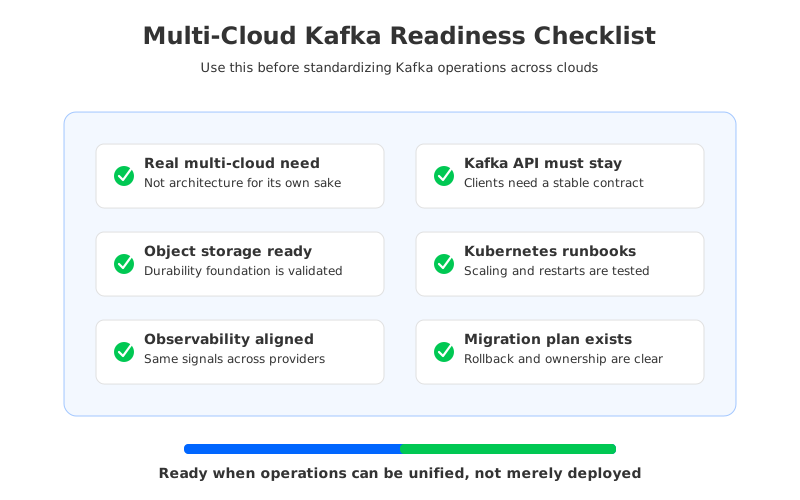
The last question keeps the story grounded. Stateless brokers can simplify operations, but production migrations still need test plans, staged traffic, rollback paths, and clear ownership between platform and application teams. Bambu Lab's case is persuasive because the architectural change matched the company's existing Kubernetes and multi-cloud direction.
That is the lesson for teams searching for multi-cloud Kafka or Kafka on Kubernetes. The goal is not to make Kafka exotic across more places. The goal is to make Kafka less exceptional inside the platform you already run. When durable state moves out of the broker and Kafka compatibility stays in front of the client, multi-cloud streaming has a chance to feel like one system again.
7FAQ
7.1What did Bambu Lab use AutoMQ for?
Bambu Lab used AutoMQ to unify Kafka-compatible data streaming across AWS and GCP in a Kubernetes-native environment. The public case says AutoMQ helped the team standardize its streaming architecture, make brokers stateless, and support seconds-level scaling.
7.2Why is traditional Kafka hard to run across clouds?
Traditional Kafka brokers usually own local partition data. That makes scaling, broker replacement, upgrades, and disaster recovery depend on data movement and cloud-specific storage behavior. Across clouds, those differences can create separate runbooks for the same streaming platform.
7.3Does AutoMQ require applications to stop using Kafka APIs?
No. AutoMQ is designed to preserve Kafka API compatibility. The Bambu Lab case reports 100% Kafka API compatibility, and AutoMQ documentation explains that the architecture retains Kafka's protocol-facing compute layer while replacing the storage layer with shared storage.
7.4What public results did Bambu Lab report?
The public customer case reports a unified experience across AWS and GCP, 50% reduction in Kafka infrastructure costs, seconds-level scaling compared with hours traditionally, and 100% Kafka API compatibility. It also says operational tasks such as node restarts, scaling, and upgrades now have minimal production impact.
7.5Should every Kubernetes team run it?
No. Multi-cloud Kafka is worth considering when a team already has a real multi-cloud requirement and Kafka's current operating model is creating fragmentation. If a single-cloud architecture meets the business need, the better engineering choice may be to keep the deployment simpler.
8Sources
- Bambu Lab customer case
- AutoMQ customer collection
- AutoMQ stateless broker documentation
- AutoMQ Kafka compatibility documentation
- AutoMQ Kubernetes deployment documentation
- AutoMQ partition reassignment in seconds documentation
- Fresha engineering style reference:
AutoMQ in Production: Auto-magically Quitting MSK, Medium, Fresha Data Engineering, public URL provided in AP context.


