
Table of Contents
Table of Contents
Multi-region Kafka is rarely approved because someone drew two regions on a diagram. It gets approved when the platform team can explain which region is active, where data is durably stored, who owns the cloud resources, how clients fail over, what happens to offsets, and which evidence proves the boundary during an incident. Those questions become sharper when the requirement is not only "Kafka across regions" but "Kafka across regions in customer-owned cloud accounts."
The phrase sounds like a deployment preference, but it is really an architecture constraint. A customer-owned cloud model changes the review from a service feature checklist to an accountability map. Compute, storage, private networking, keys, logs, automation roles, and support access may all sit inside the customer's account or virtual network. That gives security, SRE, and FinOps teams more direct control, but it also means the multi-region design has to be explicit enough to operate.
The hard part is that Kafka's client contract is stable while regional architecture is not. Producers still send records to topics. Consumers still read partitions and commit offsets. Applications still expect ordering within a partition and predictable recovery from failure. Underneath that familiar API, a multi-region design must decide whether it is active-passive, active-active, replicated by a dedicated service, replicated by Kafka tooling, or redesigned around a storage layer that makes regional recovery less dependent on broker-local state.
1The Boundary Is Part of the Architecture
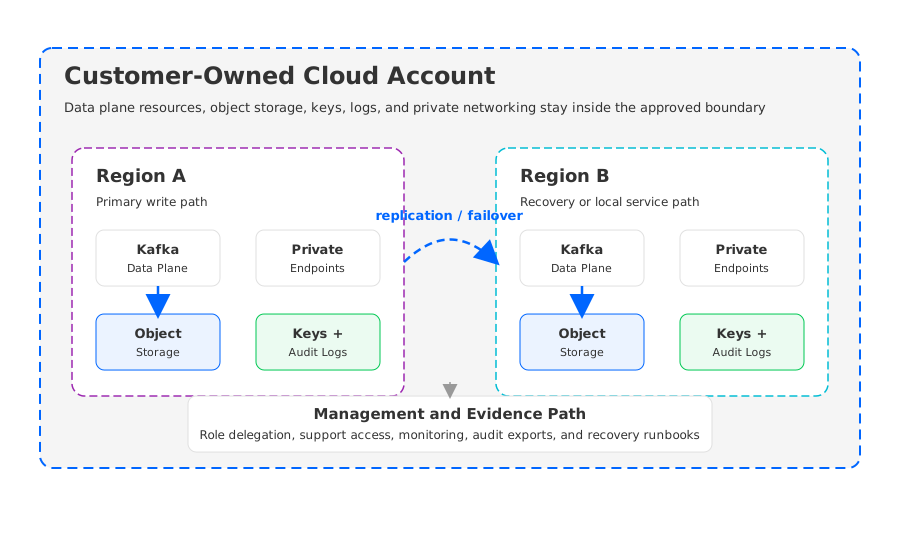
A normal Kafka architecture review starts with throughput, partitions, retention, availability zones, and operational ownership. A multi-region customer cloud review starts one level higher: which cloud accounts and networks are allowed to hold production data? The answer determines what "managed," "BYOC," "self-managed," and "cloud-native" can mean in practice.
Customer-owned cloud does not automatically mean the customer runs every process by hand. It means the runtime resources that matter to the data path can be placed inside the customer's approved cloud boundary. That boundary may include VPCs or VNets, subnets, security groups, private endpoints, object storage buckets, KMS keys, IAM roles, Kubernetes clusters, logging sinks, and tagging policies. A vendor or platform team may still automate lifecycle operations, but the access model must be reviewable.
For multi-region Kafka, this boundary has four practical dimensions:
- Data location. Durable log data, replicated copies, snapshots, and operational artifacts need a documented home in each region. Teams should separate application data from system logs and support evidence.
- Control path. Cluster creation, scaling, upgrades, and emergency access need explicit role delegation. "Provider operated" is acceptable only when the permissions and audit trail are concrete.
- Network path. Client traffic, replication traffic, monitoring exports, and support channels should have distinct diagrams. Private connectivity for clients does not prove private replication or private operations.
- Failure path. The failover procedure must say which component changes first: DNS, clients, producers, replication direction, consumer groups, storage access, or traffic routing.
This is why multi-region Kafka projects often slow down after the first proof of concept. The cluster may work, but the boundary is still fuzzy. Platform teams need to make the boundary inspectable before they can make the architecture durable.
2Multi-Region Patterns Teams Actually Compare
The first decision is not which tool to use. The first decision is the recovery model. AWS Well-Architected guidance frames disaster recovery around recovery time objective and recovery point objective, and those same ideas apply to Kafka. A platform that targets a short RTO has to automate endpoint changes, client behavior, and operational steps. A platform that targets a tight RPO has to reason carefully about replication lag, write acknowledgement, and the data that may be accepted in one region but not yet visible in another.
Most Kafka teams compare three patterns. The names vary, but the trade-offs are consistent.
| Pattern | What it optimizes | What the team must prove |
|---|---|---|
| Active-passive Kafka | Clear primary region and simpler conflict model | Replication lag, offset handling, failover runbook, DNS/client behavior, and tested recovery time |
| Active-active Kafka | Regional locality and write availability in more than one region | Topic ownership, duplicate handling, conflict strategy, schema/version discipline, and application-level idempotency |
| Customer-owned shared-storage design | Clearer storage ownership and faster broker replacement inside cloud boundaries | Kafka compatibility, write path durability, region isolation, object storage policy, and operational authorization model |
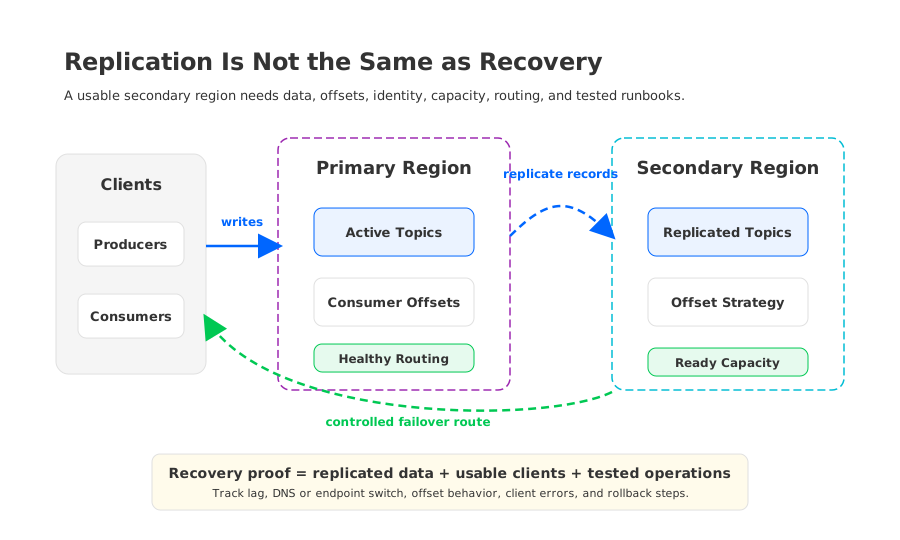
Active-passive is usually the easiest model to explain to auditors and application owners. One region is authoritative for writes, another region receives replicated data, and failover is a controlled event. The downside is that every minute of replication lag and every manual step becomes part of the recovery story. If the secondary region has stale data, incomplete offsets, or untested client routing, the architecture is only multi-region on paper.
Active-active is attractive when applications are already regional and need local writes. It is also the easiest model to underestimate. Kafka guarantees ordering within a partition, not global conflict resolution across independent regional writers. Teams need to decide whether topics are region-owned, whether producers can write to the same logical stream in multiple regions, how duplicates are handled, and whether downstream systems can tolerate eventual convergence. Without those rules, active-active Kafka becomes a distributed application design problem disguised as an infrastructure feature.
Shared-storage and cloud-native designs change a different part of the system. Instead of treating broker-local disks as the durable center of the architecture, they place durable data in cloud storage and make compute easier to replace. That does not remove the need for regional replication or failover planning. It changes what has to move during recovery and which cloud-native controls can be used as evidence.
3Kafka Semantics Do Not Disappear at Region Boundaries
Multi-region architecture discussions often get trapped in infrastructure language: regions, routes, subnets, buckets, endpoints. Kafka brings its own semantics, and those semantics are what application teams feel during recovery. A technically successful failover can still break the business if producers lose acknowledged records, consumers reprocess too much data, transactional workloads behave differently, or offsets no longer match the expected stream position.
Apache Kafka's documentation is the right baseline for this review because it defines the primitives that client applications depend on. Topics are split into partitions. Producers append records. Consumers coordinate through consumer groups and offsets. Security, transactions, idempotent producers, quotas, and client configuration all shape production behavior. A multi-region design must preserve the subset of those semantics the workload relies on, or document where application changes are required.
There are five questions worth answering before tool selection:
- What is the authoritative write region for each topic? Some organizations can assign ownership topic by topic or domain by domain. Others need a single primary region for all writes.
- What happens to consumer offsets during failover? Data replication alone is not enough if consumers cannot resume at a meaningful position.
- How are schemas and application releases coordinated? Regional failover is painful when the secondary region has different compatibility assumptions.
- What is the duplicate and replay policy? Kafka recovery commonly favors at-least-once behavior unless the full producer, transaction, and sink path is designed for stricter guarantees.
- Which tests prove the claim? A quarterly tabletop exercise is weaker than an automated failover test that records lag, routing time, client errors, and recovery steps.
These questions also expose a common anti-pattern: treating replication as backup. Replication copies data, but it does not automatically create a usable service. A usable secondary region needs capacity, identity, client endpoints, monitoring, alerting, operational permissions, and a rehearsed procedure for returning traffic to a steady state.
4The Cost Model Is Mostly Data Movement
Multi-region Kafka cost is not only broker hours. It is the cost of keeping data available in more than one place. That includes replication traffic across regions, retained storage in each region, standby capacity, operational tooling, monitoring, and the human cost of maintaining failover confidence. The exact numbers depend on the cloud provider, region pair, retention policy, compression, read fan-out, and whether traffic crosses public, private, inter-region, or inter-zone paths.
For customer-owned cloud accounts, this cost model becomes more transparent and more uncomfortable. Finance teams can see network transfer, object storage, compute, load balancing, NAT, private connectivity, and observability charges directly in the cloud bill. That transparency is useful because it lets platform teams model the actual workload. It also removes the hiding place created by a single service invoice.
The most reliable TCO worksheet for multi-region Kafka starts with workload inputs rather than product names:
| Input | Why it matters |
|---|---|
| Produce throughput by topic and region | Drives replicated bytes, broker load, and network transfer exposure |
| Retention by topic | Determines how much data is stored in each region and how replay-heavy recovery can become |
| Consumer read fan-out | Changes broker, cache, and network pressure after failover |
| RPO target | Determines acceptable replication lag and whether synchronous designs are even feasible |
| RTO target | Determines standby capacity, automation depth, endpoint strategy, and test frequency |
| Governance boundary | Determines whether cloud resources, keys, logs, and storage must remain in customer-owned accounts |
This table is intentionally boring. Good multi-region Kafka planning is boring before it is reliable. Teams that cannot fill in these rows will struggle to defend a region strategy no matter which platform they choose.
5Where AutoMQ Changes the Operating Model
Once the evaluation reaches storage ownership, recovery movement, and customer cloud boundaries, a Kafka-compatible shared-storage architecture becomes relevant. AutoMQ fits this category: it keeps Kafka API compatibility for clients while redesigning the storage layer around shared object storage and stateless brokers. In a customer-owned cloud deployment, that makes the durable data path, object storage policy, private networking, and cloud resource evidence central to the design rather than secondary implementation details.
The useful point is not that shared storage magically solves multi-region Kafka. It does not. Region strategy still needs explicit replication, failover, workload testing, and application-level semantics. The useful point is that the failure and scaling model changes. Traditional Kafka binds broker compute to broker-local log state, so broker replacement, scaling, and partition movement are operationally heavy. A shared-storage design makes brokers easier to replace because durable data is not trapped on a particular broker disk.
That difference matters in customer-owned cloud accounts for three reasons. First, storage ownership can align with cloud-native controls such as object storage policies, encryption, tagging, lifecycle rules, and audit logs. Second, compute scaling can be reviewed separately from durable data placement, which is helpful when traffic changes faster than retention. Third, operational authorization becomes more concrete: the team can separate the customer-owned data plane from the management actions required to maintain the service.
AutoMQ should enter the shortlist when the team wants to keep Kafka clients and ecosystem tooling, but the pain is caused by stateful broker operations, cloud storage economics, or unclear data-plane ownership. It should not bypass the same proof-of-concept discipline applied to any multi-region Kafka design. Test producer behavior, consumer offset recovery, ACLs, transactional workloads if used, schema workflows, observability exports, and the full failover procedure under realistic traffic.
6A Practical Evaluation Checklist
The best architecture decision record for multi-region Kafka is not a slide with two regions and a checkmark. It is a checklist with named owners and test evidence. The checklist should be short enough to maintain and specific enough to catch false confidence.
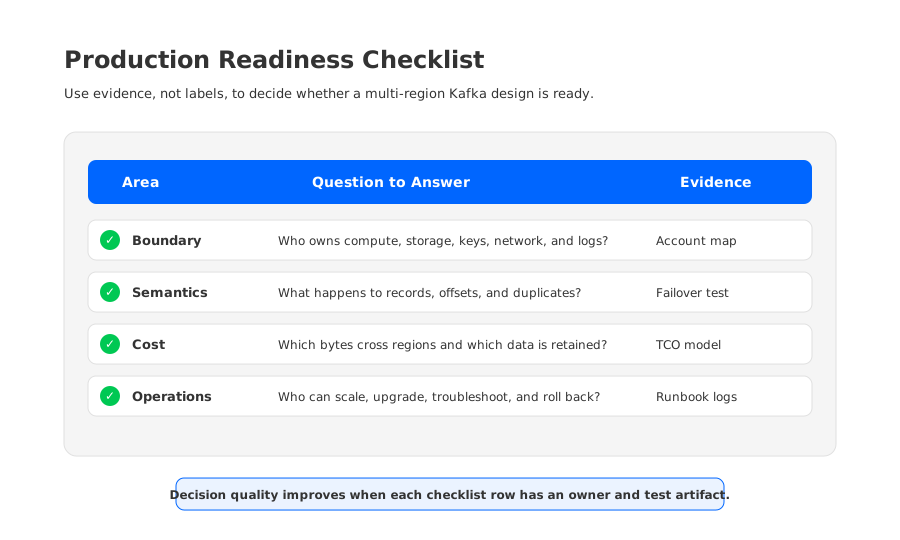
Start with the service boundary. Confirm which account owns each runtime resource, which roles can modify it, which logs capture access, and which keys protect data. Then walk the data path. A producer write should be traceable from client identity to broker handling, durable storage, replication, consumer read, and monitoring evidence. If any step crosses an external boundary, the architecture should say why and how it is controlled.
Next, test failure at the level applications experience it. Kill a broker. Disable a region endpoint. Pause replication. Break a permission intentionally in a non-production environment. Rotate credentials. Force consumers to resume in the secondary region. Measure the outcome and keep the evidence. A runbook that has never met a real failure is only a draft.
Use this decision table to keep the conclusion honest:
| If your main constraint is... | Favor this direction |
|---|---|
| Lowest operational ownership and acceptable provider boundary | Managed Kafka with documented regional replication and private connectivity |
| Maximum internal control and enough Kafka operations capacity | Self-managed Kafka with explicit replication tooling and recovery automation |
| Customer-owned data plane plus reduced stateful broker burden | Kafka-compatible shared-storage or BYOC design, validated by workload-specific failover tests |
| Local writes in multiple regions | Active-active design with application-level conflict, duplicate, and ownership rules |
The table will not choose for you, which is the point. Multi-region Kafka is a trade-off between control, recovery behavior, cost, and operational maturity. Customer-owned cloud accounts make the trade-off more visible. They also make weak assumptions harder to hide.
7References
- Apache Kafka Documentation
- Apache Kafka geo-replication notes
- AWS Well-Architected Reliability Pillar: Disaster recovery
- Amazon MSK Replicator documentation
- AutoMQ architecture overview
- AutoMQ BYOC environment on AWS
8FAQ
8.1Is multi-region Kafka the same as disaster recovery?
No. Disaster recovery is one reason to run Kafka across regions, but multi-region Kafka can also support regional locality, data residency, application isolation, and migration strategy. The design should start with RTO, RPO, topic ownership, and client behavior rather than a generic "two-region" label.
8.2Does customer-owned cloud mean self-managed Kafka?
Not necessarily. Customer-owned cloud means important runtime resources can live inside the customer's cloud account or network boundary. The platform may still use vendor automation, support processes, or managed lifecycle tooling. The key is whether the access model, data path, and evidence sources are explicit.
8.3What is the hardest part of active-active Kafka?
The hardest part is usually not replication mechanics. It is application semantics: deciding who owns writes, how duplicates are handled, how conflicts are resolved, and whether downstream systems can tolerate eventual convergence. Kafka preserves ordering within partitions; it does not remove the need for domain-level conflict rules.
8.4Where does AutoMQ fit in this decision?
AutoMQ is worth evaluating when teams want Kafka compatibility, customer-owned cloud deployment, shared object storage, and stateless broker operations. It should be tested like any other production Kafka platform: with real clients, realistic traffic, security controls, observability, replication, failover, and rollback procedures.
If the region strategy is part of a broader Kafka modernization effort, review AutoMQ's cloud-native architecture and run a workload-specific proof of concept through AutoMQ.


