
Table of Contents
Table of Contents
Kafka platforms rarely start messy. A team builds a cluster for payments, another for product analytics, another for CDC, and every decision makes sense inside its original boundary. The trouble begins when the organization tries to consolidate those streaming estates into a shared platform. The search query multi workload streaming consolidation kafka usually comes from that moment: the platform team wants fewer clusters, cleaner governance, better utilization, and a lower cloud bill, but nobody wants the shared Kafka layer to become the slowest part of the business.
Consolidation is attractive because duplicated infrastructure has visible waste. Each cluster carries its own broker fleet, storage provision, network paths, monitoring setup, access model, upgrade calendar, and on-call burden. Yet consolidation also concentrates risk. A badly isolated batch replay can hurt latency-sensitive consumers. A retention-heavy analytics topic can consume the storage budget intended for operational streams. A migration that looks simple at the API level can expose subtle differences in client behavior, offset ownership, and rollback planning.
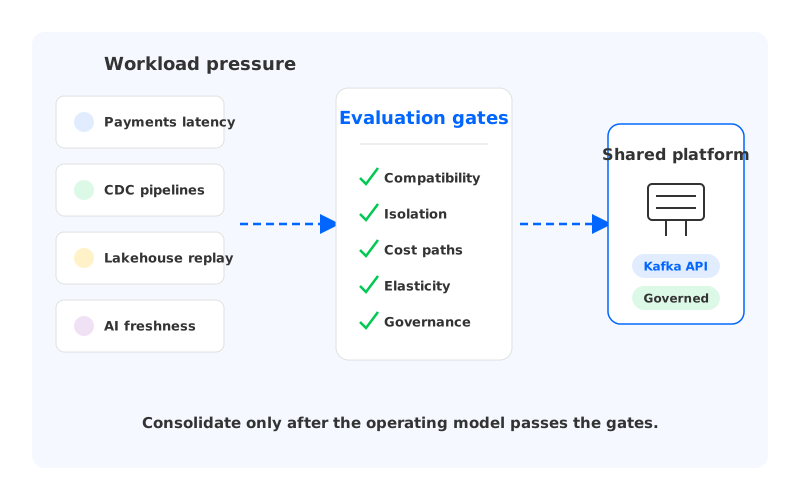
The right question is not whether one Kafka-compatible platform can host many workloads. The right question is what must be true for consolidation to reduce complexity instead of moving it into a larger blast radius.
1Why Teams Consolidate Kafka Workloads
Most consolidation programs begin with a practical observation: the company is already running Kafka as a shared dependency, but it is paying for Kafka as a set of isolated projects. One business unit owns a cluster sized for peak retail events. Another owns a cluster sized for nightly ETL. A third owns a cluster with long retention because downstream analytics jobs replay historical events. The utilization curves do not line up, so the organization pays for idle headroom in several places while still handling capacity incidents in others.
That pattern pushes platform teams toward a common streaming foundation. A shared platform can centralize security policies, standardize onboarding, reduce duplicated observability work, and give FinOps teams a clearer view of event-streaming cost drivers.
The pressure usually comes from five workload families:
- Operational event streams need predictable tail latency, clean consumer group behavior, and fast recovery from broker or zone failure.
- CDC and data integration streams need connector reliability, schema discipline, replay capacity, and a migration path that does not lose offsets.
- Analytics and lakehouse ingestion need high-throughput writes, long retention, catch-up reads, and cost-effective storage.
- AI and personalization pipelines need fresh events, fan-out, governance, and repeatable access to recent context.
- Observability streams need high volume, burst tolerance, and retention economics that do not punish growth.
These workloads can share Kafka semantics, but they do not share the same bottleneck. A platform that looks efficient at the cluster level can still be fragile at the workload level.
2Where Traditional Kafka Turns Consolidation into a Bottleneck
Apache Kafka's Shared Nothing architecture binds partition data to broker-local storage. That model is proven and widely understood, and it gives operators a concrete mental model: leaders serve reads and writes, followers replicate, disks store local log segments, and partition reassignment moves data between brokers. The same clarity becomes a constraint when many workload shapes land on one estate. Storage, compute, network, and placement are coupled tightly enough that solving one workload problem can disturb another.
Consider a consolidated cluster that hosts both low-latency payments and high-volume analytics replay. The payments workload wants stable broker CPU, low consumer lag, and limited interference. The analytics workload may want large retention, cold reads, and occasional backfills that stress storage and network paths. If both workloads depend on broker-local disks, operators have to manage throughput, retained data placement, movement speed, and hot brokers during reassignment or catch-up reads.
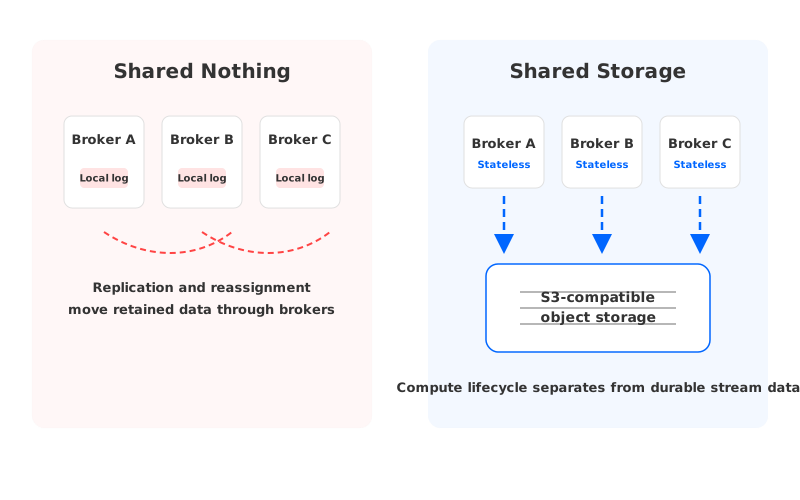
The bottleneck is not one component. It is the coupling between components:
| Consolidation pressure | Shared Nothing consequence | Buyer question |
|---|---|---|
| More workload families | Broker sizing must cover mixed latency, throughput, and retention needs. | Can the platform isolate hot paths from replay-heavy workloads? |
| Longer retention | Local or attached storage grows with the broker estate. | Does storage growth force compute growth? |
| Elastic scaling | Partition movement can require retained-data movement. | Can scaling happen without turning into a data migration project? |
| Multi-AZ deployment | Replication and client paths may create cross-AZ traffic. | Which bytes cross Availability Zone boundaries, and who pays for them? |
| Team consolidation | More tenants share the same operational surface. | Can governance prevent one workload from changing another workload's SLO? |
Consolidation failures are rarely caused by a single dramatic outage. They more often arrive as slow operational drag: capacity tickets, cautious upgrade windows, expensive over-provisioning, and runbooks that assume every incident is a storage incident until proven otherwise.
3The Cloud Cost Drivers Behind the Workload
Kafka cost in a consolidated environment is not a single broker line item. Compute is visible, but the decisive costs often sit in storage provisioning, inter-zone data transfer, retained history, connector paths, and operator time. A platform team that consolidates without modeling these cost paths can end up with fewer clusters and a more confusing bill.
The first cost driver is storage coupling. If durable history is bound to broker-local disks or attached volumes, retention growth pushes the team toward larger brokers, more disks, or more careful placement. That becomes harder when every team wants different retention, replay, and burst behavior from the same platform.
The second driver is network topology. Cloud providers price data movement according to service, region, zone, and path, and the details change by provider. A responsible consolidation plan should draw producer, broker, replica, consumer, connector, object storage, and analytics paths before claiming savings.
The third driver is operational headroom. Consolidated platforms need quotas, isolation, automation, and rollback paths. Without them, teams often compensate with more brokers, more reserved storage, and slower change windows.
4A Neutral Evaluation Checklist for Consolidation
The evaluation should start before any platform is selected. A good checklist gives FinOps, SRE, security, architecture, and application teams the same vocabulary, so the consolidation conversation does not collapse into "which option is fastest?" or "which option has the lowest storage price?"
| Evaluation area | What to verify | Why it matters |
|---|---|---|
| Kafka compatibility | Producer settings, consumer groups, offsets, transactions, ACLs, Kafka Connect, and observability integrations. | Consolidation fails quickly if workload behavior changes under a familiar API. |
| Workload isolation | Quotas, partition placement, traffic shaping, connector routing, and noisy-neighbor controls. | A shared platform must protect latency-sensitive workloads from replay-heavy tenants. |
| Storage model | Local log storage, Tiered Storage, or Shared Storage architecture. | The storage model decides whether retention and scaling are tied to broker lifecycle. |
| Cost boundary | Compute, storage, network, object requests, licensing, automation, and on-call work. | A narrow cost model can hide the line item that dominates at scale. |
| Elasticity | Broker replacement, partition movement, autoscaling, and balancing behavior. | Consolidation raises the value of fast capacity changes and lowers tolerance for data movement delays. |
| Governance | IAM, encryption, audit logs, tenant ownership, change approval, and support access. | Shared infrastructure needs explicit ownership boundaries. |
| Migration safety | Parallel run, offset validation, cutover, rollback, and client compatibility gates. | API compatibility does not automatically prove migration safety. |
This checklist clarifies which architecture trade-off is acceptable. Some teams may accept broker-local storage because their workload is small, stable, and latency-critical. Others may prioritize shared durable storage because retention growth, replay, and scaling are bigger risks than a narrow hot-path microbenchmark.
5How Shared Storage Changes the Operating Model
Once the checklist is explicit, the architecture question becomes sharper. Traditional Kafka keeps compute and durable log storage close together. Tiered Storage, introduced through Apache Kafka's KIP-405 work, can reduce local retention pressure by moving older log segments to remote storage while retaining the broker-centered hot path. A Shared Storage architecture changes the premise further: durable stream data lives in shared object storage, while brokers focus on protocol handling, caching, scheduling, and request routing.
That distinction matters because the shared platform's hardest events are rarely steady-state writes. They are scaling events, broker replacement, traffic rebalancing, backlog replay, retention growth, and tenant onboarding. If durable data is no longer owned by a specific broker's local disk, the platform can treat broker lifecycle and retained data lifecycle as separate concerns.
AutoMQ fits into this category as a Kafka-compatible cloud-native streaming platform built around Shared Storage architecture. AutoMQ uses S3Stream to replace Kafka local log storage with S3-compatible object storage, with WAL (Write-Ahead Log) storage for low-latency persistence and recovery. AutoMQ Brokers are stateless in this model: they continue to serve Kafka protocol semantics, but persistent stream data is not tied to a broker's local disk. For consolidated estates, that can reduce the operational pressure created by scaling, replacing brokers, and retaining data for multiple workload families.
There are still engineering questions to test. WAL type, object storage behavior, cache design, partition count, client settings, and cloud region topology all affect production results. AutoMQ Open Source uses S3 WAL, while AutoMQ commercial editions can use additional WAL storage options such as Regional EBS WAL or NFS WAL depending on deployment requirements.
6Governance Makes or Breaks the Shared Platform
Multi-workload consolidation is partly a storage problem and partly an ownership problem. The platform team can build a technically sound cluster and still fail if tenants cannot understand their limits, diagnose their own lag, request quota changes, or roll back a risky integration. Governance is the mechanism that keeps a shared service from becoming a shared mystery.
The practical governance model should define four boundaries. Workload ownership makes every topic, connector, schema, and consumer group accountable to a team. Resource ownership gives quotas, retention, partition counts, and replay windows review paths that match cost impact. Access ownership covers authentication, authorization, encryption, audit trails, and support access. Operational ownership separates platform alerts from application alerts.
This is where deployment boundary matters. In AutoMQ BYOC, the control plane and data plane run in the customer's own cloud account VPC, and customer business data remains in the customer's environment. It does not remove the need for internal governance, but it gives security and platform teams a clearer deployment boundary to evaluate.
7Migration Should Be Treated as a Production Feature
Consolidation often stalls because migration is treated as a one-time project instead of a production capability. If several clusters are moving into a shared platform, the migration plan must be repeatable. A team should be able to onboard one workload, validate offsets, run in parallel, cut over clients, monitor lag, and roll back without rewriting the plan.
For Kafka estates, migration safety starts with compatibility evidence. Producers need the same delivery expectations. Consumers need stable group behavior and offset handling. Kafka Connect jobs need connector configuration, schema dependencies, and error handling reviewed. The migration is not done when the first client connects; it is done when the workload behaves correctly under normal traffic, replay, failure, and rollback conditions.
AutoMQ provides AutoMQ Linking for Kafka as a zero-downtime migration tool in its product family, but the broader lesson applies to any platform choice: migration tooling should be judged by operational proof, not by a slide that says "Kafka-compatible." Every manual, fragile, or ambiguous migration step becomes a tax on the entire program.
8A Production Readiness Scorecard
The final approval gate should look like a readiness review, not a benchmark leaderboard. A platform can pass a throughput test and still be unready if the team has not tested failure behavior, tenant governance, cloud cost paths, and rollback.
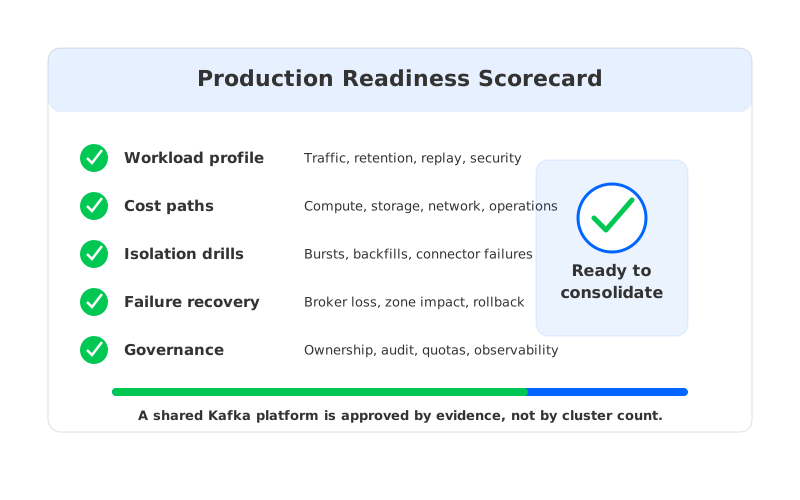
Use this scorecard before moving a critical workload into a consolidated Kafka-compatible platform:
- Workload profile is written down. Message sizes, partition count, retention, producer and consumer concurrency, replay expectations, and security settings are documented.
- Cost paths are drawn. Compute, storage, network, object storage requests, connector paths, and operational work are separated rather than blended into one number.
- Noisy-neighbor scenarios are tested. Replay, burst traffic, connector failure, and consumer lag are tested while latency-sensitive workloads remain active.
- Failure drills are completed. Broker loss, zone impairment, client reconnect, backlog replay, and rollback are tested with production-like settings.
- Governance is usable. Teams can see ownership, quotas, audit trails, metrics, logs, and escalation paths without asking the platform team for every answer.
- Migration is repeatable. Parallel run, offset validation, cutover, rollback, and post-migration monitoring are documented as a reusable workflow.
The scorecard changes the discussion from "can we put more workloads on one platform?" to "can we safely operate many workload shapes through the same service boundary?" That is the difference between consolidation as cleanup and consolidation as platform strategy.
If your current Kafka estate is held back by broker-local data movement, duplicated cluster operations, or cloud costs that are hard to assign to individual workloads, include a Shared Storage architecture in the evaluation. Start with the AutoMQ architecture overview, then bring your real workload profile to AutoMQ so the test reflects the platform you actually need to run.
9References
- Apache Kafka Documentation: https://kafka.apache.org/documentation/
- Apache Kafka Consumer Configuration: https://kafka.apache.org/documentation/#consumerconfigs
- Apache Kafka Producer Configuration: https://kafka.apache.org/documentation/#producerconfigs
- Apache Kafka KIP-405: Kafka Tiered Storage: https://cwiki.apache.org/confluence/display/KAFKA/KIP-405%3A+Kafka+Tiered+Storage
- AWS EC2 instance network bandwidth documentation: https://docs.aws.amazon.com/AWSEC2/latest/UserGuide/ec2-instance-network-bandwidth.html
- AWS Amazon S3 pricing: https://aws.amazon.com/s3/pricing/
- AutoMQ compatibility with Apache Kafka: https://docs.automq.com/automq/what-is-automq/compatibility-with-apache-kafka?utm_source=blog&utm_medium=content&utm_campaign=rpb-0071
- AutoMQ architecture overview: https://docs.automq.com/automq/architecture/overview?utm_source=blog&utm_medium=content&utm_campaign=rpb-0071
10FAQ
10.1What does multi workload streaming consolidation kafka mean?
It means consolidating multiple Kafka or Kafka-compatible workload families, such as operational events, CDC, analytics ingestion, AI pipelines, and observability streams, onto a smaller number of shared streaming platforms. The goal is usually better utilization, clearer governance, and lower operating cost, but the design must protect workload isolation and reliability.
10.2Why can Kafka become a bottleneck during consolidation?
Kafka can become a bottleneck when storage, compute, network, and tenant operations are too tightly coupled. In a traditional Shared Nothing architecture, retained data is bound to broker-local storage, so scaling, reassignment, replay, and broker replacement can create data movement and operational pressure that affects multiple workloads.
10.3What should a Kafka consolidation checklist include?
A practical checklist should include Kafka compatibility, workload isolation, storage model, compute and storage cost, cross-AZ network paths, elasticity, governance, migration safety, observability, and failure drills. The checklist should be tied to the actual workload mix, not a synthetic default.
10.4How does AutoMQ help with multi-workload consolidation?
AutoMQ keeps Kafka protocol compatibility while using Shared Storage architecture, S3Stream, WAL storage, and stateless brokers to separate compute lifecycle from durable stream data. For consolidation, that can reduce retained-data movement during scaling and broker replacement while giving teams a customer-controlled deployment model through AutoMQ BYOC.


