
Table of Contents
Table of Contents
Teams searching for near instant recovery kafka are usually past the theory stage. They already know that Kafka can replicate data, survive individual broker failures, and preserve committed offsets when the cluster is healthy. The harder question appears during real operations: how fast can the platform return to a stable serving state when a broker, availability zone, deployment, or whole cluster becomes unsafe to trust?
That question is uncomfortable because Kafka recovery is not one number. A consumer group can resume quickly while producers are still reconnecting. A broker can rejoin while replicas are still catching up. A standby environment can receive data while security rules and bootstrap endpoints remain untested. Near-instant recovery is an architecture target decomposed into durability, metadata control, client routing, elasticity, and operational proof.
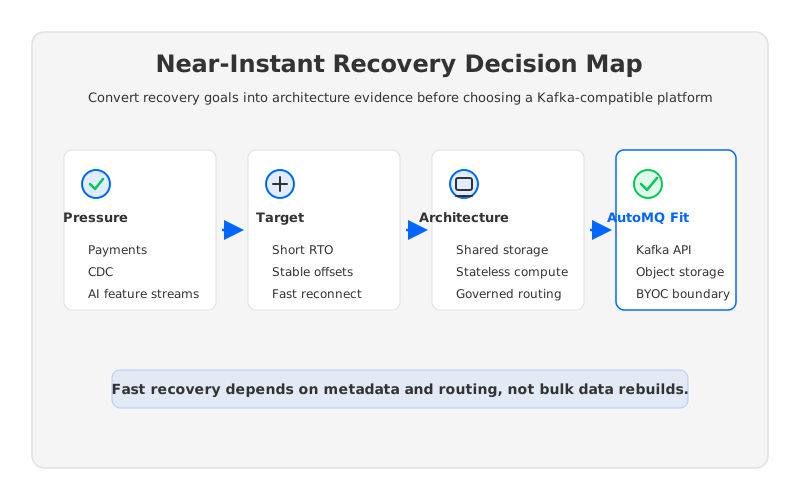
The practical goal is not to promise that every failure disappears. The goal is to design a Kafka-compatible streaming platform where the recovery path is short, rehearsed, and bounded by predictable control-plane actions rather than long data movement.
1Why Teams Search for near instant recovery kafka
Kafka often sits in the path between systems that cannot pause for long: payments, fraud signals, observability pipelines, inventory updates, personalization, CDC, and AI feature streams. When the stream stalls, downstream systems do not merely wait; they accumulate lag, miss windows, retry writes, and trigger alerts that pull several teams into the same incident channel. The business impact is rarely proportional to the failed component. One local disk, one bad broker restart, or one overloaded consumer group can turn into a recovery exercise that spans applications, networking, data governance, and SRE ownership.
The search phrase also reflects a shift in expectations. Infrastructure teams have become used to cloud primitives that recover by replacing compute and reattaching durable state. A stateless service can be rescheduled. A managed database can fail over. An object store can preserve data beyond any machine. Traditional Kafka, by contrast, still carries operational state inside brokers and local disks, so recovery often includes moving or rebuilding data before the platform is healthy again.
Near-instant recovery should be evaluated across four surfaces:
- Write availability. Producers need a valid leader, reachable bootstrap endpoints, and enough acknowledged durability to keep accepting records without unsafe shortcuts.
- Read continuity. Consumers need committed offsets, stable group coordination, and enough replica or storage access to resume without replaying large windows unexpectedly.
- Operational confidence. SREs need evidence that the recovered path is correct, observable, and reversible rather than merely green in a dashboard.
- Cost containment. Recovery designs that require large idle clusters, constant cross-zone replication, or manual overprovisioning can become too expensive to keep enabled.
These surfaces are related, but they fail in different ways. Treating them as a single RTO target hides the trade-offs that decide whether an incident ends quickly or expands.
2The Production Constraint Behind the Problem
The most important constraint is that Kafka durability and Kafka serving capacity have historically been coupled at the broker layer. A broker is not only a process that handles protocol requests; it also owns log segments, page cache behavior, replica fetch traffic, disk pressure, and partition leadership. When a broker disappears, the cluster has to recover leadership and reason about the local state that broker used to hold. When the cluster is scaled, data placement has to follow the revised topology. When a zone becomes unsafe, replicas and clients have to be steered without violating ordering, durability, or offset assumptions.
This design is coherent. Kafka was built around sequential disk IO, partition replication, and consumer group semantics that are still powerful. The issue is that a local-disk, shared-nothing model turns many cloud recovery events into data movement events. Replacing compute is fast; rebuilding broker-local storage is not. Expanding capacity is fast in the cloud control plane; redistributing partitions and replicas can still consume network, disk, and operator attention.
That coupling shows up in day-two operations:
| Recovery surface | What the team wants | What can slow it down |
|---|---|---|
| Broker replacement | New compute takes over quickly | Local log rebuild, replica catch-up, leader churn |
| Zone recovery | Traffic shifts without data loss | Cross-zone replication volume and client routing |
| Cluster migration | Applications keep offsets and ordering | Offset translation, producer cutover, connector state |
| Elastic scale-out | Capacity appears when workload spikes | Partition reassignment and disk rebalancing |
| Rollback | Operators can return to the previous path | Dual writes, divergent offsets, unclear ownership |
Recovery speed depends on what the platform must physically do after a failure. If the recovery path includes copying large amounts of stream data between brokers, the RTO is tied to data volume. If the recovery path mostly changes metadata and reconnects clients to available compute, the RTO can be driven by control-plane speed and operational automation.
3Architecture Options and Trade-Offs
There are several ways to pursue near-instant recovery in Kafka-compatible environments, and each one improves a different part of the problem. More replicas improve durability and read availability, but they also increase write amplification and network traffic. Multi-cluster replication improves regional isolation, but it introduces offset, ordering, failover, and failback questions. Tiered storage reduces pressure on local disks for older data, but hot partitions and leader recovery still have to be served by brokers. Managed services can reduce operational toil, but the underlying architecture still determines how much data must move during recovery.
The distinction that matters most is not "managed versus self-managed." It is whether the platform treats storage as broker-local state or as shared durable infrastructure. In a shared-nothing design, the broker is the unit of both compute and storage. In a shared-storage design, brokers can become closer to replaceable compute workers while durable stream data lives in an independent storage layer. That changes the recovery equation because a failed broker no longer represents a unique copy of the data path that must be reconstructed before the system can move forward.
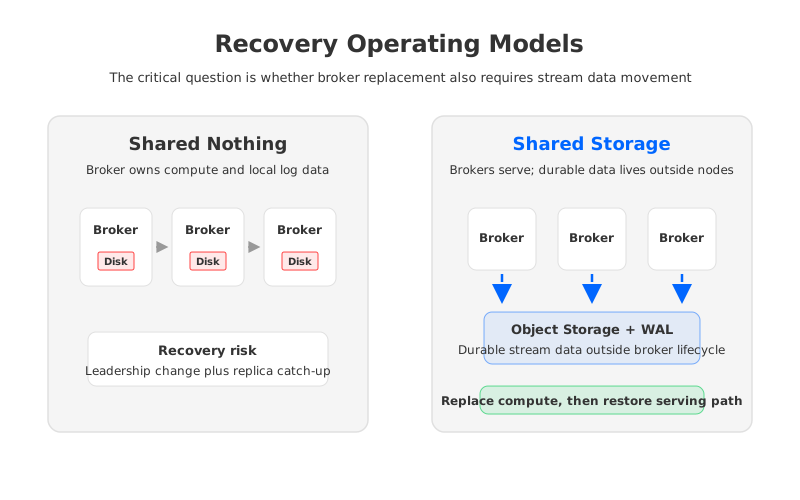
The shared-storage model is not magic. The write path still needs a persistent write buffer, ordering guarantees, metadata correctness, and careful handling of hot reads. The storage layer must be reachable, secure, and observable. The platform must also preserve Kafka protocol behavior so existing producers, consumers, stream processors, and governance tools continue to work.
A useful way to compare designs is to ask what changes during a failure:
- In a broker-local design, recovery often changes leadership and data placement at the same time. Operators have to monitor both the control-plane transition and the physical catch-up path.
- In a tiered-storage design, older data may be externalized, but the active write path and hot replica behavior still matter during failover.
- In a shared-storage design, the platform can make compute replacement the main action, while durable stream data remains available through the storage layer.
The last model is especially relevant for cloud environments because it aligns with how cloud infrastructure already behaves. Compute instances are disposable. Network topology is explicit. Durable storage is a separate service. Recovery gets faster when the streaming platform follows that boundary instead of fighting it.
4Evaluation Checklist for Platform Teams
Near-instant recovery should be tested as a set of operational claims, not accepted as a feature label. A platform can look strong in a benchmark and still be hard to recover if the team cannot rehearse cutover, observe data correctness, or roll back a failed migration. The checklist below is intentionally concrete because vague RTO targets tend to hide work that later appears during incidents.
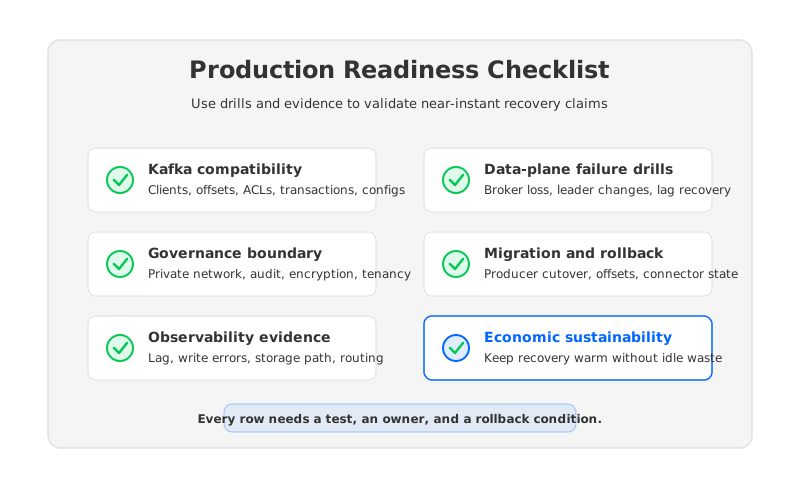
Start with compatibility. The recovery platform must preserve the Kafka protocol surface that your applications depend on: producer acknowledgments, consumer group offsets, transaction semantics if used, ACLs, quotas, topic configuration, and client versions. A small incompatibility can turn a recovery drill into an application migration.
Then test the data plane under failure. Kill brokers during sustained writes. Force leader changes. Restart consumers with committed offsets. Create lag, recover from lag, and confirm that catch-up reads do not starve current writes. Run the same tests with connectors and stream processors, because their checkpoint and offset behavior often becomes the hidden dependency in recovery planning.
Governance and security deserve the same treatment. Recovery paths tend to introduce alternate endpoints, emergency roles, mirrored topics, or standby clusters. Each one can become a policy exception if it is not designed upfront. A recovery architecture that bypasses audit logging, private networking, encryption policy, or tenancy boundaries will be hard to approve in production, even if it works technically.
The final check is economic. A recovery design that requires full duplicate capacity at all times may be acceptable for a narrow set of systems, but most teams need a more elastic model. The right question is whether the organization can afford to keep the recovery path warm, tested, and governed.
5How AutoMQ Changes the Operating Model
If the bottleneck is broker-local state, the architectural answer is to reduce the amount of unique state tied to any broker. AutoMQ is a Kafka-compatible cloud-native streaming platform that follows this direction by separating compute from storage and using object storage as the durable foundation for stream data. Brokers become closer to stateless serving nodes, while the storage layer provides the shared persistence that recovery workflows can rely on.
This matters for near-instant recovery because broker replacement no longer has to be dominated by moving historical log data back onto a specific machine. A replacement broker can participate after the platform updates metadata and reestablishes access to the shared storage path. The write path still needs a WAL, and AutoMQ documents WAL as the persistent write buffer used before data is committed to object storage. That separation is the practical bridge between Kafka-style write semantics and cloud-style recovery.
AutoMQ also changes the cost side of the recovery discussion. In multi-AZ Kafka deployments, replication and client traffic can create cross-zone transfer costs that grow with workload volume. AutoMQ's documentation describes a shared-storage architecture and routing model intended to eliminate cross-AZ traffic for production, replication, and consumption paths. For recovery planning, this helps teams keep resilient topology enabled without turning the standby or multi-zone design into an uncontrolled network bill.
Migration is the other place where recovery architecture becomes real. A team that cannot move workloads safely will struggle to adopt a better recovery model. AutoMQ provides Kafka Linking for migration from Apache Kafka or compatible distributions, including byte-to-byte replication, consumer progress synchronization, and producer proxying for cutover workflows. Those capabilities target the pieces that usually make streaming migrations risky: offsets, producer switching, and application downtime.
The neutral evaluation still applies. AutoMQ should be assessed against your client versions, latency profile, compliance boundaries, cloud provider requirements, observability stack, and rollback plan. The point is not to replace engineering judgment with a product claim. The point is that a shared-storage, Kafka-compatible design gives platform teams a different recovery primitive: replace compute quickly, keep durable stream data outside the broker lifecycle, and use migration tooling that respects Kafka offsets and client behavior.
6A Practical Readiness Scorecard
Before selecting any Kafka-compatible recovery architecture, run a scorecard that forces the decision into observable evidence. Use five rows: data durability, metadata recovery, client continuity, operational automation, and cost sustainability. Each row should have a test, an owner, and a rollback condition.
The durability row should define what counts as an acknowledged write, where the data exists after acknowledgement, and how that claim is verified after a broker or zone failure. The client continuity row should specify producer retry behavior, bootstrap endpoint changes, consumer group behavior, and what happens to long-running stream processors.
This scorecard separates real near-instant recovery from optimistic architecture diagrams. A diagram can show a standby cluster; the scorecard asks whether consumer offsets arrive in a usable form. A diagram can show object storage; the scorecard asks whether hot reads, failed writes, and metadata updates behave correctly under pressure. A diagram can show a multi-AZ deployment; the scorecard asks whether the network bill and security model are acceptable when the design runs every day.
Teams that pass this exercise usually discover that near-instant recovery is less about one heroic failover mechanism and more about removing slow recovery work from the critical path. The less data the platform has to rebuild locally, the more recovery becomes a controlled routing and metadata problem. That is the direction cloud-native Kafka-compatible platforms are taking, and it is the right standard to apply when you evaluate them.
If your current Kafka recovery plan still depends on broker-local data movement, manual cutover steps, or duplicate capacity that is too expensive to keep tested, review AutoMQ's Kafka-compatible shared-storage model and BYOC deployment approach here: Explore AutoMQ BYOC. The useful next step is not a generic demo; it is a recovery drill design based on your own producers, consumers, offsets, zones, and governance controls.
7References
- Apache Kafka documentation: https://kafka.apache.org/documentation/
- Apache Kafka tiered storage documentation: https://kafka.apache.org/40/operations/tiered-storage/
- AutoMQ overview: https://docs.automq.com/automq/what-is-automq/overview
- AutoMQ shared-storage technical advantages: https://docs.automq.com/automq/architecture/technical-advantage/overview
- AutoMQ stateless broker documentation: https://docs.automq.com/automq/architecture/technical-advantage/stateless-broker
- AutoMQ cross-AZ traffic documentation: https://docs.automq.com/automq-cloud/eliminate-inter-zone-traffics/overview
- AutoMQ Kafka Linking migration documentation: https://docs.automq.com/automq-cloud/migrate-to-automq/overview
- Amazon S3 data durability documentation: https://docs.aws.amazon.com/AmazonS3/latest/userguide/DataDurability.html
8FAQ
8.1Does near-instant recovery mean zero downtime?
No. It means the recovery path is short enough to meet the workload's operational target and predictable enough to rehearse. Some applications can tolerate brief reconnects or consumer lag. Others require stricter continuity. The architecture should make those trade-offs explicit rather than hiding them behind a single marketing phrase.
8.2Is replication factor enough for near-instant Kafka recovery?
Replication factor is necessary for many Kafka durability and availability goals, but it is not the whole recovery plan. Teams still need leader recovery, offset continuity, client routing, capacity headroom, monitoring, and rollback procedures. A replicated cluster can still recover slowly if broker-local data movement or manual steps dominate the incident.
8.3How is shared storage different from tiered storage?
Tiered storage usually offloads older log segments to an external storage layer while brokers still own the active write path and local operational state. Shared storage moves the platform closer to a model where durable stream data is independent of broker lifecycle. The exact behavior depends on implementation, so teams should test write recovery, hot reads, and metadata operations rather than relying on category labels.
8.4Where does AutoMQ fit in a Kafka recovery strategy?
AutoMQ fits when a team wants Kafka compatibility while reducing the recovery burden created by broker-local storage. Its shared-storage architecture, stateless broker model, cross-AZ traffic design, and Kafka Linking migration tooling are relevant to recovery planning, but they should be validated against the team's client versions, workload profile, security controls, and rollback requirements.


